Truth in Savings Part 707 is the National Credit Union Administration's rule implementing the Truth in Savings Act for credit unions, at 12 CFR Part 707. It does for share and deposit accounts at federally insured credit unions what Regulation DD does at banks: account disclosures before an account is opened, at least 30 calendar days' written notice before an adverse change, the annual percentage yield as the one rate members are quoted, statement disclosures including total overdraft fees, advertising rules, and two years of records. Staff trip over it because most training material, and most staff, call it "Reg DD", and Regulation DD itself says it does not apply to credit unions. Botminds' Deposit Compliance Search maps the question for them: at a credit union, a question typed as "Reg DD" is answered from Part 707, and the answer says so.
Part 707 in five numbers credit union staff are asked about
30days
written notice before a change that may reduce the APY or otherwise hurt the member
10bus. days
to send account disclosures when the member was not present and has not received them
2years
to keep evidence of compliance after the disclosure or action was due
$10
a gift worth more than this a year, for opening or keeping an account, is a bonus
What is NCUA Part 707?
It is the regulation that tells credit unions how to disclose the terms of member accounts so members "can make meaningful comparisons among credit unions and depository institutions", in the words of its own purpose clause (12 CFR 707.1(b)). It covers every credit union whose accounts are insured by, or eligible for insurance from, the National Credit Union Share Insurance Fund, except corporate credit unions and nonautomated credit unions with $2 million or less in assets after subtracting nonmember deposits. Its advertising rules reach further, to anyone who advertises a credit union account, including deposit brokers.
Part 707 carries an official staff commentary of its own, issued by NCUA's Office of General Counsel. The commentary describes its status in one sentence: "Good faith compliance with this commentary affords protection from liability under section 271(f) of the Truth in Savings Act (TISA), 12 U.S.C. 4311." Staff answers should cite it the way bank staff cite the Regulation DD commentary, as the regulator's official interpretation and not as guidance. How official interpretations rank against FAQs and guidance sets out the same ladder for Regulation E.
Does Reg DD apply to credit unions?
No. Regulation DD states that it "applies to depository institutions except for credit unions" (12 CFR 1030.1(c)), and its definition of depository institution carves credit unions out again (1030.2(j)). Credit unions follow Part 707, which parallels Regulation DD section by section: 707.4 for account disclosures where Regulation DD has 1030.4, 707.5 for change-in-terms and maturity notices, 707.6 for statements, 707.8 for advertising, 707.11 for overdraft disclosures.
The parallel is close enough that a credit union answer usually matches a bank answer in substance, which is exactly why it is easy to cite the wrong rule. An answer to an NCUA examiner that cites 12 CFR 1030 cites a regulation that does not bind the credit union. The fix is mechanical, and it is what the solution's Rule agent does: at a credit union, it maps "Reg DD" to Part 707 and cites the 707 section.
Part 707 beside Regulation DD: same structure, different words
NCUA Part 707 (credit unions): National Credit Union Administration
Regulation DD, 12 CFR 1030 (banks): Consumer Financial Protection Bureau
NCUA Part 707 (credit unions): A member, or a nonmember where allowed, who holds an account primarily for personal, family or household purposes
Regulation DD, 12 CFR 1030 (banks): A consumer: a natural person holding an account primarily for those purposes
NCUA Part 707 (credit unions): Dividends, declared or prospective, on shares; interest only on nondividend accounts under state law
Regulation DD, 12 CFR 1030 (banks): Interest
NCUA Part 707 (credit unions): Share, share draft, money market share, term share or share certificate
Regulation DD, 12 CFR 1030 (banks): Savings, checking, money market, time account or CD
NCUA Part 707 (credit unions): The annual percentage yield; the dividend rate may be added; no other rate
Regulation DD, 12 CFR 1030 (banks): The annual percentage yield; the interest rate may be added; no other rate
NCUA Part 707 (credit unions): 30 calendar days or more before the change takes effect
Regulation DD, 12 CFR 1030 (banks): 30 calendar days or more before the change takes effect
NCUA Part 707 (credit unions): Two years after the disclosure or action was due
Regulation DD, 12 CFR 1030 (banks): Two years after the disclosure or action was due
NCUA Part 707 (credit unions): NCUA staff commentary within Part 707
Regulation DD, 12 CFR 1030 (banks): CFPB Supplement I to Part 1030
Shares, dividends and the words staff may not use
Part 707 lets credit unions use plain synonyms, "checking account" for a share draft account or "certificate" for a share certificate, as long as the synonym is accurate and, in account disclosures, used together with the correct legal term. It draws one hard line: "under no circumstances may a credit union describe a share account as a deposit account, or vice versa. For example, the term 'certificate of deposit' or 'CD' may not be used to describe share certificates and other dividend-bearing term share accounts" (Part 707 commentary, 707.2(a)). A front-line script that offers a member "our 12-month CD" at a credit union is a Part 707 problem before anyone discusses the rate.
Similarly, the terms “time account” (used in Regulation DD, 12 CFR 1030.2(u)) and “time deposit” (used in Federal Reserve Board's Regulation D, 12 CFR 204.2(c)) may not be used to describe term share accounts.
Part 707 official staff commentary, on section 707.2(a)
Dividends bring a second wrinkle. A dividend-bearing account other than a certificate discloses its dividend rate and annual percentage yield "as of the last dividend declaration date", with prospective rates allowed where a change is known or contemplated, and the account disclosures must say that dividends are paid from current income and available earnings after required transfers to reserves (707.4(b)(1)(i)(B), (b)(8)). The same structure applies to a member's phone call: Part 707 tells staff to state the annual percentage yield, may add the dividend rate, and may state no other rate (707.3(e)).
What disclosures does Part 707 require, and when?
Account disclosures go to a member or potential member before an account is opened or a service is provided, whichever comes first. If the member is not present and has not already received them, the credit union has 10 business days, unless the account is opened electronically, in which case they come first (707.4(a)(1)). They are also due on request. For banks, the FDIC's 2025 examinations found Truth in Savings violations split evenly between the general disclosure rule and the account-opening disclosures, together 61 percent of the 74 cited (FDIC Supervisory Highlights, March 2026); the same two moments are where a credit union's new-accounts desk is most exposed.
What Part 707 account disclosures must contain, as applicable
- Rate information
The annual percentage yield and dividend (or interest) rate, using those terms; for variable rates, that they may change, how and how often, and any limits.
- Compounding and crediting
How often dividends compound and are credited, the dividend period, and whether dividends are forfeited if the account closes before crediting.
- Balance information
Minimum balances to open, to avoid a fee and to earn the stated yield; the balance method under 707.7; when dividends begin to accrue on noncash deposits.
- Fees
Every fee that may be imposed, or how it is determined, and when.
- Transaction limitations
Any limits on the number or dollar amount of deposits or withdrawals.
- Term share accounts
Maturity date, early withdrawal penalty and how it is calculated, effect of withdrawing dividends, and renewal and grace-period policy.
- Bonuses
Amount or type, when paid, and the balance and time requirements.
- Nature of dividends
For dividend accounts other than certificates, that dividends are paid from current income and available earnings after required transfers to reserves.
The transaction-limits item is where an old answer most often survives. Before 2020, Regulation D capped certain transfers from savings deposits at six a month, and Part 707's own commentary still refers to "the monthly limitations on transfers out of savings accounts under the Federal Reserve Board's Regulation D". The Federal Reserve deleted that limit from Regulation D in April 2020 and allowed, without requiring, institutions to stop enforcing it (85 FR 23445). Whether a member's savings account still has a limit now depends on what the credit union's own agreement and disclosure say, and a change to that limit is a change in terms.
How much notice for a change in terms at a credit union?
At least 30 calendar days before the effective date, for any change to a disclosed term that could lower the annual percentage yield or otherwise work against the member, and the notice must give the effective date (12 CFR 707.5(a)(1)). Three changes need no notice: dividend-rate changes on variable-rate accounts, check printing fees, and any change to certificates with maturities of one month or less. Changes that help the member need no advance notice.
Take a question asked at the fictional sample credit union: do members need to be told before the monthly fee on its everyday checking account rises from $5 to $8? Yes: a higher fee is adverse, so written notice is due at least 30 calendar days ahead, under Part 707. The sample credit union's own procedure sends it 45 days ahead, and a good answer shows both, labeled, because the rule and the institution's choice are different things. Certificates have their own clocks, set out below.
Part 707's notice clocks, counted back from the date that matters
- Notice out30 calendar days
- Pre-maturity notice30 days before maturity
- Alternative timing20 days before the grace period ends
- Maturity notice10 days
How dividends must be calculated, and when they start
On the full principal, every day, by one of two methods. Part 707 requires credit unions to "calculate dividends on the full amount of principal in an account for each day by use of either the daily balance method or the average daily balance method", at a daily rate of at least 1/365 of the dividend rate, or 1/366 in a leap year (12 CFR 707.7(a)(1)). Any minimum balance needed to earn dividends must be measured by the same method, unless the credit union adds a second method that is "unequivocally beneficial to the member" (707.7(a)(2)). Part 707 does not require compounding or crediting at any particular frequency; it requires that the frequency be disclosed.
The start date ties Truth in Savings to funds availability. Dividends must begin to accrue "not later than the day specified in section 606 of the Expedited Funds Availability Act (12 U.S.C. 4005) and implementing Regulation CC", and keep accruing until the day funds are withdrawn (707.7(c)). A question about when a deposited check starts earning is therefore partly a Regulation CC question, which is one reason front-line answers work better when they cite both rules than when they quote a single remembered date.
Statements, overdraft totals and advertising
Part 707 does not require periodic statements, but a statement a credit union sends must show the "annual percentage yield earned", the dividends earned, each fee debited by type and amount, and the length of the period (707.6(b)). Since 2010 it must also show "Total Overdraft Fees" and total returned-item fees, for the statement period and the calendar year to date (707.11(a)). Dividends must be calculated on the full principal each day by the daily balance or average daily balance method (707.7(a)).
Advertising rules follow the same logic as the oral rate rule. An advertisement may not be misleading, may not call an account "free" or "no cost" when a maintenance or activity fee could be charged on it, and may not use the word "profit" for dividends (707.8(a)). If it states a rate of return, it states the annual percentage yield, and then adds the conditions that apply, such as minimum balances and that fees could reduce earnings (707.8(b), (c)). Signs inside a branch and newsletters to existing members are exempt from most of that list but still state the APY and tell members to ask an employee about fees and terms (707.8(e)).
How long to keep Part 707 records?
Two years after the date the disclosures were due or the action was required (12 CFR 707.9(c)). The commentary says what the evidence is: the procedures for paying dividends and giving timely disclosures, sample disclosures for each type of account, advertisements and change-in-terms notices, and enough rate and balance information to verify dividends paid. Part 707 also records that the Truth in Savings Act's civil liability section "is repealed effective September 30, 2001" (707.9(b)), which leaves enforcement to the NCUA rather than member lawsuits.
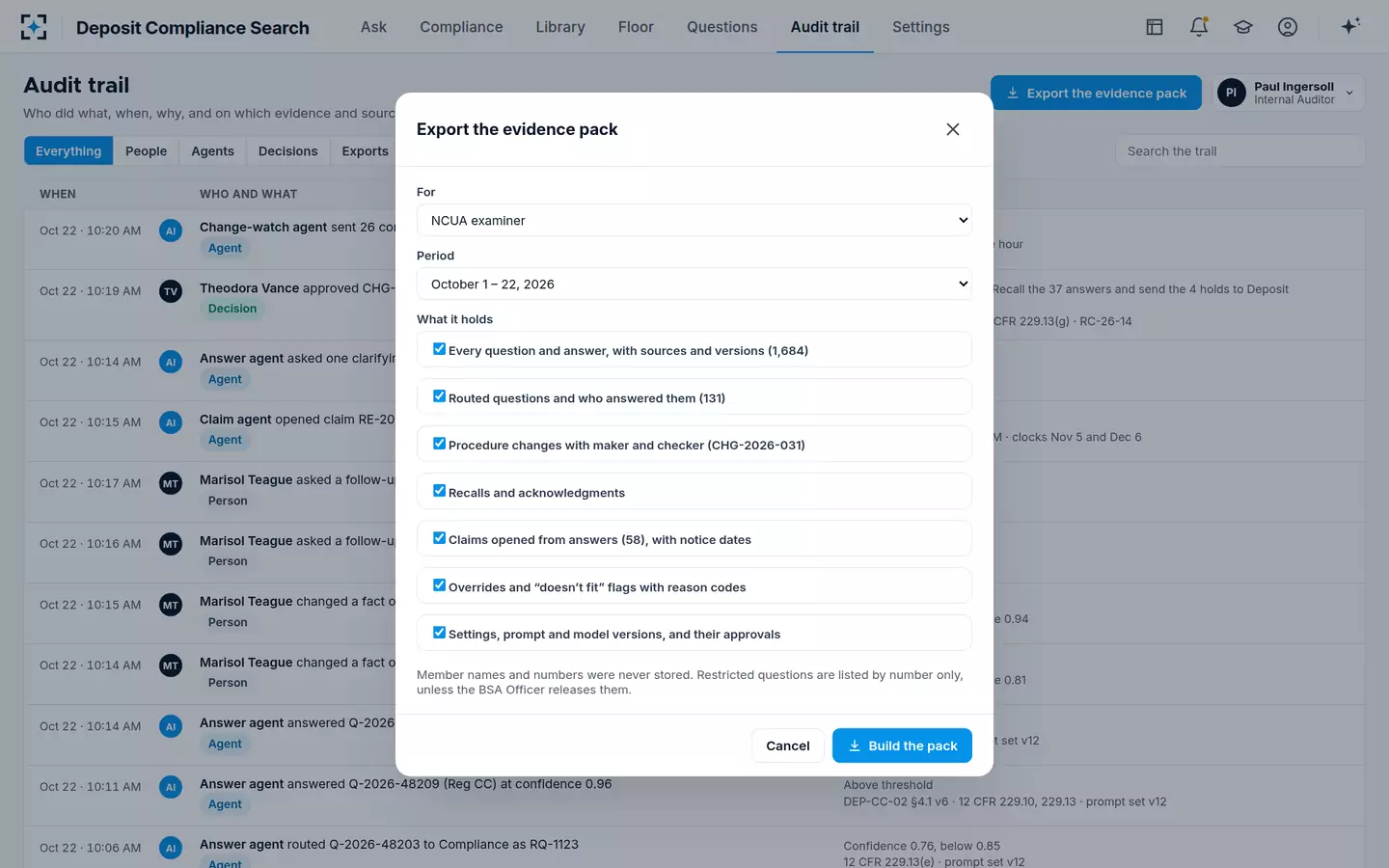
Records of what staff told members are not on the commentary's list, but they are where an examiner looks when a disclosure and a member's account of a call disagree. Deposit Compliance Search keeps every question and answer with the sources and versions it relied on, for five years at the sample credit union's setting, and builds an evidence pack for the NCUA examiner, internal audit or the Supervisory Committee in one step.
An evidence pack for the NCUA examiner, built in one step
Questions people ask
What is the difference between Part 707 and Reg DD?
Who issues and who is covered: the NCUA writes Part 707 for credit unions, and the CFPB writes Regulation DD for other depository institutions. The requirements run in parallel, but Part 707 speaks of members, shares and dividends, and bars calling a share certificate a "CD".
Does Part 707 require overdraft fee totals?
Yes, on any periodic statement: "Total Overdraft Fees" and total returned-item fees, each for the statement period and the calendar year to date, under 12 CFR 707.11(a). Fees for transfers from another share account to cover an overdraft are not included.
What is a dividend disclosure?
The part of the account disclosures that states the dividend rate and annual percentage yield, as of the last dividend declaration date for accounts other than certificates, how dividends compound and are credited, and that they are paid from current income and available earnings after required transfers to reserves.
Can a credit union call a share certificate a CD?
No. Part 707's commentary says a share account may never be described as a deposit account or the reverse, and gives "certificate of deposit" or "CD" as the example of what may not be used for share certificates. "Certificate" or "share certificate" is fine.
Do Part 707 rules apply to business accounts at a credit union?
No. Part 707 protects members who hold accounts primarily for personal, family or household purposes, so business share accounts are outside its disclosure rules. Regulation CC's availability rules still apply to them.