Deposit compliance regulations are the federal rules that govern consumer deposit accounts day to day: Regulation E for electronic transfers and error claims, Regulation CC for funds availability and check holds, Truth in Savings for account disclosures (Regulation DD at banks, NCUA Part 707 at credit unions), Regulation D for how accounts are classified, and the FDIC's Part 328 for official signs at FDIC-insured institutions. Staff rarely need the whole text; they need a dozen numbers, 10 business days, 21 days, $275, $6,725, 30 days, two years and a few more, and the exception that comes with each. The numbers are easy to memorize and easy to get wrong, because several changed in 2025 and one, the old six-transfer limit, is now zero. Botminds' Deposit Compliance Search answers these questions on a live call with the section behind every number and the institution's own procedure beside it.
Twelve numbers in deposit compliance, each with its rule and its exception
E
10business days
to investigate a Reg E error, or credit the member provisionally
Exception: 20 for transfers within 30 days of the account's first deposit
12 CFR 1005.11(c)(1)
E
45days
to finish the investigation once provisional credit is given
Exception: 90 for point-of-sale, foreign and new-account transfers
1005.11(c)(2), (3)
E
60days
after the statement is sent for the member to report an error
Exception: extended for extenuating circumstances such as travel or hospitalization
1005.11(b)(1); 1005.6(b)(4)
E
$50
most a member owes for an unauthorized transfer if she reports within two business days of learning of the loss
Exception: up to $500 after that; no cap for transfers after 60 days from the statement
1005.6(b)
E
21days
written notice before a change in EFT terms that raises fees or liability or limits transfers
Exception: none needed for an immediate security change
1005.8(a)
CC
$275
of most check deposits available the next business day
Exception: not for new accounts; was $225 until June 30, 2025
12 CFR 229.10(c)(1)(vii)
CC
$6,725
of checks in a banking day above which a large-deposit hold is allowed
Exception: also the new-account and repeated-overdraft line; was $5,525
229.13(a), (b), (d)
CC
30days
notice to consumer account holders before a slower availability policy
Exception: a faster policy may be disclosed up to 30 days after
229.18(e)
DD
30calendar days
written notice before an adverse change to a disclosed deposit term
Exception: none for variable-rate changes or check printing fees
12 CFR 1030.5(a); 707.5(a)
E · CC · DD
2years
to keep evidence of compliance with Reg E, Reg CC and Truth in Savings
Exception: longer while an investigation or lawsuit is pending, under Reg CC
1005.13(b); 229.21(g); 1030.9(c); 707.9(c)
D
0
federal limit on transfers from savings deposits, and the reserve requirement ratio
Exception: an account agreement may still set its own limit
12 CFR 204.2(d)(2); 204.4(f)
328
Apr 12027
compliance date for the FDIC's amended digital and ATM sign rules
Exception: FDIC-insured institutions; branch teller signs already required
12 CFR 328.4, 328.5; 91 FR 3801
What are the main deposit compliance regulations?
Five rules carry most of the work at the account level. Regulation E (12 CFR 1005) governs electronic fund transfers to and from consumer accounts, including error resolution, liability for unauthorized transfers and overdraft opt-in for ATM and one-time debit card transactions. Regulation CC (12 CFR 229) sets when deposited funds must be available and when holds are allowed. Truth in Savings sets account disclosures, notices, statements and advertising, through Regulation DD (12 CFR 1030) at banks and Part 707 at credit unions.
Regulation D (12 CFR 204) defines which deposits are transaction accounts and which are savings deposits, and still sets reserve requirements, now at zero. Part 328 (12 CFR 328) sets the FDIC's official signs and advertising statement for FDIC-insured institutions. Around them sit rules that touch deposits without being deposit rules, such as the Bank Secrecy Act, privacy and the unfair, deceptive or abusive practices standard; a front-line answer should know when a question has crossed into one of those.
Reg E's numbers: how many days to resolve a Reg E error?
Ten business days to decide whether an error occurred, or 45 days if the institution provisionally credits the account within those 10 business days (12 CFR 1005.11(c)). The results go to the member within three business days of finishing, and an error found is corrected within one business day. Three situations stretch the clock: 20 business days instead of 10 for a transfer within 30 days of the account's first deposit, and 90 days instead of 45 for point-of-sale debit card transfers, transfers initiated outside a state and new-account transfers.
The member's numbers are 60 and 2. A notice of error is timely if received within 60 days after the institution sends the statement on which the error first appears. Liability for an unauthorized transfer is capped at $50 if the member reports within two business days of learning that a card or code was lost or stolen, up to $500 if later, and uncapped for transfers after the 60 days from the statement (12 CFR 1005.6(b)). Every Reg E dispute deadline from first call to final letter is laid out with the Reg E Dispute Management guides.
How much notice before a Reg E change in terms?
Twenty-one days. An institution must mail or deliver written notice 21 days or more before it makes a change to a disclosed EFT term that would increase the member's fees or liability, reduce the types of transfers available or tighten transfer limits (12 CFR 1005.8(a)(1)). The exception is a change needed immediately to keep an account or system secure; if it becomes permanent, the member hears about it on the next statement or within 30 days. Regulation E's change in terms beside the other three notice clocks explains which clock applies to which fee.
Reg CC's numbers: the next-day amount and the large deposit line
The next-day amount is $275 and the large deposit line is $6,725, both since July 1, 2025. The first $275 of most check deposits on a banking day must be available the next business day (12 CFR 229.10(c)(1)(vii)), with the rest by the second business day; checks above $6,725 in a day may be held longer as a large deposit, with a written notice (229.13(b), (g)). The $6,725 figure also sets the new-account limit on next-day items and one test for repeated overdrafts.
Two more Reg CC numbers are about notice. Consumer account holders get 30 days' notice before a slower availability policy, though a faster one can be disclosed up to 30 days after it starts (229.18(e)). And a new account is new for 30 calendar days. The full Reg CC cheat sheet for 2026 puts every amount and day on one page.
How much notice for a Reg DD change?
Thirty calendar days or more before the change takes effect, for any change to a disclosed term that could lower the annual percentage yield or otherwise work against the consumer (12 CFR 1030.5(a)(1)). No notice is needed for rate changes on variable-rate accounts, check printing fees or certificates of one month or less. Credit unions follow the same 30 days under Part 707. Certificates that renew automatically have their own clock: 30 calendar days before maturity, or 20 days before the end of a grace period of at least five days.
How long must deposit records be kept?
Two years, under each of the three main deposit rules. Regulation E requires evidence of compliance to be kept for two years at least (12 CFR 1005.13(b)(1)); Regulation CC says the same in 229.21(g), adding that records tied to an investigation or lawsuit are kept until it ends; Truth in Savings counts the two years from the date the disclosure or action was due (1030.9(c), 707.9(c)). Two years is a floor. Many institutions keep longer for their own reasons, and the sample credit union in this guide keeps staff questions and answers for five years by its own setting.
Is Regulation D still in effect? The number that went to zero
Yes, but two of its best-known numbers are now zero. The Federal Reserve set reserve requirement ratios to zero percent in March 2020, and the table in 12 CFR 204.4(f) still reads "0 percent" for every tranche of net transaction accounts (12 CFR 204.4(f)). In April 2020 it deleted the six-a-month limit on convenient transfers from savings deposits; today the definition covers transfers "regardless of the number of such transfers and withdrawals or the manner in which such transfers and withdrawals are made" (12 CFR 204.2(d)(2)).
The trap is that the regulation permitted institutions to stop enforcing the limit without requiring them to. The Board's own question and answer was blunt: "The interim final rule permits, but does not require, depository institutions to suspend enforcement of the six transfer limit" (85 FR 23445). So "Reg D limits you to six transfers" is wrong as a statement of law and may still be right as a statement of a particular account agreement, which is the one a representative should read.
Two numbers for signs: 7 by 3 inches, and April 1, 2027
At FDIC-insured institutions, the official sign at each teller window where insured deposits are usually received is at least 7 by 3 inches, black lettering on gold (12 CFR 328.3). The FDIC's January 2026 amendments rewrote the digital and ATM provisions: the official digital sign now has to appear on the homepage, the login page and the page where a consumer first starts opening a deposit account, and institutions must comply by April 1, 2027 (91 FR 3801; the FDIC digital signage deadline quotes the rule's dates). The amendments took effect on March 2, 2026; no later change to that compliance date had been published as of October 27, 2026. Part 328 does not apply to credit unions, which are not FDIC-insured.
Which regulations cover checking accounts?
All five. A consumer checking account is a transaction account under Regulation D, an account under Regulation CC's availability rules, a consumer asset account under Regulation E for every electronic transfer in and out, and an account under Truth in Savings for its disclosures, fee notices and statements; at an FDIC-insured bank, Part 328 governs the signs and statements about its insurance. A business checking account keeps Regulation CC and Regulation D but leaves Regulation E and Truth in Savings, which protect only personal-purpose accounts.
Which deposit rule applies to which account
| Account | Reg E | Reg CC | Truth in Savings | Reg D |
|---|---|---|---|---|
| Consumer checking | Yes | Yes | Yes | Transaction account |
| Consumer savings or money market | Yes, for electronic transfers | No: savings deposits are outside its account definition | Yes | Savings deposit |
| Certificate or share certificate | Only if electronic transfers are allowed | No | Yes, with maturity notices | Time deposit |
| Business checking | No | Yes | No | Transaction account |
The six wrong numbers staff still quote
Most wrong answers about deposit numbers are old answers. Each of the six below was right at some point, or is right in a narrower case than the one it gets applied to, and each survives in a chart, a script or someone's memory.
Six deposit numbers that are out of date or misapplied, and what the rules say now
What staff still say: $225 of a check is available tomorrow.
What the rules say in 2026: $275 since July 1, 2025 (12 CFR 229.11(c)(1)).
What staff still say: Holds start above $5,525.
What the rules say in 2026: $6,725 since July 1, 2025 (229.11(c)(3)).
What staff still say: Nonlocal checks take five business days.
What the rules say in 2026: The Federal Reserve says all checks are local; the fifth day survives for deposits at ATMs the institution does not own.
What staff still say: Federal law allows six a month.
What the rules say in 2026: No federal limit since April 2020; an account agreement may still set one.
What staff still say: 21 days for any fee.
What the rules say in 2026: 21 days for electronic transfer fees under Reg E; 30 calendar days for other account fees under Truth in Savings.
What staff still say: 60 days from the transaction.
What the rules say in 2026: 60 days after the statement showing the error is sent (12 CFR 1005.11(b)(1)(i)).
Where examiners cite deposit rules
In the FDIC's 2025 consumer compliance examinations, Regulation E was the second most cited law and Truth in Savings the fourth. Of 1,155 violations cited, 136 were under the Electronic Fund Transfer Act, 74 percent of them in error resolution, and 74 under Truth in Savings, mostly in disclosures (FDIC Supervisory Highlights, March 2026). The numbers on this page are the ones those findings turn on: whether 10 business days were met, whether disclosures came before the account opened.
Two deposit rules among the FDIC's five most cited consumer laws in 2025
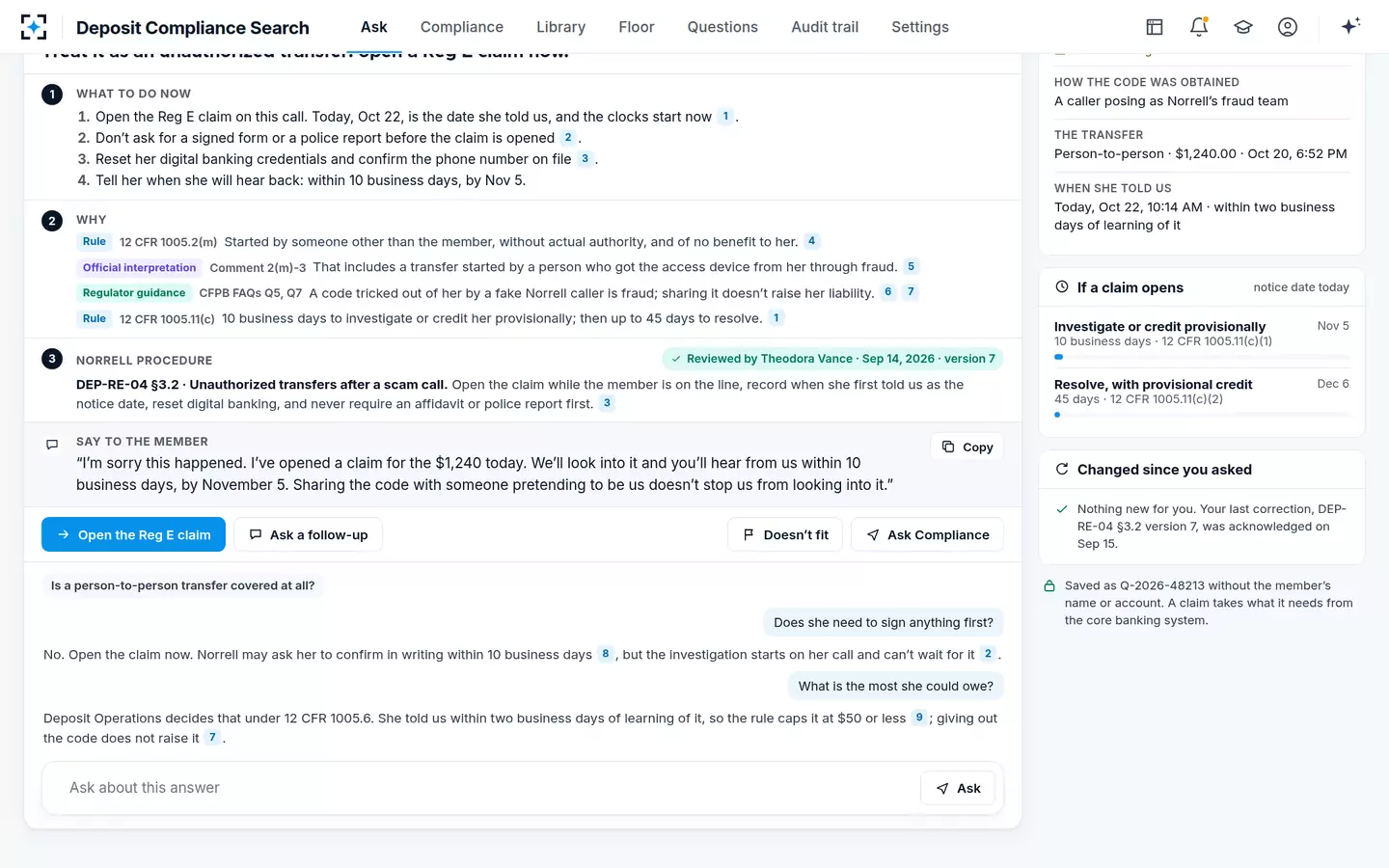
Numbers answer most questions and decide few. Whether $50 is the cap depends on when the member learned of the loss; whether $275 is available tomorrow depends on whether the account is new. That is why the answers in Deposit Compliance Search lead with what to do now, then give the why with each line labeled rule, official interpretation, regulator guidance or the institution's procedure, and when a number turns on a fact the member has not given, the agents ask for it.
Follow-up questions on the same call, each number with its citation
Questions people ask
Is the Reg D six transfer limit still in effect?
Not as federal law. The Federal Reserve deleted it from the savings deposit definition in April 2020, but allowed institutions to keep enforcing it by contract. Whether a given savings account has a limit, and what happens on the seventh transfer, depends on that account's agreement and disclosures.
Which deposit rule number do staff most often get wrong?
The Reg CC next-day amount: staff still quote $225, but it has been $275 since July 1, 2025, under 12 CFR 229.10(c)(1)(vii), and it next changes on July 1, 2030 (every amount is charted in the Reg CC cheat sheet 2026). Cash deposited to an employee, electronic payments and certain low-risk checks are available the next business day in full.
Do deposit compliance regulations apply to credit unions?
Mostly yes. Regulation E and Regulation CC apply to credit unions directly, Truth in Savings applies through NCUA Part 707 instead of Regulation DD, and Regulation D treats a regular share account as a savings deposit. The FDIC's Part 328 does not apply to credit unions.
How many deposit regulations are there?
For account-level work, five federal rules carry most of it: Regulations E, CC, DD (or Part 707), D and the FDIC's Part 328. State law adds to them, for example on unclaimed property, and the Bank Secrecy Act governs reporting and records for deposits without being a deposit disclosure rule.
Which deposit rule changed most recently?
Among the rules on this page, the FDIC's Part 328 amendments took effect on March 2, 2026, with compliance required by April 1, 2027. Before that, Regulation CC's dollar amounts changed on July 1, 2025. Regulation E's error-resolution section, 1005.11, was last amended in a change that took effect on April 1, 2019.