The FDIC digital signage deadline is April 1, 2027. By that date every insured bank must meet the amended 12 CFR 328.4 and 328.5: the FDIC official digital sign on the homepage, login page and first account-opening page of each website and app, non-deposit signage and the one-time notice where they apply, and the sign on the initial screen of deposit-taking ATMs (or the physical sign where the rule still allows it). The date has moved four times since the rule was adopted in December 2023, and the FDIC final rule of January 29, 2026 set it as the current one. The rest of Part 328 is not waiting: the misrepresentation rules have applied since January 1, 2025, and branch signs, the advertising statement and written policies since May 1, 2025. Botminds’ FDIC Signage Compliance exists for the part that does not end on April 1: knowing, every month, that every screen and every partner still complies.
The FDIC digital signage deadline in four numbers
2027
April 1, 2027: compliance with the amended §§ 328.4 and 328.5
91 FR 3801
4moves
of the compliance date for the digital and ATM signs since 2024
89 FR 84261 · 90 FR 11659 · 90 FR 54544 · 91 FR 3801
2025
the year the rest of Part 328 began to apply: subpart B in January, the rest of subpart A in May
41hours
the FDIC’s average implementation estimate per bank after 2026, which it says may understate cost
60 hours less 19
When is the FDIC digital signage deadline? April 1, 2027, for §§ 328.4 and 328.5
The FDIC’s final rule of January 29, 2026 states it in two lines: “Effective date: The amendments made in this rule are effective March 2, 2026.” and “Compliance date: Compliance is required by April 1, 2027.” (91 FR 3801). The effective date matters little in practice: it is the day the new text replaced the old in the Code of Federal Regulations. The compliance date is the day examiners can expect the signs to be there.
The date covers only the digital and ATM provisions. “The final rule does not amend other provisions under 12 CFR part 328.” Everything else from the 2023 rule already applies. When the FDIC delayed the digital and ATM sections in March 2025 it wrote that “Compliance with all other provisions in subpart A remains unchanged and generally is required by May 1, 2025.” (90 FR 11659). That covers the official sign at teller windows and other premises, non-deposit signage in branches, the advertising statement, and the written policies of § 328.8. Subpart B, the misrepresentation rules that reach fintech partners, was never delayed: “The compliance date for the final rule amendments to subpart B of 12 CFR part 328 remains January 1, 2025.” (89 FR 84261).
Three compliance dates are in force, not one
| Part of the rule | What it covers | Compliance required |
|---|---|---|
| Subpart B | False advertising, misuse of the FDIC name or logo, misrepresentation of insured status, by anyone | January 1, 2025 |
| Subpart A, except §§ 328.4–328.5 | Official sign on premises (§ 328.3), advertising statement (§ 328.6), teller-window rule (§ 328.7), written policies (§ 328.8) | May 1, 2025 |
| §§ 328.4 and 328.5, as amended in 2026 | ATMs and like devices; websites and apps | April 1, 2027 |
Was the FDIC signage deadline delayed again? Four moves and one rewrite
The deadline has moved four times, and the last move came with a rewrite of the rule itself. The FDIC adopted the rule in December 2023 with the words “Compliance is required by January 1, 2025.” (89 FR 3504). In October 2024 it delayed subpart A to May 1, 2025. In March 2025 it split the rule, holding back only the digital and ATM sections to March 1, 2026 while it reconsidered them. It proposed changes in August 2025, with comments due by October 20, 2025 (90 FR 40767). In November 2025 it moved the old text to January 1, 2027, noting that “This delayed compliance date is subject to any changes to these provisions made by any future rulemaking.” (90 FR 54544).
The January 2026 rule then replaced both the text and the date: “the January 1, 2027 compliance date set by the FDIC through the November 25, 2025 extension has been superseded.” The FDIC chose April 1, 2027 over its own proposed January date because it “ensures that IDIs have at least a full year to review the revised requirements and to implement any changes necessary”. Since then the FDIC has issued one further signage letter, FIL-22-2026 of May 15, 2026, which updated its Q&A and restated the same date (FDIC). No proposal to move April 1, 2027 has been published in the Federal Register, and the eCFR text of §§ 328.4 and 328.5 still carries the January 2026 amendments.
Every FDIC digital signage deadline since the rule was adopted
| Published | Document | Compliance date it set for the digital and ATM signs |
|---|---|---|
| January 18, 2024 | Final rule, 89 FR 3504 (adopted December 20, 2023) | January 1, 2025 |
| October 22, 2024 | Delay, 89 FR 84261 (all of subpart A) | May 1, 2025 |
| March 11, 2025 | Delay, 90 FR 11659 (§§ 328.4 and 328.5 only) | March 1, 2026 |
| August 21, 2025 | Proposed amendments, 90 FR 40767 | January 1, 2027 proposed |
| November 28, 2025 | Delay, 90 FR 54544 (old text of §§ 328.4–328.5) | January 1, 2027, later superseded |
| January 29, 2026 | Final rule, 91 FR 3801 (FIL-3-2026) | April 1, 2027, the current date |
What must be done by April 1, 2027?
Five things must be true on April 1, 2027, on every channel. The FDIC official digital sign must be on each website’s and app’s homepage, login page and first account-opening page. Pages primarily about non-deposit products must carry non-deposit signage. Links that take a signed-in customer to a third party’s non-deposit platform must trigger the one-time notice. Every deposit-taking ATM must show the digital sign on its initial screen, unless it qualifies for the physical sign. And the written policies must now address all of it. What each of those means on a page is set out in FDIC digital signage requirements in plain words.
One trap catches banks that think they finished early. The FDIC refused a blanket pass for work done to the 2023 text: “The FDIC is not deeming IDIs currently in compliance with the regulation to be in compliance with this rule.” Its Q&A explains the gap: most banks that met the 2023 rule would meet the 2026 one, but the new rule “expressly requires the display of the FDIC official digital sign on the deposit account opening page.” A bank that signed its transaction screens in 2024 should look first at where applications begin.
Ready for April 1, 2027: eight things to be able to show
- A complete list of digital channels
Every website, online banking site and app that takes deposits, with its homepage, login page and first account-opening page.
- The sign on all three pages of each
In English, navy or black (white on dark), near the bank’s name or the login fields.
- The first account-opening page, specifically
The page the 2023 text did not clearly name and the FDIC would not grandfather.
- Non-deposit signage on investing pages
Pages primarily dedicated to non-deposit products, bold or boxed if it sits low on the page.
- The one-time notice on every outbound link
For logged-in customers leaving for a third party or affiliate’s non-deposit platform.
- Every deposit-taking ATM decided
Digital sign on the initial screen, or a physical sign where § 328.4(c) allows it.
- Policies that now cover §§ 328.4–328.5
Who owns each channel, how changes are checked, how partners are monitored.
- Evidence dated after the last release
A capture of each page or screen on the version customers actually see.
How long does FDIC digital signage implementation take?
The FDIC’s own number is small and, by its own admission, probably low. In 2024 it estimated a one-time burden of sixty hours per bank for the digital work; in 2026 it cut 19 of them, noting that “The 19 hours represent a 32-percent time savings from the 60 hours of implementation burden estimated in the 2023 Final Rule.” In the same analysis it conceded that its 2023 cost estimates may have understated actual costs (91 FR 3801). Forty-one hours is the time to change a template, not the time it takes the change to reach customers.
Elapsed time is set by queues. A web change waits for a release train; an app change waits for app-store review and for customers to update; an ATM change waits for the vendor’s build and a field rollout; a partner’s change waits for the partner. The plan below is our estimate for a community bank starting in November 2026, about 21 weeks before the date. It is not a measured result, and a bank with its own development team will move faster on web and slower on nothing else.
Working back from April 1, 2027: where the weeks go
- Inventory2 wk
- Design2 wk
- Build and test4 wk
- Year-end freeze4 wk
- Release and recapture5 wk
- Inventory2 wk
- Design and build5 wk
- Year-end freeze4 wk
- Store review, adoption, recapture8 wk
- Fleet list of builds2 wk
- Vendor build6 wk
- Year-end blackout4 wk
- Pilot, rollout, photos9 wk
- Update § 328.8 policies3 wk
- Board or committee3 wk
What are vendor blackout periods, and why do they shorten the calendar?
A blackout period is a stretch, usually around year end, when a vendor or a bank’s own technology team accepts no production changes. Commenters raised them when the FDIC proposed January 1, 2027: “coordinating with outside vendors to update technological platforms takes time, and that many such vendors institute year-end blackout periods.” Some asked for more: “some commenters suggested that a compliance date be set for 18 months following the adoption of any final rule.” (91 FR 3801). The FDIC gave a little over fourteen months from publication.
The effect on a plan is arithmetic. From early November 2026, roughly four of the remaining 21 weeks fall in a typical December freeze, and app changes need weeks more after release before most customers are on the new version. Work that is not in a release by early December is, for practical purposes, a January release competing with everything else that slipped.
The commenters noted that coordinating with outside vendors to update technological platforms takes time, and that many such vendors institute year-end blackout periods.
Commenters to the FDIC, as summarised in the final rule of January 29, 2026
Do ATMs placed before 2027 need digital signs?
No. An ATM placed into service on or before April 1, 2027 may keep the physical FDIC official sign instead of the digital one, and so may a newer ATM that does not let the bank’s customer transact with non-deposit products (12 CFR 328.4(c)). The FDIC simply reused the compliance date as the cut-off: it had proposed January 1, 2027 for both and moved both together. For the deadline plan that turns an ATM software project into, for most fleets, a check that every deposit-taking machine has either the sign on its initial screen or a legible physical sign. Idle-screen advertising does not count; the details are in FDIC signage requirements for ATMs.
Where a deadline plan actually stalls: remaining work by channel
Plans stall on the channels a bank does not build itself. Take a fictional community bank, Tessaly Community Bank, with 41 branches, 58 ATMs and nine fintech partners, as it runs through Botminds’ FDIC Signage Compliance in October 2026. Of the bank’s own places that the digital and ATM rules reach, 22 are not ready, each covered by an open finding. The website’s eight include four account-opening pages that share one template, so one fix clears them.
What is left before April 1, 2027 at a sample bank, by channel
Readiness for the FDIC digital signage deadline, with what could slip
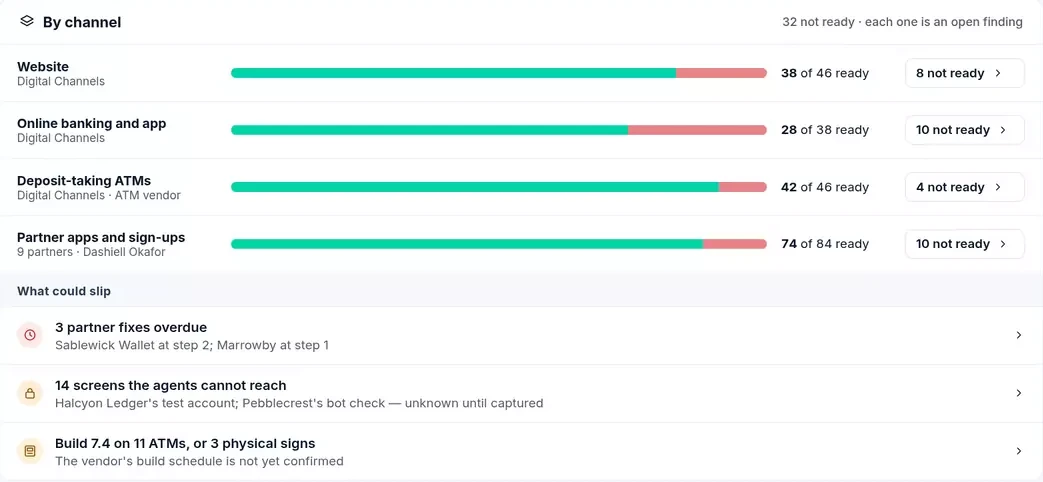
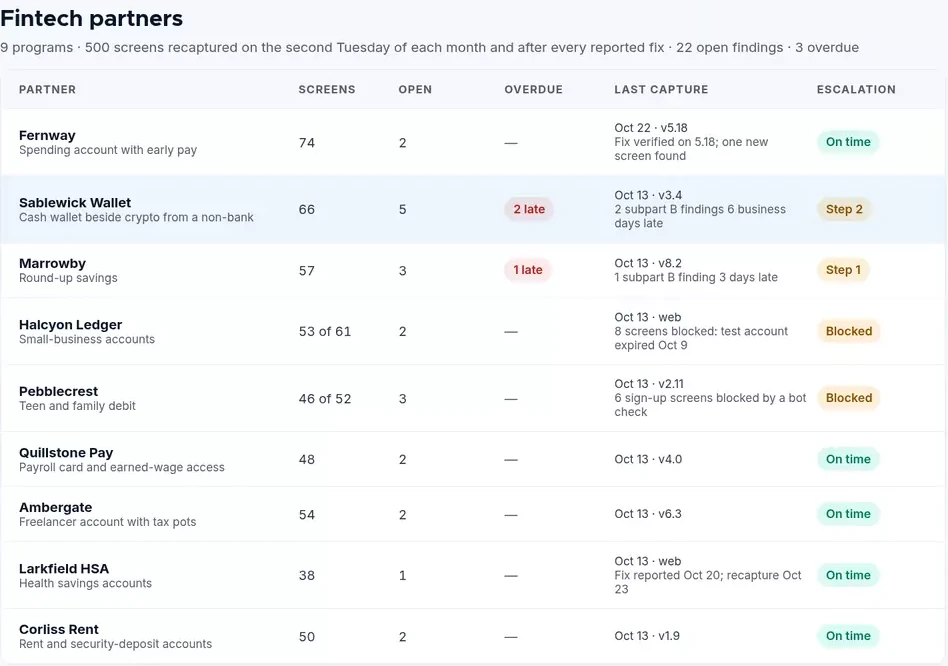
The risks in that panel are the ones a project plan rarely lists. Fourteen screens could not be captured because a partner’s test account expired and another partner’s sign-up flow sits behind a bot check: unknown, not compliant. Three ATMs off-site carry neither sign, and the fastest fix is three physical signs, which the FDIC supplies free of charge, not a software build. A partner whose fix is late has a later problem than April 1: subpart B already applies to it.
Partner fixes and escalation, tracked to the day
What happens after the FDIC signage compliance date?
After April 1, 2027 signage becomes monitoring, because the screens keep changing. Policies under 12 CFR 328.8 must fit the size, complexity and risk of the bank’s deposit-taking and must cover, as appropriate, people who offer the bank’s deposit products to others (12 CFR 328.8(a)). The FDIC’s cost analysis assumes recurring work after the deadline, to “maintain, review, and update their signage and related systems”, and counts testing that each channel shows the sign correctly among those costs (FDIC signage requirements for banks, priced by bank size works through them).
The practical test is the same every month: did any release, campaign, new ATM build or partner version move or remove a sign? An annual review answers that once a year. How to measure whether a review covered the right screens and judged them right is the subject of the FDIC signage audit.
Buying help for the deadline: what to look for, and where the solution fits
Three kinds of help are on offer, and they answer different questions. A design or development partner changes the templates. A one-time review or audit tells you, on a date, whether the pages it looked at comply. Continuous monitoring tells you every month whether every page still does. Before the deadline a bank needs the first; on the deadline it needs evidence; after it, the third.
Ask any vendor four things. How it builds the inventory, and how it notices a page that was not on it. Whether it captures screens logged in, at each device’s size, on the version customers see. Whether each finding cites the passage of Part 328 it relies on. And how a finding closes: on someone’s word, or on a new capture that passes.
Botminds’ FDIC Signage Compliance does the second and third. Its agents capture every page and screen of the bank’s channels, ATM builds and partner apps on a schedule and after every reported fix, mark where the sign belongs, check each capture against the rule with the passage cited, group failures by the template that causes them and draft the correction; a reviewer checks every finding and the Compliance Officer approves it. It does not change a template, build an ATM screen or publish anything, and it does not replace legal judgment on an ambiguous page: it says the page needs a person.
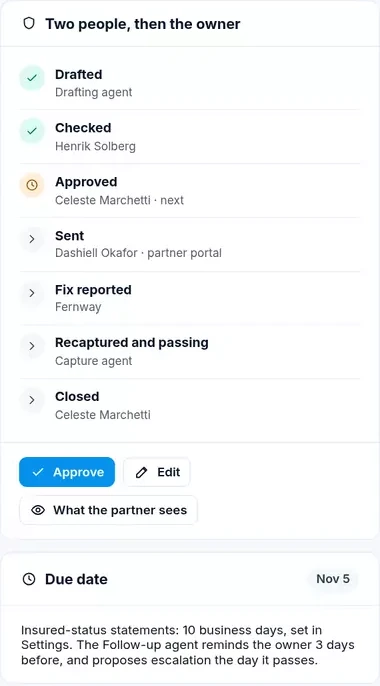
Every request goes through two people before the owner sees it
Questions people ask
What is the FDIC signage compliance date for subpart B?
January 1, 2025. When the FDIC delayed subpart A in October 2024 it said the compliance date for the subpart B amendments remained January 1, 2025, and it has not moved since. Subpart B governs misrepresentation of deposit insurance by anyone, including fintech partners.
Do banks already compliant with the 2023 rule need to change anything?
Possibly one thing. The FDIC said most banks compliant with the 2023 rule would also comply with the 2026 rule, but it would not deem them compliant, because the new rule expressly requires the sign on the first account-opening page. Banks may also remove signs the old rule required, such as on transaction screens, though the FDIC noted some may keep them.
Is the April 1, 2027 date the same for ATMs?
Yes. The amended § 328.4 for ATMs and like devices shares the April 1, 2027 compliance date, and the same date marks which ATMs may keep the physical sign: those placed into service on or before it.
Will the FDIC delay the digital signage deadline again?
Nothing published suggests it. The January 2026 rule replaced the text that kept being delayed, the FDIC’s May 2026 letter restated April 1, 2027, and no proposal to change it appears in the Federal Register. Plans built on a further delay are a bet against the FDIC’s stated reason for the date: a full year to implement.
How many banks must meet the FDIC digital signage deadline?
The FDIC counted 4,388 insured institutions subject to Part 328 at September 30, 2025. It also said it has no data on how many run digital deposit-taking channels, so it assumed all of them would be affected.