The FDIC digital signage requirements, in 12 CFR 328.5 as amended in January 2026, ask an insured bank to do three things on every website and app through which it takes deposits. Show the FDIC official digital sign, clearly and continuously, on the homepage, the login page and the page where a consumer first starts opening a deposit account. Put non-deposit signage (not insured by the FDIC, not deposits, may lose value) on pages mainly about investments, insurance or other non-deposit products. And give a signed-in customer a one-time notice before they leave for a third party’s non-deposit product. Banks must comply by April 1, 2027. The work is hard because it is spread across marketing, web, app and vendor teams and changes with every release; Botminds’ FDIC Signage Compliance exists to capture each of those screens, mark where the sign belongs and cite the passage behind every check.
The 2026 amendments made the rule smaller than the version adopted at the end of 2023, and smaller than many bank projects started in 2024 assumed. Teams that built to the old text should check one thing in particular, covered below: the first account-opening page.
Ten kinds of page, four different duties: the digital channel under § 328.5
Homepage of the website or app
Official digital sign
Near the top and beside the bank’s name or logo is the rule’s own example.
Login page
Official digital sign
Next to the username and password fields is the rule’s example for an app.
First page of deposit account opening
Official digital sign
Only the first screen of the flow. New in so many words in 2026.
Later account-opening steps
Sign not required
The rule names the first page only.
Dashboard after login
Sign not required
Not a homepage, login page or first account-opening page.
Transfer and mobile deposit screens
Sign not required
Dropped from the rule in 2026.
Pages primarily about investments, insurance, annuities or crypto
Non-deposit signage
Not insured by the FDIC; not deposits; may lose value.
Link out to a third party’s non-deposit product, customer logged in
One-time notification
Once per session per destination, dismissed by the customer or after three seconds.
Advertising pages for deposit products
Advertising statement
“Member FDIC” or a short title under § 328.6, not the digital sign.
App store listing, social media ads
No digital sign
The FDIC’s Q&A says neither needs it; ads still follow § 328.6.
What are the FDIC digital signage requirements? Three pages, one sign
The core duty is short. A bank’s digital deposit-taking channel “must clearly, continuously, and conspicuously display the FDIC official digital sign” on three pages or screens: the “Initial page or homepage of the website or application;” the login page; and the “Page or screen where the consumer first initiates a deposit account opening.” (12 CFR 328.5(c)). Everything else in § 328.5 either describes the sign, deals with non-deposit products, or gives examples.
A channel is covered only if it takes deposits and gives access to them. The scope sentence reaches websites and apps “that offer the ability to make deposits electronically and provide access to deposits at insured depository institutions”, and the FDIC’s Q&A draws the consequence: “If an IDI’s website is purely informational, with no ability to make deposits or access deposits, it would not be a digital deposit-taking channel.” (FDIC Part 328 Q&A, II.A.1). ATMs are handled separately, in § 328.4; our guide to FDIC signage requirements for ATMs covers them.
In practice “three pages” means three pages per channel. A bank with a public website, a separate online banking login, an iOS app and an Android app has at least four homepages and four login pages to get right, plus every channel where an account can be opened. That multiplication, not the sign itself, is where projects lose time.
The FDIC digital signage requirements, by the numbers
3pages
per digital channel must carry the official digital sign
12 CFR 328.5(c)
3sec
minimum display if the one-time notice closes itself
12 CFR 328.5(d)(2)(iii)
4,388
insured institutions subject to Part 328 at September 30, 2025
FDIC, 91 FR 3801
2027
April 1, 2027: compliance date for the amended §§ 328.4 and 328.5
91 FR 3801
Which pages need the FDIC digital sign after 2026, and which no longer do?
After 2026 the sign is needed on the homepage, the login page and the first account-opening page, and nowhere else by rule. The 2023 version was wider: it required the sign on the homepage, on “landing or login pages; and pages where a customer may transact with deposits.” (91 FR 3801, describing the 2023 text). In 2024 the FDIC had gone as far as saying the sign “should be displayed where an IDI’s mobile application allows customers to deposit checks remotely, because this electronic space is in effect a digital teller window.” (89 FR 3504). That instruction is gone, and the current Q&A says so in one line, quoted below.
The requirement to display the official digital sign on pages where the customer may transact with deposits was removed from the regulation in 2026.
FDIC, Questions and Answers Related to the FDIC’s Part 328 Final Rule, May 13, 2026
Two clarifications came with the cut. The sign is required “only on the first page or screen of the deposit account opening process”, so a ten-step application needs it once. And a post-login dashboard is not a homepage: “an IDI is not required to display the official FDIC digital sign on such a dashboard or portal.” (Q&A II.A.9). The FDIC also said the narrower rule should leave few pages carrying both the digital sign and non-deposit signage, since “the potential for both signage requirements to apply to the same page is greatly minimized by the amendments in this rule”.
What the 2026 amendments took out of the FDIC digital signage requirements
The 2023 text (its compliance date never arrived): Homepage; landing or login pages; pages where a customer may transact with deposits.
The rule as amended in 2026: Homepage; login page; the page where the consumer first initiates a deposit account opening.
The 2023 text (its compliance date never arrived): Specific hexadecimal color codes and wordmark sizes.
The rule as amended in 2026: Navy blue or black, Source Sans Pro Web or a similar font; no color codes or sizes; wrapping allowed.
The 2023 text (its compliance date never arrived): On each page relating to non-deposit products.
The rule as amended in 2026: On pages primarily dedicated to advertising, information about or access to non-deposit products.
The 2023 text (its compliance date never arrived): The customer had to act to dismiss it before reaching the third party.
The rule as amended in 2026: Dismissed by a click or swipe, or disappears by itself after at least three seconds.
The 2023 text (its compliance date never arrived): No equivalent provision.
The rule as amended in 2026: Expressly allowed by a new § 328.5(f).
One change cuts the other way. The FDIC refused to treat banks that had already built to the 2023 text as automatically compliant with the new one. The reason is the account-opening page, which the 2023 text did not clearly name. A bank that put the sign on transaction screens in 2024 and stopped there may still be missing it where applications begin. Our guide to the FDIC digital signage deadline turns that into a plan.
What must the FDIC digital sign look like?
The sign has fixed words and loose styling. The “FDIC” is “displayed in bold, navy blue or black”, the line “FDIC-Insured—Backed by the full faith and credit of the U.S. Government” sits beside it in smaller italic type, and “The entire FDIC official digital sign shall be displayed in Source Sans Pro Web or similar font.” (12 CFR 328.5(b)). On a dark background where navy or black would be illegible, the sign “shall be displayed in white to contrast with the background”.
The 2026 rule deliberately dropped the hexadecimal colors and font sizes of the 2023 design. In the FDIC’s words, the rule “requires that the text of the official digital sign be navy blue or black but does not mandate specific color codes.” (91 FR 3801). The FDIC still offers a ready-made file: bankers “can also download the FDIC official digital sign on FDICconnect”, and linking the sign to the FDIC’s site is optional, since “Part 328 does not require the official digital sign to be linked to the FDIC’s website.”
The FDIC official digital sign, specified in eight lines
- Words unchanged
“FDIC” followed by “FDIC-Insured—Backed by the full faith and credit of the U.S. Government”, in English.
- “FDIC” in bold
Navy blue or black. The longer line is smaller and in italic.
- One typeface family
Source Sans Pro Web or a similar font for the whole sign.
- White only on dark backgrounds
When navy or black would be illegible against the background.
- Wrapping allowed
The rule permits wrapping for space; the Q&A adds that the sign can be scaled or stacked.
- No color codes, no minimum size
Removed in 2026; legibility is judged against the rest of the page.
- Link optional
Linked versions to BankFind and EDIE exist on FDICconnect; none is required.
- Translation in addition, never instead
A Spanish or other version may sit beside the English sign.
What “clearly, continuously, and conspicuously” means on a screen
The standard is judged against the page around the sign, not against a measurement. The FDIC’s final rule says so directly: “Ultimately, whether signage is clear, continuous, and conspicuous must be based on the appearance of signage in relation to other content on a given page or screen.” (91 FR 3801). The rule gives three examples that pass: a homepage that “continuously displays the FDIC official digital sign near the top of the page and adjacent to the insured depository institution’s name”, an app login page that “displays the FDIC official digital sign immediately adjacent to the username and password fields”, and an account-opening page with the sign near the top or centre.
The Q&A settles four questions that come up in every design review. The footer is allowed: “The FDIC official digital sign may be placed in other areas of the page or in the footer if displayed clearly, continuously, and conspicuously.” The sign cannot be dismissed after login on the pages that need it, but it does not have to stick to the screen: “Part 328 does not, however, require the official digital sign to continue to follow the user as they scroll up or down the screen.” It need not repeat with the bank’s name: “IDIs are not required to display the FDIC official digital sign every time the IDI’s name appears.” And where an app shows only a logo, a sign beside the logo at the top of the screen is clear and conspicuous (Q&A II.A.3, II.A.4, II.A.7, II.A.10).
The footer permission is narrower than it sounds. Writing about disclosures, the FDIC warned that “Signage would not be displayed clearly, continuously, and conspicuously for purposes of 12 CFR part 328 if it appears at the bottom of a web page, in very small text size.” A sign in a footer passes when it is set apart from footnote text; a sign shrunk to fit a dense footer is the case the FDIC described.
What is non-deposit signage, and which pages must carry it?
Non-deposit signage is the three-part statement that non-deposit products “are not insured by the FDIC; are not deposits; and may lose value”, and on digital channels it belongs on “all pages or screens primarily dedicated to advertising or providing information about, or access to, one or more non-deposit products.” (12 CFR 328.5(d)(1)). Non-deposit products are defined widely: “insurance products, annuities, mutual funds, securities and crypto-assets”, but not credit products or safe deposit boxes.
“Primarily dedicated” replaced the 2023 phrase “on each page relating to non-deposit products”, which had swept in homepages with a single investing banner. The final rule now says a homepage with limited links to investment pages “would not meet this standard”, while pages “accessed by clicking ‘Investing’ or ‘Wealth Management’” usually will (91 FR 3801). The text need not be loud: the rule’s own example puts it “towards the bottom of the page” in a way that “distinguishes the text of the non-deposit signage from the smallest text on the page using, for example, bold or larger text, or surrounding the signage with a text box”.
Does this page need non-deposit signage? Five common cases
| Page | Non-deposit signage? | Why |
|---|---|---|
| Homepage with an investing banner | No | Not primarily dedicated to non-deposit products (91 FR 3801). |
| Navigation menu linking to Investing | No | A menu link alone does not make a page primarily dedicated (Q&A II.B.8). |
| Investing or Wealth Management landing page | Yes | The usual example of a covered page; bold or boxed text near the bottom passes. |
| Business sweep account page | No | Sweeps are “hybrid products”; neither sign is required, but § 360.8(e) disclosures apply (Q&A II.A.15). |
| Car loan with credit life or disability insurance | No | FDIC staff treat these as part of the credit offering, and credit is not a non-deposit product (Q&A II.B.7). |
What is the one-time notification?
The one-time notification is a short notice, usually a pop-up or speed bump, shown before a signed-in customer leaves the bank’s channel for a third party’s non-deposit product. The rule requires “a one-time per session notification to an insured depository institution customer who is logged into the insured depository institution’s digital deposit-taking channel before the customer leaves” it for the non-bank’s platform, saying that the third party’s products are not insured by the FDIC, are not deposits and may lose value (12 CFR 328.5(d)(2)).
The 2026 rule eased how it closes. It is satisfied if it “Is dismissed by an affirmative act of the bank customer, such as a click or swipe, after any period of time; or” if it “Automatically disappears after being displayed for a minimum of three seconds.” The FDIC was explicit that the two can be combined: “The notification would not need to remain on the page for 3 seconds if the customer affirmatively dismisses the notification before 3 seconds elapses.”
Three boundaries define it. It applies to logged-in customers only, and only on leaving: “The notification requirement applies only when a customer leaves the IDI’s digital deposit-taking channel.” Affiliates count: “the FDIC views affiliated entities as third parties”. And “one-time per session” is counted per destination: the same link clicked twice needs one notice, but a second link to a different third party in the same session needs another (Q&A II.B.3, II.B.4). A bank may add its own words, such as telling the customer they are leaving the bank’s site.
What the digital sign rules leave out
Much of the effort in early projects went into pages the rule never reached. The Q&A is now specific about what is out. “An IDI is not required to post the official digital sign in the app store where its app is available for download.” Social media advertisements do not carry it either, downloadable terms and conditions are generally out, and marketing pages for deposit products follow the advertising-statement rule instead of carrying the digital sign (Q&A II.A.12, II.A.13, II.C.2, II.E.1).
The reverse also holds. Pages that carry the digital sign do not need “Member FDIC” as well, though the Q&A does not prohibit it. When “Member FDIC” is needed, and when it is forbidden, is a separate rule with its own exceptions, set out in when the FDIC advertising statement is required.
Is a Spanish translation of the FDIC digital sign allowed?
Yes, as an addition. “IDIs must display the FDIC official digital sign in English”, and “IDIs may also display a translation of the official digital sign in another language.” (Q&A II.A.14). A Spanish-language site therefore carries the English sign, with a translation beside it if the bank wants one. Translations of the advertising statement work differently: the FDIC has published approved versions of “FDIC-Insured”, “Member FDIC” and “Member of FDIC” in 26 languages that need no further consent.
Accessibility sits beside the rule, not inside it. Asked how the sign fits with disability law on small screens, the FDIC answered that “Part 328 does not supersede or alter the requirements of IDIs to comply with ADA’s digital accessibility rules.” Teams usually treat the sign like any other meaningful image, with a text alternative and enough contrast; the white version exists for dark backgrounds, where navy or black would not read.
Who the digital sign belongs to: banks, never their partners
The official digital sign identifies an insured bank, so a non-bank that shows it misrepresents itself. The FDIC said this when it created the sign: a non-bank displaying it would improperly imply that it is FDIC-insured, a misrepresentation under subpart B (89 FR 3504). The Q&A repeats it and allows one narrow case, a bank’s sign on a non-bank-owned ATM carrying enough of the bank’s branding.
That matters for banks with fintech partners. Since the sign would present a non-bank as insured, a partner’s own app meets its duties another way: subpart B asks it to name the bank, say it is not a bank and say what insurance covers. A program agreement that tells a partner to add the official sign asks for something the FDIC has called improper. The disclosures a partner does owe, and what the FDIC’s demand letters objected to, are in the not FDIC insured disclosure.
How FDIC Signage Compliance checks the three screens
The difficulty is rarely understanding § 328.5; it is knowing, on any given morning, whether every homepage, login page and first account-opening page on every channel still carries the sign after the last release. Botminds’ FDIC Signage Compliance has agents capture each of those screens at the device’s own size, logged in with test accounts, mark where the sign belongs and where it is, and check each one against the passage it cites. Failing screens are grouped by the template that causes them, so one fix closes many; a reviewer checks every finding and the Compliance Officer approves it.
Take a fictional community bank, Tessaly Community Bank, with 41 branches, 58 ATMs and nine fintech partners, as it runs through the solution in October 2026. Of 214 places it tracks for the deadline, partner screens included, 182 are ready. On the website, 8 places are not, and one account-opening template causes four of them.
Readiness for FDIC digital signage, channel by channel
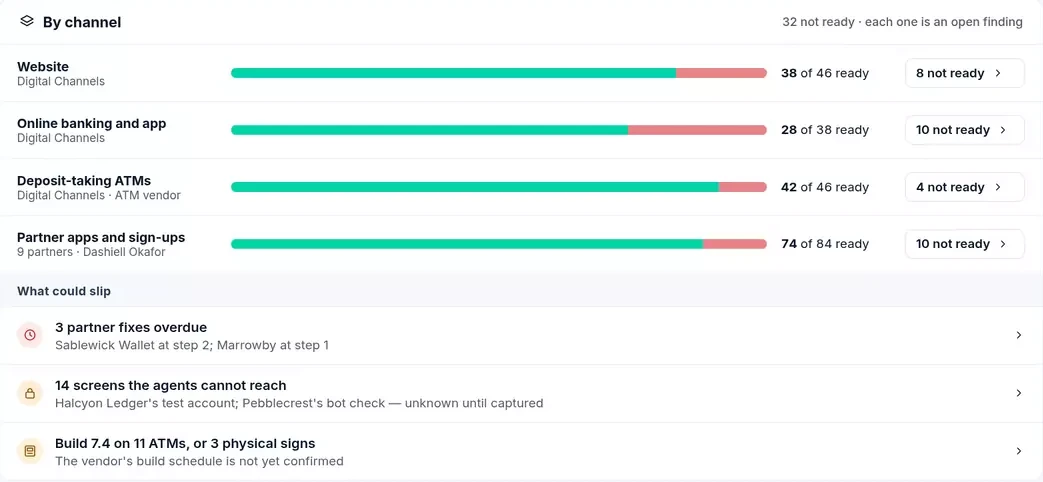
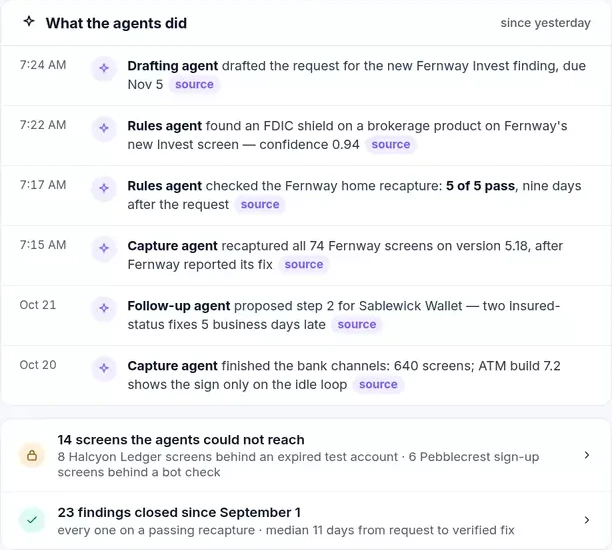
The overnight work is visible the next morning: what each agent captured, checked or drafted, with a link to the capture and the passage behind it. Agents never publish a fix, approve a finding or write to a partner, and below the bank’s confidence threshold they hand the screen to a person instead of proposing anything.
What the agents did overnight, each with its source
Questions people ask
Does the FDIC digital sign go on the login page?
Yes. The login page is one of the three pages § 328.5(c) names, alongside the homepage and the first account-opening page. The rule’s own example for an app puts the sign immediately beside the username and password fields, and the Q&A adds that it cannot be dismissed there.
Does the FDIC digital sign need to link to the FDIC?
No. Part 328 does not require a link. Optional versions linked to BankFind and to the FDIC’s Electronic Deposit Insurance Estimator are available on FDICconnect, where bankers can also download the sign itself.
What changed in the 2026 FDIC digital signage rule?
The sign moved from homepages, landing or login pages and every page where customers transact with deposits to three pages: homepage, login and the first account-opening page. Color codes and sizes were dropped, non-deposit signage was limited to pages primarily about non-deposit products, and the one-time notice may now close itself after three seconds. The rule was published on January 29, 2026, took effect on March 2, 2026, and requires compliance by April 1, 2027.
Can the FDIC digital sign go in the footer?
Yes, if it is still clear, continuous and conspicuous there. The FDIC has also said that signage at the bottom of a page in very small text is not conspicuous, so a footer sign should be set apart from the footnotes around it.
Does an informational website need the FDIC digital sign?
No. The rule covers channels that let customers make deposits electronically and access them. The Q&A says a purely informational website, with no ability to make or access deposits, is not a digital deposit-taking channel. Its advertisements for deposit products still need the advertising statement.
Do fintech partners have to show the FDIC digital sign?
No, and they should not. The FDIC has said a non-bank displaying the official digital sign would imply it is FDIC-insured, which is a misrepresentation under subpart B. A partner must instead name the insured bank, say it is not itself a bank and say that insurance only covers the bank’s failure.