The FDIC advertising statement is required in every advertisement by an insured bank that promotes deposit products or the bank’s services in general, unless one of ten exceptions in 12 CFR 328.6(d) applies. It is “Member of the Federal Deposit Insurance Corporation”, or one of the short titles “Member FDIC”, “Member of FDIC” or “FDIC-Insured”, or the FDIC symbol, in clearly legible type. It must not appear in an ad that relates solely to non-deposit products, and in a mixed ad it must be kept apart from the non-deposit part. That rule has applied since May 1, 2025. Marketing teams publish dozens of pieces a month across websites, apps and social media, and partners advertise the bank’s deposits too, which is why Botminds’ FDIC Signage Compliance checks every captured page against Part 328, the advertising statement included, with the passage cited.
When is the FDIC advertising statement required? Six questions, in order
1Is it an advertisement?
A commercial message, in any medium, designed to attract attention or patronage to a product or business.
Yes Go on.
No No statement duty. Websites and apps may still need the digital sign (§ 328.5).
2Is the advertiser an insured bank?
A fintech, broker or other partner advertising the bank’s deposits is “any person” under subpart B.
Yes Go on.
No Subpart B applies instead: “Member FDIC” only next to the insured bank’s name, never implying the advertiser is insured.
3Is it solely about non-deposit or hybrid products?
Investments, insurance, annuities, crypto-assets; sweep accounts are hybrid products.
Yes The statement is prohibited, and so is any symbol suggesting insurance.
No Go on.
4Does it mix deposits with non-deposit products?
One ad, two kinds of product: the statement must sit with the deposit portion only.
Yes Use the statement, segregated from the non-deposit part.
No Go on.
5Does it promote deposits, or the bank in general?
“Non-specific” means the bank’s name without particular products, as in “Anytown Bank, offering a full range of banking services.”
Yes Go on.
No Not required. A loan-only ad promotes neither.
6Does one of the ten exceptions apply?
Directory listings, signs on the building, supplies such as checks, short broadcast spots, pens and key chains, and five more.
Yes Not required.
No Required: “Member of the Federal Deposit Insurance Corporation”, a short title, or the symbol, clearly legible.
When is the FDIC advertising statement required?
The general rule is one sentence: “each insured depository institution shall include the official advertising statement prescribed in paragraph (b) of this section in all advertisements that either promote deposit products and services or promote non-specific banking products and services offered by the institution” (12 CFR 328.6(c)(1)). An ad is non-specific if it names the bank without listing or describing particular products; the rule’s example is “Anytown Bank, offering a full range of banking services.”
Two other provisions shape it. A new bank must use the statement in its ads no later than its twenty-first day of operation as an insured institution. And a foreign bank with insured and uninsured U.S. branches must say which is which in every ad that requires the statement. The section was renumbered and amended by the December 2023 rule, and its compliance date was not one of the delayed ones: it has applied since May 1, 2025 (90 FR 11659).
The FDIC advertising statement in four numbers
10cases
kinds of advertisement that do not need the statement
12 CFR 328.6(d)
4forms
the full statement, three short titles, or the FDIC symbol
12 CFR 328.6(b)
26langs
with FDIC translations of the short titles usable without asking
FDIC Q&A II.C.3–4
2025
May 1, 2025: compliance with the rewritten § 328.6
90 FR 11659
What counts as an advertisement under Part 328?
Almost any marketing. The rule defines an advertisement as “a commercial message, in any medium, that is designed to attract public attention or patronage to a product or business.” (12 CFR 328.6(a)). “Any medium” takes in banners, emails, app promotions, video and social posts. The FDIC confirms that social media is covered, while sparing it the digital sign: “IDIs are not required to display the FDIC official digital sign on its social media advertisements.”, but they “should ensure that social media advertisements are compliant with the official advertising statement requirements” (Q&A II.E.1).
The same test splits a website in two. Marketing pages for deposit products are ads and need the statement, not the digital sign: “IDIs are not required to display the official FDIC digital sign on advertising pages.” The homepage, login page and first account-opening page need the digital sign and not the statement: “the advertising statement is not required on web pages where an IDI displays the official digital sign, such as the bank’s homepage” (Q&A II.C.1–2). Both may appear together; neither substitutes for the other where it is required.
Member FDIC and the digital sign are two different duties
The advertising statement (§ 328.6): “Member of the Federal Deposit Insurance Corporation”, a short title or the FDIC symbol.
The official digital sign (§ 328.5): “FDIC” beside a line saying deposits are backed by the full faith and credit of the U.S. Government.
The advertising statement (§ 328.6): Advertisements for deposits or for the bank in general, in any medium.
The official digital sign (§ 328.5): The homepage, login page and first account-opening page of each website and app.
The advertising statement (§ 328.6): Required in ads that promote deposits, unless an exception applies.
The official digital sign (§ 328.5): Not required on social media ads.
The advertising statement (§ 328.6): Clearly legible; translations need FDIC approval unless on the FDIC’s list.
The official digital sign (§ 328.5): Navy or black (white on dark), Source Sans Pro Web or similar, in English.
The advertising statement (§ 328.6): May 1, 2025.
The official digital sign (§ 328.5): April 1, 2027.
The digital sign has its own page-by-page rules, set out in FDIC digital signage requirements in plain words. The rest of this guide stays with ads.
Are there exceptions to the FDIC advertising statement?
Ten. Some are about the medium, some about the content, one about impracticality. The two that matter most in daily marketing are the last two in the list: “Advertisements which are of the type or character that make it impractical to include the official advertising statement, including, but not limited to, promotional items such as calendars, matchbooks, pens, pencils, and key chains”, and ads that already say, in substance, that the bank is a member of the FDIC or that its deposits are insured to at least the standard maximum amount (12 CFR 328.6(d)(9)–(10)).
The ten advertisements that do not need the FDIC advertising statement
| Exception in § 328.6(d) | Typical example | |
|---|---|---|
| 1 | Statements and reports of condition required by law | The published call report summary |
| 2 | Bank supplies: stationery (except circular letters), envelopes, deposit slips, checks, drafts, signature cards, passbooks, certificates of deposit | A printed deposit slip |
| 3 | Signs or plates in the bank’s offices or attached to its buildings | The bank’s name over the door |
| 4 | Listings in directories | A telephone or business directory entry |
| 5 | Ads that do not set forth the bank’s name | An unbranded teaser campaign |
| 6 | Entries in a depository institution directory that marks members elsewhere on the page | A trade directory with an FDIC symbol beside members |
| 7 | Joint or group ads listing insured and noninsured institutions | A shared ATM network ad |
| 8 | Radio or television ads, other than display ads, of 30 seconds or less | A 30-second radio spot |
| 9 | Ads where the statement is impractical | Pens, calendars, key chains |
| 10 | Ads that already say the bank is an FDIC member or its deposits are insured to at least the standard maximum | A line saying deposits are FDIC-insured up to $250,000 per depositor |
Can you use FDIC-Insured instead of Member FDIC?
Yes. Since the 2023 rule, “FDIC-Insured” is one of the permitted short forms: “The short title ‘Member of FDIC’, ‘Member FDIC’, ‘FDIC-Insured’, or a reproduction of the symbol of the Corporation” may be used at the bank’s option (12 CFR 328.6(b)(1)). The full form remains “Member of the Federal Deposit Insurance Corporation.”
There is no minimum size. “The official advertising statement shall be of such size and print to be clearly legible.” If the symbol is shrunk until the small lines above and below “FDIC” are unreadable, the rule allows those lines to be dropped rather than printed as a smudge. Legibility is judged on the finished ad: a statement in grey six-point type on a photograph is the advertising version of a sign nobody can read.
Does a loan ad need Member FDIC?
No. On the rule’s own words, the statement is required in ads that promote deposit products or non-specific banking services. An ad for a mortgage or a car loan promotes a particular credit product, so it is neither. Nor is it banned: the prohibition covers ads “relating solely to non-deposit products”, and Part 328 defines non-deposit products to exclude credit: “credit products and safe deposit boxes are not non-deposit products.” A bank may include the statement on a loan ad if it wishes.
The answer changes as soon as the ad strays. A loan ad that also promotes a checking account, or that closes with a general line about the bank’s full range of services, is promoting deposits or non-specific banking, and the statement is required unless an exception applies. Credit ads have their own disclosure rules under Truth in Lending, which are a separate review.
Investment and insurance ads: never the statement
An insured bank “shall not include the official advertising statement, or any other statement or symbol which implies or suggests the existence of Federal deposit insurance, in any advertisement relating solely to non-deposit products.” The same ban covers ads solely about hybrid products such as sweep accounts. In a mixed ad the bank “shall clearly segregate the official advertising statement or any similar statement from that portion of the advertisement that relates to the non-deposit products.” (12 CFR 328.6(e)).
This is where real banners fail. A fictional sample bank running through Botminds’ FDIC Signage Compliance had an annuity-only banner on its website carrying “Member FDIC”: a statement the rule forbids on that ad, not one it requires. Investment pages instead need non-deposit signage, and subpart B separately makes it a misrepresentation for anyone to attach FDIC terms or images to an uninsured product without a clear disclaimer.
Do social media posts need the FDIC advertising statement?
A social post that promotes deposit products, or the bank in general, is an advertisement and needs the statement unless an exception applies. The radio and television exception is narrow, covering only broadcast ads of 30 seconds or less that are not display ads, so it should not be stretched to a social video without legal advice. The FDIC’s examiners have pointed at the channel: their list of risk-mitigating practices says “Comprehensive advertising reviews include promotions on websites, mobile applications, and social media sites and posts.” (FDIC Supervisory Highlights, March 2024).
Character limits are not an exception. The short titles exist for small spaces; “FDIC-Insured” is twelve characters, and the FDIC symbol may be used instead.
Is the FDIC advertising statement required in Spanish ads?
The statement is required in a Spanish ad on the same terms as in English, and it may be translated. The rule allows a non-English version “provided that the translation has had the prior written approval of the Corporation.” (12 CFR 328.6(f)). The FDIC has pre-approved translations of “FDIC-Insured”, “Member FDIC” and “Member of FDIC” in 26 languages, and “An IDI does not need FDIC’s consent or prior approval to use any of the translations provided above”; for Spanish, “FDIC-Insured” is “Asegurado por la FDIC” (Q&A II.C.3–4). Any other translation still needs a request to the FDIC.
Can a fintech partner say Member FDIC?
Only next to the bank’s name. A partner is not an insured bank, so § 328.6 does not apply to it; subpart B does. The FDIC’s supervisors summarised the 2023 rule as treating a non-bank’s use of the statement or FDIC-associated terms as a misrepresentation unless the statement sits next to the name of at least one insured bank (FDIC, March 2024). A line such as Banking services provided by, followed by the bank’s name and Member FDIC, is the familiar form. What else a partner must say, and what the FDIC’s letters objected to, is in the not FDIC insured disclosure.
Reviewing one ad for the FDIC advertising statement
- Classify the ad first
Deposit, non-specific, credit-only, non-deposit, hybrid or mixed. The answer follows from the class.
- Check the advertiser
The bank’s own ad follows § 328.6; a partner’s follows subpart B.
- Test the ten exceptions honestly
Impracticality covers pens and key chains, not a banner that is merely crowded.
- Use a permitted form
The full statement, “Member FDIC”, “Member of FDIC”, “FDIC-Insured”, or the symbol.
- Judge legibility on the final asset
Size, contrast and placement as published, not on the design file.
- Keep it away from non-deposit products
Never on a non-deposit or hybrid ad; segregated in a mixed one.
- Check the translation
One of the FDIC’s published translations, or written FDIC approval.
- Keep the version that ran
Examiners compare ads as published; a capture with its date and channel is the evidence.
How examiners test the statement, and how FDIC Signage Compliance does
Examiners review ads. The Part 328 chapter of the FDIC’s examination manual tells them to “Determine whether the official advertisement statement” is included in all advertisements that need it and to review the non-deposit restrictions, though it still cites the section numbers in force before the 2023 rule and was last updated in May 2023 (FDIC manual X-1). A bank cannot rely on that chapter for the current numbering; it can rely on the questions.
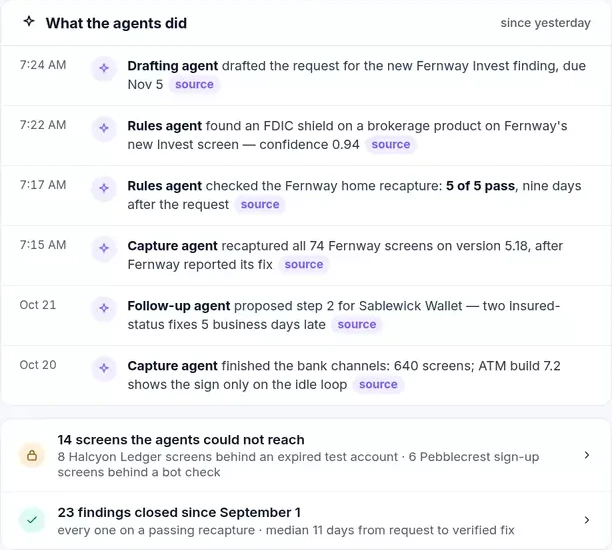
Botminds’ FDIC Signage Compliance asks the same questions of every page and screen it captures across the bank’s channels and partners: is there an advertising statement, is it a permitted form, is it on an ad that forbids it, does it sit next to the bank’s name on a partner screen. Each check names the passage it rests on. A reviewer checks every finding and the Compliance Officer approves it; the agents never edit an ad or contact anyone.
Overnight checks, each linked to its capture
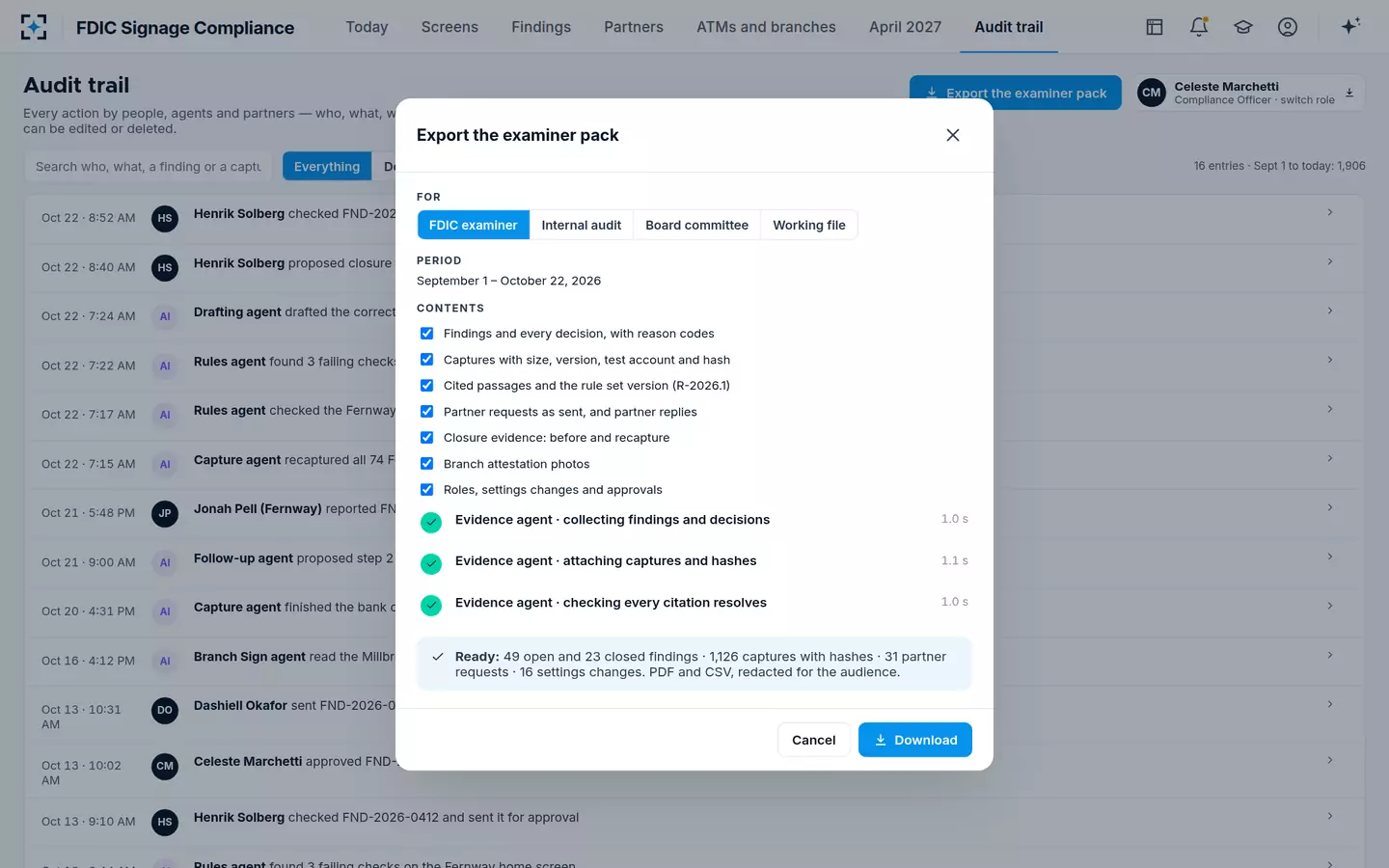
The examiner pack: every decision, with its capture and citation
Questions people ask
Which ads need Member FDIC?
Ads by an insured bank that promote deposit products, or the bank and its services in general, unless one of the ten exceptions applies. The statement may be the full “Member of the Federal Deposit Insurance Corporation”, a short title or the FDIC symbol.
What size must Member FDIC be?
There is no fixed size. The rule requires the statement to be of such size and print as to be clearly legible, and lets a bank drop the small lines of the FDIC symbol if they become illegible when the symbol is reduced.
Does a deposit-slip or checkbook need Member FDIC?
No. Bank supplies such as deposit slips, checks, drafts, signature cards, passbooks and certificates of deposit are one of the ten exceptions in § 328.6(d), as is stationery other than circular letters.
Can a bank put Member FDIC on an investment ad?
No. The rule bars the statement, and any symbol suggesting deposit insurance, in an ad relating solely to non-deposit or hybrid products. In an ad that mixes deposits and investments, the statement must be clearly segregated from the investment part.
When did the current FDIC advertising rules take effect?
The rewritten § 328.6, including “FDIC-Insured” as a short title, took effect on April 1, 2024, and compliance has been required since May 1, 2025. The 2026 amendments changed the digital and ATM sections, not § 328.6.