The FDIC signage requirements for ATMs, in 12 CFR 328.4 as amended in January 2026, are three. A bank’s ATM or like device that receives deposits must “clearly, continuously, and conspicuously” display the FDIC official digital sign on its initial screen, the welcome screen shown before a card is inserted, and an idle screen saver or advertisement is not that screen. Two kinds of machine may carry the physical FDIC sign instead: those placed into service on or before April 1, 2027, and later ones that do not let the bank’s customer transact with a non-deposit product. And an ATM that sells non-deposit products must show non-deposit signage on the first screen of that transaction. Banks must comply by April 1, 2027. The ATM is the one device that is both a sign on a wall and a screen, which is why it is easy to get wrong; Botminds’ FDIC Signage Compliance captures each ATM build’s screens and matches branch photos to see which sign each machine actually carries.
One ATM session, five screens: which notice belongs where
- 1
Idle screen or rotating ads
Does not count
The rule says a screen saver or an advertisement on an idle ATM is not the initial screen. A sign shown only here does not meet § 328.4(b).
- 2
Initial (welcome) screen
FDIC official digital sign
Shown before the customer inserts a card or other credentials. Required unless the ATM may carry the physical sign instead.
- 3
Main menu and shortcuts
Nothing required
A menu offering a non-deposit option is the screen before the transaction, not the first screen of it.
- 4
First screen of a non-deposit transaction
Non-deposit signage
Not insured by the FDIC, not deposits, may lose value. Only for the bank’s own customers, only on ATMs that take deposits.
- 5
Before the customer deposits
Reg CC availability notice
Funds may not be available for immediate withdrawal: on a sign, the screen or the envelope, before the deposit is made.
What are the FDIC signage requirements for ATMs?
The base rule is one screen. Except where the physical sign is allowed, “an insured depository institution must clearly, continuously, and conspicuously display the FDIC official digital sign specified in § 328.5(b) on the initial screen of the insured depository institution’s ATMs and like devices.” (12 CFR 328.4(b)). The sign is the same one a website uses: “FDIC” in bold navy or black beside the line saying deposits are insured and backed by the full faith and credit of the U.S. Government, in Source Sans Pro Web or a similar font, white on a dark screen.
The 2023 version asked for much more. It required the digital sign on an ATM’s “homepage or screen and on each transaction page or screen relating to deposits.” The 2026 rule cut that back: “The FDIC official digital sign is no longer required on homepages or screens or on each transaction page or screen relating to deposits.” (91 FR 3801). ATMs are also kept apart from websites and apps on purpose: “For purpose of this section, ATMs and like devices are not digital deposit-taking channels.”, so the three-page rule for websites does not apply to them.
The FDIC’s published examination procedures have not caught up. The Part 328 chapter of its Consumer Compliance Examination Manual was last updated in May 2023 and still tells examiners that the official sign is not required at ATMs (FDIC manual X-1). That was the old rule. A bank that builds its own test program from the manual will test a requirement that no longer exists and miss the one that starts on April 1, 2027.
What is the initial screen of an ATM?
The initial screen is the welcome screen, the one a person sees before presenting a card or phone. The FDIC’s Q&A defines it: “The ‘initial screen’ is the screen that is displayed before an IDI’s customer inserts a debit card or other credentials to access the device (sometimes referred to as a ‘welcome screen’).” The rule excludes the idle loop in so many words: “a screen saver or an advertisement for products, services, or events on the screen of an idle ATM is not considered the ‘initial screen.’” (12 CFR 328.4(b)).
The exclusion exists because idle loops advertise everything. Commenters pointed out that banks run rotating ads for financial and non-financial products there, and the FDIC agreed that a sign beside such content could mislead. It also guaranteed that every machine has a screen to sign: “Whether or not a given device displays advertisements when idle, all ATMs and like devices will have at least one ‘initial screen’ on which the FDIC official digital sign is displayed”.
The practical consequence is the most common ATM finding: a screen build that puts the sign on one slide of the idle loop and nowhere on the welcome screen. To a branch manager that ATM shows the FDIC sign; to the rule it does not.
If the FDIC official digital signage appeared with such content, it may be misleading.
FDIC, final rule of January 29, 2026
Can an ATM show the physical FDIC sign instead?
Yes, in two cases. The physical official sign “may be displayed in lieu of the FDIC official digital sign” on “ATMs and like devices placed into service on or before April 1, 2027.” and on “ATMs and like devices placed into service after April 1, 2027, that do not permit an insured depository institution’s customer to transact with a non-deposit product” (12 CFR 328.4(c)). In practice every machine in a fleet today qualifies.
The physical sign is the 7-by-3-inch black-on-gold official sign of § 328.2, which a bank can order from the FDIC at no charge. Varied commercial versions are also allowed (12 CFR 328.2(c)). Banks need not remove physical signs when they add the digital one: “IDIs are not required to take down physical FDIC official signs attached to ATMs.” (Q&A II.D.1).
Condition still matters. The 2026 rule deleted the provision on degraded signs only because the general standard already covers it: “Signage that is degraded or defaced to an extent that a consumer is unable to read and understand its content would not be displayed clearly.” A sun-bleached sticker on an off-site machine is the physical-sign version of the idle-loop problem.
Which FDIC sign does this ATM need?
| ATM | Takes deposits? | Lets your customer transact in non-deposit products? | What satisfies § 328.4 |
|---|---|---|---|
| In service on or before April 1, 2027 | Yes | Either | Digital sign on the initial screen, or the physical sign |
| Placed into service after April 1, 2027 | Yes | No | Digital sign on the initial screen, or the physical sign |
| Placed into service after April 1, 2027 | Yes | Yes | Digital sign on the initial screen, plus non-deposit signage on the first non-deposit transaction screen |
| Any ATM, transfers between accounts only | No cash or check deposits | Either | Not subject to § 328.4 (Q&A II.D.5) |
| Non-bank owned, bank-branded | Yes, for the bank | Either | The bank’s digital sign may appear where the bank’s branding clearly identifies it (Q&A II.D.6) |
What about ATMs placed into service after April 1, 2027?
A new machine placed into service after April 1, 2027 needs the digital sign on its initial screen only if it lets the bank’s customers transact with a non-deposit product; otherwise the physical sign still satisfies the rule. The FDIC had proposed January 1, 2027 as the cut-off and moved it with the compliance date: “Because the compliance date for this rule is April 1, 2027, that date will also serve as the ‘placed into service’ date for the physical sign exception for ATMs and like devices.”
For procurement this is a specification line, not a project. A screen build ordered for 2027 deliveries should put the sign on the welcome screen anyway, because the cost is a design decision made once, while a physical sign is a sticker someone must check on every machine for its whole life. The ATM vendor’s next build is the cheap moment.
Must the FDIC sign appear on every ATM screen?
No. The digital sign belongs on the initial screen only, and non-deposit signage on one screen only: “This signage must be displayed on the first page or screen displayed upon initiating a transaction with a non-deposit product.” (12 CFR 328.4(d)). The FDIC rejected the idea that a shortcuts menu counts: “a screen that presents a range of options and shortcuts, one of which is to transact with a non-deposit product, would be the screen displayed prior to, rather than upon, initiating a transaction with a non-deposit product.”
Non-deposit signage is also limited by who is at the machine. The duty runs to the bank’s own customers: “This requirement does not apply to a non-customer, such as a user logging into their account at another institution using a debit card issued by that other institution.” (Q&A II.D.3). The FDIC’s reason was technical: an ATM usually cannot tell what kind of account a non-customer is reaching. And the rule allows more than it requires: the 2026 rule added that § 328.4 does not limit a bank’s ability to include additional disclosures.
Do ATMs that do not take deposits need the FDIC sign?
No. “The sign requirements in section 328.4 only apply to IDIs’ ATMs and other remote electronic facilities that receive deposits.” (Q&A II.D.5). A cash-only machine, or one that moves money between accounts without taking cash or checks, is outside § 328.4. Night depositories are outside the premises rule too: FDIC staff do not treat deposits left in a night drop as usually and normally received (Q&A I.A.3).
The exclusion makes the fleet list the first control. In the fictional sample bank below, 46 of 58 ATMs take deposits; the other 12 need no sign under § 328.4, and a review that treats all 58 alike either wastes a quarter of its effort or, worse, records the wrong population as compliant.
Does Reg CC require an ATM deposit notice? Yes, a different one
Yes. Regulation CC has its own ATM notice, about money rather than insurance: at each ATM location the depositary bank must post or provide a notice that deposited funds may not be available for immediate withdrawal (12 CFR 229.18(c)(1)). An off-premises ATM emptied no more than twice a week must also show the days on which its deposits count as received.
Timing is where the two notices differ most. The FDIC sign belongs on the screen before the card goes in. The Reg CC notice must reach the customer before the deposit is made; the Federal Reserve’s commentary lets it go on a sign, on the screen or on the deposit envelopes at the machine (FDIC funds availability signage quotes the three forms), while “a notice provided on the customer’s deposit receipt or appearing on the ATM’s screen after the customer has made the deposit would not satisfy this requirement.” (Reg CC commentary). How both fit a branch lobby is the subject of FDIC funds availability signage.
Two notices on one ATM, under two different rules
FDIC official sign (12 CFR 328.4): The bank is FDIC-insured, and its deposits are backed by the full faith and credit of the U.S. Government.
Reg CC availability notice (12 CFR 229.18(c)): Funds deposited may not be available for immediate withdrawal.
FDIC official sign (12 CFR 328.4): The initial (welcome) screen, or a physical sign on qualifying machines.
Reg CC availability notice (12 CFR 229.18(c)): On a sign, the screen or the deposit envelope.
FDIC official sign (12 CFR 328.4): Before inserting a card or other credentials.
Reg CC availability notice (12 CFR 229.18(c)): Before making the deposit; a receipt afterwards does not count.
FDIC official sign (12 CFR 328.4): The bank’s ATMs that receive deposits.
Reg CC availability notice (12 CFR 229.18(c)): Every ATM at which deposits can be made to the depositary bank’s accounts.
FDIC official sign (12 CFR 328.4): Non-deposit signage on the first non-deposit transaction screen.
Reg CC availability notice (12 CFR 229.18(c)): Off-premises ATMs emptied twice a week or less: the days deposits count as received.
FDIC official sign (12 CFR 328.4): The bank; a non-bank owner may show the bank’s sign only with clear bank branding.
Reg CC availability notice (12 CFR 229.18(c)): The bank, or a third party such as the ATM owner by arrangement.
Bank-branded ATMs owned by someone else
A bank’s sign on another company’s ATM is allowed only when the machine is clearly the bank’s. The FDIC’s general position is that a non-bank showing the sign implies it is insured, but “staff believes use of the FDIC official digital sign by a bank on non-bank owned, bank-branded ATMs does not raise this concern” where there is enough bank branding, such as the bank’s sign on the machine and its name and logo on the screen (Q&A II.D.6). Reg CC lets the bank arrange for the owner or operator to post its notice. Both arrangements belong in the contract with the operator, with photos to prove them.
Checking an ATM fleet: build, screen and photo
An ATM fleet is checked by build, not by machine: every ATM running the same screen build shows the same initial screen. Take a fictional community bank, Tessaly Community Bank, as it runs through Botminds’ FDIC Signage Compliance. It has 58 ATMs, 46 of which take deposits. Thirty-five run screen build 7.4, with the sign on the initial screen. Eleven run build 7.2, which shows the sign only on the idle loop.
58 ATMs at a sample bank: which sign actually counts
The sign on the idle loop does not count: an ATM build, captured
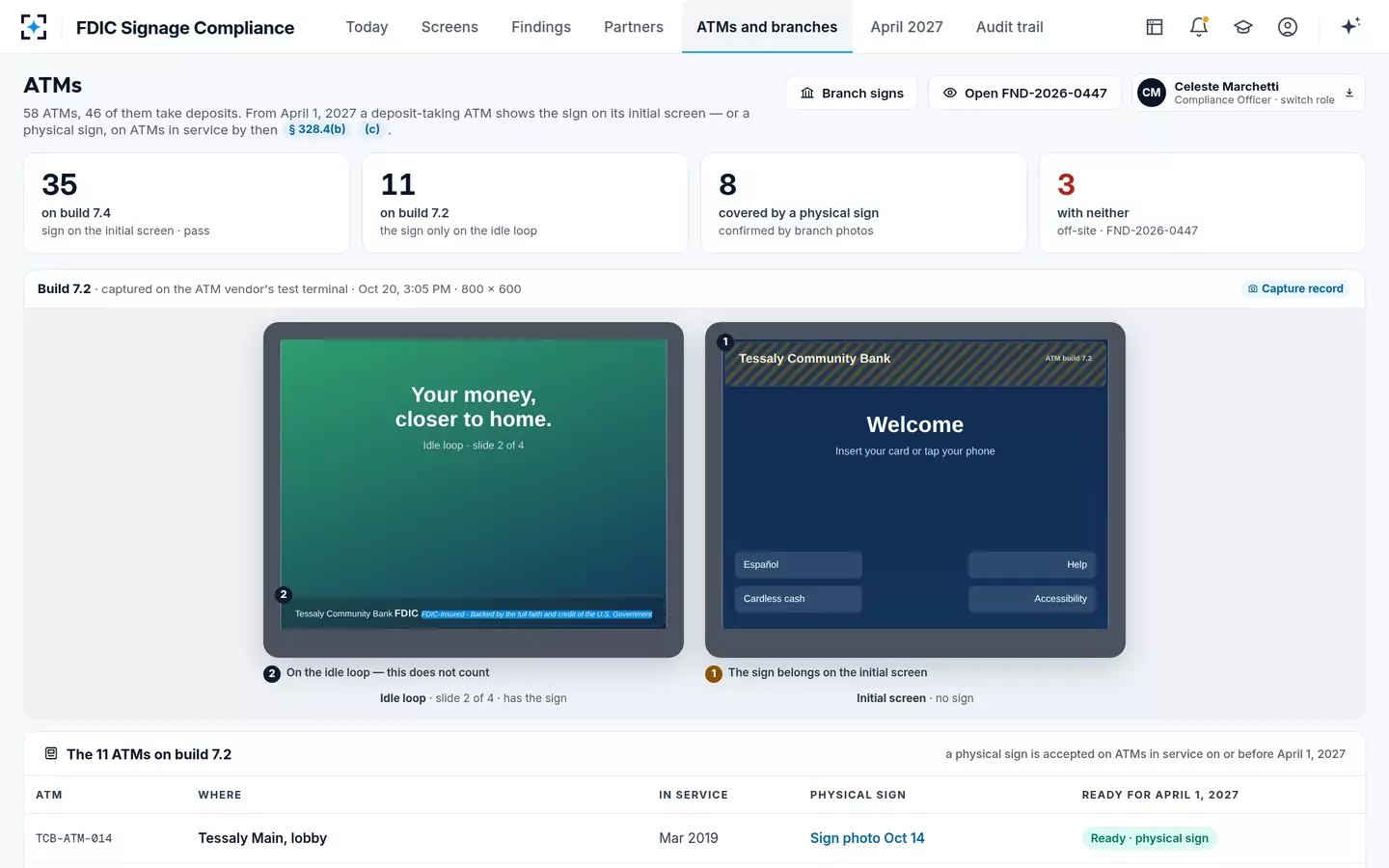
The fix has two routes with very different calendars. Three physical signs, free from the FDIC, close the gap with one round of field visits. Moving the eleven machines to build 7.4 closes it for good but depends on the vendor’s schedule. The solution records both options and their dates; the decision, and the request to the vendor, stay with the bank’s people.
Branch photos show which machines carry a physical sign
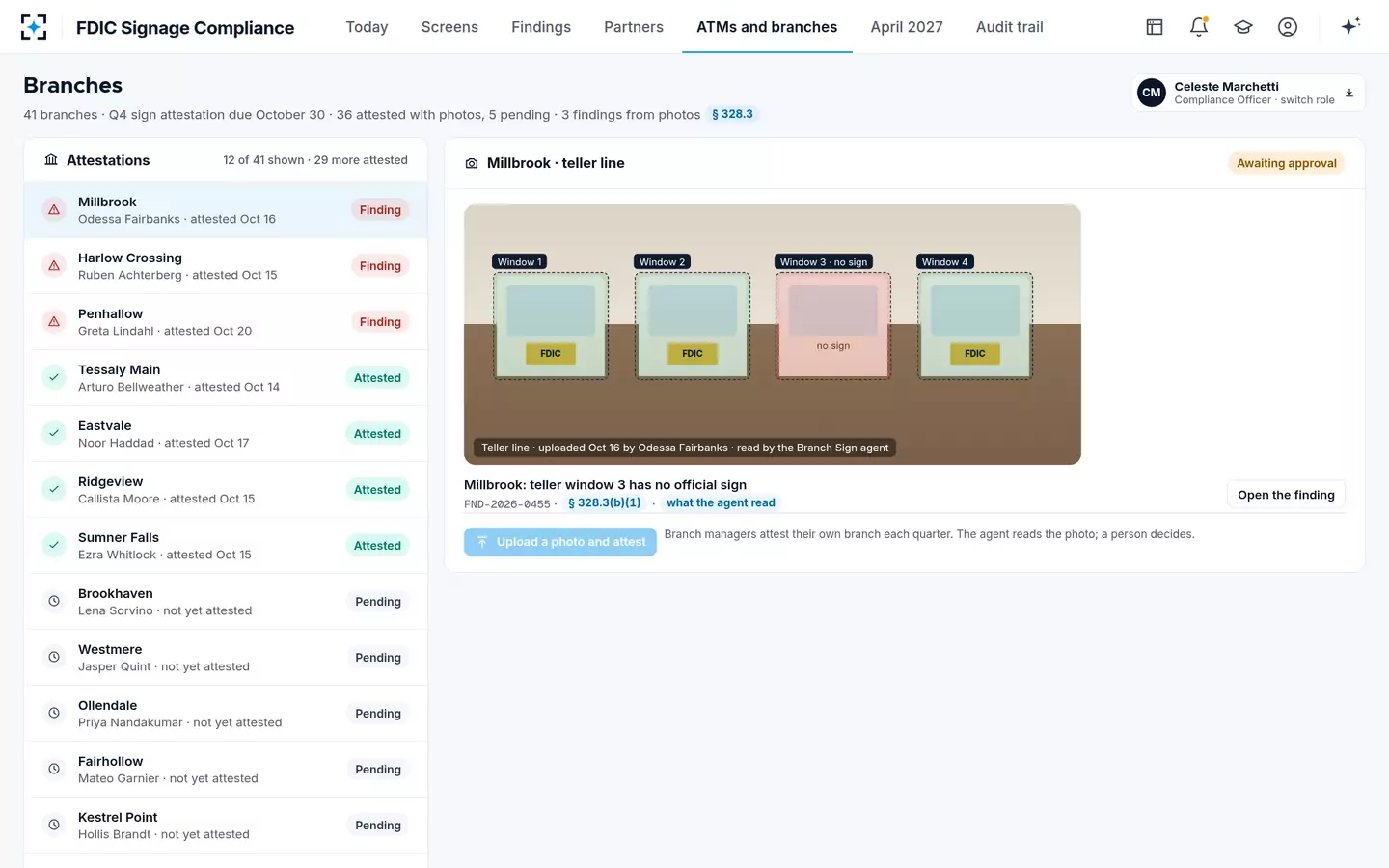
An ATM signage review in seven checks
- List deposit-taking ATMs only
Cash-only and transfer-only machines are outside § 328.4; night depositories are not ATMs.
- Group machines by screen build
One capture of each build’s welcome screen answers for every machine running it.
- Capture the welcome screen, not the loop
An idle-screen advertisement with the sign does not count.
- Record the in-service date of each machine
It decides whether the physical sign is an option after April 1, 2027.
- Photograph physical signs
Dated photos show the sign exists and is legible, not degraded or defaced.
- Walk a non-deposit transaction as a customer
Where the ATM sells non-deposit products, the first screen of that transaction needs non-deposit signage.
- Check the Reg CC notice in the same visit
Sign, screen or envelope, before the deposit; and received-days on rarely emptied off-site machines.
ATMs are one channel of several, and a deadline plan that treats the fleet as a software project usually overestimates it. How ATMs fit the rest of the April 1, 2027 work is set out in the FDIC digital signage deadline; the same three-page rule for websites and apps is in FDIC digital signage requirements.
Questions people ask
What signage is required on an ATM?
For a bank’s deposit-taking ATM, the FDIC official digital sign on the initial screen, or the physical official sign where § 328.4(c) allows it, plus non-deposit signage on the first screen of any non-deposit transaction. Regulation CC separately requires a notice that deposited funds may not be available immediately, given before the deposit is made.
Does every ATM need the FDIC digital sign?
No. ATMs placed into service on or before April 1, 2027 may use the physical sign instead, and so may later machines that do not let the bank’s customers transact with non-deposit products. ATMs that do not receive deposits are not covered at all.
Does a screen saver with the FDIC logo satisfy the ATM rule?
No. The rule says a screen saver or an advertisement on an idle ATM is not the initial screen. The sign must be on the welcome screen shown before the customer inserts a card or other credentials.
Do I have to remove the physical sign when I add the digital one?
No. The FDIC’s Q&A says banks are not required to take down physical official signs attached to ATMs, so both can be displayed at once.
Do non-customers have to see non-deposit signage at my ATM?
No. The 2026 rule limited non-deposit signage on ATMs to the bank’s own customers, because an ATM often cannot tell what a customer of another institution is accessing. A non-customer using another bank’s debit card is outside the requirement.