A not FDIC insured disclosure tells a consumer what deposit insurance does not cover. Under 12 CFR Part 328 subpart B, which applies to “any person”, it takes two forms. A company that is not a bank but talks about deposit insurance must say clearly that it is not an FDIC-insured institution and that FDIC insurance only covers the failure of the insured bank, and it must name that bank. And where uninsured products such as investments or crypto-assets sit beside deposits, the disclosure says they are not insured by the FDIC, are not deposits and may lose value. Leaving either out can be a misrepresentation even if no one was actually misled. The FDIC’s published demand letters from 2022 to 2024 show exactly what it objected to. Banks answer for the screens of the fintech partners that offer their deposits, which is why Botminds’ FDIC Signage Compliance checks every partner screen against these rules.
Eight published rounds of FDIC demand letters, 2022 to 2024
Voyager Digital (with the Federal Reserve)
Said Voyager itself was FDIC-insured, that customers’ funds held by Voyager were covered, and that the FDIC would insure against Voyager’s failure.
Five companies, among them FTX US and FDICCrypto.com
Said crypto products, or stocks in brokerage accounts, were FDIC-insured; one registered a domain name suggesting FDIC endorsement.
CEX.IO Corp. and Zera Financial, plus two websites
Claimed FDIC-insured status and protection of cryptocurrency; two sites were told to remove the same claims about CEX.IO.
Utoppia Inc.
Claims in English and Spanish that it was FDIC-insured and that insurance protected cryptocurrency; no insured bank named.
Bodega Importadora de Pallets, Money Avenue, OKCoin USA
Insured-status claims, FDIC name or logo misuse, no bank named; one on a Spanish website, so the letter went out in Spanish.
Unbanked, Inc.
FDIC-insured “crypto accounts” with no disclaimer, from a non-bank with relationships with two insured banks.
Atmos Financial, BybitcoinEx, OGPay, Horizon Globex, Zil Money
The four patterns, in combination: insured-status claims, name or logo misuse, wrong extent or manner of coverage, no bank named.
PrizePool; AmeriStar and HighLine Gold (one joint letter)
The same list of patterns; the FDIC said the evidence suggested harm, or potential harm, to consumers.
What is a not FDIC insured disclosure?
It is the material information subpart B says a statement about deposit insurance must not leave out. The rule lists examples of omissions that count as misrepresentation. A non-bank that implies its product is insured, but “fails to clearly and conspicuously identify the insured depository institution(s) with which the representing party has a direct or indirect business relationship for the placement of deposits”. A non-bank that “fails to clearly and conspicuously disclose that the person is not an FDIC-insured depository institution and that FDIC insurance only covers the failure of the FDIC-insured depository institution.” A website offering deposits and non-deposit products close together without “disclosing that Non-Deposit Products: are not insured by the FDIC; are not deposits; and may lose value”. And a pass-through claim that “fails to clearly and conspicuously disclose that certain conditions must be satisfied for pass-through deposit insurance coverage to apply.” (12 CFR 328.102(b)(5)).
The standard is the reasonable consumer, not proof of harm. A statement violates the rule if it carries material representations “which would have the tendency or capacity to mislead a reasonable consumer, regardless of whether any such consumer was actually misled”. Any mention of FDIC terms or images, or any implication about coverage, makes a statement a statement about deposit insurance. For banks, the same three-part wording appears as non-deposit signage on their own websites and branches, covered in FDIC digital signage requirements.
Misrepresentation of FDIC insurance, by the numbers
9letters
cease-and-desist letters the FDIC issued in 2023 alone
Supervisory Highlights, 2024
100s
submissions to the FDIC’s misrepresentation complaint portal in 2023
Supervisory Highlights, 2024
15days
minimum time an advisory letter gives to commit or respond, unless harm is ongoing
12 CFR 328.106(b)
1,500
non-banks the FDIC estimated subpart B’s 2024 clarifications would affect
89 FR 3504
What did the FDIC say in its cease and desist letters?
The letters say the same four things in different combinations. The two 2024 rounds spell them out: companies made false representations “by: (1) stating or suggesting that these entities are FDIC-insured or that certain uninsured financial products are insured by the FDIC; (2) misusing the FDIC name or logo; (3) misrepresenting the nature or extent of deposit insurance; and/or (4) failing to clearly identify the insured depository institutions with which they have a relationship for the placement of customer deposits and into which funds may be deposited.” (FDIC, March 19, 2024).
The early letters were about crypto. Voyager Digital had said, among other things, that “Voyager itself is FDIC–insured;”. The FDIC and the Federal Reserve added the sentence quoted below, which explains why the rule exists (FDIC and Federal Reserve, July 28, 2022). Later letters reached payments and financial-services firms, a Spanish-language website and companies with real bank relationships, such as Unbanked, which “has represented banking relationships with two FDIC-insured banks.”
It appears that these representations likely misled and were relied upon by customers who placed their funds with Voyager and do not have immediate access to their funds.
FDIC and Federal Reserve, joint letter to Voyager Digital, July 28, 2022
The four patterns, and the letters that named each
| Pattern | What it looked like | Rule it breaks |
|---|---|---|
| Claiming insured status | “Voyager itself is FDIC–insured”; crypto or stocks called FDIC-insured (2022); FDIC-insured “crypto accounts” (Unbanked, 2023) | § 328.102(a)(3)(iv), (b)(1) |
| Misusing the FDIC name or logo | A domain name suggesting FDIC endorsement (2022); name or logo misuse among the 2023 and 2024 findings | § 328.102(a)(1)–(2) |
| Wrong extent or manner of coverage | Insurance said to protect cryptocurrency or to cover the company’s own failure (2022–2023) | § 328.102(b)(1)(ii)–(iii), (b)(4) |
| No insured bank named | Utoppia (2023); the 2023 and 2024 multi-company rounds | § 328.102(b)(5)(i) |
When must a fintech say it is not FDIC insured?
Whenever it says anything about deposit insurance. A fintech that tells customers their money is insured must, in the same place, say clearly that it is not itself an FDIC-insured bank, that FDIC insurance only covers the failure of the insured bank, and which bank holds the money. The rule even offers wording that passes: “A statement that a person is not an FDIC-insured bank and deposit insurance covers the failure of an insured bank would be considered a clear statement for purposes of this provision.” (12 CFR 328.102(b)(5)(ii)).
The failure covered is the bank’s, not the fintech’s. The FDIC’s own consumer page puts it bluntly: “FDIC deposit insurance doesn’t cover default or bankruptcy of any non-FDIC-insured institution.” A banner reading “Your money is FDIC insured up to $250,000” on a fintech’s home screen says none of the three things, and the $250,000 is itself incomplete: coverage is “$250,000 per depositor, per FDIC-insured bank, for each account ownership category.” (FDIC, Understanding Deposit Insurance).
Not FDIC insured disclosure: five sample partner screens, before and after
Sample wording that fails subpart B: “Your money is FDIC insured up to $250,000.”
What subpart B asks for instead: The fintech is not an FDIC-insured bank; deposits are held at the named bank; FDIC insurance only covers that bank’s failure.
Sample wording that fails subpart B: “All your money, FDIC insured” above a crypto balance.
What subpart B asks for instead: Crypto-assets are not insured by the FDIC, are not deposits and may lose value; the insured balance and its bank named separately.
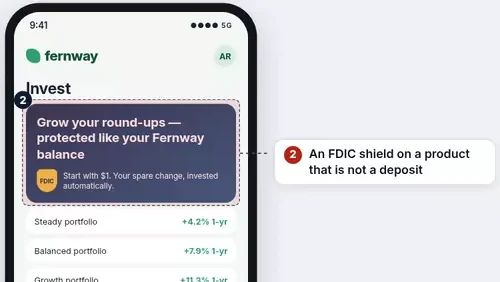
Sample wording that fails subpart B: An FDIC shield beside “protected like your Fernway balance” on a brokerage product.
What subpart B asks for instead: No FDIC term or image on the uninsured product, or a clear, conspicuous and prominent statement that it is not FDIC insured.
Sample wording that fails subpart B: Pass-through coverage claimed with no conditions.
What subpart B asks for instead: Say that certain conditions must be satisfied for pass-through coverage to apply.
Sample wording that fails subpart B: “Your kids’ money is FDIC protected.”
What subpart B asks for instead: Name the bank, say the company is not a bank, and say insurance covers only the bank’s failure.
Is crypto covered by FDIC insurance?
No. The FDIC said so in its 2023 letter to Unbanked: “In fact, FDIC insurance does not cover cryptocurrency or digital assets.” (FDIC, August 4, 2023). Part 328 lists crypto-assets among non-deposit products, alongside insurance, annuities, mutual funds and securities, and the FDIC’s consumer guidance adds that insurance “does not cover non-deposit investment products, even those offered by FDIC-insured banks.”
Mixed screens are where omissions happen. The FDIC wrote in 2024 that “some non-banks provide ‘mixed advertisements’ where deposit products and non-deposit products are offered on the same web page or as part of a single social media post.”, and it made the three-part disclosure a requirement in that setting: “it is a material omission if the non-bank’s website failed to state that the non-deposit products are not insured by the FDIC, are not deposits, and may lose value.” (89 FR 3504). One carve-out: for a wallet that holds fiat money and does not fluctuate, “failure to disclose that the Non-Deposit Product may lose value will not be a material omission”, though “not insured” and “not a deposit” still apply.
Stablecoins are heading the same way by statute. The FDIC’s April 2026 proposal implementing the GENIUS Act would bar a permitted payment stablecoin issuer from representing that its coins are backed by the U.S. Government “or subject to Federal deposit insurance or Federal share insurance.”, and notes that Part 328 separately prohibits knowing misrepresentations about deposit insurance (91 FR 18534, proposed).
Can a non-bank use the FDIC logo?
Not to imply that it, or an uninsured product, is insured. The rule names, among prohibited uses, “An Advertisement for any Uninsured Financial Product that features or includes one or more FDIC-Associated Terms or FDIC-Associated Images, without a clear, conspicuous, and prominent disclaimer that the products being offered are not FDIC insured or guaranteed.” FDIC-associated terms include “FDIC-insured,” “FDIC insurance,” “insured by FDIC,” “member FDIC;” and anything similar (12 CFR 328.101–102).
Two lines settle most partner designs. “Member FDIC” is acceptable from a non-bank only beside the bank’s name: the FDIC’s supervisors summarised the 2024 rule as saying such use “is a misrepresentation unless the advertising statement is next to the name of one or more IDIs.” And the official digital sign is off limits: “Display of the FDIC official digital sign by any non-bank third party would improperly imply that the non-bank is FDIC-insured and would constitute a misrepresentation under part 328 subpart B.” (89 FR 3504). When a bank must use the statement in its own ads is a separate question, answered in when the FDIC advertising statement is required.
A partner’s new screen puts an FDIC shield on a brokerage product
Who enforces FDIC misrepresentation rules, and what penalties apply?
The FDIC enforces subpart B against anyone, with the General Counsel holding the delegated authority. The usual first step is an advisory letter asking the recipient to stop, commit in writing and confirm the fix; recipients “will be provided not less than fifteen (15) days” to respond unless the FDIC believes consumers may be harmed meanwhile (12 CFR 328.106). Formal action follows a failure to respond, or a repeat: the General Counsel “has delegated authority to bring administrative enforcement actions against any person under sections 8(b), (c), (d), and (i) of the FDI Act”, which include cease-and-desist orders and civil money penalties (12 CFR 328.107).
Two other doors are open. Where conduct may be criminal, the FDIC may refer it through its Office of Inspector General (12 CFR 328.105(a)(3)). And an advisory letter changes the legal footing: a representation is deemed knowingly made if the person “Has been advised by the FDIC in an advisory letter”, or by another regulator, and then continues. For a regulated bank whose primary regulator is the OCC or the Federal Reserve, the FDIC first recommends action to that agency and may act itself “If the appropriate Federal banking agency does not take the recommended action within 30 days”.
What banks answer for when the screen is a partner’s
Banks answer twice: through their own policies, and through examiners’ view of their oversight. Part 328 requires written policies that cover, as appropriate, how the bank watches and evaluates the firms that provide deposit services to it or offer its deposit products to others (the clause is quoted inthe sample FDIC signage policy). The FDIC gave the fintech case as its example: a deposit account offered under a non-bank’s branding warrants policy provisions to monitor that partner’s compliance (89 FR 3504).
Examiners have already cited banks. In its 2024 highlights the FDIC reported Part 328 violations tied to third parties and noted that “some banks relied significantly on the third-party providers to implement controls for compliance” and that “some financial institutions did not effectively enforce or implement important controls established through these” agreements (FDIC, March 2024). The partner is not shielded by the bank either: the FDIC expects to act against a non-bank that misrepresents deposit insurance, formally or informally, whether or not it has a bank partner. How the sponsor-bank model distributes these duties is explained in what a sponsor bank is; how to write them into a policy is in a sample FDIC signage policy.
Checking a partner screen for a not FDIC insured disclosure
- Does the screen say anything about insurance?
Any FDIC term or image, or any implication about coverage, makes it a statement about deposit insurance.
- Is the insured bank named, clearly?
§ 328.102(b)(5)(i): the bank where the deposits are placed, near the claim.
- Does it say the company is not a bank?
And that insurance covers only the failure of the insured bank (§ 328.102(b)(5)(ii)).
- Are uninsured products beside deposits?
Then: not insured by the FDIC, not deposits, may lose value. Fiat wallets may omit “may lose value”.
- Any FDIC shield, logo or digital sign?
Not on uninsured products; the official digital sign never on a non-bank’s own screen.
- Any pass-through claim?
It must say that conditions apply (§ 328.102(b)(5)(iv)).
- Is the amount right?
$250,000 per depositor, per insured bank, per ownership category; not a flat promise.
- Was it captured as a customer sees it?
Logged in, at the device’s size, on the current app version: the screen the FDIC would see.
How FDIC Signage Compliance checks partner screens
Partners send the screenshots they choose, at the size and on the version they choose, which is why checking them from emailed images rarely holds up. Botminds’ FDIC Signage Compliance has an agent log in to each partner’s app and web sign-up flow with a test account, capture every screen at the device’s own size, and check each claim about insurance against subpart B and the bank’s program agreement, labelling which one creates each obligation. A reviewer checks each finding, the Compliance Officer approves it, the program manager sends the correction, and the finding closes only when a recapture of the fixed version passes.
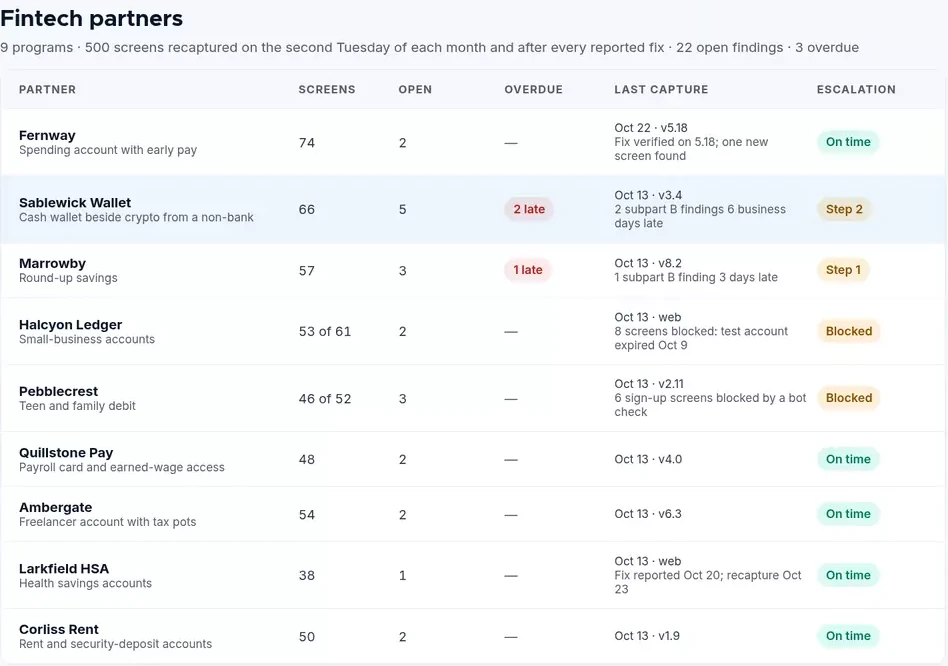
Take a fictional community bank, Tessaly Community Bank, with nine fintech partners and 500 partner screens recaptured each month. One partner’s wallet showed “All your money, FDIC insured” above a crypto balance; its fix is late and has reached the second step of the bank’s escalation ladder. The agents never write to a partner; people decide who hears what, and when.
Nine partners, their open findings and how late each fix is
Questions people ask
Are fintechs FDIC insured?
No. A fintech company is not an insured bank, and FDIC insurance does not cover its failure. Money a fintech places at an insured bank can be insured as a deposit of that bank, on a pass-through basis if the conditions are met, which is why subpart B requires the fintech to name the bank and say it is not one.
What does not FDIC insured mean?
It means the product is not a deposit at an insured bank, so the FDIC will not pay if it loses value or the company behind it fails. Investments, insurance, annuities and crypto-assets are not FDIC insured even when an insured bank sells them.
What is misrepresentation of FDIC insurance?
Any statement about deposit insurance that would have the tendency or capacity to mislead a reasonable consumer, whether or not anyone was misled, or that leaves out material information such as the bank’s name. Using FDIC terms or images to imply that a non-bank or an uninsured product is insured is the most common form.
Does the not FDIC insured rule apply to banks too?
Yes. Subpart B applies to any person, banks included. A bank may not put the advertising statement or any symbol suggesting insurance on an ad that relates solely to non-deposit products, and its own websites and branches carry non-deposit signage under subpart A.
Do FDIC demand letters carry fines?
The published letters demanded that companies stop and correct their statements; they did not themselves impose penalties. A recipient that ignores one risks formal action under section 8 of the FDI Act, including civil money penalties, and its later statements are deemed knowingly made.