“FDIC funds availability signage” runs two rules together. Funds availability signage is required by Regulation CC, the Federal Reserve’s rule on check holds, not by the FDIC: a bank must post, where its employees take deposits to consumer accounts, a notice of how long deposited funds may be held, and give a notice at each ATM. The FDIC’s signage rule, 12 CFR Part 328, requires something else in the same lobby: the black-and-gold FDIC official sign at each teller window where deposits are taken, and separate non-deposit signage wherever investments or insurance are sold. Three notices, two regulators, three sets of placement rules, often checked once a year by a branch manager’s tick. Botminds’ FDIC Signage Compliance checks the FDIC signs from dated branch photos and every digital screen the bank runs, so the lobby is reviewed with the same evidence as the website.
Three notices a branch lobby needs, and the rule behind each
| FDIC official sign | Non-deposit signage | Funds availability notice | |
|---|---|---|---|
| Rule | 12 CFR 328.3(b), FDIC | 12 CFR 328.3(c), FDIC | 12 CFR 229.18(b), Regulation CC |
| What it says | The bank is FDIC-insured (the official sign’s fixed design) | Non-deposit products are not insured by the FDIC, are not deposits and may lose value | The time periods for availability of funds deposited to consumer accounts |
| Where | Each teller window or station where insured deposits are usually and normally received | Each location in the premises where non-deposit products are offered | A conspicuous place in each location where employees receive consumer deposits |
| Every window? | Yes, at 7″ × 3″ or larger, unless the branch sells no non-deposit products | No: wherever non-deposit products are offered | No: where depositors are likely to see it before depositing |
| Drive-through | Depends on the set-up; each bank assesses it | Only if non-deposit products are offered there | Not required |
| Night depository | Not required | Not applicable | Not required |
| Spacing rule | Not near non-deposit signage | May not be displayed in close proximity to the official sign | None |
Is funds availability signage required? Yes, by Regulation CC
Yes. Regulation CC requires a notice of the availability periods for consumer deposits, posted where customers will see it in every place the bank’s employees take deposits to consumer accounts (12 CFR 229.18(b)). The rule applies to consumer accounts only, and like the bank’s other availability disclosures it must be clear and conspicuous; posted notices are the exception to the usual requirement that disclosures be in a form the customer can keep (12 CFR 229.15(a)).
The search phrase “FDIC funds availability” is understandable: FDIC examiners test Regulation CC at the banks they supervise, under the Expedited Funds Availability Act chapter of their manual. But the notice’s content and placement come from Regulation CC, and nothing in Part 328 mentions holds. A sign that combines both is allowed only if each part still meets its own rule, and the FDIC sign has a fixed design.
Where must the funds availability notice be posted?
Where depositors will see it before they deposit, not at every window, as the Federal Reserve’s official commentary explains in the passage below. Its example is practical: “For example, the notice might be posted at the point where the line forms for teller service in the lobby.” (Reg CC commentary, § 229.18(b)).
It also lists where the notice is not needed: “The notice is not required at any drive-through teller windows nor is it required at night depository locations, or at locations where consumer deposits are not accepted.” And it must “specifically state the availability periods for the various deposits that may be made to consumer accounts”, so a generic placard saying only that funds may be held does not satisfy it. That generic line belongs elsewhere: on preprinted deposit slips, which must carry “a notice that deposits may not be available for immediate withdrawal.”
The notice need not be posted at each teller window, but the notice must be posted in a place where consumers seeking to make deposits are likely to see it before making their deposits.
Federal Reserve, official commentary to Regulation CC, § 229.18(b)
Is the FDIC sign required at every teller window?
Usually, yes. Where deposits are usually and normally received at teller windows, the bank must display the official sign “At each teller window or station where insured deposits are usually and normally received, in a size of 7″ by 3″ or larger with black lettering on a gold background as described in § 328.2(a); or”, and that “or” matters: a branch that sells no non-deposit products may instead post it “at one or more locations visible from the teller windows or stations”, large enough to be legible from anywhere in the area (12 CFR 328.3(b)(1)).
The FDIC’s Q&A settles the edge cases. A new accounts desk needs the sign if the banker there usually takes and processes deposits; if every deposit is walked to the teller line, the teller-window sign is enough. Night drops do not: “FDIC staff does not view that deposits are usually and normally received by the IDI when placed in a night depository.” Drive-throughs depend on the layout: “Because drive-through lanes at IDIs can vary greatly, each IDI should assess their situation and apply the requirements under part 328 as appropriate.” (Q&A I.A.1, I.A.3, I.A.5).
FDIC funds availability signage: the numbers that matter in a lobby
7×3in
minimum size of the FDIC official sign at a teller window
12 CFR 328.3(b)(1)(i)
$0
cost of the official sign ordered from the FDIC
12 CFR 328.2(c)
30days
notice before a change to the availability policy for consumer accounts
12 CFR 229.18(e)
2030
the next Reg CC dollar-amount adjustment, every fifth July after 2025
12 CFR 229.11(a)
What size is the FDIC official sign, and can it vary?
The official sign is 7 by 3 inches, black lettering on gold, and the FDIC provides it free: “An insured depository institution may procure the official sign from the Corporation for official use at no charge.” (12 CFR 328.2(c)). Banks may buy their own versions in other sizes, colors or materials, but where the sign is required a varied sign “must not be smaller in size than the official sign, must have the same color for the text and graphics, and includes the same content.” The rule also allows “electronic media to display the official sign and non-deposit sign”, so a lobby screen can carry them, provided it does so continuously.
Timing is fixed for new banks: the sign must be up “no later than its twenty-first calendar day of operation as an insured depository institution”, unless the bank asked the FDIC for one promptly and is still waiting. For everyone else, the premises rules rewritten in 2023 have applied since May 1, 2025; the FDIC’s later delays reached only the digital and ATM sections (90 FR 11659).
What is the non-deposit sign, and how far from the FDIC sign must it be?
The non-deposit sign tells customers that investments, insurance and other non-deposit products are not FDIC-insured, are not deposits and can lose value, and it goes wherever those products are offered on the premises, including private offices: “If non-deposit products are offered in individual offices, the non-deposit sign should be visible in those offices.” (Q&A I.B.1). The two FDIC signs must stay apart: the non-deposit sign “may not be displayed in close proximity to the official sign.” (12 CFR 328.3(c)(2)).
Small branches get one concession. Where a banker sells both deposits and non-deposit products at the same desk, the banker “may switch between displaying the FDIC official sign and non-deposit sign when discussing the relevant product to help minimize customer confusion”, but the FDIC adds that “at no time should a non-deposit sign be displayed in close proximity to the FDIC official sign.” Separately, an insured bank may not take deposits at a teller window where a noninsured institution takes deposits (12 CFR 328.7).
Are FDIC and Reg CC signs the same thing? Six differences
FDIC official sign in the lobby: Tells depositors the bank is FDIC-insured.
Reg CC funds availability notice in the lobby: Tells depositors when deposited funds will be available.
FDIC official sign in the lobby: A fixed design from the FDIC; varied signs keep the same content and colors.
Reg CC funds availability notice in the lobby: The bank’s own availability periods for each kind of deposit to consumer accounts.
FDIC official sign in the lobby: Each teller window where deposits are usually received (or visible from them, if no non-deposit products).
Reg CC funds availability notice in the lobby: One conspicuous place per location, where people will see it before depositing.
FDIC official sign in the lobby: 7″ × 3″ or larger at teller windows.
Reg CC funds availability notice in the lobby: No size; it must be conspicuous.
FDIC official sign in the lobby: Only if the FDIC requires a change, on at least 30 days’ written notice.
Reg CC funds availability notice in the lobby: When the bank’s policy changes, or Reg CC amounts are adjusted every fifth July.
FDIC official sign in the lobby: Part 328 chapter of the FDIC examination manual.
Reg CC funds availability notice in the lobby: Expedited Funds Availability Act chapter.
Does an ATM need a funds availability notice?
Yes. “A depositary bank shall post or provide a notice at each ATM location that funds deposited in the ATM may not be available for immediate withdrawal.” (12 CFR 229.18(c)(1)). The commentary allows three forms: “The notice may be posted on a sign, shown on the screen, or included on deposit envelopes provided at the ATM.” It must come before the deposit; a receipt afterwards does not count. An off-premises ATM emptied no more than twice a week must also say “the days on which deposits made at the ATM will be considered received.”
The same machine carries the FDIC sign under a different rule, on its welcome screen or as a physical sign, from April 1, 2027. How the two fit on one ATM, and why an idle-screen advertisement does not count for the FDIC sign, is covered in FDIC signage requirements for ATMs.
Lobby and drive-up ATMs: the FDIC sign belongs on the welcome screen
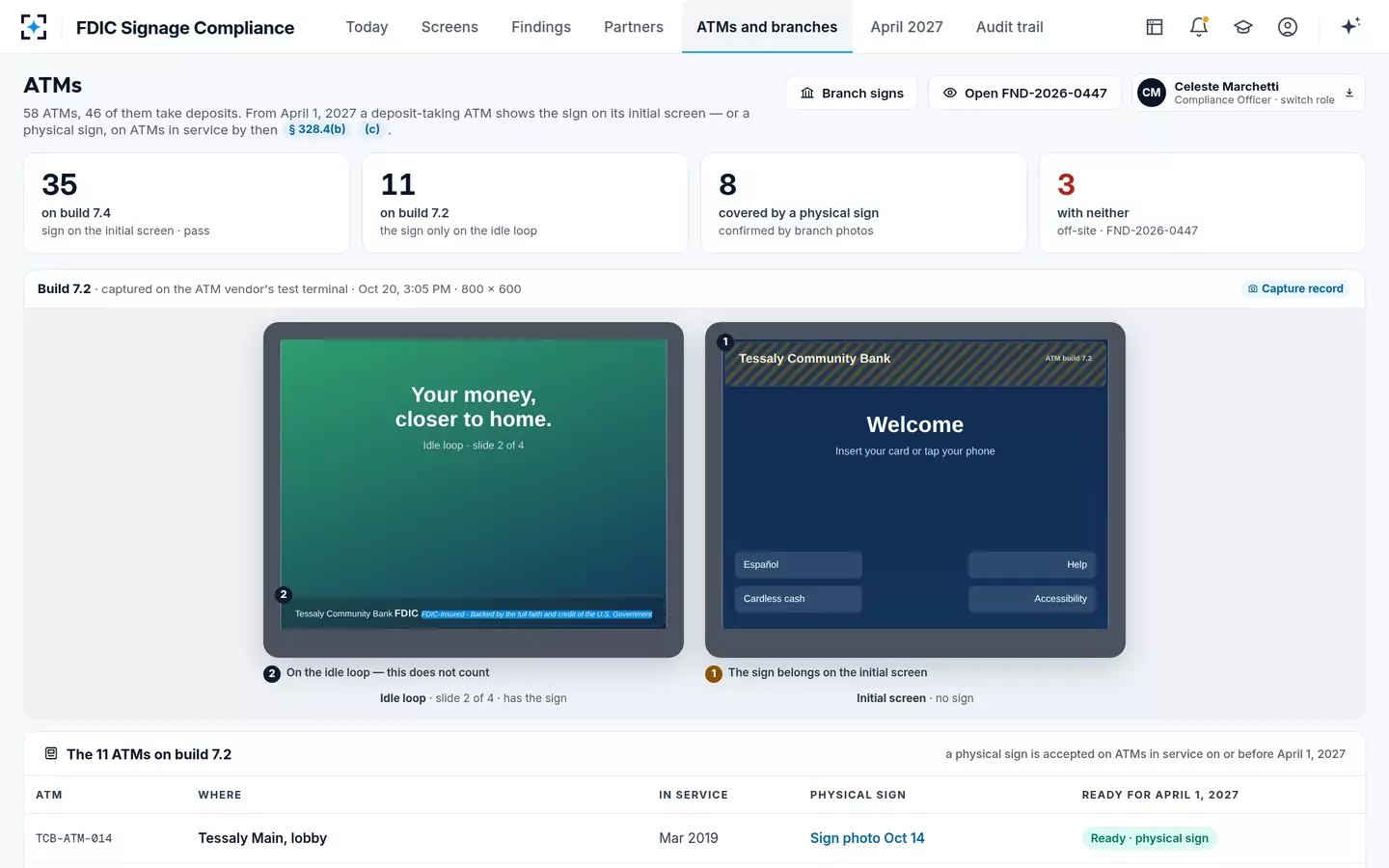
When the availability notice has to change
A lobby notice that states dollar amounts goes stale on a schedule. Regulation CC’s amounts are adjusted for inflation every five years, most recently on July 1, 2025, and next on July 1, 2030 (12 CFR 229.11(a)). The last adjustment raised the next-day amount from $225 to $275 and the large-deposit threshold from $5,525 to $6,725. What else changed that July is covered in Reg CC changes from July 2025.
A bank changing its own policy must tell consumer account holders at least 30 days before the change takes effect, though a change that makes funds available sooner may be disclosed up to 30 days after (12 CFR 229.18(e)). The posted notice should change on the same day as the policy, which is the step branch networks most often miss.
Who checks branch signage, and how often?
Often a branch manager, once a year, with a checkbox. Nobody outside the branch sees the teller line, and such an attestation records that a sign existed, not that it was at window 3 or that it was the right size. Neither rule sets a review frequency; § 328.8 asks for written policies scaled to the bank’s deposit-taking risk. Remodels, temporary teller stations, new non-deposit sales desks and seasonal staffing are the moments a lobby changes.
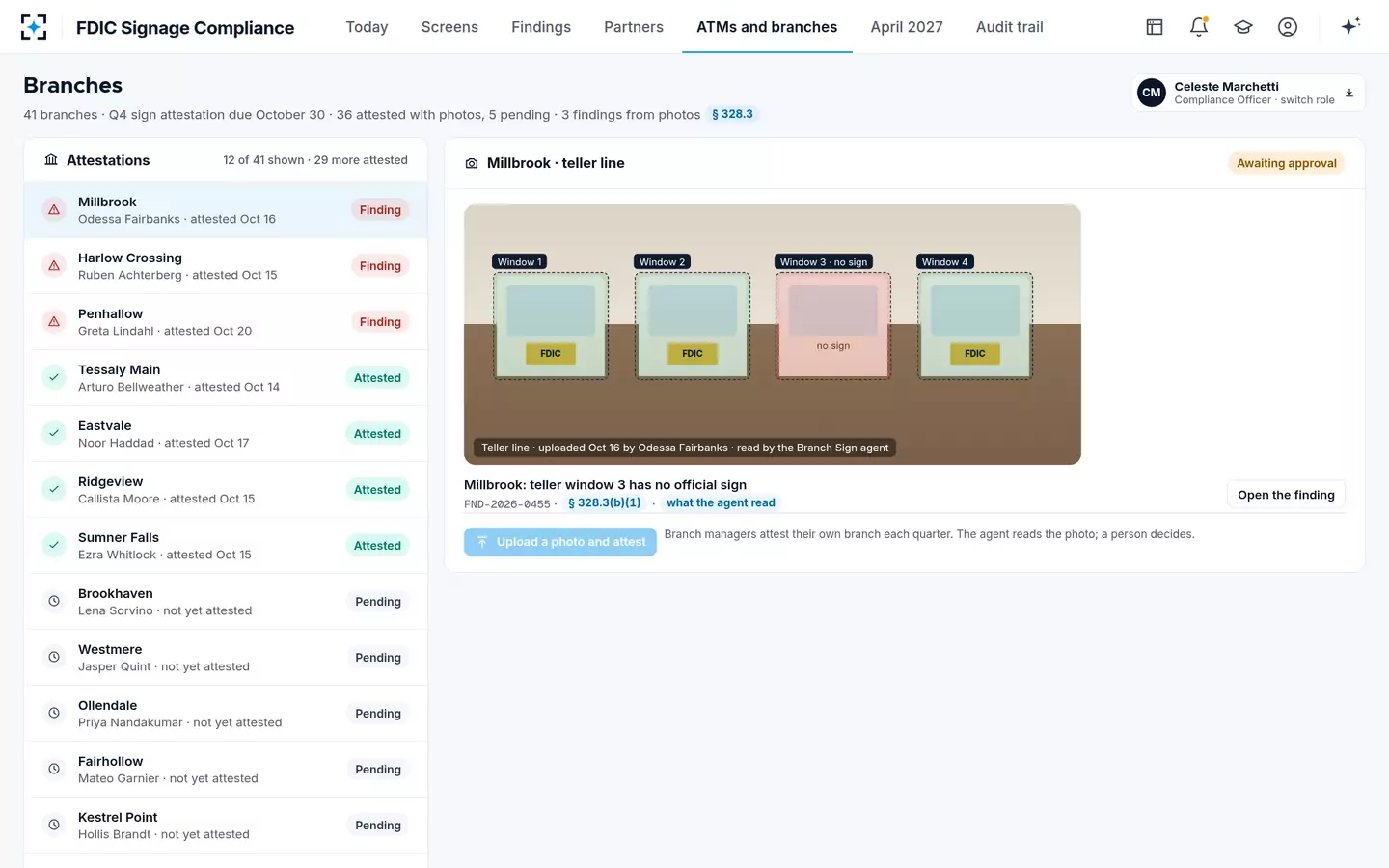
Take a fictional community bank, Tessaly Community Bank, with 41 branches, as it runs through Botminds’ FDIC Signage Compliance. Each branch manager uploads a photo of the teller line every quarter; an agent marks every window, a reviewer checks what it found, and a missing sign becomes a finding the Compliance Officer approves. This quarter, 36 branches have attested with photos, five are pending, and three photos produced findings.
Quarterly lobby attestations at a sample bank of 41 branches
41 branches, fourth quarter
- Photo attested, no finding (33) · 80.5%
- Photo attested, finding (3) · 7.3%
- Not yet attested (5) · 12.2%
A teller-line photo, every window marked
A lobby walk for the three notices
- Where are deposits usually received?
Teller windows, new accounts desks, drive-ups: each one decides where the FDIC sign goes.
- An FDIC sign at each of those windows
7″ × 3″ or larger, black on gold, or a varied sign no smaller, same colors and content.
- Any non-deposit sales on the premises?
Then non-deposit signage there, segregated areas, and no non-deposit sign near the FDIC sign.
- One availability notice where the line forms
Specific availability periods for consumer deposits, visible before depositing.
- Current Reg CC amounts on the notice
Updated for July 1, 2025; the next change is July 1, 2030.
- ATMs in the lobby or drive-up
Reg CC notice before the deposit; FDIC sign on the welcome screen or a physical sign.
- Preprinted deposit slips
Funds may not be available for immediate withdrawal.
- A dated photo, not a tick
One per lobby per review, kept with who took it and who checked it.
Lobby signs are one row in a bank’s Part 328 policy, which also has to cover websites, apps, ATMs and partners. How those rows fit together, and who waits on whom, is the subject of a sample FDIC signage policy.
Questions people ask
Is there an FDIC funds availability sign?
No. The FDIC publishes an official sign about deposit insurance, not about holds. The funds availability notice is a Regulation CC requirement, written by each bank to state its own availability periods, and FDIC examiners test it at the banks they supervise.
Does a drive-through need a funds availability notice?
No. The Reg CC commentary says the notice is not required at drive-through teller windows or night depositories. The FDIC official sign at a drive-through depends on how deposits are received there, and the FDIC asks each bank to assess its own layout.
Can the FDIC sign and the non-deposit sign hang side by side?
No. Part 328 says the non-deposit sign may not be displayed in close proximity to the official sign. In a small office where one banker sells both, the banker may switch between the two signs depending on the product being discussed, never showing both together.
Can a bank use a digital screen for its lobby signs?
Yes for the FDIC signs: Part 328 lets banks use electronic media to display the official sign and the non-deposit sign, as long as the display stays clear, continuous and conspicuous. Reg CC’s lobby notice must be conspicuous where people deposit, so a rotating slide that is often off screen is a weak choice.
Who is responsible for branch signage?
The bank, under the written policies § 328.8 requires; in practice branch managers maintain the signs, a compliance reviewer checks them and the Compliance Officer answers for them. A dated photo of each lobby is the simplest evidence that the check happened.