A bank deposit compliance training outline should be written for whoever answers first, the contact-center representative, the teller, the new-accounts desk and the chat team, and organized around the questions those people hear rather than the order of the regulations. Three rules carry most of it: Regulation E for electronic transfers and error claims, Regulation CC for funds availability and holds, and Truth in Savings, which is Regulation DD at a bank and NCUA Part 707 at a credit union. The training is hard because the first sentence a member says can fix a legal date before anyone in Compliance hears about it. Botminds' Deposit Compliance Search exists for that moment: staff type the member's words and get an answer that cites the rule, the official interpretation, regulator guidance and the institution's own procedure, while the member is still on the line.
The outline below is built from what the regulations say about front-line moments, what FDIC examiners cited in 2025, and the questions a fictional sample credit union's staff asked in one month as it runs through the solution. The research figures are linked where they appear.
For example, in 2019-BCFP-0001, the Bureau found that the practice of requiring a consumer to contact the merchant before initiating an error resolution investigation was a violation of Regulation E.
CFPB, Electronic Fund Transfers FAQs, Error Resolution
What should a bank deposit compliance training outline cover?
It should cover the decisions a front-line employee makes without knowing they are decisions: recognizing that a member has given notice of an error, promising when deposited money will be available, quoting a rate, and telling a member about a fee change. Each of those has a rule behind it, and each can go wrong in a sentence. A module per regulation is the usual shape; a module per moment works better, because members do not arrive labeled "Reg E".
The useful unit inside each module is a question with its deciding fact. "Is this unauthorized?" turns on who started the transfer. "When can she use the money?" turns on the type of check and whether the account is new. "Do we have to tell members first?" turns on whether the change is adverse. A representative who knows which fact to ask for can answer most questions or route the rest; one who memorized a chart cannot tell when the chart stops applying.
A bank deposit compliance training outline in six modules, each built on a moment
- Module 1 · When a member reports a problem (Regulation E)
What counts as notice of an error, why a call to the wrong number still counts, what may be asked for and what may not be required first, and which questions are not errors at all.
- Module 2 · When a member deposits a check (Regulation CC)
Next-day items and the $275, the second business day, the large-deposit and new-account exceptions, the cutoff hour, and the notice that must be handed over at the counter.
- Module 3 · When a member asks about a rate or a fee (Truth in Savings)
Quoting the annual percentage yield, giving account disclosures before opening, and the 30 days of notice before an adverse change.
- Module 4 · Questions that sound like compliance but belong elsewhere
Savings transfer limits, deposit insurance coverage, questions about reports filed on a member, goodwill credits: what to say and whom to route to.
- Module 5 · When the procedure changes
How staff learn that an answer they gave last month is no longer right, and what they do about the members who got it.
- Module 6 · Practice on real questions
Last month's questions, de-identified, with the deciding fact and the source for each, refreshed every quarter.
Who needs deposit compliance training? Whoever answers first
Everyone who can receive a member's words about an account needs it, and the obvious list is too short. Regulation E's notice rule does not depend on reaching the right employee, and Regulation CC puts a notice duty on the person at the counter, so the people who need training are defined by where members talk, not by job title. Chat agents, branch greeters and outsourced call centers are on the list for the same reason as tellers.
Four front-line seats, and the deposit rule each one can trigger without knowing it
Today
Hears scam calls, card losses and fee complaints; searches procedure PDFs, then puts the member on hold or promises a call back.
With agents
Types the member's words and reads back a cited answer and a script; opens the Reg E claim on the call when that is the answer.
Still theirs: recognizing that the member is reporting a problem, and the conversation itself
Today
Takes a large check, tells the member "a few days", and leaves the hold notice for the back office to mail.
With agents
Checks the availability answer for that deposit before the member leaves, with the section that sets each date.
Still theirs: handing over the hold notice at the window, and judging whether something about the check looks wrong
Today
Quotes "the rate" on a share certificate and gives the disclosure booklet after the account is open.
With agents
Asks how to state a rate or when disclosures are due, and gets the rule with the institution's own procedure beside it.
Still theirs: the disclosures before opening, and the member's choice
Today
Answers the balance question and misses the sentence that disputes a payment.
With agents
Pastes the message in; the answer says when a sentence is a notice of error and what clock it starts.
Still theirs: the reply to the member, and judgment on an ambiguous message
Where examiners find the gaps, by regulation
The gaps sit in front-line events. In its spring 2026 Supervisory Highlights the FDIC reported that the Electronic Fund Transfer Act moved from the fourth to the second most frequently cited law in its 2025 consumer compliance examinations, and that error resolution, 12 CFR 1005.11(c) and (d), made up 74 percent of those violations (FDIC, Consumer Compliance Supervisory Highlights, March 2026). Error resolution starts with a conversation. If the conversation is not recognized as notice, every later clock is counted from the wrong day.
The FDIC's 2025 deposit findings start at the front line
136
Regulation E violations cited by the FDIC in 2025, the second most of any consumer law
74%
of those were error resolution: investigating on time, and the steps when no error is found
74
Truth in Savings violations, split evenly between disclosure form and account-opening disclosures
104,200
checking or savings complaints the CFPB received in 2025
Truth in Savings tells the same story from the other side of the desk. The two most cited sections were the general disclosure rule, 12 CFR 1030.3, and the account-opening disclosures in 1030.4(a) and (b): the documents a new-accounts representative hands over. The CFPB's complaint report adds what members say happened on the phone: consumers reported representatives who were unhelpful or gave wrong or contradictory answers (CFPB, Consumer Response Annual Report 2025). Training that targets those moments targets the findings.
Module 1, Reg E: when a member's words are already a notice
The first lesson is that notice under Regulation E does not wait for a form, a specific phone line or the right department. Section 1005.6(b)(5)(ii) says a consumer "may notify the institution in person, by telephone, or in writing", and the official interpretation goes further: notice counts "even if the consumer notifies the institution but uses an address or telephone number other than the one specified by the institution" (comment 6(b)(5)-1). An institution may designate a number for error notices, but only if it keeps reasonable procedures to refer members who call elsewhere (comment 11(b)(1)-6).
The second lesson is what may be asked for and what may not be required first. An institution may ask for written confirmation within 10 business days of an oral notice, and if it does, the employee taking the call has to tell the member so and give the address (12 CFR 1005.11(b)(2)). It may not hold the investigation for that confirmation, and the CFPB's Electronic Fund Transfers FAQs answer "No" to the question "Can a financial institution require a consumer to file a police report or other documentation as a condition of initiating an error resolution investigation?" (CFPB EFT FAQs, Error Resolution Q4). The Reg E training plan by role walks the error-notice conversation step by step.
The third lesson is the scam call. The CFPB's 2025 complaint report found that many complaints about deposits and withdrawals concern money taken by fraud or moved by a member who was tricked (the cost of waiting on a compliance answer quotes it). A member tricked into reading back a code has not authorized the transfer: the CFPB's FAQs say that a consumer deceived into giving up account information has not furnished an access device (Unauthorized EFTs Q6; what Reg E says about friendly fraud quotes the answer). A member who sent the money herself, to a caller posing as the electric company, is in a different place: the transfer is authorized, and what the institution offers is a matter for its own procedure and Compliance. The account itself can decide coverage too, which is why a representative should know when to ask whose account it is.
Module 2, Reg CC: what the teller promises at the counter
A teller who says "the money will be there Monday" has made a funds availability promise, and Regulation CC says what it must be. For most check deposits to an established account, the first $275 is available the next business day (12 CFR 229.10(c)(1)(vii)) and the rest by the second business day (229.12(b)), with up to $550 of it in cash by 5:00 p.m. if the institution delays cash withdrawals by a day (229.12(d)). A deposit after a cutoff hour of 2:00 p.m. or later at a branch, or noon or later at an ATM, may be treated as made the next banking day (229.19(a)(5)).
Exceptions are where the front line matters most. When a hold rests on an exception such as a large deposit over $6,725, the notice must be given at the time of the deposit if it is made in person, unless the facts behind the hold only become known later (229.13(g)(1)(ii)). A teller who lets the member leave without it has turned a lawful hold into a late notice. Each branch where employees take consumer deposits must also post the availability periods in a conspicuous place (229.18(b)), and anyone who asks, orally or in writing, is entitled to the availability policy (229.18(d)).
Regulation CC is also the only one of the three deposit rules whose text mentions employee training: section 229.19(f) requires procedures and a statement of them for each employee whose duties the rule touches. Reg CC training for tellers, one deposit day at a time covers the window in detail, and the Reg CC cheat sheet for 2026 puts every amount and day on one page with its source.
Module 3, Truth in Savings: one rate, said one way
The most common Truth in Savings mistake a front-line employee can make is saying the wrong rate. When a member asks what an account pays, the rule is short: the institution "shall state the annual percentage yield. The interest rate may be stated in addition to the annual percentage yield. No other rate may be stated" (12 CFR 1030.3(e)). Part 707 says the same for credit unions in terms of the dividend rate, and its official interpretation applies the rule to "credit union employees and volunteers acting in the ordinary course of credit union business" (comment 707.3(e)-1).
The second rule is timing. Account disclosures go to the consumer before the account is opened or a service is provided, whichever is earlier, and within 10 business days only when the consumer is not present and has not received them (12 CFR 1030.4(a)(1)(i)). An adverse change to a disclosed term needs at least 30 calendar days' written notice. The FDIC's 2025 findings put account-opening disclosures among the two most cited Truth in Savings sections, which makes the new-accounts desk the place to start. Part 707 in plain words sets out the credit union version.
Module 4, the questions that sound like compliance and belong elsewhere
Some questions a representative should recognize in order to route them, not answer them. The six-transfer limit on savings accounts is one: the Federal Reserve deleted it from Regulation D in April 2020, but its interim final rule let institutions stop enforcing the limit without making them do so (85 FR 23445; the Board's own words are in deposit compliance regulations in 12 numbers), so whether a limit still applies depends on the account agreement, not the regulation. A representative who answers from memory will be wrong in one direction or the other.
Others are routing questions by nature: how much of a member's money is insured, which belongs with whoever handles deposit insurance; whether the institution filed a report about a member's cash deposits, which no front-line employee should confirm or deny; and whether a member who was scammed into sending money will get a goodwill credit, which is a decision for Compliance or Deposit Operations. Teaching these as "who answers this" rather than "what is the answer" is part of the outline, not a gap in it.
How often is deposit compliance training required?
No federal rule sets a frequency for deposit compliance training. Regulation E and Truth in Savings say nothing about training, and Regulation CC requires procedures and a statement of them for each affected employee without a schedule. The FDIC's compliance management guidance sets the standard instead: "An effective compliance training program is frequently updated with current, complete, and accurate information on products and services and business operations of the institution, consumer protection laws and regulations, internal policies and procedures, and emerging issues in the public domain" (FDIC Consumer Compliance Examination Manual, II-3).
That makes change, not the calendar, the real trigger. Regulation CC's dollar amounts moved on July 1, 2025 and move again on July 1, 2030. An institution's own procedures move more often. On the sample credit union, a procedure that had asked members for a signed affidavit before a scam claim was opened was corrected in September; the change reached the 17 staff who had given 22 answers under the old text, and all of them acknowledged it within two days. What to do about the answers given before a change is its own discipline.
Build the outline from last month's questions
The best source for a training outline is the log of what staff actually asked. Take the sample credit union, Norrell Federal Credit Union, with 38 branches and a contact center, as it runs through the solution: in the first 22 days of October its staff asked 1,684 questions, 775 of them about Regulation E, 522 about Regulation CC and 236 about Truth in Savings. The topics are not evenly spread, and neither should the training be.
What staff at one sample credit union asked about in 22 days
Read that way, the outline writes itself. Holds and scam calls lead, so modules 1 and 2 carry the most practice questions. Certificate maturity sits at the bottom, but it is a Truth in Savings notice with its own clock, so it stays in module 3. And the questions that recur by person matter more than totals: on the sample floor, 11 representatives asked about scam-call transfers twice in one month, which is a lesson rather than eleven separate lookups.
Turning a real question into a training item: the question, the deciding fact, the source
| Question as staff asked it | The fact that decides it | Where the answer comes from |
|---|---|---|
| A caller posing as our fraud team got her code and sent $1,240. Is that covered? | Who started the transfer: someone else with her code, or the member herself | 12 CFR 1005.2(m), comment 2(m)-3, CFPB EFT FAQs |
| Her husband used her card at the ATM and took $400. Unauthorized? | Whether she had given him the card and PIN to use before | 12 CFR 1005.2(m)(1), comment 2(m)-2 |
| She deposited a $9,800 check this morning. How much tomorrow? | Type of check, whether the account is new, and whether it was in person | 12 CFR 229.10(c)(1)(vii), 229.12(b), 229.13(b) |
| Do we tell members before the monthly fee goes from $5 to $8? | Whether the change is adverse to the member | 12 CFR 707.5(a) at a credit union, 1030.5(a) at a bank |
| What rate do I quote on the 12-month certificate? | Nothing: the annual percentage yield is always stated | 12 CFR 707.3(e) or 1030.3(e) |
The supervisor's view: what staff asked this month, and a lesson waiting for approval
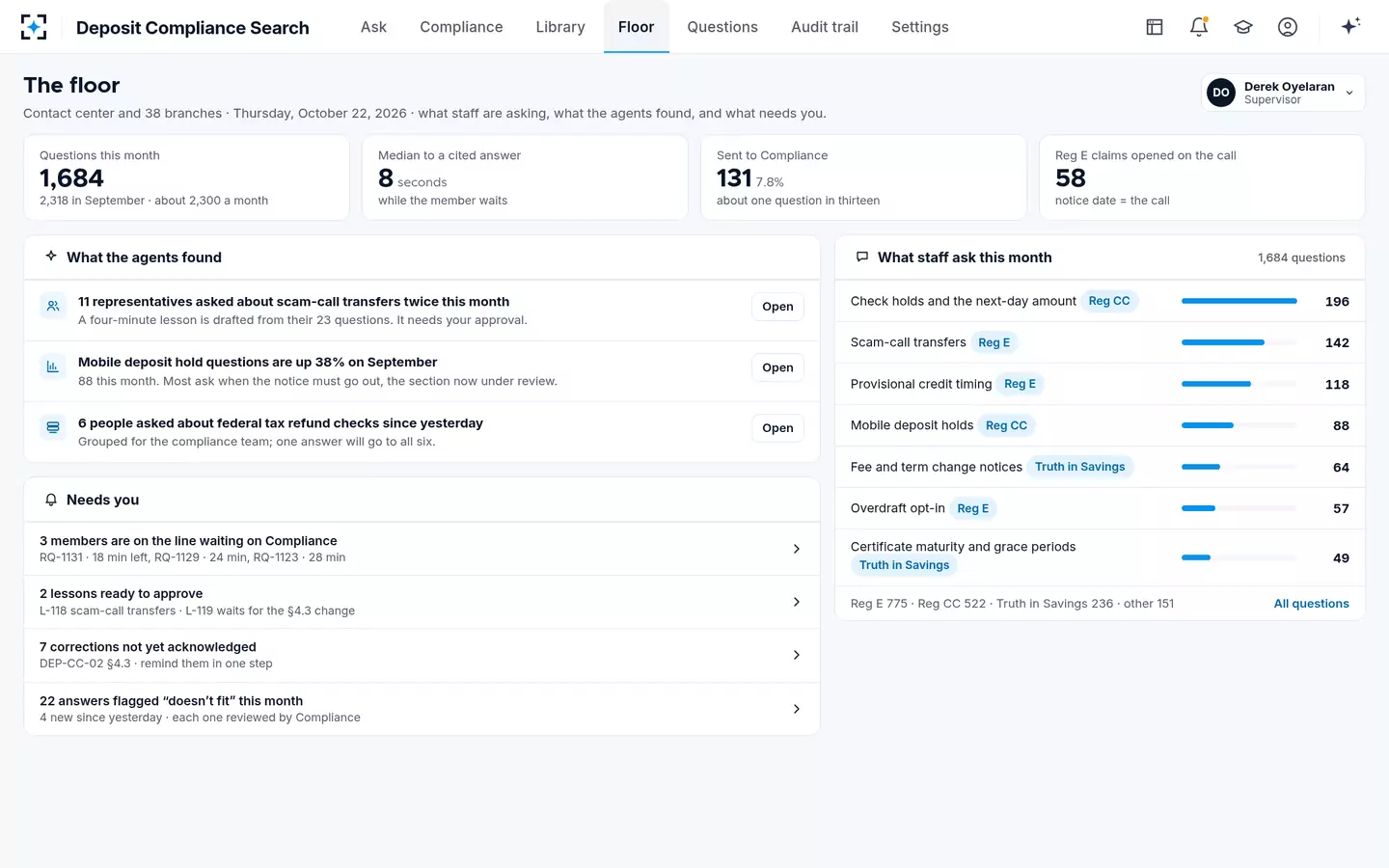
Where Deposit Compliance Search fits, and where training still does the work
The solution shortens the gap between a question and a cited answer; it does not replace knowing that a question has been asked. A representative still has to recognize that "I never sent that" is a notice of error, and a teller still has to hand over the hold notice. What changes is what happens next: the answer arrives in three layers, what to do now, why, and the institution's procedure section with its version, and when one missing fact would change the answer the agents ask for it first instead of guessing.
It also turns the training loop around. Questions that fall below the confidence threshold, or touch an unsettled point, go to Compliance with a drafted answer and a clock; repeated questions become short lessons the supervisor approves; and when Compliance changes a procedure, everyone who received an answer based on the old text gets a correction to acknowledge. A training lead gets a list of what people actually did not know, which is better material than any outline written in advance.
Questions people ask
Who needs Reg E training at a bank?
Anyone a member can tell about a problem with an electronic transfer: contact-center staff, tellers, chat and secure-message teams, and outsourced call centers. Under 12 CFR 1005.6(b)(5) notice is given when the consumer takes the steps reasonably necessary to tell the institution, whether or not a particular employee receives it, so the list follows where members talk, not job titles.
What do front-line staff need to know about Reg CC?
Four things: the $275 next-day amount and second-business-day schedule for most checks, the exceptions such as large deposits over $6,725 and new accounts, the cutoff hour, and the duty to hand over an exception notice at the time of an in-person deposit. The amounts changed on July 1, 2025, so a chart printed before then is wrong.
Does an oral claim start the Reg E clock?
Yes. Regulation E applies its error-resolution timing to a notice of error whether it is spoken or written, and the 10-business-day period runs from receipt of the notice. An institution may ask for written confirmation within 10 business days, but it may not wait for it to start investigating.
What should a teller say about a check hold?
The availability date for each part of the deposit, and, when an exception hold applies, the written notice with the reason and the date the funds will be available. The notice belongs to the member at the counter when the deposit is made in person and the reason is already known; otherwise it goes out no later than the first business day after the deposit or after the facts become known, whichever is later.
How do you train staff on Truth in Savings?
Start with what front-line staff say and hand over: quote only the annual percentage yield (with the interest or dividend rate if they wish), give account disclosures before an account is opened, and know that adverse changes need 30 calendar days' notice. At a credit union, teach it as NCUA Part 707 with its own vocabulary of shares and dividends.
What Reg E mistakes do staff make most?
Treating a call as a request rather than a notice, asking for a signed form or police report before starting, and turning away a scam victim because she shared a code. The FDIC found error resolution behind 74 percent of the Reg E violations it cited in 2025, and each of those mistakes moves the date an investigation is measured from.