CLO compliance software recomputes a collateralized loan obligation's coverage tests, collateral quality tests and portfolio limits from the manager's own positions and the indenture's definitions, compares the result with the trustee's report, and helps the team explain and resolve each difference before the payment date. The hard part is not the arithmetic; it is that a tool which recomputes a test and also declares its own tie-out correct is checking itself, and the errors that matter most, a definition applied to the wrong loan or a price from the wrong side of the market, are the ones a single calculation repeats with confidence. Botminds' CLO Compliance splits the work: one agent recomputes, another explains each break, a third re-derives the explanation independently, and people confirm, approve and sign.
The figures from the solution on this page are sample data on fictional firms, centred on Quillfield Capital's October cycle. Regulators' words are quoted from their own documents and linked where they appear.
One trustee report through CLO Compliance, on the sample deal
59min
from a 64-page draft report arriving to 62 tests recomputed from 418 positions
17causes
behind 34 breaks across 15 deals, each re-derived by a second agent
100%
of coverage test breaks explained to the loan before the trustee finalizes: the design target
What is CLO compliance software?
CLO compliance software is any tool a CLO manager uses to produce its own mark for each test the indenture sets, so that it can check the trustee's. Three kinds are in use. A coded compliance engine holds each deal's tests as rules and recomputes them from the manager's positions. A shadow trustee, run by a third party or in-house, produces an independent full set of numbers. Agent-based tools read the reports and the indenture, recompute, and also explain the cause of each difference.
All three answer the same question, but they leave the analyst in different places. A coded engine or a shadow trustee leaves a list of differences; someone still has to open the indenture, the trade ticket and the price history to say which difference is real. The comparison of a shadow trustee and a compliance engine runs the three approaches against one month's report in detail. This page is about the control inside whichever tool you choose.
How do CLO managers check trustee reports today?
Most managers check a trustee report in four steps: re-key or load the report and its data file, recompute the tests in their own system or a shadow file, tie out test by test and then loan by loan in spreadsheets, and write to the trustee about what does not agree. Each step is a place for error, and the last two take the most judgement. A 46 basis point gap on a junior overcollateralization test can come down to one loan treated under one definition; finding that loan means reading the indenture, the ticket and the price history together.
The stakes of the tests themselves are well documented. Studying 6,012 monthly reports of 415 CLOs, two accounting researchers found "a positive association between these discretionary activities and the probability of avoiding an OC test violation", where the activities were discretionary loan valuation and strategic trading (Loumioti and Vasvari, Journal of Accounting and Economics, 2019). Whatever a manager's intentions, a test near its trigger is the test everyone will scrutinise, so the manager's own calculation has to be one it can defend line by line.
Why a tool that recomputes and approves its own tie-out is checking itself
A calculation that is wrong because of how it reads a definition will be wrong the same way every time it runs. Re-running the same engine, or asking the same model to "check" its own answer, adds a second identical opinion, not a second opinion. That is the logic of separating maker and checker, and it applies with more force to software that reads documents, because a reading error leaves no arithmetic trace.
An SEC administrative case over three CLOs is a reminder that the definitions, not the sums, are where disputes start. It turned on how the manager categorized the loans, and as the judge's decision explains, "the category of each asset might affect the carrying value of the asset for calculating the numerator of the OC Ratio" (SEC Initial Decision No. 1182, 2017). The judge found the violations unproven and dismissed the proceeding in September 2017. A compliance tool that cannot show which definition it applied to each loan, and why, cannot help a manager in that kind of argument.
So the useful question for any CLO compliance software is not "does it recompute the tests?" Every serious tool does. It is: who, or what, independently checks the explanation before it is relied on, and who signs?
The duties matrix: who recomputes, who explains, who checks, who signs
In CLO Compliance each duty belongs to one agent or one person, and each agent has written limits. The table is the control in one view; the "never" column is what makes the result something a trustee, an investor or an examiner can rely on.
CLO Compliance's duties matrix: every step has one owner and a 'never'
| Who | Does | Never |
|---|---|---|
| Reader agent | Extracts every test, trigger, asset row, trade and cash line from the trustee report and data file, with page citations; checks totals (sum of par against the reported aggregate). | Edits a figure, or guesses an unreadable page; it asks the trustee for a clean copy. |
| Recompute agent | Recalculates every test from the manager's own positions as of the determination date, with the deal's approved definition versions. | Uses an unapproved definition, or any price or rating dated after the determination date. |
| Diff agent | Explains each break to the loan, groups breaks into causes, measures each cause's effect on every test, proposes an action. | Forces a cause (a residual stays "unexplained"), or decides an interpretation. |
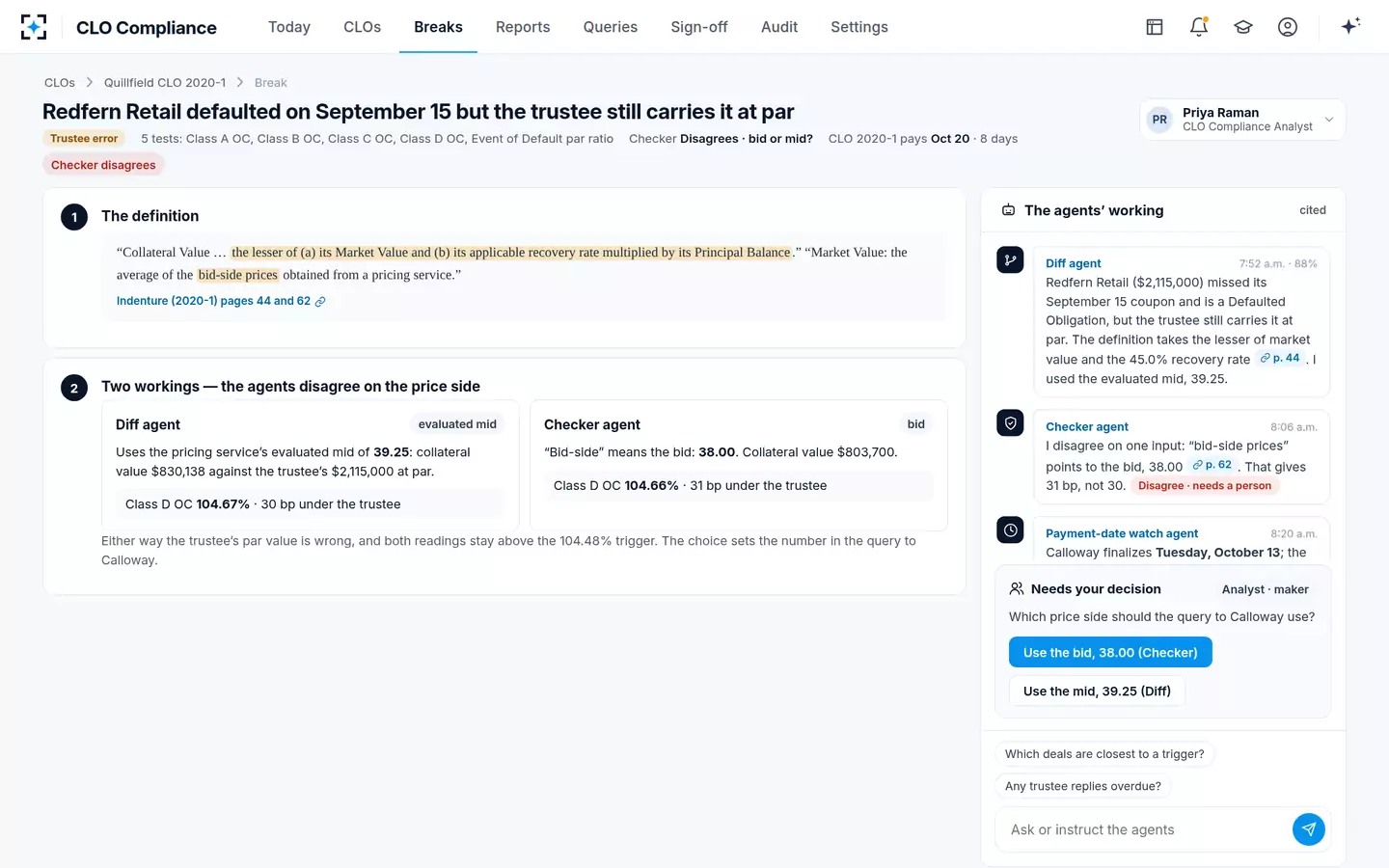
| Checker agent | Re-derives each explanation on its own, from an asset-level rebuild on a different model family; agrees or challenges. | Lets anything be shown as explained without its agreement; disagreements go to the analyst with both workings. |
| CLO compliance analyst | Confirms or rejects each cause with a reason code and a note; drafts the sign-off. | Approves her own query or her own sign-off. |
| Head of CLO operations | Approves every trustee query, fix and definition change as the second person; rules on interpretation; signs with a second factor. | Signs a deal whose checklist is incomplete. |
| Trustee relationship manager | Sends approved queries; owns the trustee correspondence. | Sends anything a second person has not approved. |
Two details in the matrix do most of the work. First, the Checker works from an asset-level rebuild on a different model family, so a misreading in the Diff agent's model is not simply repeated. Second, nothing is shown as explained until the two agree; when they do not, the analyst sees both workings. Agreement is not proof, but disagreement is the cheapest warning a reconciliation can give.
When the two agents disagree, CLO Compliance shows both workings and a person chooses
Can AI recompute CLO tests?
Yes, if the definitions it uses are fixed, versioned and approved, and if its inputs are dated. The arithmetic of a coverage test is simple; what a general-purpose model lacks is the deal's own vocabulary. FINRA, writing for broker-dealers rather than CLO managers, lists the same risk among the hazards of AI agents: a general-purpose agent may not know a specialised field well enough to carry out its tasks reliably (FINRA, 2026 Annual Regulatory Oversight Report; the report's list is quoted in AI earnings call analysis: why the reader is never the checker).
The design answer is to keep the model away from the parts that need no judgement and to bind it to the deal's text in the parts that do. In CLO Compliance the Recompute agent calculates only with approved definition versions, and never uses a price or rating dated after the determination date, which removes a common source of false breaks. The Diff agent's reading of a definition is always cited to its page, so a person can check the quotation, not just the answer.
Supervisors expect the same controls whatever the tool. FINRA's report describes ongoing monitoring that can include keeping each prompt with its answer, noting which model version was in use, and having people validate the output. The SEC's Division of Examinations, in its fiscal 2027 priorities, notes that registrants now use what it calls "super intelligence" for work that includes compliance monitoring and surveillance (SEC, Fiscal Year 2027 Examination Priorities; how are asset managers using AI? quotes the passage). A CLO manager adopting agents should expect to be asked how each output was checked and by whom.
In CLO Compliance a new agent version goes live only after a golden-set evaluation and approval by the head of CLO operations. On the sample firm's golden set of past breaks, the current Diff agent version explained 39 of 40; the fortieth is the reason the Checker and the analyst exist.
Who signs off a CLO compliance break?
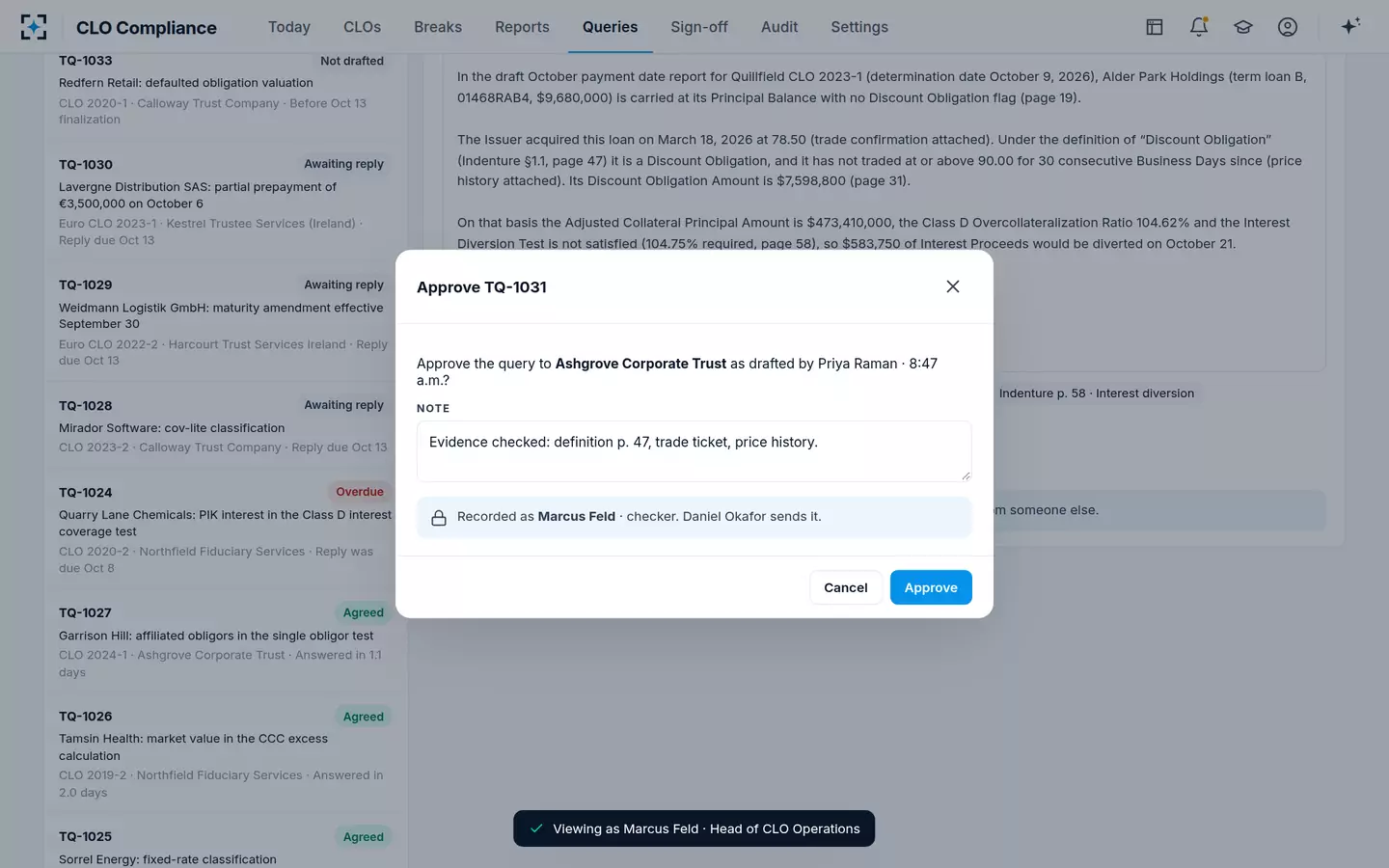
A person signs, and never the same person who prepared the work. The flow below is the sample manager's: the agents read, recompute, explain and check; the analyst confirms the cause; a second person approves the query; the relationship manager sends it; the head of operations signs the deal once every check passes.
From trustee report to signature in CLO Compliance: four agents, three people
Agent
Reader agentReads the draft payment date report and data file; extracts 62 tests and 418 asset rows with page citations; totals agree to $1.
Never: edits a figure
Agent
Recompute agentRebuilds all 62 tests from the manager's 418 positions with indenture definitions version 3: 54 agree, 8 do not.
Never: uses a price dated after 9 October
Agent
Diff and Checker agentsThe Diff agent traces the 8 breaks to 3 causes; the Checker re-derives each and agrees on the Alder Park cause at 97%.
Never: calls a cause explained without both
A person decides
CLO compliance analystConfirms the cause with the reason code "Trustee error, definition not applied" and submits the drafted query.
A person decides
Head of CLO operationsApproves the query as checker with a note on the evidence he reviewed; later signs the deal with a second factor.
A person decides
Trustee relationship managerSends the approved query to the trustee with the indenture pages, the trade confirmation and the price history attached.
A query drafted by an agent, approved by a second person, sent by a third
What to test before buying CLO compliance software
Test any CLO compliance software on your own past trustee reports, including at least one month with a break you already understand. Vendors' demonstrations run on deals the tool has seen; your indentures and your trustees' formats are the real test. The checklist is ours; each item is something we have seen a reconciliation get wrong or leave unexplained.
Eight things to test in a CLO compliance software pilot
- Definitions are versioned and cited
Every recomputed figure should name the definition version and page it used; a supplemental indenture should create a new version that someone approves.
- Inputs are dated
Prices and ratings after the determination date should be refused, or every month will show false breaks.
- Breaks are explained to the loan
A list of 34 differences is not an answer; ask for causes, the tests each cause moves and the evidence.
- Residuals stay unexplained
A tool that always finds a cause is guessing some of the time; it should be able to say "unexplained".
- An independent check exists
Ask who or what re-derives an explanation, on what data, and what happens when the two disagree.
- People decide and sign
Reason codes on every decision, a second person on every query and sign-off, enforced by role rather than by habit.
- The payment-date effect is shown
A break that changes the waterfall should be ranked above one that does not, with the dollars at stake.
- The evidence can leave the system
Internal audit should be able to take the month's report, workpapers, break log, queries and signatures as one tamper-evident file.
Where CLO Compliance fits, and where it does not
CLO Compliance fits a manager that already keeps its own positions and wants its own mark for every test, explained, before the trustee finalizes. It reads trustee reports from portals, email and SFTP, each deal's indenture and supplements, the loan administration and order management systems, pricing and rating feeds, and agent notices in German, French, Dutch and Spanish for European loans. European deal data is stored and processed in the EU.
It does not replace the trustee or the collateral administrator: the trustee's report remains the report of record, and the solution ties it out rather than issuing a competing one. It does not price loans; it uses the manager's pricing vendor and rating feed, as of the determination date. It does not decide how an ambiguous clause should be read; it shows both readings to the head of CLO operations. And it does not send anything to a trustee or instruct a payment. A manager that wants an outsourced third set of numbers with no internal review may be better served by a shadow trustee service.
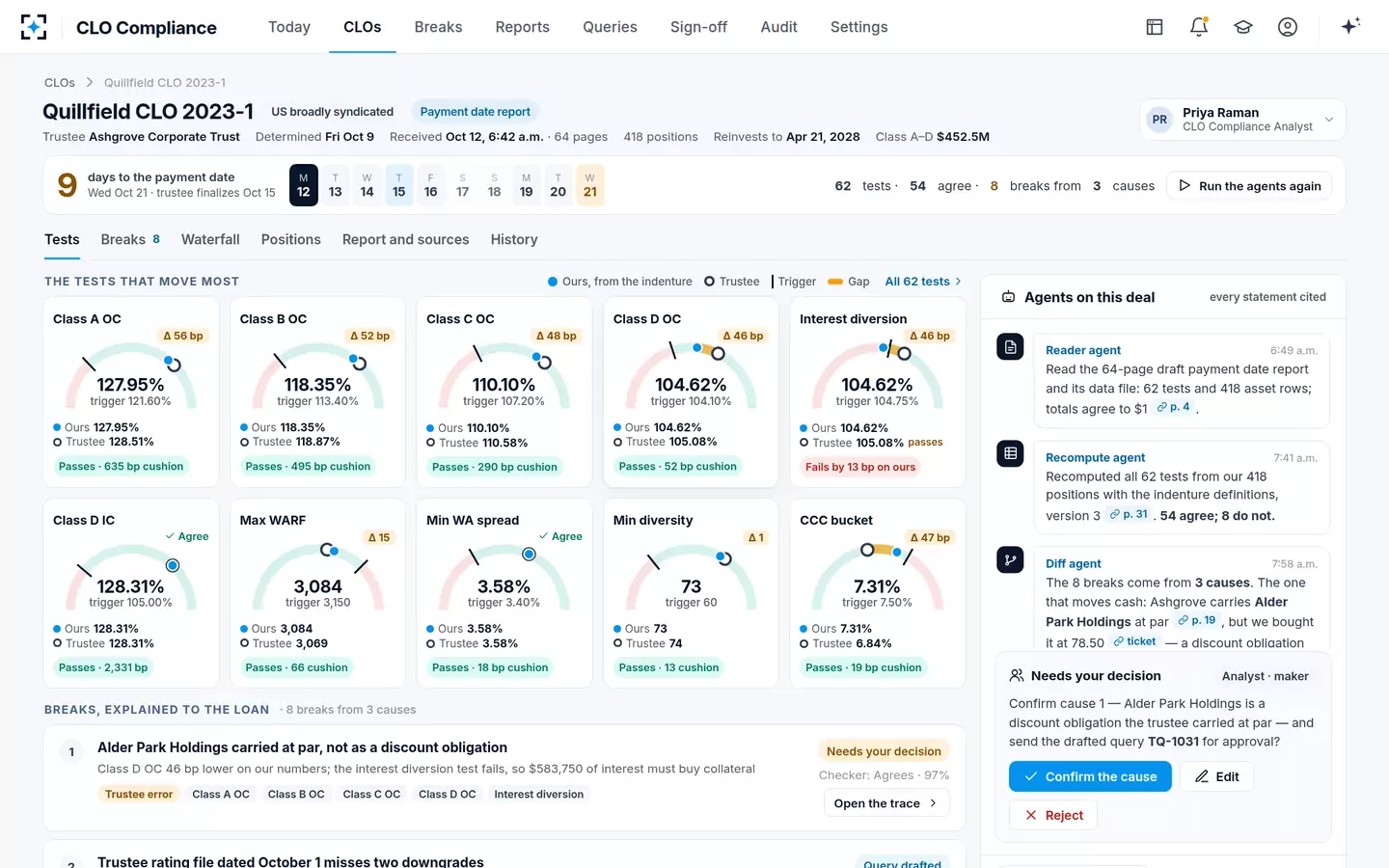
Every test with two marks and the trigger between them
What does CLO compliance software cost?
Vendors don't publish prices for CLO compliance software, and shadow trustee fees are not published either, so a buyer has to build the comparison from its own costs. The useful unit is analyst time per cycle plus the cost of a break found too late. Count the analyst days your team spends per month on re-keying, recomputing, tying out, finding causes, queries and sign-off; then count the breaks in the last twelve months that were found after a trustee finalized.
On the second number, one sample break shows the scale. In the October cycle, the Alder Park cause meant the interest diversion test failed on the manager's numbers, so $583,750 of interest had to buy collateral on 21 October instead of reaching the subordinated notes. Had the break been found after finalization, that cash would have gone to the equity, and the fix would have waited for a later period, if it came at all. CLO analytics that measure breaks, not tests sets out five measures for pricing a programme on those terms.
To see the duties matrix working on sample deals, or to run CLO Compliance on a sample of your own past trustee reports and indentures, start from CLO Compliance.
Questions people ask
What is a coded compliance engine?
It is software that holds each CLO's tests as coded rules, built from the indenture, and recomputes them from the manager's positions each cycle. It gives a second mark for every test but usually not the cause of a difference. Its accuracy depends on whoever coded each deal's definitions and on keeping them current when an indenture is supplemented.
How do CLO managers check trustee reports?
They recompute each test from their own positions and the indenture, compare it with the trustee's report, and query the trustee about differences before the report is finalized. Research on CLO reporting describes the trustee as calculating the tests with the manager working alongside it, so the manager's own mark is its check on inputs it supplied. Differences are classified as trustee errors, timing, the manager's own data or interpretation.
What is a tie-out in CLO reporting?
A tie-out is the reconciliation of one figure in the trustee's report to the manager's own figure and to its source: the position, trade, price, rating or indenture definition behind it. A report is tied out when every test agrees within tolerance or has a recorded cause. In the sample firm a coverage test difference above 1 basis point counts as a break.
Does CLO compliance software replace the trustee or the collateral administrator?
No. The trustee's report remains the report the deal pays on; the manager's software produces a second mark and the evidence for queries. When a trustee agrees with a query it reissues the report, and the manager's tool ties out the revised version. In the sample cycle that happened on the same morning.
Can CLO compliance software handle European CLOs?
It should, but test it: European deals add agent notices in several languages, sterling and euro conversions, and EU rules on where data is held. In CLO Compliance the Reader agent shows each notice in the original with the English beside it, and European deal data is stored and processed in the EU. One sample break came from sterling converted a day apart by the trustee and the manager.