A CLO analyst, in the compliance and operations sense, is the person who takes the trustee's monthly or payment date report for each collateralized loan obligation, ties every coverage test, collateral quality test and portfolio limit to the manager's own positions and to the indenture's definitions, and explains each difference before the trustee finalizes the report and the deal pays. The work is hard because the trustee and the manager start from different files, the indenture defines every input its own way, and a single loan treated under the wrong definition can change where millions of dollars of interest go. Botminds' CLO Compliance exists for that seat: agents read the report, recompute the tests and trace each break to the loan, and the analyst confirms the cause, approves the query and signs.
The worked example on this page is sample data on fictional firms: Quillfield Capital, a manager of 31 CLOs (22 US and 9 European) with $14.8 billion of loans in 12,184 positions, and its October reporting cycle. Every regulatory and research figure is linked to the publisher's own text.
Why the CLO analyst's seat carries more risk than its title
$676.9B
of loans held by CLOs issued outside the US, second quarter of 2026
~4%
typical junior OC slack above its trigger in 2008–2013 monthly reports
88%
of CLOs that just met a monthly OC test would have failed it without manager discretion
What does a CLO analyst do?
A CLO analyst on the compliance side answers one question every reporting cycle: are the trustee's numbers right, under this deal's indenture, for this determination date? Everything else in the job follows from it. The analyst downloads each trustee report and its data file, rebuilds the coverage tests (overcollateralization and interest coverage by class, and often an interest diversion test), the collateral quality tests (maximum weighted average rating factor, minimum weighted average spread, minimum diversity) and the portfolio limits such as the CCC bucket, and then ties them out, test by test and loan by loan.
The title covers more than one job. On a credit team, "CLO analyst" can mean the person who underwrites the loans going into the portfolio; at an investor, it can mean someone who models CLO tranches. This page is about the operational seat at the manager: the person who owns the reconciliation and the queries to the trustee. Search engines blur the three, and so do job descriptions, which is one reason the seat is easy to underestimate.
The cycle is monthly because the reporting is. CLOs, in the words of a peer-reviewed study of their reporting, "are required to disclose monthly detailed loan-level information on the portfolio's structure and performance", and their compliance tests "are specified in the CLO prospectus" with thresholds that "typically do not change over the life of the CLO" (Loumioti and Vasvari, 2019). The thresholds stay put; the portfolio moves every day. The analyst's job is to say whether the movement crossed a line.
Who prepares the CLO trustee report, and who checks it?
The trustee or its collateral administrator prepares and distributes the report, but much of what goes into it comes from the manager, and an indenture can relieve the trustee of verifying it. That division is why the manager keeps its own second set of numbers. The same 2019 study describes the trustee as "responsible for calculating the monthly compliance test scores as well as preparing and distributing the CLO reports", adding that "the CLO manager usually works with the trustee to prepare the reports" and that an accounting firm's structured finance team checks the calculations (Loumioti and Vasvari).
An SEC administrative case over three CLOs put the division in plainer terms. Describing three CLOs' indentures, the administrative law judge found that "the information in the reports was provided by the Funds" and that "the indentures absolved the trustee of any responsibility to verify the accuracy of information it received" from the manager (SEC Initial Decision No. 1182). The judge dismissed that proceeding on 27 September 2017, finding the alleged violations "unproven", and the decision became the Commission's final decision on 28 November 2017 (SEC notice of finality). The point for the analyst is not who was right; it is that the trustee's report is only as good as the inputs and the reading of the definitions behind it.
In practice, then, three parties hold a version of the truth. The trustee holds the report of record, which is what pays on the payment date. The manager holds its loan administration system, its trade tickets and its own reading of the indenture. The analyst sits between the two and is the only person whose job is to make them agree, or to explain why they should not.
Who carries one trustee report at a CLO manager, and what changes with CLO Compliance
Today
Re-keys trustee reports, rebuilds each test in a spreadsheet or a coded engine, and hunts differences loan by loan across 16 deals.
With agents
Starts from the breaks the agents have already traced to a loan and a definition, confirms or rejects each cause with a reason code, and prepares the sign-off.
Still theirs: the decision on every cause, and every interpretation question raised to the head of operations
Today
Approves every trustee query and signs each report before the payment date, and wants the evidence for each one within reach.
With agents
Approves as the second person on every query, fix and sign-off, with the indenture page, the ticket and the price history one click away.
Still theirs: the signature, and rulings on how a definition is read
Today
Trades inside the tests on the trustee's last numbers and the analyst's best estimate of the real cushion.
With agents
Sees both marks and the cushion to each trigger, and can ask what a sale or a purchase would do to the tests before trading.
Still theirs: every trading decision; read-only on the tests
Today
Owns correspondence with five trustees and tracks their response times, one email thread per question.
With agents
Sends only queries a second person has approved, each with its evidence attached, and sees replies matched to the open break.
Still theirs: the relationship and every message that leaves the firm
The monthly cycle of a CLO analyst, from determination date to payment date
Every deal runs on its own clock, and the analyst's month is a stack of those clocks. A payment date report is struck at the determination date, arrives as a draft a few days later, is finalized by the trustee a few days after that, and pays on the payment date. Between draft and finalization sits the only window in which a correction is cheap: after finalization, a test that should have failed has passed, and the cash has its instructions.
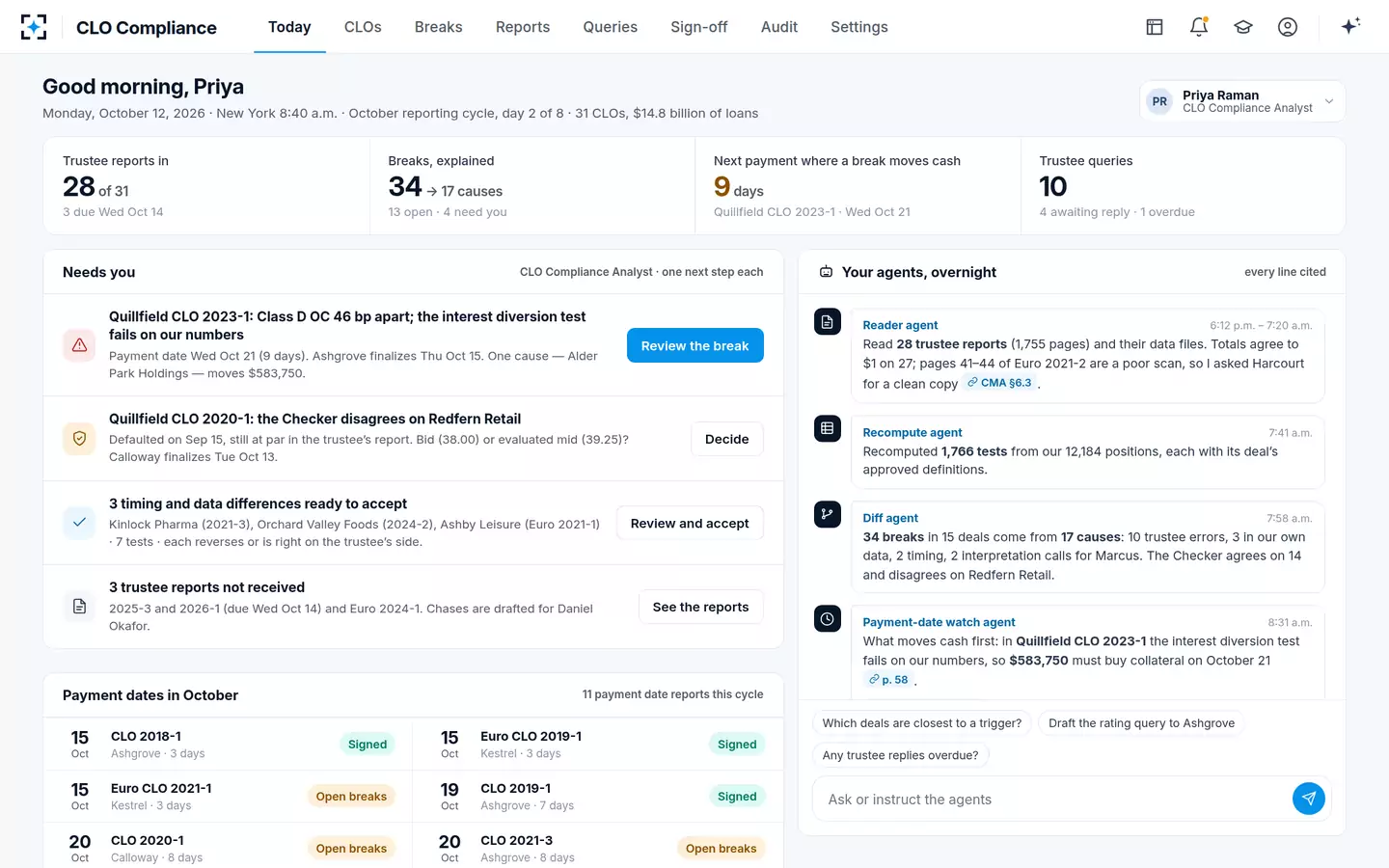
Take Quillfield CLO 2023-1. Its determination date was Friday 9 October 2026. The draft payment date report from its trustee arrived at 6:42 a.m. on Monday 12 October: 64 pages and 418 positions. The trustee finalizes on Thursday 15 October, and the deal pays on Wednesday 21 October. Across the firm, 28 of 31 reports were in by Monday morning, and three more were due on Wednesday.
The analyst does not get a quiet week per deal. With 31 deals on different calendars, payment dates fell on the 15th, 19th, 20th, 21st, 22nd and later in the same month, each with its own finalization date. The skill that matters is triage: knowing which break, in which deal, moves cash first.
The analyst's morning in CLO Compliance: start with the break that moves cash
CLO analyst vs CLO portfolio manager: who owns which number
The portfolio manager owns the portfolio; the analyst owns the measurement of it. That sounds tidy until a test is close to its trigger, which is exactly when the two jobs collide. A portfolio manager deciding whether to buy a discounted loan needs to know the real cushion on the junior overcollateralization test, not the trustee's last published figure, and only the analyst's reconciliation can supply it.
The research says why the cushion matters. Across 2008–2013, senior noteholders sat behind "a high senior OC slack of about 20% above the senior OC test threshold", while "the reported junior OC slack is narrower, at around 4% above the junior OC test trigger" (Loumioti and Vasvari). Four percent is a few large loans. A mistake in one definition can consume a meaningful part of it, which is why the CLO OC test deserves to be read definition by definition rather than as a single ratio.
The same study found something every analyst should keep in mind: "about 88% of the CLOs that just meet a monthly OC test would have violated it that month if their managers had not inflated the loan fair values and traded strategically." That is a finding about manager discretion in a past period, not an accusation against any manager today, but it explains why investors, trustees and auditors look hardest at the deals near their triggers, and why the analyst's evidence has to stand up on exactly those deals.
Why the analyst's job is mostly definitions, not arithmetic
The arithmetic of a coverage test fits on one line. The definitions behind it fill pages: what counts as a defaulted obligation, when a loan bought at a discount stops being a discount obligation, which rating applies when two agencies disagree, which price side values a defaulted loan. A difference between the trustee and the manager is usually a difference of definition, timing or data, and the analyst's real work is deciding which.
In the sample cycle, the decisive break was a single term loan. The trustee carried $9,680,000 of the Alder Park Holdings term loan B at par. Quillfield had bought it at 78.50 on 18 March 2026, which under the deal's definition makes it a discount obligation carried at purchase price until its market value has been at or above 90.0% for 30 consecutive business days. Its highest price since purchase was 86.50. One flag dropped from the trustee's asset schedule moved the Class D overcollateralization ratio by 46 basis points and turned the interest diversion test from a pass into a fail.
Timing breaks look similar on a spreadsheet and mean something quite different. A purchase that settled after the trustee's cut-off, a paydown not yet booked in the manager's holdings, a currency converted a day apart: each produces a difference that reverses on its own next month. Telling a timing break from a definition break quickly is most of the analyst's skill, and why loan trades fail to settle explains where many of the timing breaks start.
What skills does a CLO analyst need?
A CLO analyst needs to read an indenture the way a lawyer does, a loan file the way an operations team does and a rating file the way a credit analyst does, and to write a query a trustee can answer in one reply. The list below is ours, drawn from what the work requires each cycle; no regulator publishes a job standard for the seat.
The CLO analyst's working skills, and why each one matters each cycle
- Read the definitions section, not just the tests
Adjusted collateral principal amount, discount obligation, defaulted obligation, CCC excess and market value are where trustee and manager part ways.
- Know the loan operations calendar
Trade date, settlement date, paydown notices and the trustee's cut-off decide whether a difference is timing or error.
- Follow the rating data
Which agency, which date, which rating when two disagree, and which loans rest on a credit estimate rather than a public rating.
- Price a defaulted loan the way the indenture does
Bid, mid or evaluated price; lesser of market value and recovery; the side matters to the ratio.
- Write a query with its evidence
The page of the report, the clause of the indenture, the ticket and the price history, so the trustee can agree in one reply.
- Keep information walls
A manager that sits in lender groups can learn nonpublic information about loans its CLOs trade.
The last skill is a compliance matter in its own right. In August 2024 the SEC announced settled charges against a CLO manager for failing to maintain policies "reasonably designed to prevent the misuse of material nonpublic information (MNPI) concerning its trading of collateralized loan obligations"; the manager agreed to pay a $1.8 million civil penalty, and the SEC said it "did not adopt a written policy" for its pre-trade reviews until July 2022 (SEC press release 2024-106). An analyst who sees lender-group notices alongside trustee reports needs to know where the wall is, which private side vs public side sets out.
How many CLOs does one analyst cover?
No regulator or independent study publishes a figure for how many deals one compliance analyst covers, and the honest answer depends on how much of the cycle is manual. What can be measured is the size of the whole. The Federal Reserve's financial accounts show $676.9 billion of loans held by CLOs issued outside the US in the second quarter of 2026, vehicles a Federal Reserve staff note describes as "incorporated in offshore tax havens, mainly the Cayman Islands" (Federal Reserve Z.1, table S.2.s; FEDS Notes, 2019). Each of those deals produces its own reports.
At the sample manager, one analyst covers 16 US CLOs and a second covers the 9 European deals, reading agent notices in German, French, Dutch and Spanish. The split below is Botminds' estimate of where one analyst's reporting cycle goes for a book of about 16 CLOs, by hand and with the agents doing the reading, recomputing and tracing. It is an estimate made for planning, not a measured result at any firm.
Where the analyst's cycle goes for a 16-deal book, by hand and with CLO Compliance
- Download and re-key1 d
- Recompute the tests1.5 d
- Tie out test by test2 d
- Find each cause1.5 d
- Queries1 d
- Sign-off and evidence1 d
- Agents0.45
- Analyst0.75
Where CLO Compliance takes the mechanical part, and what stays with the analyst
The agents take the parts of the job that are reading and arithmetic; the analyst keeps every decision. In CLO Compliance a Reader agent extracts every test, trigger and asset row from the report with page citations and checks the totals; a Recompute agent rebuilds each test from the manager's own positions with the deal's approved definitions; a Diff agent explains each break to the loan and groups breaks into causes; and a Checker agent re-derives each explanation independently on a different model family before anything is called explained.
What the agents do not do is as important as what they do. They never send a query, sign a report, change a definition or decide how a clause should be read. When the Diff and Checker agents disagree, the analyst sees both workings and chooses. In the sample cycle, the Redfern Retail break turned on whether "bid-side prices" meant the bid of 38.00 or the evaluated mid of 39.25; the agents set out both, and the analyst chose before any query was drafted.
The analyst confirms each cause with a reason code; CLO Compliance records who and why
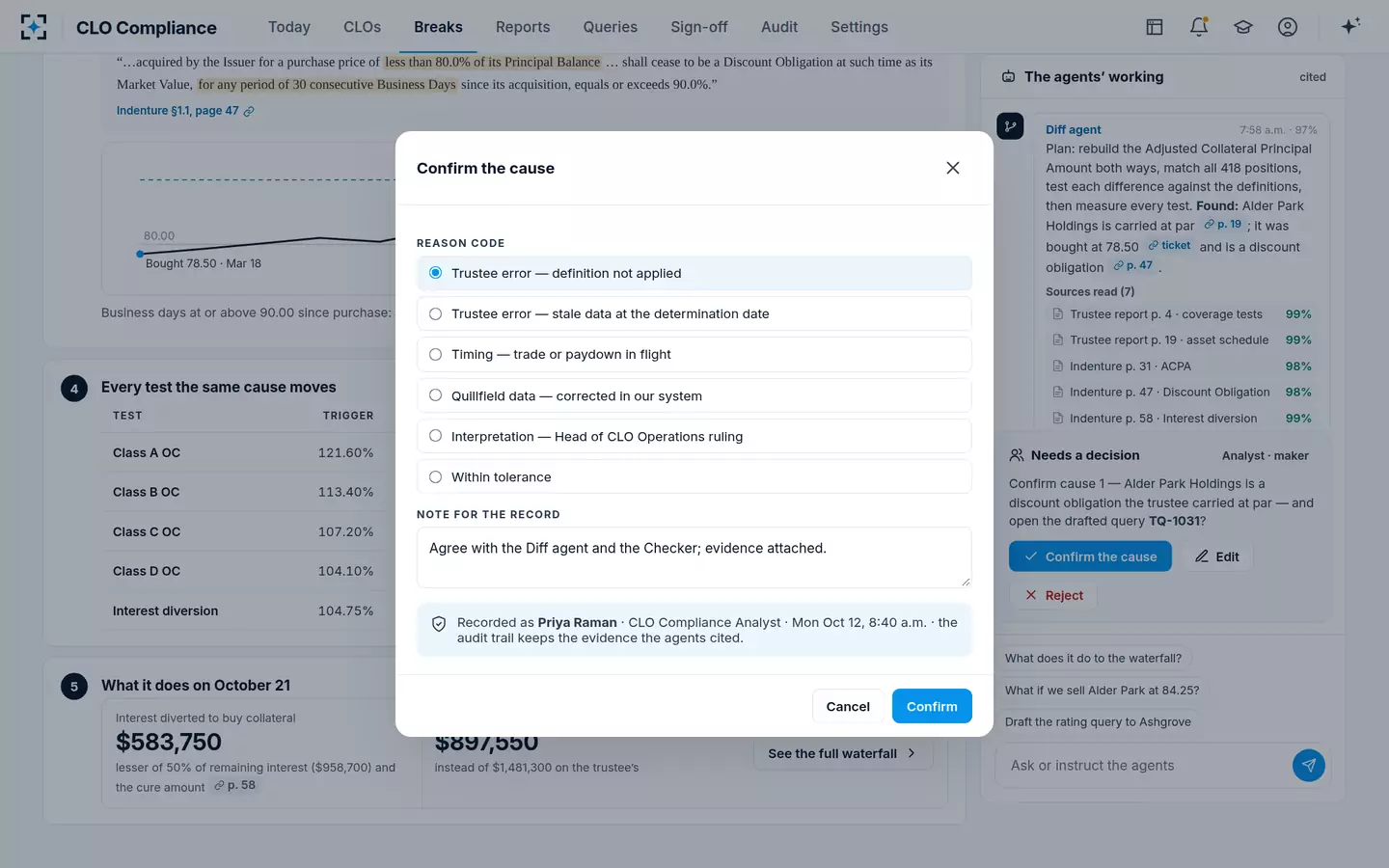
The result is a different day rather than a shorter one. The analyst spends the morning on the handful of causes that need judgement and on the trustee conversations that follow, and the evidence for each decision is kept as it is made, which is what the evidence file behind a CLO trustee report needs. To see the whole cycle on the sample deals, start from CLO Compliance.
Questions people ask
What is a CLO compliance analyst?
It is the analyst at a CLO manager who reconciles each trustee report with the manager's own positions and the indenture, and explains every difference in the coverage tests, collateral quality tests and portfolio limits. The role sits in operations or compliance rather than in credit research. Its output is a set of confirmed causes, trustee queries and a signed report for each payment date.
What is a collateral administrator?
A collateral administrator is the agent appointed under a CLO's documents to keep its collateral records, calculate its tests and produce its monthly and payment date reports for the issuer and the trustee. Research on CLO reporting describes the trustee as "responsible for calculating the monthly compliance test scores", with the manager working alongside it to prepare the reports. The manager keeps its own calculation because an indenture can relieve the trustee of verifying what the manager supplies.
What does a CLO operations team do?
A CLO operations team settles trades, keeps the loan administration system current, reconciles positions and cash with the trustee, and checks each trustee report before the payment date. Its measure of success is a payment date on which the cash goes where the indenture says.
How is a CLO analyst different from a CLO credit analyst?
A credit analyst decides which loans the CLO should own; a compliance analyst checks whether the portfolio, as owned, passes its tests as the indenture defines them. The two need each other: a downgrade the credit analyst expects will move the CCC bucket and the weighted average rating factor that the compliance analyst ties out the following month.
Do CLO analysts need to read the indenture?
Yes, and mostly its definitions section. A coverage test is a single ratio, but its inputs are defined terms such as adjusted collateral principal amount, discount obligation and defaulted obligation, and those terms differ from deal to deal. In the sample cycle, one definition applied to one loan moved a junior OC test by 46 basis points.