CLO haircuts are the reductions an indenture makes to the par value of certain loans before they count toward a collateralized loan obligation's overcollateralization (OC) tests: defaulted loans are carried at the lower of a market value and a recovery value, loans rated CCC above the deal's limit are carried at market value, and loans bought at a deep discount are carried at their purchase price. Because the OC numerator is otherwise par, these few lines decide most of the movement in a junior OC ratio, and each depends on a definition, a price side and a rating date that the trustee and the manager can read differently. Botminds' CLO Compliance recomputes every haircut from the indenture's own wording with prices and ratings as of the determination date, and traces any difference to the loan, the clause and the source.
The sample cases are fictional, from Quillfield Capital's October 2026 cycle in CLO Compliance. The worked example of the haircuts themselves comes from a peer-reviewed study and is linked where it appears.
Haircuts in four numbers
7.95%
of par lost to haircuts in a textbook example after 8 defaults and 10 CCC downgrades
4of 80
CLO reports in one study held any deep-discount loans: managers avoid them
47bp
CCC bucket gap in a sample deal, from two downgrades missing in the trustee's file
1bp
Class D OC moved by the choice of bid or mid on one defaulted sample loan
What is a CLO haircut?
A CLO haircut is any rule that counts a loan at less than its principal balance in the OC numerator. Performing loans count at par, whatever they trade at; the haircut lines are the exceptions. A study of CLO reporting lists them in the definition of the numerator: "the fair value or the recovery value of defaulted loans, whichever is lower", "the fair value of excess CCC-rated loans", and "the purchase price of deep-discount loans" (Loumioti and Vasvari, 2019).
The word "haircut" is market shorthand, not an indenture term. Indentures use defined phrases such as Collateral Value, Market Value, CCC Excess and Discount Obligation Amount, and the exact words decide which price, which rating and which date apply. Two indentures can both be said to "haircut CCC excess at market" and still produce different numbers if they rank the loans in the excess differently, or if one values them at the bid and another at an average of bids.
A worked example: where par goes when loans default and are downgraded
The 2019 study works a simple case. A CLO holds 100 loans of $1 million each and has issued $68.6 million of senior notes and $19.6 million of junior notes, with OC triggers of 136% and 107% and a CCC limit of $5 million. Then eight loans default, ten are downgraded to CCC and ten more fall to 85% of par without a downgrade. The defaulted loans are carried at $3 million in total, the CCC excess at $2.05 million, and the performing loans at $87 million: "a total CLO portfolio value of $92.05 million" (Loumioti and Vasvari).
Thirteen of the 100 loans land in the haircut lines, and 61% of their par never reaches the OC numerator
$100m of par after 8 defaults and 10 CCC downgrades
- Performing loans, counted at par · 87%
- Defaulted loans and CCC excess · 13%
The $13m in the haircut lines
- Counted: recovery value of defaults ($3m) and fair value of CCC excess ($2.05m) · 38.8%
- Lost to haircuts ($7.95m) · 61.2%
Two lessons sit in that example. First, price alone does not move the test: ten loans at 85 cost nothing, while ten downgrades and eight defaults cost nearly eight points. Second, the haircut values are estimates. The example goes on to show that if the manager values the excess CCC loans at $2.85 million and the defaulted loans at $3.45 million, and sells ten loans trading at 120% of par, the junior ratio moves from 104% to 108% and the CLO "just pass[es] both tests". The study's empirical finding is that this kind of discretion was associated with avoiding OC violations in 2008–2013.
The junior OC ratio in the study's three cases, against a 107% trigger
What is CCC excess in a CLO?
CCC excess is the amount by which loans rated CCC or below exceed the share of the portfolio the indenture allows, and only the excess is haircut. The study defines excess CCC-rated loans as "loans that are in excess of the maximum amount of loans rated CCC or below that a CLO is allowed to hold", and in its example "the fair value of excess CCC-rated loans is assessed by ranking the market values of all CCC-rated loans and taking the values of the lowest priced loans over and above the maximum threshold" (Loumioti and Vasvari).
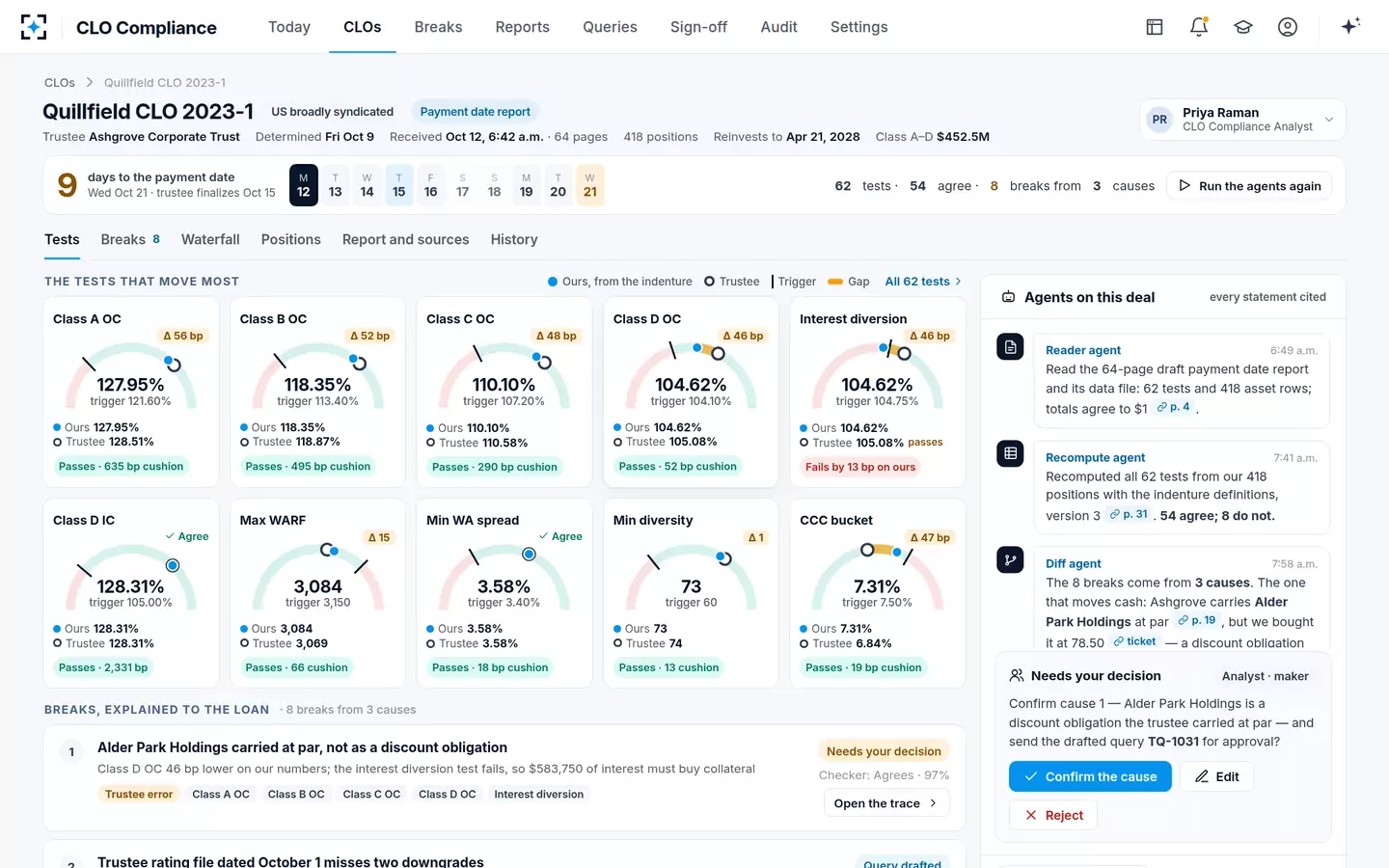
Three inputs decide the number, and each can differ between the trustee and the manager: which loans are CCC on the determination date, which agency's rating counts when they disagree, and which prices are used to rank and value the excess. In the sample deal, the manager's CCC bucket was 7.31% of the portfolio and the trustee's 6.84%, against a 7.50% maximum. The 47 basis point gap came from two downgrades, Castellan Foods and Brightwater Dental, that the trustee's rating file dated 1 October did not yet show.
What is the CCC bucket limit, and why does a pass still need checking?
The CCC bucket limit is the maximum share of the portfolio the indenture lets the CLO hold in CCC-rated loans before the excess is haircut in the OC tests; each indenture sets its own figure. In the sample deal it is 7.50%. Both the trustee's 6.84% and the manager's 7.31% pass, so there is no excess and no haircut this month, which is why the gap could be mistaken for noise.
It is not noise. On the manager's numbers the cushion is 19 basis points, on the trustee's 66. A portfolio manager deciding whether to buy a loan rated B3 on negative watch needs the 19, not the 66: one more downgrade of that size and the deal is in excess, and the excess is then haircut in every OC test. The stale rating file is drafted as its own query to the trustee, separate from the discount obligation break on the same deal.
The CCC bucket in CLO Compliance: both marks pass, but the real cushion is 19 bp
How are defaulted assets valued in a CLO?
Defaulted loans are usually carried at the lesser of their market value and a recovery value, rather than at par. The study describes the recovery values as "the lower of their fair values or the recovery values provided by credit rating agencies such as Standard and Poor's and Moody's", and defines defaulted loans as "those that do not pay principal and/or interest, are D-rated, or their borrowers filed for bankruptcy" (Loumioti and Vasvari). The indenture defines both terms, and the words matter: a distressed exchange, for instance, may or may not make a loan a defaulted obligation, which is why what a distressed exchange means is worth reading beside the indenture.
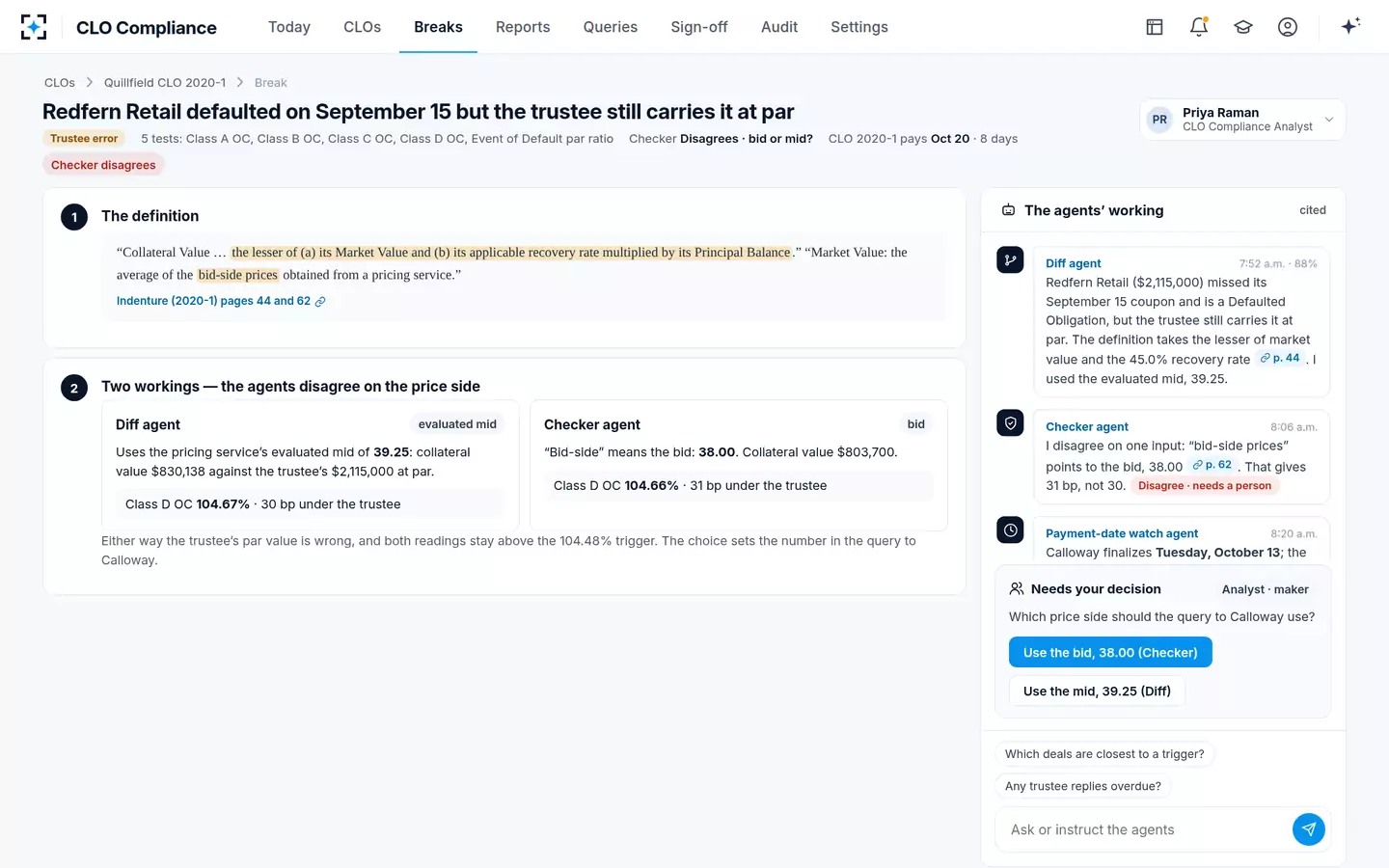
The sample shows how. In Quillfield CLO 2020-1, Redfern Retail missed its 15 September coupon and is a defaulted obligation that the trustee still carried at par: $2,115,000. The indenture defines collateral value as "the lesser of (a) its Market Value and (b) its applicable recovery rate multiplied by its Principal Balance", and market value as "the average of the bid-side prices obtained from a pricing service". At a 45.0% recovery rate, the recovery value is $951,750, so market value governs. But which market value? The pricing service's evaluated mid was 39.25 ($830,138); its bid was 38.00 ($803,700).
One defaulted sample loan, three carrying values
| Treatment | Price used | Carrying value | Class D OC (trigger 104.48%) |
|---|---|---|---|
| Trustee's draft: still at par | — | $2,115,000 | 104.97% |
| Diff agent: evaluated mid | 39.25 | $830,138 | 104.67% |
| Checker agent: "bid-side" read as the bid | 38.00 | $803,700 | 104.66% |
Discount obligations: the haircut a manager buys
A discount obligation is a loan bought below a price threshold, carried at its purchase price rather than par, so the haircut is fixed at the moment of purchase. The 2019 study describes deep-discount loans as "loans purchased at 80%–85% of par value or below" and notes that "CLOs usually avoid purchasing deep-discount loans, since they permanently erode OC test scores": in a sample of 80 CLO reports it found "only four which report deep-discount loans" (Loumioti and Vasvari).
"Permanently" depends on the deal. The sample indenture lets a discount obligation cure: it stops being one when its market value has been at or above 90.0% of par for 30 consecutive business days. That cure is a clock someone has to keep. In October 2026 the trustee dropped the discount flag on a $9,680,000 loan bought at 78.50, although its highest price since purchase was 86.50; the loan moved from purchase price to par in the trustee's numerator, and the junior OC ratio rose 46 basis points on paper. The full trace is in the CLO OC test, one loan and two definitions.
Why do CCC downgrades hurt CLOs?
CCC downgrades hurt CLOs twice: once through the haircut on the excess, which can push an OC test toward failure, and again through the selling managers do to avoid it. Cordell, Roberts and Schwert note that a coverage test failure "occurs when the quality of the collateral pool deteriorates because of defaults or a large fraction of downgrades to CCC+ or lower" (CLO Performance, working paper version). Elkamhi and Nozawa, using loan-level holdings, found that "constrained CLOs are forced to sell loans downgraded to CCC or below, and thus loans widely held by constrained CLOs experience temporary price depreciation" (Journal of Financial Economics, 2022).
The Federal Reserve saw the same pattern in 2020, when "the surge in underlying loan downgrades and defaults led to a spike in the number of CLOs that failed collateral tests" and "managers of CLOs that failed overcollateralization tests typically attempted to cure those failures by selling risky collateral" (Federal Reserve, Financial Stability Report, November 2020). A working paper by Kundu argues that such sales can spill over: CLOs pushed "closer to their covenant thresholds" by one industry's shock "fire-sell unrelated loans" (SSRN working paper, 2023, not peer reviewed in this version).
For compliance, the implication is timing. A downgrade on the day before the determination date changes the CCC bucket, and possibly the OC numerator, in this month's report; whether the trustee's rating file caught it is a question of dates, which is why CLO Compliance never uses a rating or price dated after the determination date and flags any file dated before it.
Where the rating behind "CCC" comes from
The rating that puts a loan in the CCC bucket is usually a public agency rating, but some CLO loans have no public rating and enter through a credit estimate, an abbreviated assessment produced for the deal's rating. Indentures also set which rating counts when agencies disagree. Both details change who is in the bucket, so a manager checking the CCC test has to know the source and date of every rating it used.
The SEC's examiners have described credit estimates as more abbreviated than ratings, and the American Academy of Actuaries found widespread disagreement between agencies on CLO collateral; both findings, and what they mean for the weighted average rating factor test, are set out in where the ratings in WARF come from.
A defaulted loan valued two ways in CLO Compliance, and the choice left to the analyst
What to check in the haircut lines every month
Every haircut line has a small number of inputs, and most breaks come from one of them being stale, misread or mis-dated. The checklist is ours, built from the sample cycle's breaks and the definitions above.
Seven checks on the OC haircut lines before signing a trustee report
- Every default flag against the payment record
A missed coupon, a bankruptcy filing or a D rating should move a loan out of par before the determination date.
- The price side the definition names
Bid, mid, average of bids or evaluated price; and the pricing service the indenture allows.
- Recovery rates by the indenture's table
The applicable rate depends on the loan type and, often, the rating agency named in the deal.
- The rating file's date
A file dated before the determination date misses late downgrades; the sample deal's missed two.
- Which rating counts when agencies split
Lower, higher or a specific agency, as the definition says.
- Discount obligation flags and their cure clocks
Purchase price, the threshold (sometimes different below B3) and the run of business days at the cure price.
- The ranking rule for CCC excess
Which CCC loans fall into the excess and at what value, recomputed whenever the bucket is near its limit.
To see each haircut recomputed and cited on sample deals, or on a sample of your own past trustee reports, start from CLO Compliance.
Questions people ask
How are CCC assets haircut in a CLO?
Only the CCC loans above the indenture's limit are haircut, and the excess is usually carried at market value instead of par in the OC numerator. Which loans make up the excess depends on the deal's ranking rule; in a textbook example, the lowest-priced CCC loans are counted first. Loans within the limit stay at par.
What is the OC numerator?
It is the adjusted collateral amount the OC test divides by the notes: par of performing loans, plus principal cash, plus defaulted loans, CCC excess and discount obligations at their haircut values. Indentures name it differently, for example Adjusted Collateral Principal Amount. In the sample deal it was $473,410,000 on the manager's numbers.
What is a credit estimate?
A credit estimate is an assessment rating agencies use for the credit risk of an unrated asset in the collateral of a rated transaction, such as a loan in a CLO. The SEC's examiners have described credit estimates as typically based on a more abbreviated analysis than a credit rating.
Do haircuts apply to the interest coverage test?
Not in the same way. The IC test compares interest collected with interest due, so a defaulted loan affects it by paying no interest rather than through a haircut on par. The haircut lines belong to the OC tests and, in the sample deal, to the interest diversion test, which uses the same numerator.
Can a manager avoid CCC haircuts by selling?
Selling a CCC loan removes it from the bucket and turns it into cash at its sale price, which counts in full. Research on 2008–2013 found strategic trading associated with avoiding OC violations, and with worse later performance. The compliance question is whether each trade and each valuation followed the indenture, with the evidence kept.