The CLO OC test, or overcollateralization test, compares the collateral a collateralized loan obligation holds, measured as an adjusted par amount the indenture defines, with the principal of the notes at a given class and every class senior to it; if the ratio falls below the trigger, interest that would have gone to junior notes and equity is diverted to pay down the senior notes or buy collateral. The ratio can be arithmetically right and still wrong for the indenture, because its numerator is not simple par: defaulted loans, discount purchases and CCC excess are each carried at values the indenture defines in its own words, and one loan treated under the wrong definition can move a junior test by tens of basis points. Botminds' CLO Compliance rebuilds the numerator both ways, the trustee's and the manager's, line by line, and traces any gap to the loan and the clause behind it.
The worked example below is sample data on fictional firms: Quillfield Capital's CLO 2023-1 in its October 2026 cycle. Research and regulatory figures are linked to their publishers.
The OC test in four numbers
57%
of CLOs were failing minimum OC tests in June 2009, the crisis peak
~12%
of monthly CLO reports showed an OC test violation, 2008–2013
~4%
typical junior OC slack above its trigger, against about 20% for the senior test
46bp
one sample loan's effect on a junior OC test, from one definition
What is the CLO OC test?
The CLO OC test is a coverage test that checks there is enough collateral behind each class of rated notes. The Federal Reserve's 2010 report to Congress on risk retention describes CLO debt holders as protected by two families of tests, asset quality tests and cash flow coverage tests, and says of the second: "The OC test ensures that a minimum amount of collateral secures the rated debt. The IC test ensures that the cash coupon payments generated from the collateral are adequate to pay fees and interest due on the rated notes" (Federal Reserve, Report to the Congress on Risk Retention).
Each class has its own OC test and its own trigger. The American Academy of Actuaries, in a report prepared for the NAIC in October 2026, puts it simply: the tests "compare the par value of the collateral to the outstanding balance of a given tranche and all tranches senior to it", and "each tranche has its own OC test with a minimum threshold (e.g., AAA OC ≥ 120%)" (American Academy of Actuaries, Model Construction and Development of RBC C-1 CLO Factors). In the sample deal the Class A trigger is 121.60% and the Class D trigger 104.10%: the more junior the class, the closer its trigger sits to 100%.
The tests are run every month. Researchers who read thousands of trustee reports note that "CLOs are required to meet two OC tests every month: the senior and the junior OC test", and that the thresholds "typically do not change over the life of the CLO" (Loumioti and Vasvari, 2019). Many deals add an interest diversion test to the OC and IC tests; Cordell, Roberts and Schwert name all three as the "common tests" (working paper, 2021). Because they share inputs, a single cause can move several at once: in the sample deal it moved five.
How is the overcollateralization ratio calculated?
The overcollateralization ratio is the adjusted collateral amount divided by the principal of the notes at that class and above. The denominator is easy: the outstanding balance of the covered notes. The numerator is built from definitions, and the 2019 study lists its usual parts: "(a) the principal balance of performing loans; (b) the cash generated by loan trading and held by the CLO; (c) the fair value or the recovery value of defaulted loans, whichever is lower; (d) the fair value of excess CCC-rated loans; and (e) the purchase price of deep-discount loans" (Loumioti and Vasvari).
The OC numerator is a sum of defined terms, and three of them are haircuts
Principal balance
Par of performing loans, excluding defaulted and discount obligations
Usually more than 90% of the pool
Loan administration system
Principal proceeds
Principal cash on deposit, not yet reinvested
Counted at face value
Trustee cash accounts
Defaulted obligations
Lesser of market value and recovery rate × principal
Price side and recovery rate as defined
Pricing service; rating agency recovery rates
Discount obligations
Purchase price × principal balance
Until the cure condition in the definition is met
Trade tickets
CCC excess
Excess over the CCC limit, carried at market value
Lowest-priced CCC loans first, in the 2019 study's example
Rating feed and prices
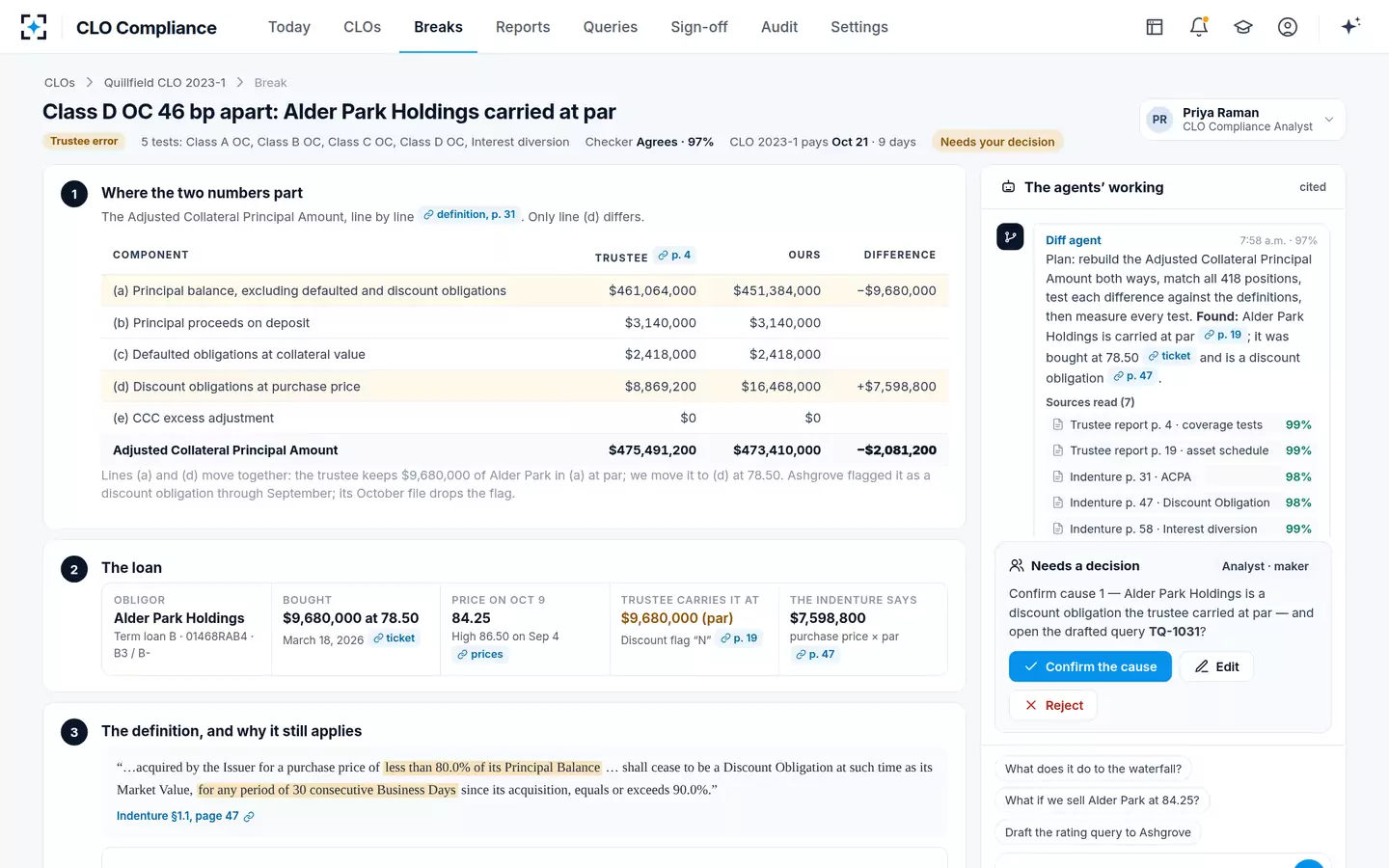
In the sample deal, the indenture calls the numerator the Adjusted Collateral Principal Amount, and the Class D OC test divides it by the $452.5 million of Class A to D notes. On the manager's numbers the numerator is $473,410,000, so the ratio is 104.62% against a 104.10% trigger: a pass, with 52 basis points of cushion. The trustee's draft showed $475,491,200 and 105.08%.
The sample deal's OC numerator, rebuilt both ways: only line (d) moves
| Component | Trustee | Manager (CLO Compliance) | Difference |
|---|---|---|---|
| (a) Principal balance, excluding defaulted and discount obligations | $461,064,000 | $451,384,000 | −$9,680,000 |
| (b) Principal proceeds on deposit | $3,140,000 | $3,140,000 | — |
| (c) Defaulted obligations at collateral value | $2,418,000 | $2,418,000 | — |
| (d) Discount obligations at purchase price | $8,869,200 | $16,468,000 | +$7,598,800 |
| (e) CCC excess adjustment | $0 | $0 | — |
| Adjusted Collateral Principal Amount | $475,491,200 | $473,410,000 | −$2,081,200 |
| Class D OC (÷ $452.5M; trigger 104.10%) | 105.08% | 104.62% | −46 bp |
One loan, two definitions: how a single term loan moves the ratio 46 basis points
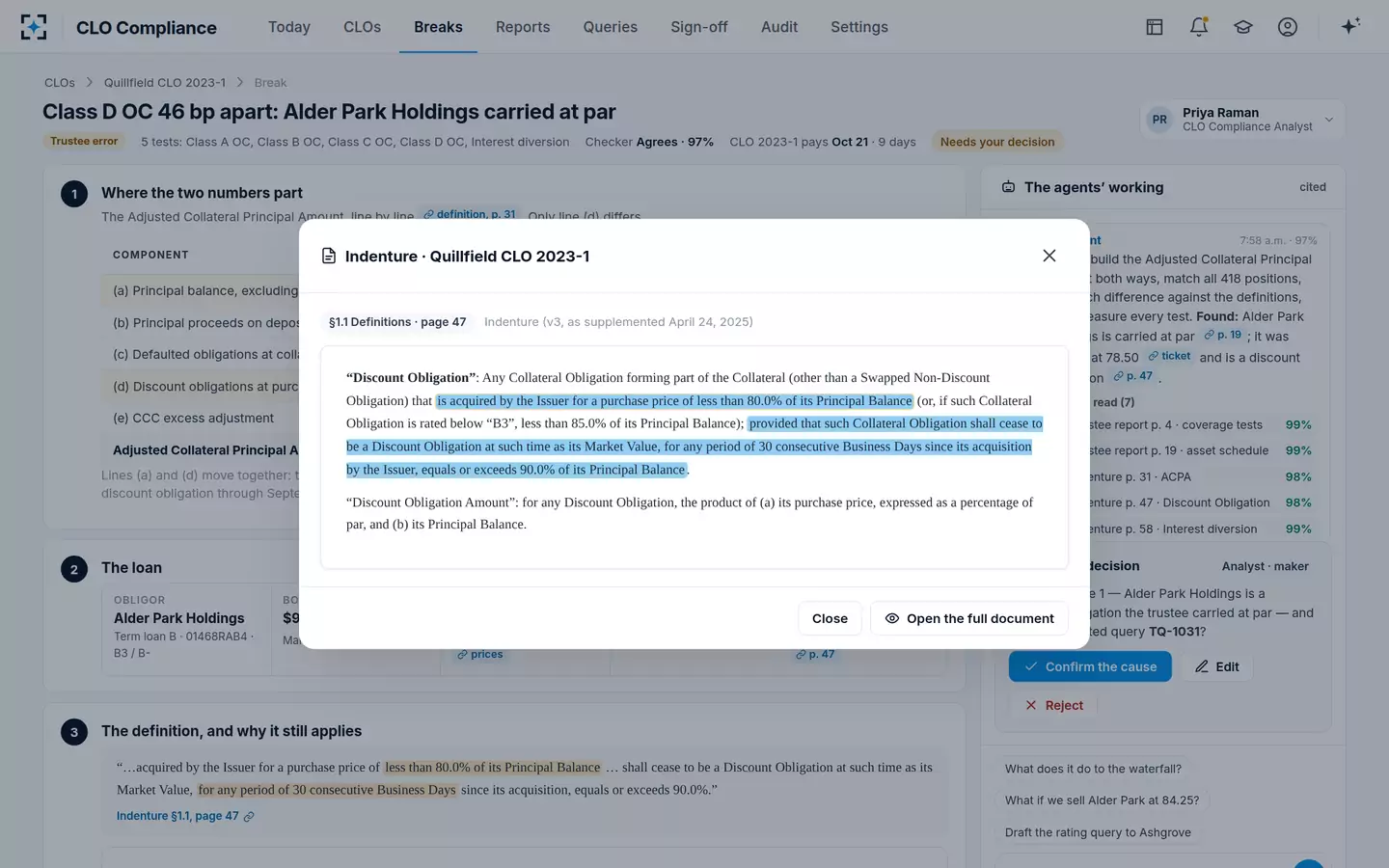
The 46 basis point gap comes from one loan, the Alder Park Holdings term loan B, and one defined term, Discount Obligation. The trustee's October asset schedule carried the $9,680,000 position at par, with no discount flag. The manager had bought it at 78.50 on 18 March 2026. Under the deal's definition, a loan bought for less than 80.0% of its principal balance (85.0% if rated below B3) is a discount obligation, carried at purchase price, until its market value has been at or above 90.0% for 30 consecutive business days.
The price history settles it. The loan's high since purchase was 86.50, on 4 September; on the determination date it was 84.25. It has none of the 30 business days it needs, so it is still a discount obligation, and the difference between par and 78.50 on $9,680,000 is $2,081,200 of adjusted par. The trustee had flagged the loan correctly through September; its October file dropped the flag. Nothing in the arithmetic was wrong on either side.
The same loan read two ways: the trustee's October file and the indenture as written
Trustee's draft report: Collateral obligation at par; discount flag "N" on the asset schedule, page 19.
Indenture, applied by CLO Compliance: Discount Obligation: bought at 78.50, below 80.0%; 0 of 30 business days at or above 90.0%.
Trustee's draft report: $9,680,000 (principal balance).
Indenture, applied by CLO Compliance: $7,598,800 (78.50% × $9,680,000).
Trustee's draft report: Line (a), principal balance.
Indenture, applied by CLO Compliance: Line (d), discount obligations at purchase price.
Trustee's draft report: 105.08%, passes with 98 bp of cushion.
Indenture, applied by CLO Compliance: 104.62%, passes with 52 bp of cushion.
Trustee's draft report: Passes.
Indenture, applied by CLO Compliance: Fails by 13 bp: $583,750 of interest must buy collateral on the payment date.
CLO Compliance traces the OC break to the loan, the definition and the trustee's page
What happens when a CLO fails its OC test?
When a CLO fails an OC test, cash that would have gone down the waterfall is redirected to deleverage the deal until the test is cured. Cordell, Roberts and Schwert describe the consequence as "the repurposing of loan interest payments to pay down the principal of senior noteholders until the coverage test is passed", calling coverage tests "automatic stabilizers that deleverage the capital structure of the CLO" (Journal of Finance, 2023; quoted from the working paper version).
The 2019 study adds the consequences for the people involved: "managers cannot use loan principal and interest payments to buy new portfolio loans", junior noteholders "cannot receive payments, as cash flows are diverted to senior noteholders", and managers lose "their performance-linked compensation, which is, on average, about 40 basis points of a CLO portfolio's par value" (Loumioti and Vasvari). Failure is not rare in a downturn. In June 2009, according to the Federal Reserve, "57 percent of CLOs" were "failing minimum OC tests"; by September 2010 only 10 percent were still in breach.
What is the OC cushion, and why is the junior one so thin?
The OC cushion is the distance between a class's ratio and its trigger, and it is widest at the top of the structure. Across 2008–2013, the senior OC slack averaged "about 20% above the senior OC test threshold (except during the credit crisis)", while "the reported junior OC slack is narrower, at around 4% above the junior OC test trigger" (Loumioti and Vasvari). The junior test is the one a single loan can move.
The sample deal's OC cushions on the manager's numbers: wide at the top, thin at the bottom
A thin cushion changes what counts as material. A 46 basis point difference on the Class A test would leave 589 basis points of room on either set of numbers; on the Class D test it decided whether the deal was 52 or 98 basis points from its trigger, and on the interest diversion test it decided whether the test passed at all. That is why the sample firm's settings flag any coverage test difference over 1 basis point as a break, and ask for a second look at any difference that changes a result.
Can CLO managers manage the OC test?
Managers can and do act to keep tests passing, and research shows the discretion is real. The 2019 study found "a positive association between these discretionary activities and the probability of avoiding an OC test violation", where the activities were discretionary fair valuation of defaulted and CCC loans and strategic trading, and that "strategic trading—but not discretionary fair valuation—relates to worse future CLO performance" (Loumioti and Vasvari). Some of that is ordinary portfolio management: selling a loan above its carrying value raises the numerator legitimately.
The question for compliance is whether each judgement the tests depend on is the one the indenture permits and is recorded. The SEC tested that line in a case over three CLOs, where the Enforcement Division argued that the manager's categorization of loans affected the OC ratio. The administrative law judge dismissed the proceeding in September 2017, finding the alleged violations "unproven" (SEC Initial Decision No. 1182), and the case is set out with its record in the evidence file behind a CLO trustee report.
What is the interest coverage test in a CLO?
The interest coverage test, or IC test, compares the interest the collateral produces with the interest due on a class and the classes above it, after senior fees and expenses. The Academy writes it as interest income from collateral divided by interest due on covered tranches, and notes that "a failing IC test similarly redirects cash away from junior investors toward senior paydown" (American Academy of Actuaries, 2026). In the sample deal the Class D IC ratio is 128.31% on both sets of numbers against a 105.00% trigger, with 2,331 basis points of cushion.
IC tests rarely produce reconciliation breaks of the OC kind, because interest collected is a cash figure both sides can see. Their weak point is the opposite one: interest that is due but not collected. In the SEC's 2017 decision on the three CLOs, the judge noted that the trustee reports listed, "in separate places, the interest rate (and balance) of each individual loan and the interest that actually was collected on the loan" (SEC Initial Decision No. 1182). Whether a loan that pays less than its coupon is still performing is a definition question, and it feeds the OC test, not only the IC test.
Why reconciliation has to read definitions, not just numbers
A reconciliation that compares the trustee's ratio with the manager's ratio finds that two numbers differ; it does not find why. The usual causes fall into four groups: the trustee applied a definition differently (as with Alder Park), one side's data is stale (a rating file dated before two downgrades), a trade or paydown is in flight across the cut-off, or the clause is genuinely ambiguous. Only the last needs a person to rule; the first three need the definition, the data and the dates side by side.
That is the design of CLO Compliance. The Recompute agent rebuilds each test with the deal's approved definition version; the Diff agent rebuilds the numerator both ways and matches each difference to a definition; the Checker agent re-derives the explanation independently. In the sample deal one cause moved five tests, Classes A to D and the interest diversion test, and the analyst confirmed it with the reason code "trustee error, definition not applied".
The Discount Obligation definition, opened from its citation
For the CCC and default rules that shape the same numerator, see CLO haircuts and the OC test. To trace an OC break on sample deals, or on your own past reports, start from CLO Compliance.
Questions people ask
What is the OC test formula for a CLO?
OC ratio = adjusted collateral principal amount ÷ principal of the notes at the tested class and all classes senior to it. The numerator is par for performing loans plus principal cash, with defaulted loans, discount purchases and CCC excess carried at lower values the indenture defines. The result is compared with the class's trigger; below it, the test fails.
Who calculates CLO tests?
The trustee or its collateral administrator calculates the tests and publishes them in the monthly and payment date reports, working from data the manager also supplies. Research on CLO reporting adds that an accounting firm's structured finance team typically checks the calculations. The manager recomputes every test itself to check the report before it is final.
How are defaulted assets treated in the OC test?
A defaulted loan is usually carried at the lesser of its market value and a recovery value, rather than par. In the sample deal's sister CLO, the definition is the lesser of market value and a 45.0% recovery rate times principal, with market value taken from "bid-side prices"; the choice between the bid and the evaluated mid moved the junior OC ratio by one basis point.
How often is the CLO OC test run?
Monthly in the trustee's reports and again on each payment date; in the structure Cordell, Roberts and Schwert describe, payments run at quarterly intervals. Managers also run the tests before trading, because every purchase or sale changes them. In CLO Compliance a portfolio manager can ask what a sale would do to each test before trading; nothing is traded by the agents.
Is the CLO OC test based on par or market value?
Mostly par: performing loans count at principal balance whatever their price. Market value enters only through the haircut terms, for defaulted loans, CCC excess and, in some definitions, discount obligations that have recovered. The Academy's 2026 report describes the test as comparing the par value of the collateral to the covered notes.