A shadow trustee is an independent recalculation of a CLO's trustee reporting: a third party, or a team inside the manager, that rebuilds the coverage tests, collateral quality tests and portfolio limits from the same positions and the indenture, so the manager has its own full set of numbers to compare with the trustee's before the report is final. It is one of three ways managers check trustee reports today, alongside a coded compliance engine that recomputes the tests from the manager's own positions and, more recently, agents that also explain each difference. The choice matters because each leaves the analyst somewhere different on the morning a report arrives: with a list of differences, or with causes. Botminds' CLO Compliance takes the third approach, and this guide sets out, honestly, where a shadow trustee is still the better answer.
The comparison uses sample data on fictional firms: Quillfield Capital's October 2026 cycle, in which one draft payment date report produced 8 breaks on one deal and 34 across the firm. Rules and research are linked to their publishers.
One month's reports, and what a second mark has to explain
62tests
on one sample deal; 54 agreed with the trustee and 8 did not
3causes
behind those 8 breaks; one of them moved $583,750 on the payment date
17causes
behind 34 breaks across 15 of the sample firm's 31 deals
What is a shadow trustee?
A shadow trustee is a service, or an in-house function, that independently reproduces the trustee's calculations for a CLO, test by test and often line by line, and reports where its results differ. No regulator defines the term; it is market usage for a second calculation of the trustee's work. The service usually ingests the trustee's data files, the manager's positions and trades, and its own coding of each indenture, and returns a parallel report.
The need for one follows from how CLO reporting is built. The trustee, in the words of a peer-reviewed study of CLO reports, is "responsible for calculating the monthly compliance test scores as well as preparing and distributing the CLO reports", while "the CLO manager usually works with the trustee to prepare the reports" (Loumioti and Vasvari, Journal of Accounting and Economics, 2019). The report is a joint product with one author of record, and the manager needs a way to check the parts it did not write.
What is the difference between a trustee and a collateral administrator?
The trustee holds the collateral and the accounts for the noteholders and pays according to the indenture's priority of payments; the collateral administrator keeps the collateral records and calculates the tests and reports. For the manager, the distinction matters less than the fact that both work from inputs the manager supplies, and that their report is the one the deal pays on.
Who sees the report is also set by the documents. In the SEC's 2017 decision on three CLOs, the judge noted that "the trustee made the reports available to the noteholders on a secure website" and that "the reports were confidential and not to be shared by the recipients with other parties" (SEC Initial Decision No. 1182). That decision dismissed the proceeding in September 2017 and became final in November 2017. In Europe the law assigns the duty: the originator, sponsor and issuer "shall designate amongst themselves one entity to fulfil the information requirements", and that entity publishes through a securitisation repository (Regulation (EU) 2017/2402, Article 7(2)).
Shadow trustee vs compliance engine vs agents: three approaches on one month's report
All three approaches produce a second mark; they differ in what they do with it. The table runs them against the questions an analyst asks on the morning a draft report arrives. The middle columns describe the approaches as generally offered, not any one provider; the last describes CLO Compliance.
Shadow trustee, coded engine, agents: what each answers on report day
| Question on report day | Shadow trustee | Coded compliance engine | Agents (CLO Compliance) |
|---|---|---|---|
| What does it produce? | A full parallel report from its own coding of the indenture. | The manager's own mark for each test, from its positions and coded rules. | Both marks for every test, and an explanation of each difference. |
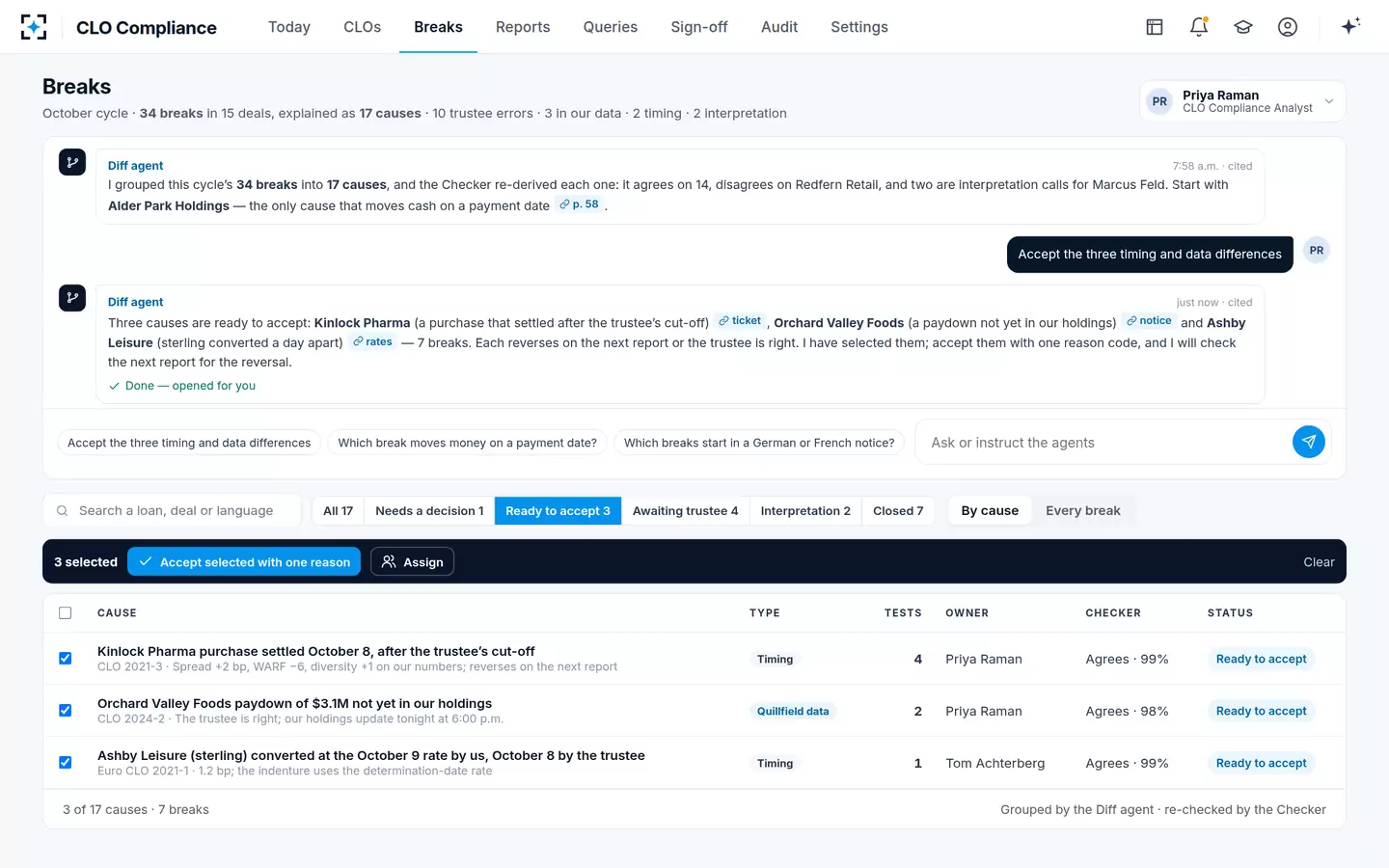
| Does it find the cause of a difference? | Sometimes, by an analyst at the provider; often after the manager asks. | No: it shows that two numbers differ. | Yes: traced to the loan and the clause, then re-derived by a second agent. |
| Whose reading of the indenture does it use? | The provider's coding. | Whoever coded each deal, internally or at the vendor. | The manager's approved definition versions, each cited to its page. |
| What does the payment date look like? | Not usually shown. | Not usually shown. | The waterfall on both sets of numbers, with the dollars a break moves. |
| What is left for the analyst? | A list of differences to investigate and query. | A list of differences to investigate and query. | Causes to confirm or reject, and queries drafted with evidence to approve. |
| Where is it strongest? | Independence: a separate organisation with its own data path. | Speed and cost on stable deals with few amendments. | Explanation and evidence, especially on deals near a trigger. |
What a third set of numbers leaves you with
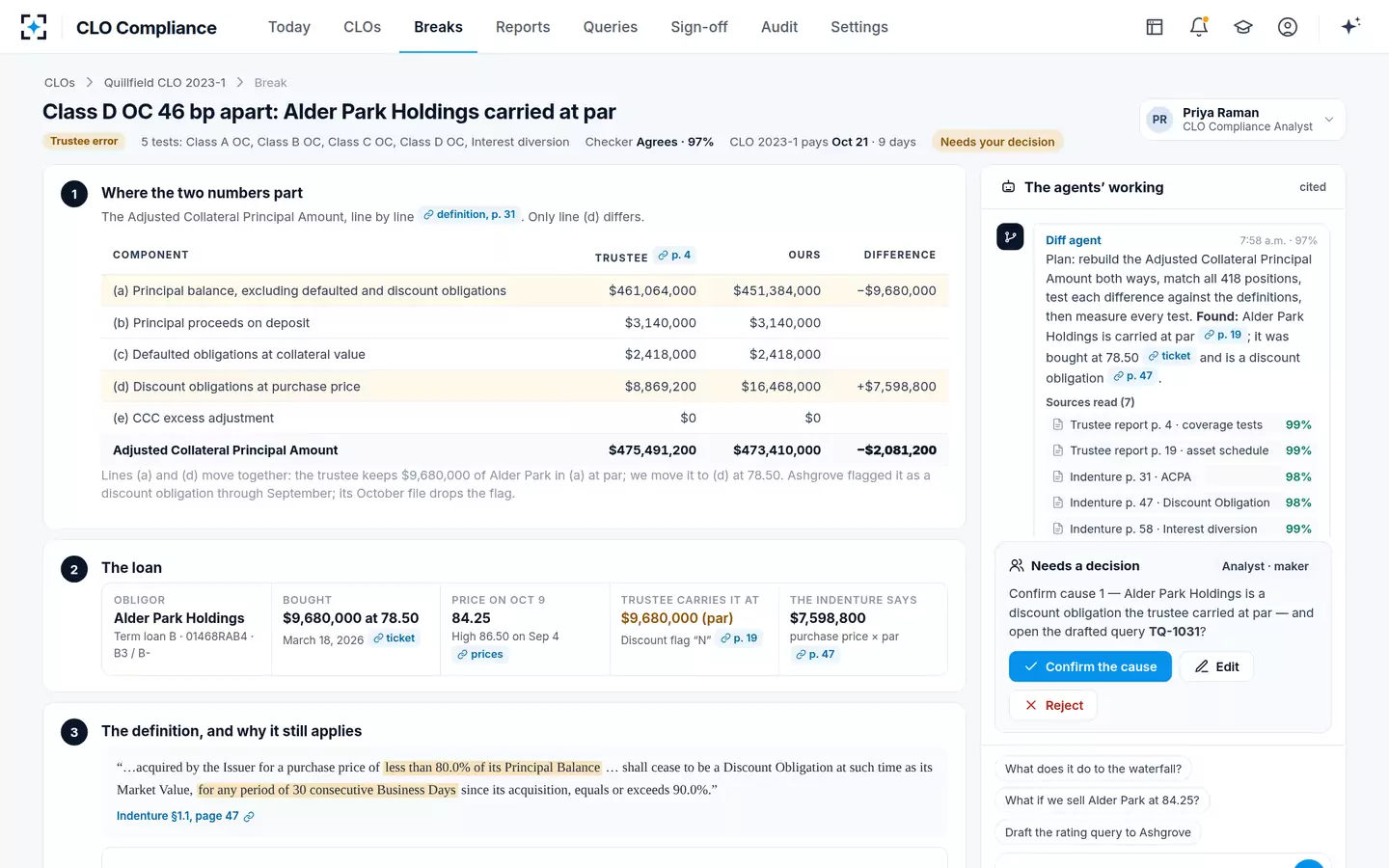
A third set of numbers tells the analyst that the trustee's Class D OC ratio is 105.08% and the second mark says 104.62%; it does not say why. On the sample deal, the answer was one loan, the Alder Park Holdings term loan B, carried at par by the trustee although it had been bought at 78.50 and was still a discount obligation under the indenture. Finding that took the asset schedule, the definition on page 47 of the indenture, the trade ticket and 30 business days of prices.
The same 46 bp gap, as a list of differences and as an explanation
A second mark alone: Trustee 105.08%; ours 104.62%; difference 46 bp.
CLO Compliance's explanation: Same marks; the gap is $2,081,200 of adjusted par, all from lines (a) and (d) of the numerator.
A second mark alone: Three more differences, 56, 52 and 48 bp.
CLO Compliance's explanation: The same cause: one loan, so one query rather than four.
A second mark alone: Trustee passes; ours 104.62% against 104.75%.
CLO Compliance's explanation: Fails by 13 bp on the indenture's reading: $583,750 must buy collateral on 21 October.
A second mark alone: To be collected by the analyst.
CLO Compliance's explanation: Trustee report pages 4 and 19, indenture pages 31, 47 and 58, the trade ticket and the price history, cited.
A second mark alone: Investigate, then draft a query.
CLO Compliance's explanation: Confirm the cause with a reason code; approve the drafted query; a second person checks it.
CLO Compliance rebuilds the numerator both ways and names the loan
Do CLO managers need a shadow trustee?
CLO managers need an independent mark for every test; whether it should come from an outside shadow trustee depends on what the manager already has. A manager that keeps its own positions in a loan administration system, has an operations team that reads indentures, and wants explanations before finalization needs a second mark it controls. A manager without its own position data, or with a small number of deals and no in-house reconciliation team, may be better served by buying the whole recalculation.
Supervisory pressure points the same way for both. The SEC's Division of Examinations says it will "review the pricing and valuation of illiquid instruments, such as private credit and private equity" among its fiscal 2027 priorities (SEC, Fiscal Year 2027 Examination Priorities). For a CLO manager the prices of defaulted and CCC loans flow straight into the overcollateralization tests, so a check that cannot show which price it used, and why, will not satisfy an examiner whichever approach produced it.
What is an independent CLO reconciliation?
An independent CLO reconciliation is one that does not share the error it is meant to catch. Independence has three parts: a different data path (positions and prices from the manager's own systems, not the trustee's file), a different method (the indenture applied afresh, not the trustee's coding re-run), and a different checker (someone or something other than the party that produced the calculation). A shadow trustee is strong on the first and often the second; it is weaker on the third when the same provider both calculates and explains.
CLO Compliance builds independence inside one system. The Recompute agent uses only the manager's positions and approved definitions as of the determination date; the Diff agent explains differences; the Checker agent re-derives each explanation from an asset-level rebuild on a different model family, and nothing is shown as explained without its agreement. When the two agents disagree, as they did over whether "bid-side prices" meant the bid or the mid for a defaulted loan, the analyst sees both workings and decides.
How much does a shadow trustee cost?
Shadow trustee fees are not published, and what is included, a parallel report alone or explanations too, varies by provider. The honest comparison is against your own costs. Count the analyst days spent per cycle on loading, recomputing, tying out, finding causes and queries; add the fee for any outside service; and set beside it the breaks in the last year that were found only after a report was final, with the dollars each moved.
The last item usually decides the question. On the sample deal's calendar, with the draft on a Monday and finalization on Thursday, a parallel report that arrives two days after the draft leaves one day to investigate, query and get an answer. In the sample cycle, the payment-moving cause was traced 76 minutes after the draft arrived and queried before 9 a.m., and the trustee had agreed and reissued the report the same morning. What a programme should be priced on, breaks explained before finalization, is set out in five CLO analytics measures.
How to switch CLO compliance providers without a gap
Switch in parallel, never in sequence: run the new approach alongside the old one for at least two full reporting cycles, including one payment date per deal, and only stop the old one when every difference between them has an explanation. The checklist below is ours; most of it is about keeping the indenture readings and the history, which are what a switch can lose.
Seven steps to change from a shadow trustee or coded engine without losing a cycle
- Inventory every deal's definitions and versions
Each supplemental indenture, and every interpretation the head of operations has ruled on, should move with its date and reason.
- Carry over tolerances as settings
Break thresholds per test family, second-look rules and their approval history.
- Run both for two cycles, including payment dates
Compare the new and old marks to each other as well as to the trustee; every difference needs a cause.
- Replay a month you already understand
Pick a past report with a known break and check the new approach finds the same cause.
- Keep the evidence archive readable
Past breaks, queries, replies and sign-offs must stay retrievable after the old contract ends.
- Re-map trustee contacts and formats
Each trustee's data file layout and query route, for every deal, US and European.
- Decide who signs during the overlap
One report of record per deal; the head of operations signs on one mark, with the other as a check.
What the analyst works from in CLO Compliance: causes, not a list of differences
Where a shadow trustee is still the right call
A shadow trustee is the right call when the manager has no reliable position data of its own, when it wants a fully separate organisation's view for a governance reason, or when its deal count is small enough that a parallel report a few days after each draft is enough. It is also a reasonable bridge while an in-house function is built. CLO Compliance does not replace that independence of organisation; it adds independence of method inside the manager, and explanations in time to use them.
Where the two meet, they can work together: a shadow trustee's parallel report can be one more input the agents tie out. To see how the agents explain a month's breaks on sample deals, or to run them on your own past reports, start from CLO Compliance; the controls that keep recompute and checking apart are described in what to test in CLO compliance software.
Questions people ask
What does a collateral administrator do?
A collateral administrator keeps a CLO's collateral records, calculates its coverage and collateral quality tests, and produces the monthly and payment date reports for the issuer and the trustee. It works from trade, position and cash data, much of which the manager supplies. The manager then checks the result against its own mark before the report is finalized.
Is a shadow trustee the same as a shadow accounting service?
They are close cousins. Shadow accounting usually means independently recalculating a fund's books and net asset value; a shadow trustee recalculates a CLO's tests and reports under its indenture. Both give a manager a second, independent set of numbers rather than an explanation of the differences.
Can a manager run its own shadow trustee in-house?
Yes: a coded compliance engine run by an operations team is, in effect, an in-house shadow. The weak point is independence: the same team often builds the calculation and checks it. Separating the recompute from the check, and recording a second person's approval on every query and sign-off, addresses that.
How long does a shadow trustee take to return results?
It depends on the provider and on when the trustee's data file arrives; turnaround is agreed in each contract. What matters is how much time is left before the trustee finalizes. In the sample cycle the draft arrived on a Monday and the trustee finalized on Thursday.
Do European CLOs need a different approach?
The tests are similar, but the reporting is set by EU or UK securitisation law, and agent notices arrive in several languages. EU rules require one designated entity to publish quarterly investor reports through a securitisation repository. Any approach has to read the notices and keep European data where the deal's rules require.