A CLO waterfall is the priority of payments in a collateralized loan obligation's indenture: on each payment date the trustee pays expenses and senior fees first, then interest on each class of notes from the most senior down, then subordinated fees and finally the equity, except that when a coverage test fails, interest that would have flowed further down is diverted to pay down notes or buy collateral until the test is cured. The order is fixed; what decides whether the exception applies is the test result in the trustee's payment date report. That is why a single break in a junior overcollateralization test can change who gets paid. This page follows one fictional cycle in Botminds' CLO Compliance, where a 46 basis point gap on one deal turned a passing interest diversion test into a failing one, and $583,750 of interest went to collateral instead of the equity.
The deal, the trustee and every name in the cycle are sample data on fictional firms: Quillfield Capital's CLO 2023-1, trustee Ashgrove Corporate Trust, October 2026. The descriptions of how waterfalls work are quoted from peer-reviewed research and regulators' texts.
One payment date, one break, in CLO Compliance
46bp
gap between the trustee's and the manager's Class D OC ratio, from one loan
13bp
by which the interest diversion test fails on the manager's numbers; the trustee showed a pass
$583,750
of interest that must buy collateral on 21 October instead of reaching the equity
9days
between the signed, corrected report and the payment date
How does a CLO waterfall work?
A CLO waterfall works by paying cash from the loans in a fixed order set by the indenture, with the coverage tests deciding whether interest continues down the order or is redirected. Cordell, Roberts and Schwert describe the normal case: "Interest received from the collateral pool is first used to pay administrative expenses and senior management fees. The remainder is used to pay interest on the secured notes beginning with the senior tranches, followed by the mezzanine tranches, and then the junior tranches" (CLO Performance, Journal of Finance, 2023; quoted from the working paper version). Principal received during the reinvestment period buys new loans; after it, principal pays down the notes in order.
The interest waterfall in order, and where a failing coverage test cuts in
| Step | Paid to | What changes if a test fails |
|---|---|---|
| 1 | Trustee, administrative fees and expenses | Nothing; paid first in any case. |
| 2 | Senior management fee | Nothing. |
| 3 | Interest on the AAA notes, then AA, A, BBB and BB in order | Interest to classes junior to a failing test can be cut off. |
| 4 | Coverage test cure payments | Cash goes here instead of further down: to pay down senior notes, or to buy collateral under an interest diversion test. |
| 5 | Subordinated management fee | Paid only from what is left after any cure. |
| 6 | Incentive fee, then the equity (subordinated notes) | Receives the residual, which is what the cure reduces. |
The actuaries' October 2026 report to the NAIC states the same order compactly: "trustee and administrative fees are paid first, followed by the senior management fee and then interest on the AAA tranche, continuing down through AA, A, BBB, and BB tranches", then "OC/IC cure payments are made if any tests are failing, followed by the subordinate management fee, and finally equity distributions" (American Academy of Actuaries). Because the equity sits at the bottom, it is the class whose payment a test result changes most directly.
One cycle, from determination date to payment date
Every payment date has a fixed run-up: a determination date at which the portfolio is measured, a draft payment date report, a window for the manager to check it, the trustee's finalization, and the payment itself. For Quillfield CLO 2023-1 in October 2026 those were Friday the 9th, Monday the 12th, Thursday the 15th and Wednesday the 21st. The window in which a correction is cheap was three days long.
The sample deal's October calendar: twelve days, three of them for corrections
- Determination date to draft report9–12 Oct
- Draft to trustee finalization12–15 Oct
- Finalization to payment date15–21 Oct
Monday morning: a 46 bp gap on a junior test
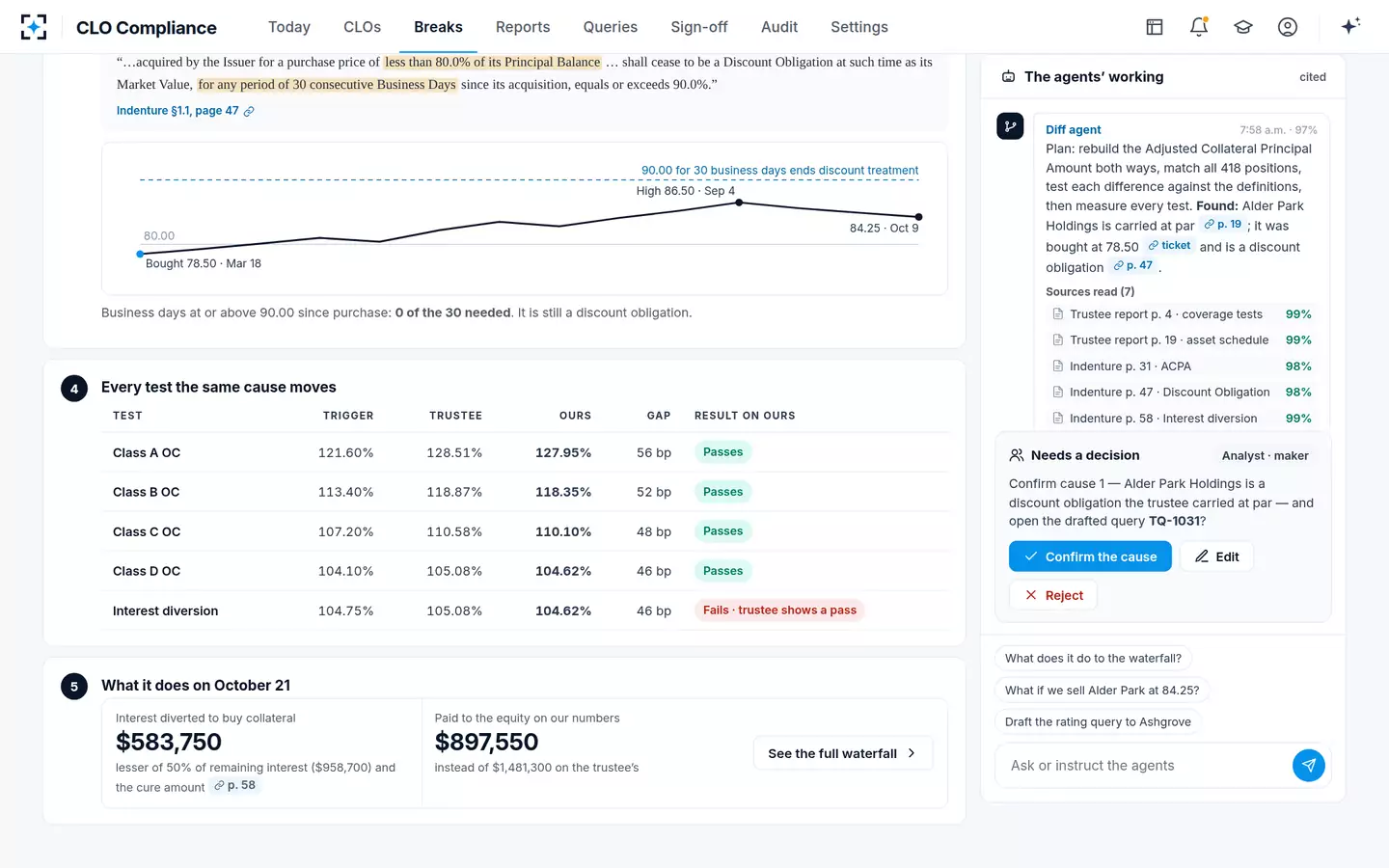
The draft payment date report arrived at 6:42 a.m.: 64 pages and 418 positions. By 7:41 the Recompute agent had rebuilt all 62 tests from the manager's own positions with the indenture's approved definitions; 54 agreed with the trustee and 8 did not. By 7:58 the Diff agent had traced the 8 breaks to 3 causes, and one of them moved cash. The Class D overcollateralization ratio was 105.08% on the trustee's numbers and 104.62% on the manager's, against a 104.10% trigger: a pass either way. But the deal's interest diversion test uses the same ratio with a higher trigger, 104.75%, and on the manager's numbers it failed by 13 basis points.
The cause was one loan. The trustee carried $9,680,000 of the Alder Park Holdings term loan B at par; the manager had bought it at 78.50 in March, which made it a discount obligation under the indenture, carried at purchase price until its market value had been at or above 90.0% for 30 consecutive business days. It never had been. The difference, $2,081,200 of adjusted par, is the whole 46 basis points. The definition-by-definition trace is in the CLO OC test, one loan and two definitions.
What is interest diversion in a CLO?
Interest diversion is the redirection of interest that would otherwise pay junior fees and the equity into buying collateral, triggered when an interest diversion test fails. Cordell, Roberts and Schwert list it among the "three common tests", with overcollateralization and interest coverage, and describe the general consequence of failing a coverage test as "the repurposing of loan interest payments" until the test is passed; "any remaining interest is then used to pay interest according to the priority structure" (CLO Performance, working paper version). In the sample deal, the diverted interest buys collateral rather than paying down notes, so the sample firm's settings list it as the "interest diversion / reinvestment test".
The amount is set by the indenture. The sample indenture sets it as the lesser of 50% of the remaining interest and the cure amount, the extra collateral needed to bring the ratio back to the test level. The cure amount is plain arithmetic: 104.75% of the $452,500,000 of Class A to D notes is $473,993,750 of adjusted collateral; the manager's figure is $473,410,000; the gap is $583,750. That was the smaller of the two, so $583,750 is diverted.
Every test the cause moves, and what it does to the CLO waterfall on 21 October
What the waterfall would have paid on the trustee's numbers
On the trustee's draft, every test passed, so the interest would have run to the bottom of the waterfall and the subordinated notes would have received $1,481,300. On the indenture's reading, the interest diversion test fails, $583,750 buys collateral, and the subordinated notes receive $897,550. The difference is exactly the diverted amount: nothing above the equity changes.
Quillfield CLO 2023-1 on 21 October: the trustee's draft and the indenture as written
Trustee's draft payment date report: At par, $9,680,000; no discount flag.
Indenture, applied in CLO Compliance: Discount obligation at 78.50: $7,598,800.
Trustee's draft payment date report: 105.08%: passes.
Indenture, applied in CLO Compliance: 104.62%: passes.
Trustee's draft payment date report: 105.08%: passes.
Indenture, applied in CLO Compliance: 104.62%: fails by 13 bp.
Trustee's draft payment date report: $0.
Indenture, applied in CLO Compliance: $583,750.
Trustee's draft payment date report: $1,481,300.
Indenture, applied in CLO Compliance: $897,550.
Had the break been found after the 15th, the report would have been final and the trustee would have paid on it. The cash would have reached the equity, the collateral the indenture says it must buy would not have been bought, and the fix would have waited for a later period, if it came at all. That is the whole case for checking every payment date report before finalization rather than after.
The query, the reply and the revised report
The rest of the cycle, from the traced cause at 7:58 to the signature at 9:11, took 73 minutes, and every step had a person's name on it. The analyst confirmed the cause with the reason code "trustee error, definition not applied". The Query agent had drafted the query to the trustee with its evidence attached: the trustee's own page 19, indenture pages 31, 47 and 58, the trade confirmation and the price history. The analyst submitted it at 8:49; the head of CLO operations approved it at 8:53 as the second person; the trustee relationship manager sent it at 8:57.
Monday 12 October in CLO Compliance: from draft report to signature in two and a half hours
- Read, recompute59
- Trace17
- Confirm, approve55
- Send, reply6
- Fix, sign12
The trustee agreed and reissued the report: Class D OC 104.62%, the interest diversion test failing, $583,750 diverted. The Reader agent tied out the revised report; after one fix in the manager's own loan administration system, a borrower coded to the wrong industry, which a second person approved, 62 of 62 tests agreed. The head of CLO operations signed with a second factor at 9:11 a.m., nine days before the payment date. The evidence behind each step is described in the evidence file behind a CLO trustee report.
What the what-if showed before anyone traded
A diversion is not the only way to cure the test; the manager can also change the portfolio. The portfolio manager asked what selling Alder Park at its current price of 84.25 would do. The sale turns a loan carried at $7,598,800 into $8,155,400 of principal cash, which counts in full, so the adjusted collateral rises to $473,966,600 and the Class D OC to 104.74%: one basis point short of the 104.75% interest diversion level. The sale alone would still divert $27,150 on 21 October, instead of $583,750.
A what-if in CLO Compliance before any trade: selling the loan nearly cures the test
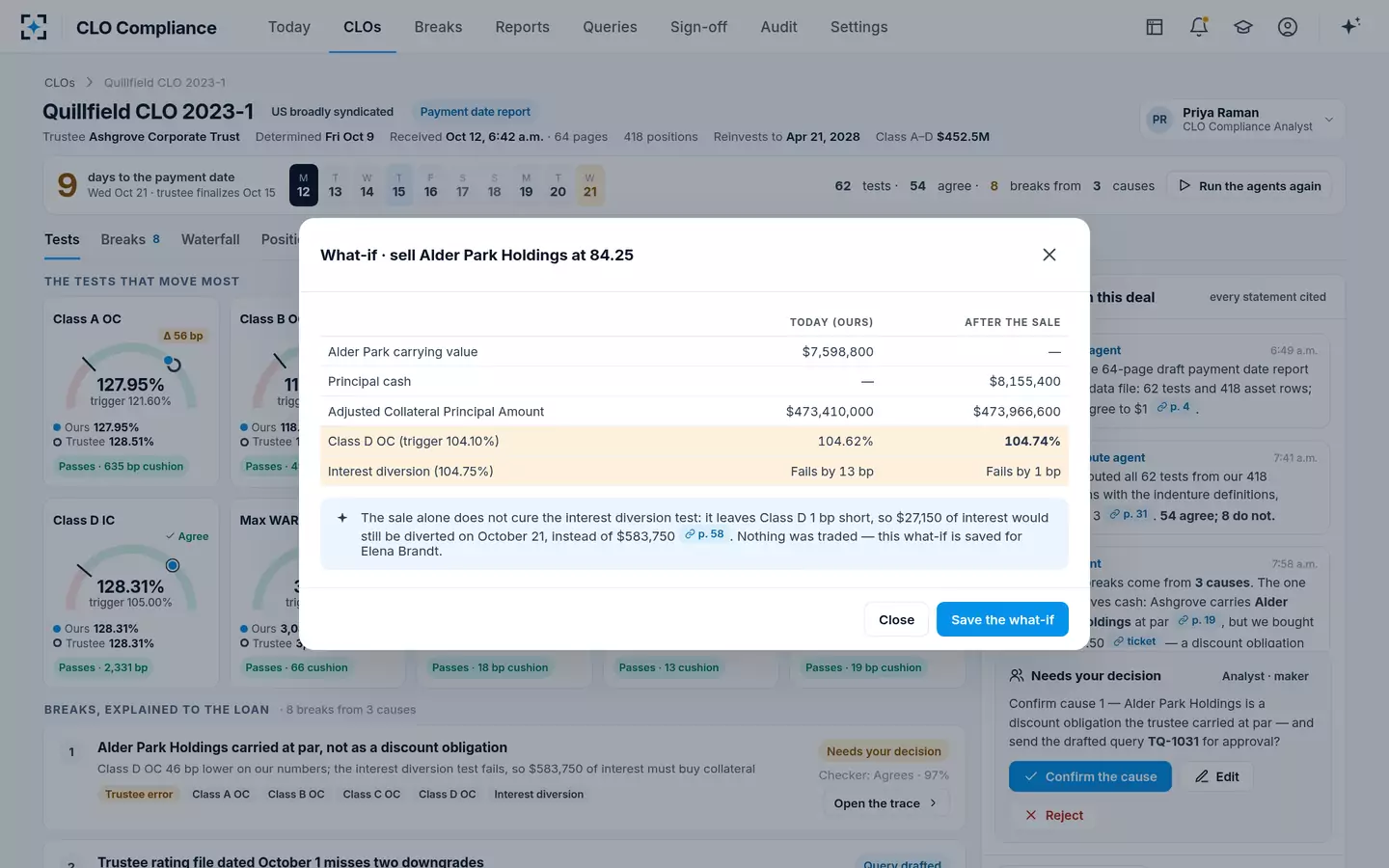
The what-if is the analyst's real contribution to the portfolio manager: not a list of failures, but the size of the cushion and what a trade would do to it, on the indenture's own numbers. Whether to sell is a trading decision, and stays one.
What happens when a CLO test fails, and when it fails silently
When a coverage test fails and the trustee's report shows it, the waterfall does what the indenture says: interest is cut off below the failing class and redirected. In one of the deals in the SEC's 2017 decision, "if a Fund failed its OC Ratio Test (or its IC Ratio Test), the trustee was to use available monies to pay down principal, starting with the highest Class A noteholders", and "the Subordinated Collateral Management Fee and preference shareholders would not be paid" (SEC Initial Decision No. 1182). The judge dismissed that proceeding in 2017, finding the alleged violations unproven; the description of the waterfall stands.
Tests fail in numbers in bad years. The Federal Reserve reported to Congress that breaches of OC triggers "peaked in June 2009", before most deals cured (Federal Reserve, Report to the Congress on Risk Retention, 2010). The failure that does the most damage to the waterfall, though, is the silent one: a test that fails on the indenture's numbers and passes on the trustee's. Nothing in the payment date report flags it, and the waterfall pays as if the test had passed. Only a manager that recomputes each test before finalization will see it.
To follow a payment date like this one on sample deals, or on a sample of your own past trustee reports, start from CLO Compliance.
Questions people ask
What happens on a CLO payment date?
The trustee distributes the cash collected since the last payment date through the indenture's priority of payments: expenses and senior fees, interest on each class of notes in order, any cure payments required by failing tests, subordinated fees and the equity. It pays on the final payment date report. Principal is reinvested during the reinvestment period and repays notes in order after it.
Who gets paid first in a CLO?
The trustee and administrative expenses, then the senior management fee, then interest on the AAA notes, in the order the actuaries' 2026 report describes. The equity is paid last, from whatever remains. A failing coverage test inserts cure payments above the subordinated fees and the equity.
How is cash redirected in a CLO?
A failing OC or IC test redirects interest from the classes below it to pay down the senior notes until the test passes; a failing interest diversion test, in deals that have one, redirects part of the interest to buy collateral. The indenture sets the amount; in the sample deal it is the smaller of 50% of the remaining interest and the cure amount, which came to $583,750.
What is a CLO payment date report?
It is the trustee's report for a payment date: the tests as of the determination date and the distribution through the waterfall. It arrives as a draft, is open to the manager's queries, and becomes final a few days before payment. In the sample deal the draft arrived on 12 October and the trustee finalized on the 15th.
Can a CLO manager cure a failing test before the payment date?
Sometimes, by trading: selling or buying loans changes the adjusted collateral and the ratio. In the sample deal, selling the discount loan at 84.25 would have lifted the ratio to 104.74%, one basis point short of the test level, leaving $27,150 still diverted. Whether to trade is the portfolio manager's decision.