A CLO reinvestment period is the part of a collateralized loan obligation's life during which the manager may use principal from loans that repay, mature or are sold to buy new loans, subject to the indenture's collateral quality and coverage tests; it typically runs four to five years after the deal becomes effective. When it ends, the deal starts to amortize: principal pays down the notes in order, the manager's trading is largely limited to reinvesting unscheduled principal, and the conditions on any purchase tighten. For compliance, the end date is a switch: the same portfolio is tested against different rules the day after. Botminds' CLO Compliance reads each deal's non-call, reinvestment and maturity dates and the clauses tied to them from the indenture, so that every test and trading restriction is checked under the rules in force for that deal on that determination date.
Where a sample deal appears, it is fictional, from Quillfield Capital's book in CLO Compliance. Durations and rules are quoted from the Federal Reserve, peer-reviewed research, a court, and EU and UK legislation, each linked where it appears.
The reinvestment period in four numbers
4–5
years of reinvestment in today's deals; a two-year non-call period runs alongside its start
~20%
of the collateral a manager turns over each year in most deals, in the Fed's 2010 description
5%
risk retention still required of EU and UK securitisations; US open-market managers exempt since 2018
Apr 2028
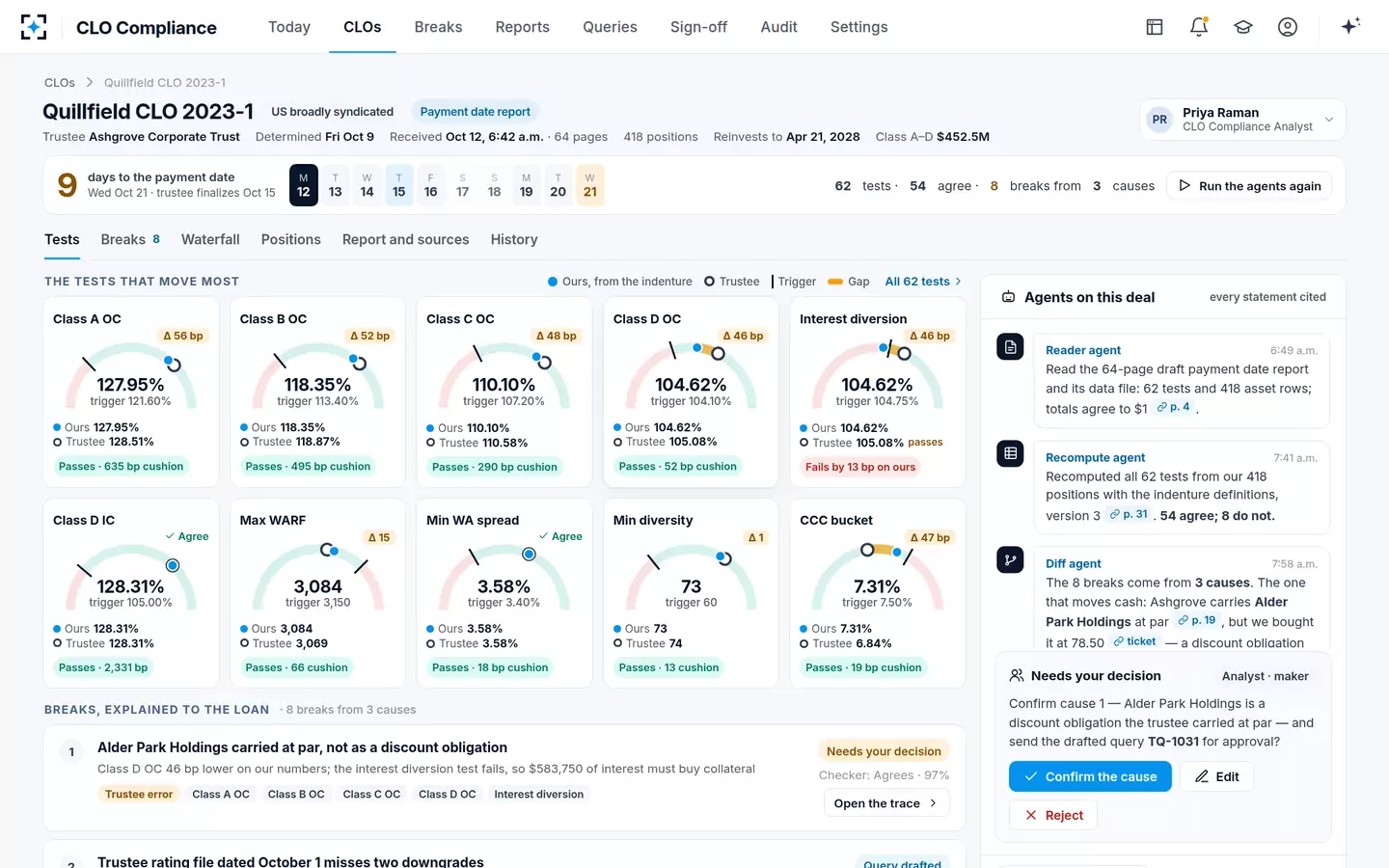
end of the sample deal's reinvestment period, shown on every test screen
What is a CLO reinvestment period?
A CLO reinvestment period is the window in which the manager actively manages the portfolio, reinvesting principal rather than repaying notes. The Federal Reserve's 2010 report to Congress explains that "[e]ven after the CLO closing, the CLO manager continues to make investment decisions over a specified reinvestment period during which proceeds from sold, maturing, or refinanced loans are reinvested", that "[i]n most deals, the manager turns over a limited portion of the collateral, generally around 20 percent, each year", and that "the manager's ability to alter the composition of the portfolio is restricted and could be eliminated if the CLO fails to meet certain performance tests" (Federal Reserve, Report to the Congress on Risk Retention).
Cordell, Roberts and Schwert describe the phase in today's deals: "The second is the reinvestment phase, which lasts four to five years. During this phase, the CLO manager actively trades loans to manage the credit risk and principal balance of the collateral pool, subject to the collateral quality requirements and coverage tests spelled out in the CLO indenture" (Journal of Finance, 2023; quoted from the working paper version). The American Academy of Actuaries, in its October 2026 report for the NAIC, gives the reinvestment period as "typically ~5 years" and a legal final maturity of "10–13 years from closing" (American Academy of Actuaries).
How long CLOs reinvest, then and now: the reinvestment period has shortened
- Reinvestment5–7 yrs
- After reinvestment, to contractual maturityto 12–15 yrs
- Reinvestment4–5 yrs
- After reinvestment, to legal finalto 10–13 yrs
The phases of a CLO's life, and the rules in each
A CLO moves through five phases, and each changes what the manager may do and which tests bind. Cordell, Roberts and Schwert set out the sequence: a warehouse that "takes six to nine months", a ramp-up "typically no more than six" months, after which "the CLO becomes effective" and "[c]ovenants, such as coverage tests, become effective"; then a non-call period "which lasts two years", overlapping a reinvestment phase of four to five years; and finally amortization, when "[a]ll principal generated by the collateral pool is used to retire the outstanding CLO tranches" (CLO Performance, working paper version).
Which rules apply in which phase: the questions CLO Compliance asks of each indenture
| Phase | Principal proceeds | What the manager may buy | What to read in the indenture |
|---|---|---|---|
| Warehouse | Warehouse financing, before closing. | Loans meeting the eligibility criteria, to build the pool. | Eligibility criteria; what transfers into the deal at closing. |
| Ramp-up | Issuance proceeds. | Loans until the target par is reached. | Target par and effective date conditions; when the tests start to apply. |
| Non-call (overlaps reinvestment) | Reinvested. | As in reinvestment. | Non-call end date; who may call, reset or refinance afterwards, and how. |
| Reinvestment | Reinvested in new loans. | Any loan meeting eligibility, if the collateral quality and coverage tests are satisfied or not made worse, as the indenture sets. | Reinvestment end date; trading conditions; discretionary sale limits. |
| Amortization (post-reinvestment) | Pay down the notes in order, most senior first. | Largely limited to reinvesting unscheduled principal, if the indenture allows it at all. | Post-reinvestment trading conditions; which tests a purchase must satisfy; sale limits. |
The EU reporting template uses the same phases. For each CLO the reporting entity must state the "Current Period" as "Warehouse (WRHS) Ramp-up (RMUP) Reinvestment (RINV) Post-reinvestment (PORI)", with the start and expected end dates, and the "Non-Call Period End-Date" (Delegated Regulation (EU) 2020/1224, Annex XIV). A compliance system that cannot say which period a deal is in on the determination date cannot say which rules to test.
What happens after the CLO reinvestment period ends?
After the reinvestment period ends, principal from the loans repays the notes in order of seniority, and the manager's freedom to trade narrows sharply. "At this stage," Cordell, Roberts and Schwert write, "the manager's ability to buy and sell collateral is limited to the reinvestment of unscheduled principal payments" (CLO Performance, working paper version). The actuaries describe the same switch: "Once the reinvestment period ends, principal proceeds are used to pay down tranches sequentially, starting with the most senior (AAA). This is known as the sequential paydown" (American Academy of Actuaries).
The structure changes in a way the tests feel. As principal repays the senior notes, every OC ratio above 100% rises, because the same amount leaves the numerator and the denominator; meanwhile the collateral quality tests are measured on a shrinking pool. A downgrade that would have been a rounding error in a full portfolio can move a WARF or CCC test materially in a small one. The actuaries' modelling found that "tail risk decreases as CLOs approach maturity", while noting that practitioners argue the opposite for deals with a long reinvestment horizon still ahead, because "the CLO manager can offset poor credit experience through active management and buying loans at a discount" (American Academy of Actuaries).
The reinvestment end date sits on every deal screen in CLO Compliance
Can a CLO reinvest after the reinvestment period?
Only in a limited way. In the structure Cordell, Roberts and Schwert describe, trading after the end date is "limited to the reinvestment of unscheduled principal payments"; each indenture sets which proceeds count as unscheduled, how long the manager has to reinvest them and on what conditions, and requires the rest to repay notes. It is the clause most worth reading before the end date arrives.
The EU template shows how many separate limits can apply, because it asks for them one by one: the allowed percentage of "discretionary sales per year", the actual "discretionary sales, year to date", the "amount reinvested, year to date", and whether there are "restrictions when notes can be refinanced" (Delegated Regulation (EU) 2020/1224, Annex XIV). Each is a limit a manager can breach without any coverage test failing.
What is maintain or improve in a CLO?
"Maintain or improve" is a trading condition: a purchase or sale is allowed only if, afterwards, a given test is no worse than before, or passes. Indentures can use it as a condition on trading, for example while a collateral quality test is failing or after the reinvestment period, and the EU template itself gives "must maintain or improve OC test ratios after purchase" as an example of a restriction on note redemptions (Delegated Regulation (EU) 2020/1224, field SESC22). Which tests, measured how and against which date, is in the definition.
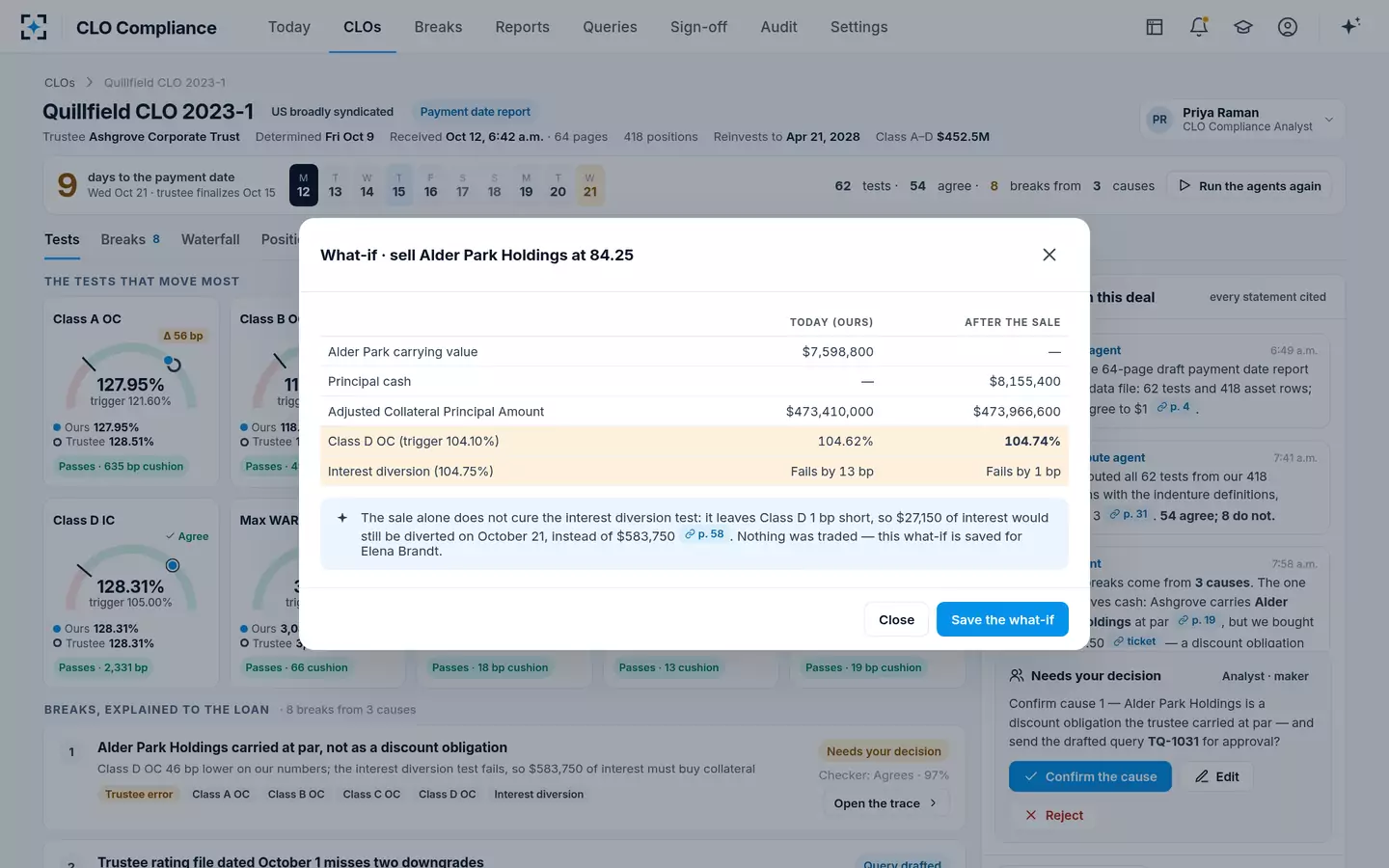
For compliance, maintain-or-improve turns every trade into a test of its own, run on the manager's numbers before the trade and on the trustee's after. That is why CLO Compliance lets a portfolio manager ask what a sale or purchase does to each test before trading, on the indenture's definitions; in the sample deal, selling one discount loan would have moved the junior OC ratio from 104.62% to 104.74%. The agents compute; they never trade.
A what-if before a trade in CLO Compliance: the test result after the sale, on the indenture's numbers
What is a CLO reset, and how does it differ from a refinancing?
A reset rewrites the deal's terms, typically extending its reinvestment period and maturity; a refinancing only replaces the notes at new spreads. Cordell, Roberts and Schwert define both: "In a refinancing, some or all of the deal's existing liabilities are called and reissued at prevailing market spreads to lower the cost of capital, while other aspects of the deal are unchanged. In a reset, the liabilities are refinanced and other terms of the CLO indenture are modified, typically for the purpose of extending the reinvestment period and deal maturity" (CLO Performance, working paper version). Both usually wait for the non-call period to end.
A reset is a new set of rules on an old portfolio. For a compliance team it means a new definition version, a new reinvestment end date and possibly new test levels, effective from a specific date, and the risk that the trustee and the manager switch to the new terms on different determination dates. The actuaries' 2026 capital model for the NAIC does not address resets at all, noting that a reset "materially changes a CLO's structural characteristics—including its reinvestment period, liability costs, and collateral profile" (American Academy of Actuaries, section 9.4.2).
What are the CLO risk retention rules in the US, the EU and the UK?
In the US, managers of open-market CLOs have not had to retain risk since 2018; in the EU and the UK, a 5% retention by the originator, sponsor or original lender still applies. The US position comes from a court. Dodd-Frank directed regulators to require "any securitizer" to retain "not less than 5 percent of the credit risk", and the agencies applied the rule to CLO managers. The D.C. Circuit disagreed: "Because we agree with the CLO managers that they are not 'securitizers' under § 941, the managers need not retain any credit risk" (Loan Syndications and Trading Association v. SEC, No. 17-5004, D.C. Cir., decided 9 February 2018).
The court ordered the district court "to vacate the rule insofar as it applies to open-market CLO managers". The rule's open-market CLO provision remains printed in the Code of Federal Regulations, defining an open market CLO as one managed by a registered adviser that "holds less than 50 percent of its assets ... in loans syndicated by lead arrangers that are affiliates" (17 CFR 246.9), but after the decision it does not bind open-market managers.
CLO risk retention after 2018: the US court ruling against EU and UK rules
United States: Not open-market CLO managers: the D.C. Circuit held they are not "securitizers" (2018). Balance sheet CLOs were outside that case.
EU and UK: The originator, sponsor or original lender: EU Article 6(1); UK FCA SECN 5.2.1 since 1 November 2024.
United States: 5% of credit risk under the statute, where it applies.
EU and UK: "Not less than 5 %", measured at origination.
United States: Statute reaches parties that transfer assets to the issuer.
EU and UK: An entity "established or operates for the sole purpose of securitising exposures" is not an originator.
United States: Not a separate CLO reporting duty.
EU and UK: EU quarterly investor reports must include "information about the risk retained", including which retention method applies.
The EU text requires that the originator, sponsor or original lender "shall retain on an ongoing basis a material net economic interest in the securitisation of not less than 5 %", and adds that "an entity shall not be considered to be an originator where the entity has been established or operates for the sole purpose of securitising exposures" (Regulation (EU) 2017/2402, Article 6(1)). The UK carried the rule into its own regime: the FCA, the PRA and the Treasury "decided to implement the FCA and PRA rules on 1 November 2024" (FCA PS24/4) under the Securitisation Regulations 2024, and the FCA's rule SECN 5.2.1 repeats the 5% requirement (FCA Handbook). A reset of a European deal is therefore a moment to confirm that the retention is still held as the documents and the investor reports say.
How long is a CLO reinvestment period, and why does the end date matter?
Typically four to five years from the effective date in recent deals, according to the research and the actuaries above, and five to seven in pre-crisis deals according to the Federal Reserve's 2010 report; the indenture fixes each deal's date, and a reset can move it. The date matters because three things change on it: where principal goes, what the manager may buy, and which trading conditions apply.
The end date also shapes how the deal behaves in a downturn. Cordell, Roberts and Schwert attribute CLOs' resilience to "their closed-end structure, long-term funding, and embedded options to reinvest principal proceeds" (CLO Performance, abstract). A deal past its reinvestment period has given up most of that last option, which is one reason the date should be on every screen where a test is read.
Six things to check in a CLO's indenture before its reinvestment period ends
- The exact end date, and what can move it
A reset, an extension or an event of default can change it; record the version in force on each determination date.
- What happens to scheduled and unscheduled principal
Which proceeds may still be reinvested afterwards, within what time, and which must repay notes.
- Post-reinvestment trading conditions
Which tests a purchase must satisfy or maintain or improve, and on what measure date.
- Sale limits
Discretionary sales allowed per year, and how credit-risk and defaulted sales are treated.
- Non-call, refinancing and reset terms
Who may call, the notice periods, and what a reset may change.
- Retention, for EU and UK deals
Who retains, by which method, and what the investor reports say about it.
The tests that bind in each phase are the same ones described in the WARF and collateral quality tests and the OC test; what changes at the end of the reinvestment period is which trades they restrict. To see deal dates and phase rules applied on sample deals, start from CLO Compliance.
Questions people ask
What is a CLO non-call period?
It is the first part of a CLO's life, usually two years in the deals Cordell, Roberts and Schwert studied, during which the equity cannot call the notes, reset or refinance the deal, or liquidate it early. It overlaps the reinvestment period. EU reporting templates record its end date for every CLO.
What is the CLO amortization period?
It is the phase after the reinvestment period ends, when principal from the loans pays down the notes in order of seniority and the deal winds down. The manager's trading is limited to what the indenture allows, mostly reinvesting unscheduled principal. The EU template calls it the post-reinvestment period.
Does a CLO reset extend the reinvestment period?
Usually, yes: a reset refinances the notes and modifies other terms of the indenture, typically to extend the reinvestment period and maturity. A refinancing, by contrast, only reissues the notes at new spreads and leaves the other terms unchanged. Both normally wait until the non-call period ends.
Do US CLO managers have to retain 5% of the deal?
Not open-market CLO managers: in LSTA v. SEC the D.C. Circuit held in February 2018 that they are not "securitizers" under the Dodd-Frank risk retention provision, and directed that the rule be vacated as applied to them. EU institutional investors, though, must verify before investing that a non-EU originator, sponsor or original lender retains at least 5% (Regulation (EU) 2017/2402, Article 5(1)(d)), so a US deal sold to them has to meet that test.
What are the European CLO risk retention rules?
The EU Securitisation Regulation requires the originator, sponsor or original lender to retain a material net economic interest of not less than 5%, by one of the methods in Article 6(3), and excludes entities that exist only to securitise from counting as originators. The UK applies the same requirement through FCA and PRA rules in force since 1 November 2024. EU investor reports must state the retention and its method.