A CLO trustee report is the monthly report, and on each payment date the payment date report, that the trustee or collateral administrator of a collateralized loan obligation publishes for its noteholders: the outstanding notes, interest and principal received, every loan in the portfolio, and the result of every coverage test, collateral quality test and portfolio limit the indenture sets. It is the report the deal pays on, but it is not evidence that its numbers are right, and much of what goes into it comes from the manager. A manager that confirms a trustee report should be able to show, for every test, why: the position, the trade ticket, the price and rating as of the determination date, the indenture clause, and for every difference the query, the trustee's reply and who signed. Botminds' CLO Compliance builds that evidence file as the reconciliation happens, not afterwards.
The sample deal on this page is fictional: Quillfield Capital's CLO 2023-1 in October 2026. The SEC case, the EU rules and the federal record-keeping rule are quoted from the publishers' own texts.
What a trustee report holds, and what one SEC case found in them
68pages
in one quarterly trustee report cited in the case, against 9 pages of financial statements
125.28%
OC ratio one report showed as passing, while a loan in it paid far less interest than due
2017
year the case was dismissed: the alleged violations were found unproven
64pages
in the sample deal's draft payment date report, with 418 asset rows
What is in a CLO trustee report?
A CLO trustee report contains the deal's balances, cash received and paid, the full collateral list and the result of every test, prepared from data the issuer and manager supply. Describing three CLOs' indentures, an SEC administrative law judge summarised the duty this way: the trustee was "required to prepare and distribute a monthly report to noteholders containing various information about the Fund and its assets, including the outstanding balance of the notes, interest received, a description of loans in the portfolio, and the outcome of tests relating to the collateral, including the OC Ratio test" (SEC Initial Decision No. 1182).
For European deals the content is set by law. The EU Securitisation Regulation requires the designated reporting entity to publish "quarterly investor reports" containing "all materially relevant data on the credit quality and performance of underlying exposures", "information on events which trigger changes in the priority of payments or the replacement of any counterparties", data on cash flows, and "information about the risk retained" (Regulation (EU) 2017/2402, Article 7(1)(e)). The Commission's technical standards then fix the fields, including a section for every test, event and trigger.
How the EU investor report template records each CLO test
| Field | Name | What the reporting entity must enter |
|---|---|---|
| IVSR4 | Description | "Describe the test/event/trigger, including any formulae", with "key definitions to allow an investor/potential investor to form a reasonable view". |
| IVSR5 | Threshold Level | The level at which the test is met or the trigger breached. |
| IVSR6 | Actual Value | The current value of the measure compared with the threshold. |
| IVSR7 | Status | Whether the test is in "Breach" at the data cut-off date. |
| IVSR8 | Cure Period | The maximum number of days to bring the test back into compliance; 0 if none. |
| IVSR9 | Calculation Frequency | Days between calculations: 30 for monthly, 90 for quarterly. |
| IVSR10 | Consequence for Breach | A change in the priority of payments, replacement of a counterparty, both, or other. |
The template does not oblige anyone to explain why the actual value is what it is. That remains the manager's job, and the EU may make the template lighter rather than richer: the Commission's June 2025 proposal to amend the Securitisation Regulation says "the number of required fields should be significantly reduced – by at least 35%, or more where feasible" (COM(2025) 826). It was still going through the EU legislative process in October 2026.
How often are CLO trustee reports published?
US CLO trustee reports are typically monthly, with a fuller payment date report on each payment date; EU rules require investor reports at least quarterly. In the deals the SEC judge reviewed, the indentures also required "monthly reports and quarterly note valuation reports" to go "to each Rating Agency, the Trustee, the Preference Share Paying Agent, . . . the Collateral Manager, . . . and the Holders of Notes", and the trustee made them available "on a secure website" (SEC Initial Decision No. 1182).
The monthly rhythm is what makes the manager's check a monthly job. For each report there is a determination date, a draft, a window for queries, a finalization date and, for payment date reports, a payment date. In the sample deal those were 9, 12, 15 and 21 October 2026. A report is cheapest to correct between draft and finalization.
What a 2017 SEC decision shows about reading a trustee report
The SEC's case against Lynn Tilton and Patriarch Partners shows how much can sit in a trustee report without being read together, and it ended in a dismissal. In March 2015 the SEC instituted proceedings alleging that the manager of three CLO funds, the Zohar funds, had "consistently misled investors and collected almost $200 million in fees and other payments to which they were not entitled", in part through how it categorized loans for the overcollateralization test (SEC press release 2015-52). On 27 September 2017 an administrative law judge found that "the violations alleged in the OIP are unproven" and ordered the proceeding dismissed; on 28 November 2017 the SEC gave notice that the decision had become the Commission's final decision (SEC notice of finality).
The Tilton case, from charges to dismissal
- Charges to hearing, Mar 2015 – Oct 2016 (incl. court stay)19 mo
- Hearing to decision, Oct 2016 – Sep 201711 mo
- Decision to finality, Sep – Nov 20172 mo
The decision is useful to anyone who reads trustee reports for a living. The judge found that "the trustee reports provided far more information than the financial statements", and that "there is no evidence in the record that any of these dollar values were inaccurate". The difficulty was elsewhere. For one fund, the report as of 8 June 2010 showed a loan's interest rate and the interest actually collected, which "was far less than the interest due according to the interest rate"; the loan did not appear in the list of defaulted loans; and "the OC Ratio was reported as passing at 125.28%" (SEC Initial Decision No. 1182).
Noting that investors had to glean these facts from different pages of the trustee reports, the Division points to [two other cases]. These cases are inapplicable to the instant case …
SEC Initial Decision No. 1182, 27 September 2017
The judge's reasoning was that the investors, "large financial institutions", could work out the gap themselves, and one investor's witness agreed that it took just "basic math". For a manager, the lesson runs the other way. A report can be accurate line by line and still require someone to put pages 19, 31 and 38 together, and the party best placed to do that each month is the manager, with its own positions and its own reading of the indenture. The evidence file is how it shows it did.
The evidence file behind every tie-out
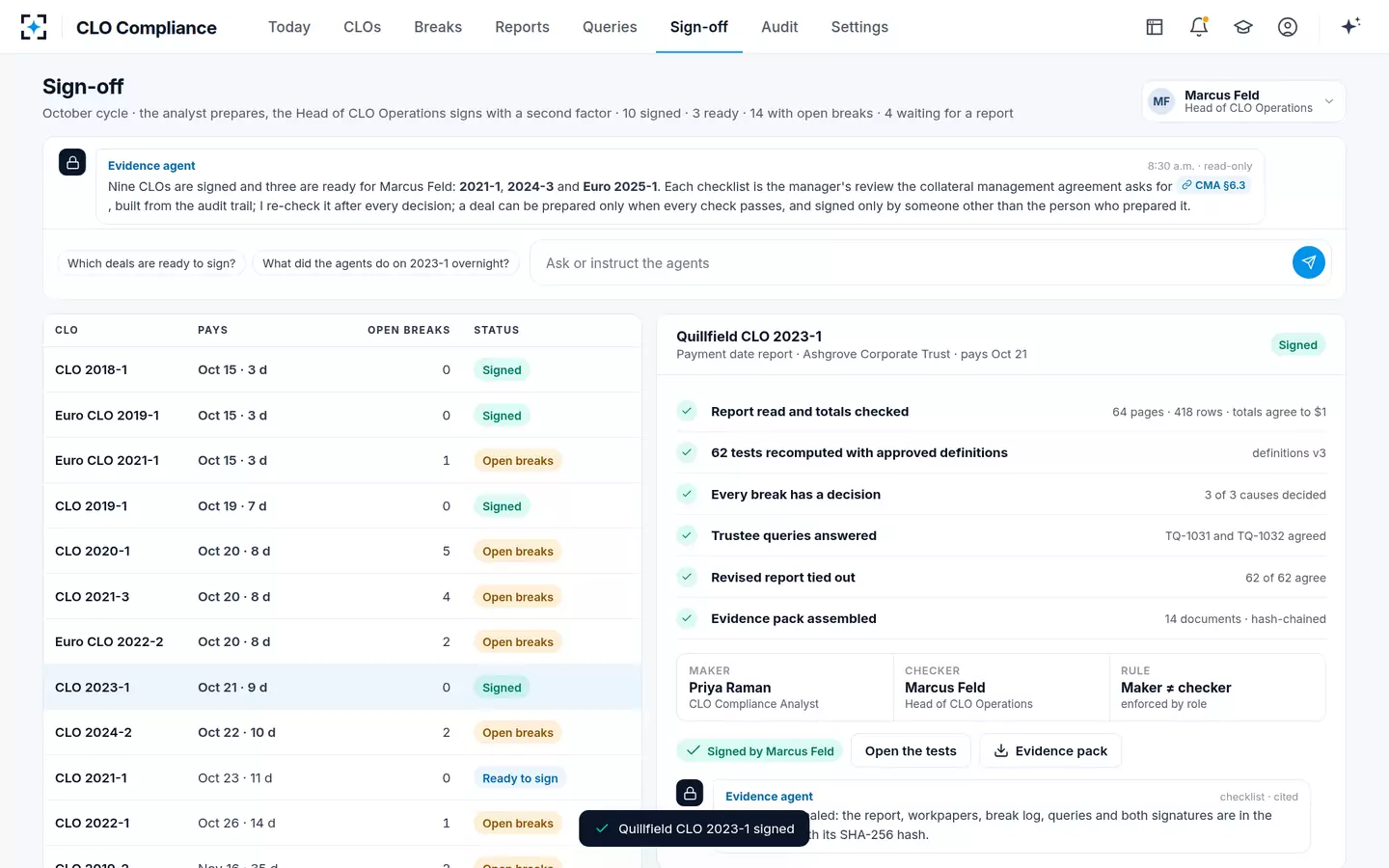
An evidence file is the set of documents that lets someone else reach the same conclusion about a trustee report without asking the analyst. For every test that agrees, it holds the recompute and its inputs; for every break, it holds the cause, the sources, the query, the reply and who decided what. In CLO Compliance the Evidence agent builds each deal's sign-off checklist from the audit trail and assembles the month's file; it is read-only and never alters a record.
One break's evidence in CLO Compliance, from the trustee's page to the signature
Agent
Reader agentExtracts the trustee's figures with page citations: the Class D OC on page 4, the Alder Park line with discount flag "N" on page 19.
Never: edits a figure
Agent
Diff and Checker agentsTrace the 46 bp gap to the loan; cite the trade confirmation (78.50 on 18 March 2026), 30 business days of prices and indenture pages 31, 47 and 58; the Checker agrees.
Never: decide an interpretation
A person decides
AnalystConfirms the cause with the reason code "Trustee error, definition not applied" and a note; submits the drafted query.
A person decides
Head of CLO operationsApproves the query as checker: "Evidence checked: definition p. 47, trade ticket, price history."
A person decides
Trustee relationship managerSends the query with its evidence; logs the trustee's agreement and the revised report.
Agent
Evidence agentRe-checks the deal's checklist after every decision and seals the file: report, workpapers, break log, queries, both signatures and their hashes.
Never: alters a record
The sign-off checklist CLO Compliance builds from the audit trail
Who reviews the CLO trustee report?
The trustee or collateral administrator prepares it; the manager checks it against its own books before finalization; and the noteholders, many of them insurers and other institutions, read it after. The judge in the 2017 decision noted that one investor compared the stated interest rates with interest actually received only after the SEC's proceeding began, using an analyst who "entered the data in Excel" (SEC Initial Decision No. 1182). Investors can check; the question is whether anyone does so each month, before the cash moves.
Within the manager, review should be two people, not one. In CLO Compliance the analyst prepares the sign-off and the head of CLO operations signs it with a second factor, and the role rules stop anyone from approving their own work. That is the control an investor or an examiner can rely on, because it does not depend on any one person's diligence. How the seat is staffed is described in what a CLO analyst does.
What records should a CLO manager keep, and for how long?
A CLO manager that is a registered investment adviser must keep the books and records the Advisers Act's record-keeping rule lists, generally "for a period of not less than five years from the end of the fiscal year during which the last entry was made on such record, the first two years in an appropriate office of the investment adviser" (17 CFR 275.204-2(e)(1)). The list includes certain written communications and, under (a)(17), the firm's compliance policies and "any records documenting the investment adviser's annual review of those policies and procedures".
Which CLO compliance workpapers fall within those categories is a question each manager should settle with its counsel; the rule does not name trustee reports or reconciliations. A simple answer is one retention period for the whole monthly evidence file, so that nothing depends on classifying each document. The sample firm keeps seven years, with a legal hold per deal, and stores European deal data in the EU.
What a month's evidence file should hold for each CLO
- The trustee's draft and final reports, and data files
As received, with their arrival times, so the window between draft and finalization can be shown.
- The manager's recompute of every test
With the definition version and the positions, prices and ratings as of the determination date.
- The break log
Every difference over tolerance, its cause, its reason code, who confirmed it and when.
- Queries and replies
Each query with its attachments, the approver, the sender, the trustee's answer and the revised report it produced.
- Interpretation rulings
When the head of operations decides how a clause is read, the reason, both readings and the clause.
- Fixes to the manager's own data
The proposal, the approval by a second person and the before-and-after values.
- The sign-off
Maker, checker, time and the method of signature; and a way to show nothing changed afterwards.
How are trustee report errors corrected?
Trustee report errors are corrected by a query the trustee agrees with, followed by a revised report that the manager ties out again. The query works best when it carries its own proof. In the sample deal, the query stated that the loan was acquired at 78.50, attached the trade confirmation and the price history, quoted the definition on page 47 and showed the resulting figures: an adjusted collateral amount of $473,410,000, a Class D OC of 104.62% and an interest diversion test not satisfied, so $583,750 of interest would be diverted on 21 October. The trustee agreed and reissued the report the same morning.
The audit trail in CLO Compliance: who did what, when, why and on what evidence
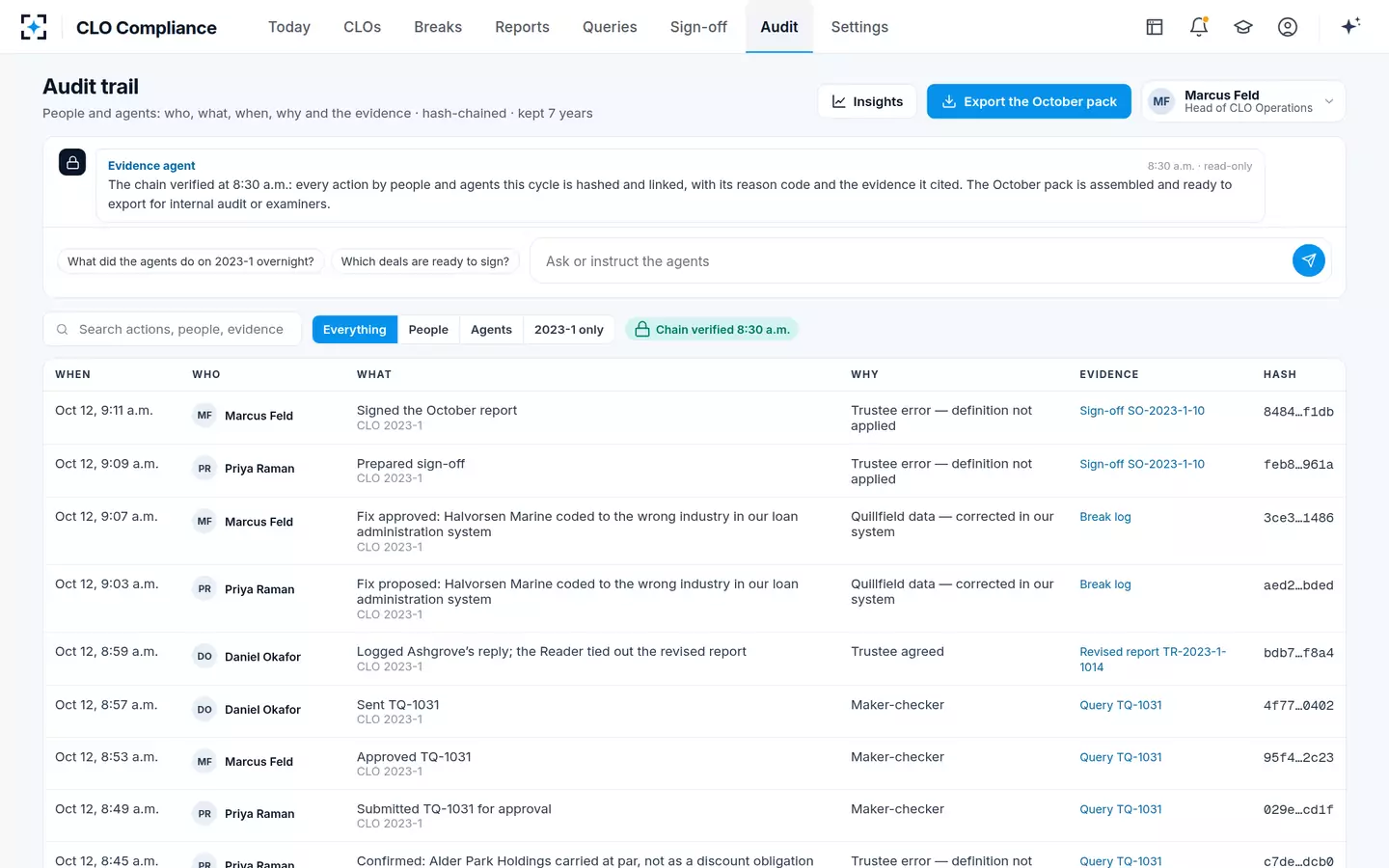
Not every break is the trustee's to fix. In the same cycle, one cause was a borrower coded to the wrong industry in the manager's own loan administration system; the analyst proposed the fix and a second person approved it before it was written back. For European deals there is a further duty: EU rules require the reporting entity to make available "any significant event such as ... a material breach of the obligations provided for in the documents ..., including any remedy, waiver or consent subsequently provided in relation to such a breach" (Regulation (EU) 2017/2402, Article 7(1)(g)).
What does the SEC expect from CLO managers?
The SEC expects a CLO manager that is a registered adviser to keep compliance policies reasonably designed for its business, follow them and be able to show it, and it has brought cases where a manager's policies did not reach a CLO-specific risk. In 2024 it announced settled charges against one CLO manager whose policies did not address nonpublic information from lender groups about loans in the CLOs it traded, with a $1.8 million penalty (SEC press release 2024-106). The 2017 dismissal shows the other side: an allegation about how tests were computed has to be proved against what the reports disclosed and what the indenture permitted.
For the trustee report, that translates into three practical expectations: a written procedure for checking each report before finalization, evidence that it was followed for every deal and every month, and a second person's sign-off. To see the file assembled on sample deals, or on a sample of your own past reports, start from CLO Compliance; the payment-date consequence of the sample break is followed step by step in one CLO waterfall cycle.
Questions people ask
What is a CLO payment date report?
It is the trustee report prepared for a payment date: it shows the tests as of the determination date and how the cash collected will be paid through the waterfall to fees, each class of notes and the equity. Monthly reports between payment dates show the tests without a distribution. The sample deal's payment date report arrived as a 64-page draft three days before the trustee's finalization and nine days before the payment date.
Are CLO trustee reports public?
Generally not in the US: the SEC describes CLOs as "typically sold in a private placement" and resold to qualified institutional buyers under Rule 144A (Rule 192 adopting release, 2023), and trustee reports go to noteholders, often on a secure website, under confidentiality terms. In the 2017 SEC decision, the reports were "confidential and not to be shared by the recipients with other parties". EU deals must publish investor reports through a securitisation repository.
How long should CLO records be kept?
For a registered adviser, the federal record-keeping rule sets at least five years for the records it lists, the first two in an appropriate office. Which compliance workpapers fall within the rule is for the manager and its counsel to settle. The sample firm keeps the whole monthly evidence file for seven years.
Who is responsible for errors in a CLO trustee report?
It depends on the documents and on where the error started: the trustee prepares the report, but much of its data comes from the manager, and indentures can limit the trustee's duty to verify it. In practice the manager is the party best placed to catch an error before finalization. The sample cycle had ten causes that were the trustee's and three that were the manager's own data.
What is a note valuation report?
In the deals the SEC reviewed in 2017, the indentures required quarterly note valuation reports alongside the monthly reports, distributed to the rating agencies, the trustee, the collateral manager and noteholders. The name and content vary by deal; read the reporting section of the indenture.