The weighted average rating factor, or WARF, is a measure of a loan portfolio's average credit quality: each loan's rating is converted to a numerical factor that rises steeply as ratings fall, and the factors are averaged by each loan's principal balance. In a collateralized loan obligation the indenture sets a maximum WARF the manager may not exceed, as one of the collateral quality tests alongside the minimum weighted average spread and the minimum diversity score. The test looks mechanical, but its inputs are not: some leveraged loans have no public rating, agencies often disagree, and a rating file a day out of date changes the result. Botminds' CLO Compliance recomputes WARF for every deal from the manager's own positions and dated, cited ratings, and traces any difference from the trustee's figure to the loans behind it.
Sample figures on this page come from fictional deals in CLO Compliance. Research and regulatory figures are linked to their publishers, and the rating factors quoted are those printed in an October 2026 report by the American Academy of Actuaries.
WARF in four numbers
~2,800
typical WARF of a CLO portfolio, in the actuaries' description
87.7%
of CLO collateral line items carried an issuer rating from one of two agencies
28.6%
of line items rated by both agencies carried disagreeing ratings
3,084
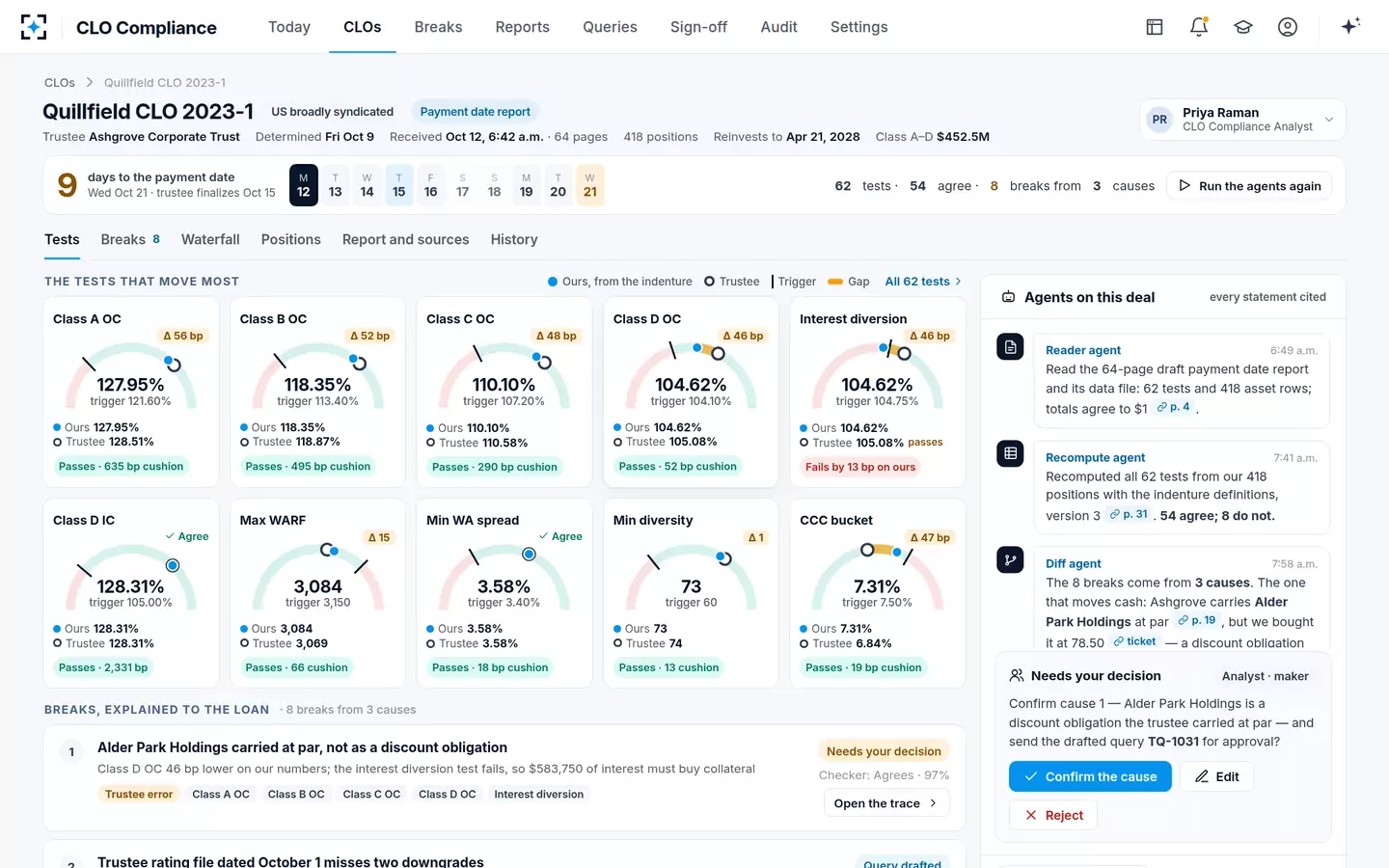
sample deal's WARF on the manager's numbers, against a 3,150 maximum
What is the weighted average rating factor?
The weighted average rating factor is the par-weighted average of numerical factors assigned to each loan's rating. The American Academy of Actuaries, in its October 2026 report to the NAIC on capital factors for CLOs, describes it as "a Moody's-derived numerical measure of the average credit quality of the loan portfolio", in which "higher WARF corresponds to lower average quality", "each rating maps to a numerical factor (e.g., Ba3 ≈ 1,766; B1 ≈ 2,220; B2 ≈ 2,720; B3 ≈ 3,490)", and "the indenture sets a maximum WARF the manager cannot breach" (American Academy of Actuaries, 2026).
The factors are built to reflect default probability, not rating notches, so they do not rise in equal steps. In the four values the Academy prints, each notch down costs more than the one before: 454 points from Ba3 to B1, 500 from B1 to B2, and 770 from B2 to B3. That curvature is the point of the measure. A portfolio that shifts a few loans from B2 to B3 moves its WARF far more than one that shifts the same par from Ba3 to B1.
How is WARF calculated?
WARF is calculated by multiplying each loan's principal balance by its rating factor, adding the products, and dividing by the total principal balance of the loans included. The indenture decides which loans are included, which agency's scale applies, and which rating to use when there are several. The table works a small portfolio with the Academy's printed factors.
A four-loan WARF, worked with the factors the actuaries print, then one downgrade
| Loans | Par | Rating | Factor | Par × factor |
|---|---|---|---|---|
| Group 1 | $30m | Ba3 | 1,766 | 52,980 |
| Group 2 | $40m | B1 | 2,220 | 88,800 |
| Group 3 | $50m | B2 | 2,720 | 136,000 |
| Group 4 | $30m | B3 | 3,490 | 104,700 |
| Portfolio | $150m | — | WARF = 382,480 ÷ 150 | 2,550 |
| After $10m of group 3 falls to B3 | $150m | — | +10 × (3,490 − 2,720) ÷ 150 | 2,601 (+51) |
The arithmetic is trivial; the inputs are not. Every row of a real WARF calculation rests on a rating with a date and a source, and the trustee and the manager can hold different versions of the same rating. In the sample deal the manager's WARF was 3,084 and the trustee's 3,069, a 15-point gap against a 3,150 maximum. The sample firm treats any WARF difference over 5 as a break and asks for a second look over 25.
What is a WARF test in a CLO?
The WARF test is a collateral quality test: the portfolio's WARF must stay at or below the maximum the indenture sets. The Academy lists "Maximum weighted average rating factor (WARF)" among the constraints that "ensure the portfolio remains diversified and within the risk parameters promised to investors at issuance", alongside minimum and maximum weighted average spread, industry concentration limits and a minimum diversity score (American Academy of Actuaries).
Failing a collateral quality test is usually less dramatic than failing a coverage test: it does not redirect interest, but it can restrict what the manager may buy, on terms each indenture sets and which change when the CLO reinvestment period ends. That makes the manager's own WARF, and its cushion, a trading input. In the sample deal the cushion was 66 points on the manager's numbers and 81 on the trustee's; a portfolio manager planning a purchase needs the first.
The maximum WARF test in CLO Compliance, with both marks and the trigger
Where do the ratings in WARF come from?
The ratings in a CLO's WARF come from three places: public ratings of the borrower or the loan, credit estimates produced privately for loans that have no public rating, and proxies set by the indenture when neither exists. The second and third are where the test is softest. The SEC's Office of Credit Ratings, reporting on its 2025 examinations, wrote that rating agencies "frequently use credit estimates to assess the credit risk of unrated assets that are part of the underlying collateral of a rated transaction (e.g., collateralized loan obligations and funds)", and that "such credit estimates are typically based on a more abbreviated analysis than the analysis conducted to determine a credit rating" (SEC, 2025 Staff Report on Nationally Recognized Statistical Rating Organizations). What the same examinations found inside the agencies' own rating files is summarised in NRSRO list 2026: what SEC examiners found.
The actuaries' data show how much of CLO collateral depends on which source. In the collateral file behind their 2026 model, "approximately 87.7% of collateral line items carry an issuer-level rating from either Moody's or S&P, and 95.1% carry at least one rating at the security or issuer level"; the rest needed "a rating assignment based on available proxies". Where both agencies rated a line, "approximately 28.6% ... carry disagreeing ratings across the two agencies" (American Academy of Actuaries, section 9.1.1).
Ratings behind CLO collateral: mostly public, but split between agencies more than a quarter of the time
For a compliance team, each of those categories is a different check. A public rating needs a date. A credit estimate needs to be the current one the deal is entitled to use. A proxy needs to follow the indenture's rule for assigning it. And a split needs the indenture's rule for which agency counts, applied the same way by trustee and manager. The same split-rating rule decides who sits in the CCC bucket and its haircuts.
What is a good WARF for a CLO?
A good WARF is one comfortably below the deal's own maximum, on the manager's numbers; there is no universal level. The Academy describes a typical CLO at issuance with a WARF of "2,600 – 3,400 (roughly B/B+ average quality)" and notes that "CLOs generally have a WARF of ~2,800" (American Academy of Actuaries). A deal's maximum is set when it is structured and traded off against its spread and diversity tests.
What matters month to month is the cushion and its direction. A WARF that is rising because of downgrades, while the portfolio's spread is falling because of repricings, is a deal approaching a trading restriction even if every test still passes.
How do downgrades affect WARF?
A downgrade raises a loan's factor, and because factors rise more steeply at lower ratings, a downgrade from B2 to B3 adds more to WARF than one from Ba3 to B1. In the worked example above, moving $10 million of a $150 million portfolio from B2 to B3 added 51 points. A downgrade to the CCC range does more: it can also put the loan into the CCC bucket, and if the bucket is over its limit, into the haircut in the OC tests.
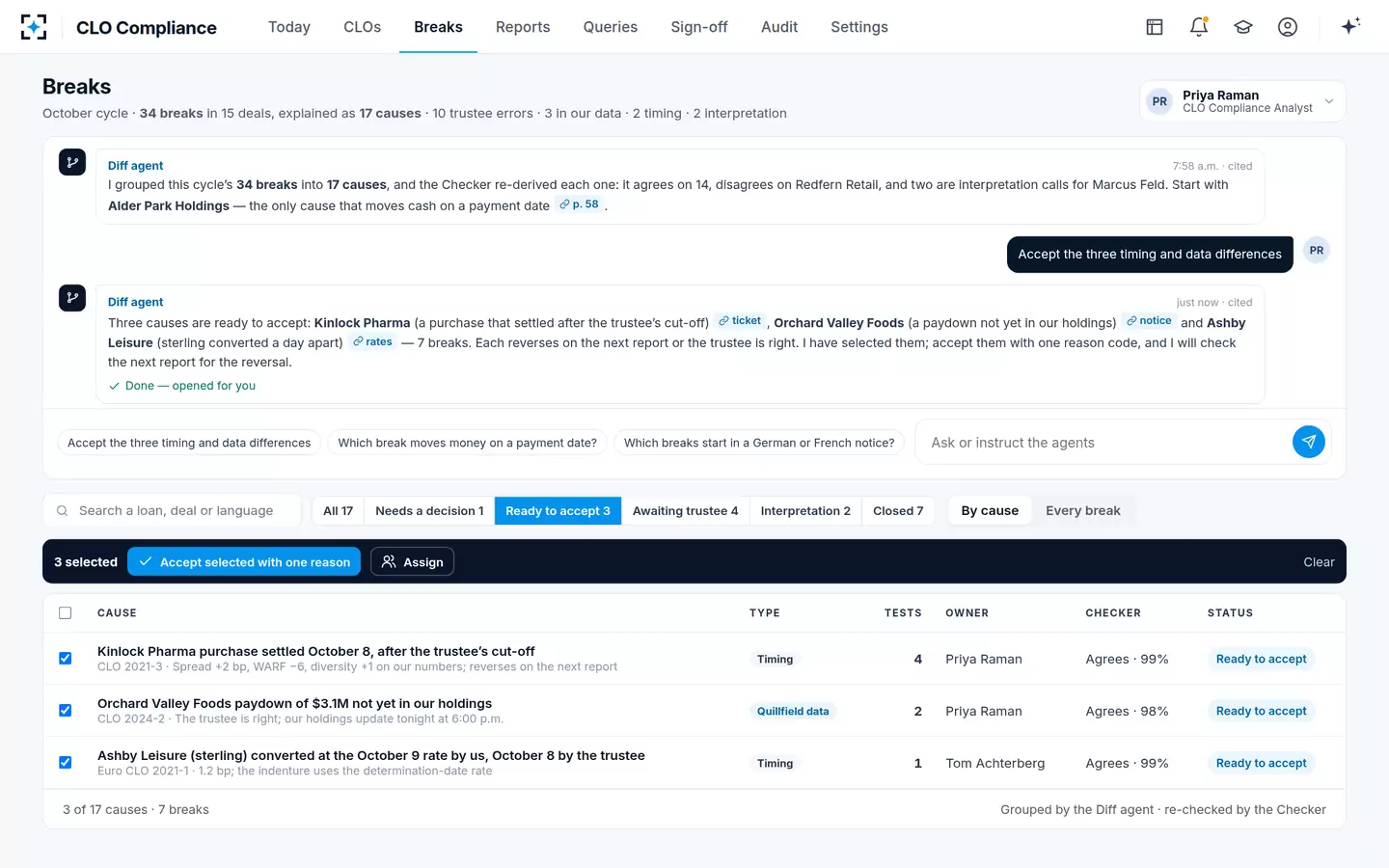
Timing breaks show up here too. In the sample cycle, a purchase that settled one day after the trustee's cut-off left the manager's WARF 6 points lower than the trustee's on another deal, with the spread 2 basis points higher and the diversity score one higher. The difference reverses in the next report, and CLO Compliance checks that it does.
A timing difference that moves WARF, spread and diversity at once
What is the diversity score in a CLO?
The diversity score is a collateral quality measure of how spread a CLO's portfolio is across borrowers and industries, expressed as a single number; the indenture sets its formula and a minimum. In the sample deal the minimum is 60, the manager's score 73 and the trustee's 74, and the sample firm treats any difference in the score as needing a second look, because a single reclassified borrower can change it.
Diversification rules protect each deal and, collectively, can concentrate risk. Elkamhi and Nozawa found that fire-sale risk in leveraged loans "is exacerbated by diversification requirements. As the CLO market grows, each CLO's effort to diversify its portfolio leads to similarity in loan holdings among CLOs, and thus their leverage constraints simultaneously bind" (Journal of Financial Economics, 2022). For a compliance team the practical lesson is narrower: industry codes are inputs to the diversity test, and in the sample cycle one break came from a borrower coded to the wrong industry in the manager's own system, fixed only after a second person approved the change.
Minimum weighted average spread: the test that sits beside WARF
The minimum weighted average spread (WAS) test requires the portfolio's average spread over the reference rate, weighted by balance, to stay above a floor; the Academy explains that "a minimum WAS is required to ensure sufficient interest income to pay all tranches", and gives SOFR plus 350–425 basis points as a typical level at issuance (American Academy of Actuaries). WARF and WAS pull against each other: lower-rated loans pay more spread, so a manager can usually improve one only by giving up some of the other.
In the sample deal both the trustee and the manager computed 3.58% against a 3.40% minimum: no break, 18 basis points of cushion. The sample firm's tolerance for spread is 1 basis point, with a second look over 5.
How the NAIC is changing the treatment of CLOs for insurers
US insurers are among the largest CLO investors, and the NAIC is moving away from relying on ratings alone to set their capital. Insurers held $276.8 billion of CLOs at year-end 2024, about 39% of it rated AAA and 9% unrated, including equity (NAIC Capital Markets Bureau). Its reasoning is set out in the amendment that assigned CLO modelling to its Structured Securities Group: "An insurer that purchases every tranche of a CLO holds the exact same investment risk as if it had directly purchased the entire pool of loans backing the CLO", and if the capital charge for owning all the tranches is less than for owning the loans, "it means there is risk-based capital (RBC) arbitrage" (NAIC, P&P Manual amendment 2025-010.01).
The NAIC's CLO timeline: from rating-based designations to modelled tranches
- Modelling adoptedFeb 2023
- Start moved to YE 2026Dec 2025
- CLO capital factors2026
- Tranche modellingYE 2026
The NAIC's direction follows a long federal one. After Dodd-Frank, the Office of Financial Research wrote: "Regulators have responded by substituting definitions of creditworthiness, requiring regulatory models, and hiring third parties other than rating agencies to set credit standards. Each approach has challenges" (OFR Brief 16-04). For a CLO manager with insurance investors, the change means more questions about the collateral itself, the same questions a WARF test asks: which ratings, from where, dated when. CLO Compliance keeps each rating it used with its source and date, which is what lets those questions be answered from the audit trail. To see it on sample deals, start from CLO Compliance.
Questions people ask
What is a rating factor table?
It is the table that maps each rating to a numerical factor for the WARF calculation, published by the rating agency whose methodology the indenture names. The factors rise faster at lower ratings; the Academy's examples run from about 1,766 for Ba3 to 3,490 for B3. The indenture says which table applies and how to treat loans rated by only one agency.
Is WARF the same across rating agencies?
No. WARF as CLO indentures use it is built on one agency's scale (the actuaries call it "Moody's-derived"), and other agencies maintain comparable but different measures, as the American Academy of Actuaries notes. The manager has to recompute the measure its indenture names, on that agency's scale.
What is a credit estimate in CLOs?
It is a rating agency's assessment of an unrated loan that sits in a rated CLO's collateral, used so the loan can be included in the deal's rating-based measures. The SEC's examiners describe credit estimates as typically based on a more abbreviated analysis than a credit rating. A compliance team should know which loans in each deal rest on one.
How often is WARF tested?
Every month in the trustee's reports, with the other collateral quality tests, and on each payment date report. Managers also run it before trading, since every purchase or sale changes it. In the sample firm a WARF difference over 5 between trustee and manager is treated as a break.
Does the NAIC use WARF?
Not directly to designate a CLO tranche. Its Structured Securities Group is to model CLO tranches under weighted collateral stress scenarios to assign designations, starting with year-end 2026 after a December 2025 deferral. The Academy's capital work for the NAIC uses ratings and tranche thickness as inputs.