Vehicle title management companies do the mechanical half of a lender's title work: preparing and filing title applications, chasing dealers and state offices, running the electronic lien connections, receiving and storing paper titles, and sending releases when a loan pays off. What they cannot do is take on the consequence of a lien that never reached a state's record — that stays with the lender who funded the car, and so does the duty to supervise the firm doing the work. Botminds' Vehicle Title and Lien Management is built for the part that cannot be handed over: knowing, every day, which cars have a recorded lien and which do not, whoever is doing the filing.
That line is not a legal technicality. The federal consumer regulator has already found servicers liable for what their title service providers did slowly, and the federal banking agencies have put the principle in one sentence of supervisory guidance. The figures below come from a fictional sample lender, Tamarack Auto Credit, with 186,420 financed cars in 31 states; the supervisory sources are linked where they appear.
What do vehicle title management companies do?
Five things, in roughly this order of value. They prepare and submit title applications in states where the lender, rather than the dealer, does the filing. They hold the enrolments and the connections into each state's electronic lien programme — the messaging layer that lets a lienholder "perfect, update, and release lien information on vehicle titles" electronically (AAMVA) — so a lender does not have to enrol separately in thirty-one places. They receive and store the documents in the states that still issue a paper title to the lienholder. They chase: dealers who have not filed, offices that have rejected a filing, states that have gone quiet. And they release liens at payoff and send the title where it has to go.
Three of those five are genuinely better done at scale, because they are the same work repeated across many lenders in the same thirty-one places. The other two — the chase and the release — are where the lender's own risk actually lives, and they are the two most likely to be measured by activity rather than by outcome.
A title service and a title system solve different halves of the same problem
A title management service: Doing the same filing, lookup and vault work across many lenders in the same states, with people who know each office
A system the lender runs over its own book: Knowing which of your cars do not have a recorded lien today, in whose name, and why
A title management service: In the provider’s queue, on the provider’s calendar, reported back in a monthly file
A system the lender runs over its own book: On your own funded book, every night, against each state’s own measured normal time
A title management service: Activity: filings made, letters sent, titles received, exceptions worked
A system the lender runs over its own book: Position: perfection rate by funding month, cars past 30 and 90 days, cars in recovery with no lien
A title management service: The lender. A provider pays an indemnity at best; the subordinated lien is still yours
A system the lender runs over its own book: The lender, who can now see it in time to act
A title management service: Tell you what it does not know about — a filing it never made, for a car it was never told about
A system the lender runs over its own book: File anything. A system does not stand at a county counter
A title management service: Keep it for the hands-on work, and hold it to an outcome
A system the lender runs over its own book: Keep the measurement, the evidence and the decision in-house, whoever files
The three operating models
Lenders run title operations in one of three shapes, and the choice is usually historical rather than deliberate. The first is a desk: the lender's own title team, with its own enrolments and its own vault, chasing dealers directly. The second is a bureau: a title management company does the filing, the chasing and the storage, and reports monthly. The third is a hybrid that has become the common end state — the provider keeps the state connections and the vault, and the lender keeps the clock, the evidence and the decision about what to say to a dealer.
Three ways to run title operations, and what changes with each
| Model | What it carries | Who is liable when a lien is missing | What to measure | Where it breaks |
|---|---|---|---|---|
| The lender’s own desk | Enrolments, filings, chasing, the vault, the releases — all in-house | The lender, directly and visibly | Perfection rate by funding month; cars past 30 and 90 days; days to lien by state | Headcount. A desk that works 60 to 80 exceptions a day per person cannot grow with the book |
| A title management company | Filing, lookups, chasing, storage and releases, across many lenders | The lender. The provider’s exposure ends at its indemnity; the subordinated lien does not | The outcome the provider is paid for — liens recorded within 30 days of funding — not the letters it sent | Visibility. The lender learns of a problem in a monthly file, which is one to thirty days after it mattered |
| Provider plus a lender-run system | The provider keeps the state connections and the vault; the lender keeps the clock and the evidence | The lender, with the evidence to act in time and to hold the provider to its number | Both sides: the provider’s outcome, and the lender’s own independent readback from the state’s records | Duplication, if the lender lets the system become a second chasing team instead of a measurement |
What never leaves the lender: who is responsible if a title vendor misses a lien
Three things never transfer, whatever the contract says. The first is the legal consequence. An unperfected security interest is subordinate to a person who becomes a lien creditor first (UCC §9-317(a)), and no state asks who was supposed to file; Texas says plainly that a retail lien is perfected only by recording it on the title (TxDMV Motor Vehicle Title Manual §12.2). The second is the loss: a repossessed car that cannot be sold with clean title is the lender's car, and the borrower's bankruptcy trustee does not accept a vendor's apology. The third is the duty to supervise.
That third one is now written down in one sentence of interagency supervisory guidance: "Whether activities are performed internally or via a third party, banking organizations are required to operate in a safe and sound manner and in compliance with applicable laws and regulations. A banking organization's use of third parties does not diminish its responsibility to meet these requirements to the same extent as if its activities were performed by the banking organization in-house" (Interagency Guidance on Third-Party Relationships: Risk Management, published 9 June 2023 and issued by the OCC as Bulletin 2023-17).
A banking organization's use of third parties does not diminish its responsibility to meet these requirements to the same extent as if its activities were performed by the banking organization in-house.
Interagency Guidance on Third-Party Relationships: Risk Management, June 2023
The supervisory finding that should shape the contract
In its October 2024 special edition on auto finance, the Consumer Financial Protection Bureau described exactly this failure mode. Examiners found that auto-loan servicers committed unfair acts or practices because borrowers were harmed when titles were not delivered on time after a payoff — and the mechanism was a service provider. "Examiners found that the servicers' policies are generally to provide title documentation within two business days but that delivery times significantly exceeded this timeline," the report says, with borrowers unable to sell their vehicles, paying extra insurance, and having "no ability to make the servicers, or the service providers, more quickly process or deliver the titles" (Supervisory Highlights: Auto Finance, §2.3.2).
Two details in that finding matter more than the headline. The servicers had a policy, and it was a good one — two business days. What they did not have was a measurement of whether the provider met it, which is why the gap between policy and practice ran long enough to become a supervisory finding. And in the same report, where examiners found other service-provider failures, the entities were directed to "update and revise language in contracts with their service providers to set forth clear expectations about the service providers' compliance with and consequences for failure to comply with applicable Federal consumer financial laws", and to enhance their risk management "to mitigate unwarranted risks to consumers from service providers". The remedy was contractual and it was measured.
What to measure in a title services contract
Measure the outcome the lender is exposed to, and nothing that can be improved by working faster at the wrong thing. The interagency guidance makes the point in its section on performance measures: a service-level agreement can specify expectations for both parties, but "it is important to negotiate performance measures that do not incentivize imprudent performance or behavior, such as encouraging processing volume or speed without regard for accuracy, compliance requirements, or adverse effects on the banking organization or customers" (Interagency Guidance).
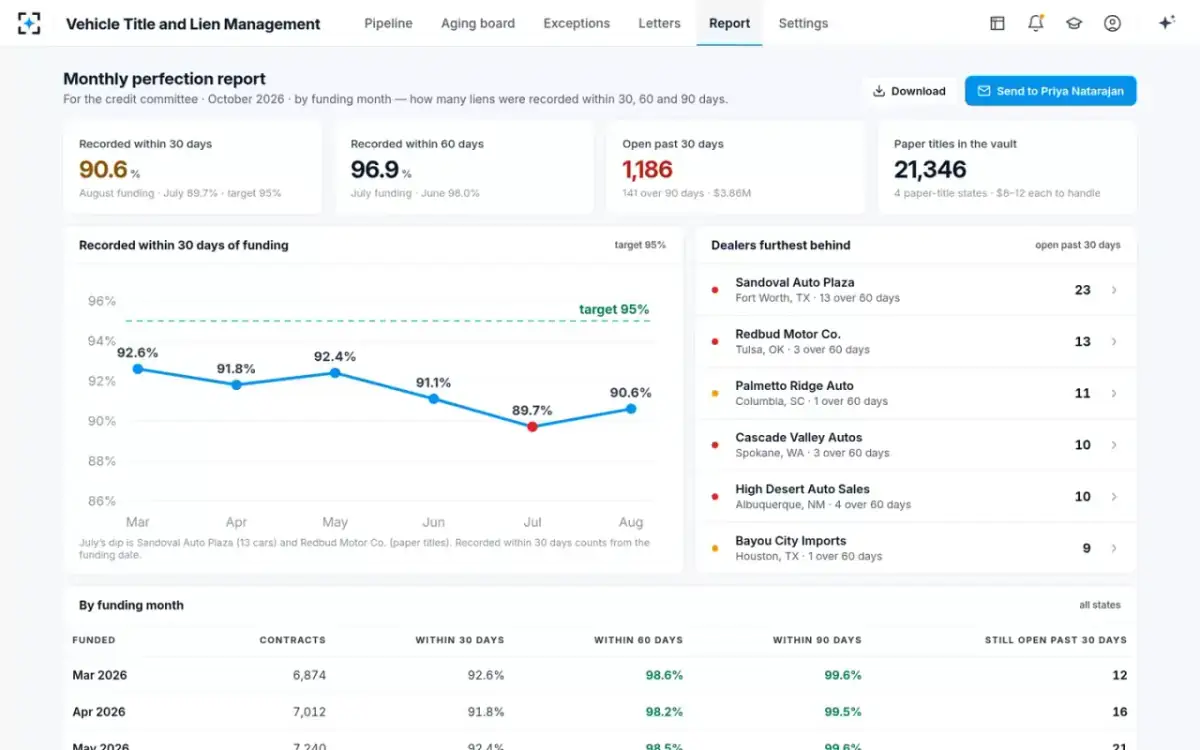
In title work, the measure that satisfies that test is the share of a funding month's cars with a lien recorded in the lender's exact legal name within 30 days of funding, reported by funding month and never restated. Everything else is secondary: letters sent is activity, exceptions closed is activity, average days to respond is the provider's own clock. The sample lender's own number for August was 90.6% against a 95% target, with 96.9% recorded within 60 days — a gap of more than four points that would be invisible in any report built from letters sent.
The only number that settles a title contract: liens recorded within 30 days, by funding month
Reported this way, a dip has to be explained rather than absorbed. July's 89.7% in the sample portfolio comes from two named dealers; a provider held to a flat number would have an incentive to argue about attribution, which is why the contract should require the causes alongside the rate — the dealer, the state and the reason, every month. Working out those causes from the state's own records rather than from the provider's notes is what checking the title and lien status of a VIN is for.
The monthly number a title contract should be written around
Should a lender outsource title management? Where it works and where it does not
Outsourcing works best where the work is identical across lenders and the consequence of an error is a delay rather than a loss. Enrolling and maintaining connections in thirty-one states is the clearest case: the work is the same for everyone, the states change their rules without warning, and a provider that does it for forty lenders will notice a change the week it happens. Physical custody is the second: a vault of paper titles is a scale business with a compliance tail, and few lenders improve on it by running their own.
It works least well where judgement meets a relationship. Deciding that a dealer's twenty-three missing liens share one cause, deciding whether to send a repurchase demand under the dealer agreement, deciding whether a car in recovery can go to auction — these are decisions about the lender's own money and its own dealer network, and they are made badly by anyone who cannot see both. A provider also has a structural blind spot that no contract fixes: it cannot chase a car it was never told about, so a contract break in the funding feed produces a silence that looks exactly like success.
Reading a provider's report honestly
Three questions turn a monthly file from reassurance into information. First: is this reported by funding month, or by the month the work happened? A report of activity in October tells you how busy the provider was; a report of October's funded cars tells you what happened to your collateral. Second: what is the denominator? A perfection rate computed over "cars we were asked to file" excludes exactly the cars that went missing before anyone asked. Third: where did the status come from? A provider's own system saying a lien is recorded is a claim; the state's record saying so is proof, and the difference between the two is the thing you are paying someone to close.
The practical test is an independent readback, run by the lender and not by the provider: take a sample of last month's recorded liens, ask the states again, and compare the answers to the report. If the two disagree on more than a handful, the problem is the measurement rather than the filing, and no amount of chasing will fix it.
Questions to ask before you sign
Eight questions for a title services provider, and the answer that should satisfy you
- What exactly will you be measured on?
The right answer names an outcome — liens recorded in our legal name within 30 days of funding, by funding month — and not a volume of letters or an average response time.
- What is in the denominator?
Every car we funded in the month, not every car we successfully handed you. Ask what happens to a car the feed never delivered, and who notices.
- Where does a “recorded” status come from?
The state’s message or title record, with the state’s own recording date stored. If it comes from the provider’s workflow system, you are buying an opinion.
- How do we read the evidence ourselves?
Ask for the underlying state records and county notices, not a summary. A provider that can only show you its own screens cannot support a dispute with a dealer.
- Who may speak to our dealers, and with what wording?
A chase letter is a commercial act in your name. The answer should put approval on your side, and template changes on your side too.
- What happens on a rejection?
Rejections are where liens quietly die. Ask for the resubmission rate and the median days from rejection to acceptance, and ask to see one case end to end.
- How do you handle a car in recovery, payoff or bankruptcy?
These should be flagged the day they appear, not in the monthly file. In the sample portfolio this is the one list whose acceptable length is zero.
- What do you do that we would still have to do?
The honest providers answer this one directly: you still have to measure them, keep the evidence, and own the decisions. Be careful of the ones who say “nothing”.
The decision is rarely build or buy. It is which half to buy, and how to stay able to prove the other half yourself. What that costs, line by line, is worked through in what a lien perfection fee actually pays for, and what a lender should add rather than replace in the guide to title management software. To see the measurement side on your own book, start from Vehicle Title and Lien Management.
Questions people ask
What is a title service provider?
A firm that carries out title and registration work for lenders, dealers or fleets: preparing and filing title applications, maintaining electronic lien connections with state motor-vehicle agencies, storing paper titles, chasing missing filings and processing lien releases at payoff. It acts as the lender's agent; it does not become the lienholder.
Who is responsible if a title vendor misses a lien?
The lender, in every way that costs money. The security interest is unperfected and subordinate to a lien creditor whatever the contract between lender and vendor says, and supervisory guidance is explicit that using a third party does not diminish a banking organisation's own responsibility. A vendor may owe an indemnity, but an indemnity is a claim against a company, not a lien against a car.
How much does title outsourcing cost?
No government or non-profit source publishes per-transaction prices for title services, and vendor-published figures vary with volume, state mix and how much paper is involved, so quoting one would be misleading. The useful way to price it is from your own unit economics: the state's own fee, the filing work, the storage, and the chase that follows a filing that did not stick.
What should a title services contract measure?
One outcome, by funding month: the share of cars with a lien recorded in the lender's exact legal name within 30 days of funding, with the causes behind any shortfall named by dealer and state. Supervisory guidance warns specifically against measures that reward volume or speed without regard for accuracy and compliance, which is what activity counts do.
What stays the lender's job when titles are outsourced?
Measuring the provider against an outcome, keeping independent evidence from the states' own records, approving anything that goes to a dealer in the lender's name, and the decisions where money is at stake — a repurchase demand, holding a car back from auction, releasing a payoff. Oversight is work, and it is the part that cannot be delegated with the work.
How do you oversee a title vendor without duplicating its work?
By measuring position rather than repeating activity. The lender's system should answer, every morning, which funded cars have a recorded lien and which do not — independently of the provider's status file — while the provider keeps doing the filing, the chasing and the custody. Duplication starts when a lender builds a second chasing team; oversight is a different job from chasing.