Proof of lien perfection on a financed car comes from one place: the record of the state that titles it, searched in the lender's exact legal name and read for what that state says about this VIN. Nothing else settles it: not a field in a servicing system, not a dealer's assurance, not the absence of a complaint from the borrower, and not a national vehicle-history file. Botminds' Vehicle Title and Lien Management traces each VIN to the state's own record, shows every document it read along the way, and refuses to call a lien recorded without one.
The reason to be strict about the word "proof" is that the cost of being wrong lands years later and on someone else's desk — at a repossession, a payoff or a bankruptcy filing. The examples below use a fictional sample lender, Tamarack Auto Credit, and one of its cars; the statutes and the federal rules behind the national file are linked where they appear.
How does a lender check the title and lien status on a vehicle?
Four places, in this order, and only the last two are evidence. Start with your own funding file to learn which state titles the car, when you funded, and the exact lienholder name you expect the state to show. Then search the state's electronic lien messages for that VIN. Then read the state's title record itself. Then, if a document is owed to you, check whether it has arrived in the vault.
What makes this harder than it sounds is that the four places disagree in a specific and dangerous way: the first is always full, and the others are often empty. An absent lien notice is the most common single thing a title desk sees, and it is also the least informative, because the same emptiness is produced by a filing that is four days from being recorded and by a filing that never happened. That is why checking status is a trace rather than a lookup — it has to turn an absence into a cause.
One VIN, six documents: what each one actually establishes
The retail installment contract
Signed 15 July
Establishes that a security interest was granted, by whom and in what. It is the only document here that the lender holds itself — and it proves nothing about the state.
The lender’s own funding file
Funded 16 July, $38,940
Starts the clock. A field in this file reading “lien perfected” is a note somebody typed, not evidence.
The state’s electronic lien notice
None, searched since 15 July
Would be the proof. Its absence is not proof of the opposite: it may mean nothing was filed, or that something was filed and not yet recorded.
The county’s receipt or rejection notice
Form 130-U accepted at Tarrant County, 19 August
In Texas this is the moment of perfection — if the application disclosed the lien. This one did not: the lienholder section was blank.
The state’s title record
Title 03319871254, issued 21 August
Names the owner, Darnell Price, and no first lienholder. This is the state’s answer, and it is the document that settles the question.
The title document itself
Not held
Confirms what the record already says. Useful for a vault count; never the first place to look.
What counts as proof, and what does not
A lien is recorded when the state says it is, on the state's record, naming the lender as it is actually incorporated. Texas states the rule as a monopoly: "a person may perfect a security interest in a motor vehicle that is the subject of a first or subsequent sale only by recording the security interest on the title as provided by this chapter" (TxDMV Motor Vehicle Title Manual §12.2, quoting Tex. Transp. Code §501.111). Florida puts the same obligation on the face of the document: each lien "shall be noted upon the face of the Florida certificate of title" (Fla. Stat. §319.27(1)).
So the test has three parts, and all three have to hold. The state's record carries a lien against this VIN; the lien names your entity, spelled as your charter spells it; and it sits in first position. A record showing a lien in the name of a predecessor entity, a servicing brand or a slightly different spelling is not your lien proved — it is a correction waiting to be filed, and the time it takes to get it fixed runs against you.
Six records a title desk will be offered, and what each one is worth
| The record | What it proves | What it does not prove | Use it for |
|---|---|---|---|
| Your own servicing or funding system | That someone intended to perfect a lien and recorded that intention | Anything at all about the state. A “perfected” field is an entry, not evidence | Starting the clock and knowing which state to ask |
| The dealer’s copy of the title application | That an application was prepared, and whether the lienholder section was completed | That it was ever filed, or accepted, or that the state keyed it as written | Diagnosing a cause once you already know the lien is missing |
| The state’s electronic lien notice | That the state recorded the lien, on the date it gives | Nothing when it is absent — absence has at least six different causes | The primary proof, in an electronic state |
| The county or state receipt for the application | In Texas, the moment of perfection, if the application disclosed the lien | That the record now shows your name correctly — keying happens afterwards | Establishing the date, especially near a 30-day line |
| The state’s title record, read by VIN | Owner, every lienholder and its position, brands, and the issue date | What is in flight today; a record is as current as the state’s last update | The settling answer, and the one to keep in the file |
| The national title-history file (NMVTIS) | Where a VIN is titled, the validity of a title document, brands and odometer | Whether your lien is recorded. It is not a lien register | Finding the state to ask, and catching a branded or junked car |
The trace, step by step: one VIN to the state's record
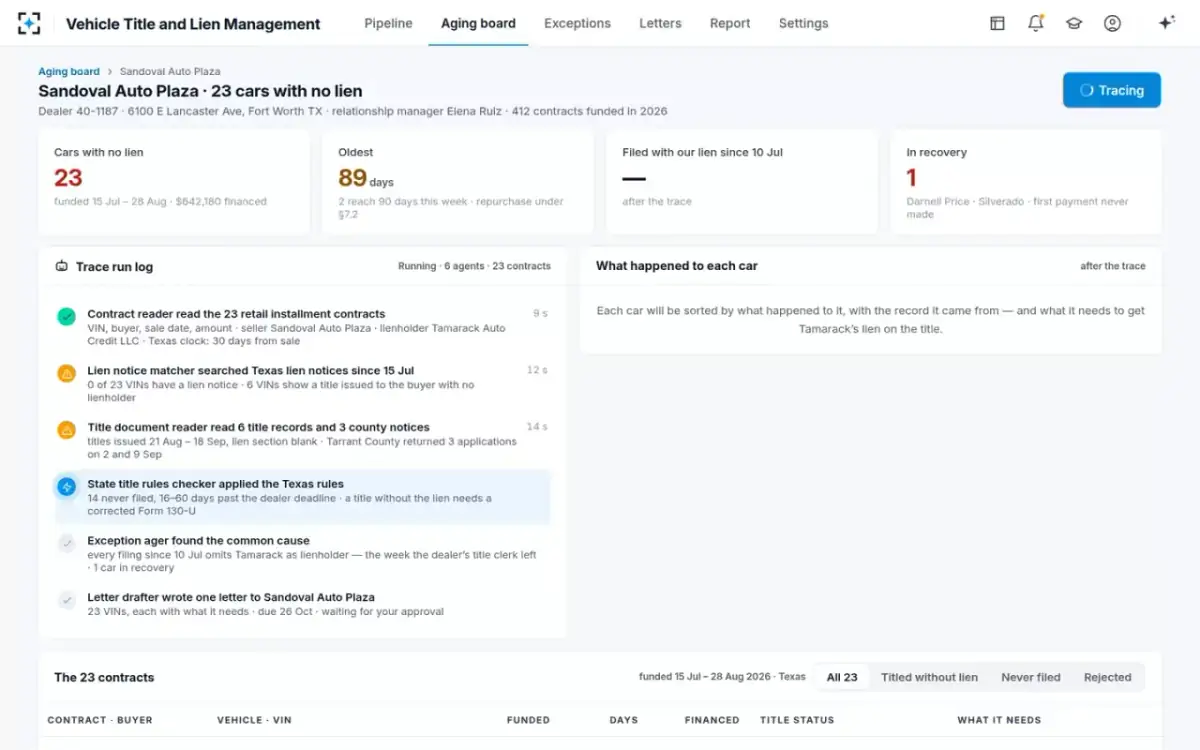
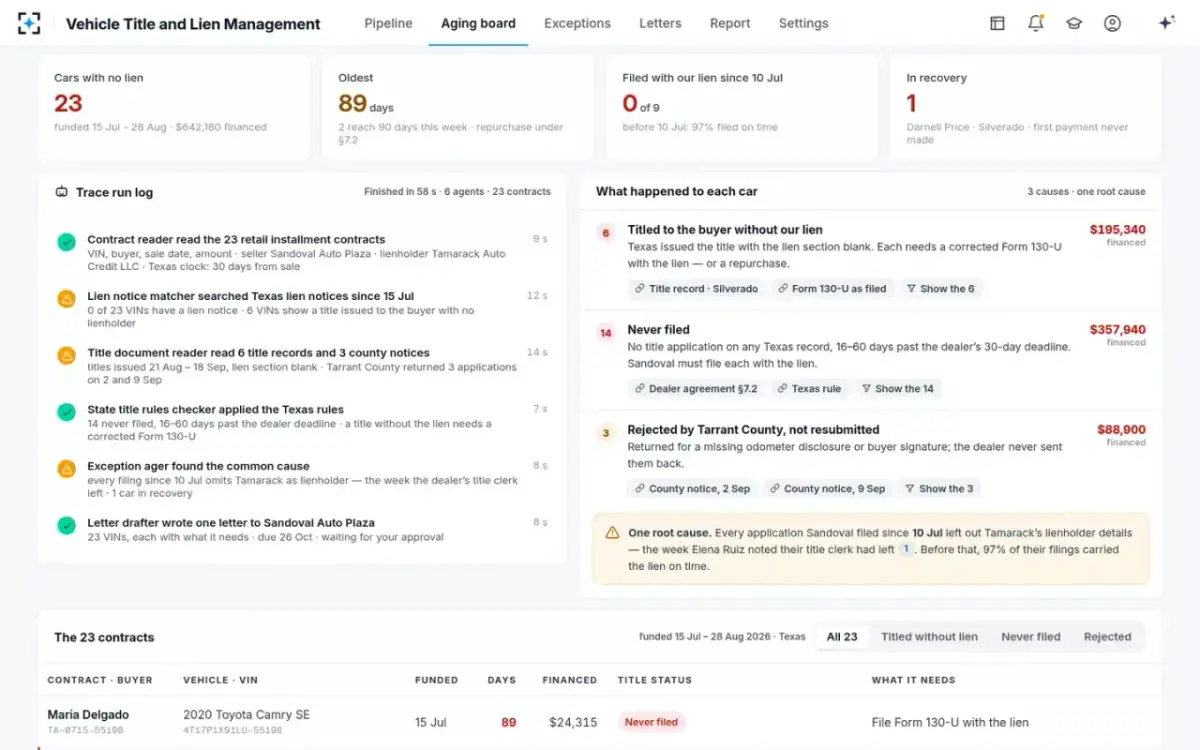
A trace is worth running only if a person can disagree with it, which means every step has to show what it read and how long it spent. In the fictional sample portfolio, one dealer's 23 cars were traced in 58 seconds by six agents: the contract reader took the 23 retail installment contracts (9 seconds), the lien notice matcher searched the Texas lien notices filed since 15 July and found none for any of the 23 VINs, with six showing a title issued to the buyer and no lienholder (12 seconds), the title document reader read six title records and three county notices (14 seconds), the state rules checker applied the Texas rules (7 seconds), the exception ager found the one cause the 23 shared (8 seconds), and the letter drafter wrote a single letter listing every VIN with what it needs (8 seconds).
The six steps of a status check, and the conclusion each one refuses to draw
Agent
Contract reader · 9 sReads each funded contract for the fields the state will be asked about: VIN, buyer, sale date, the titling state, the dealer and the lienholder name as the contract gives it.
Never: Never edits a contract. Where a field differs from the funding file, it reports both and names the page it read.
Agent
Lien notice matcher · 12 sSearches the state’s lien messages and title issuances for that VIN over the relevant period, and matches them to the contract.
Never: Never marks a lien recorded without the state’s notice or the title itself, and never matches on a VIN alone when the make differs.
Agent
Title document reader · 14 sReads the state title records and county notices it found: title number, owner, every lienholder and its position, brands, odometer, and the stated reason for any rejection.
Never: Never accepts a title that does not show the lender as first lienholder, however close the name looks.
Agent
State title rules checker · 7 sApplies that state’s deadline, forms and correction route, so the finding comes with the next action rather than a label.
Never: Never guesses a rule it does not hold — it asks the title lead, and a rule change waits for her review.
Agent
Exception ager · 8 sAges each car against its own state’s normal time to lien and looks for the cause a group of cars shares.
Never: Never closes an exception without the recorded lien, and flags at once any car in recovery, payoff or bankruptcy.
Agent
Letter drafter · 8 sWrites one letter per dealer, every VIN with the document it needs and the record that shows why.
Never: Never sends without a person’s approval; a repurchase demand needs two.
A status check that shows its working while it runs
Where the records live, and what NMVTIS can and cannot tell you
Three different systems get confused with one another, and only one of them records liens. The state motor-vehicle agency holds the title record and is the authority on the lien. The state's electronic lien and title programme is the messaging layer over it: an ELT application, in the association's own words, "provides an electronic means of transferring information between lienholders and jurisdiction motor vehicle agencies to perfect, update, and release lien information on vehicle titles" (AAMVA). And the National Motor Vehicle Title Information System is a federal title-history file whose purpose is "to assist in efforts to prevent the introduction or reintroduction of stolen motor vehicles into interstate commerce, protect states and individual and commercial consumers from fraud" and provide "consumer protection from unsafe vehicles" (28 CFR §25.51).
What NMVTIS is for is written into the rule as a list of five things a user must be able to establish "instantly and reliably": the validity and status of a document purporting to be a certificate of title; whether a VIN is titled in a particular state; whether a car is or has been a junk or salvage vehicle; the odometer disclosure on the date the title was issued; and whether the VIN has been reported as junk or salvage (28 CFR §25.53(b)). A lien is not on that list. The titling information each state must send, every 24 hours, is the VIN, the description and brands on the title, the name of the person the certificate was issued to, junk and salvage information, and the odometer disclosure (28 CFR §25.54(a)) — again, no lienholder.
There is one place the rule mentions lienholders, and it is worth reading precisely because it is so often over-read. When a state runs its own title verification check before issuing a title to a car coming from another state, it uses the search results "to determine the validity of other information presented (e.g., lien-holder status, etc.)" — that is a state checking what an applicant handed it, not a lien register a lender can query. For a lender, the honest use of the national file is to find out where a VIN is titled and whether the car has been branded, and then to go and ask that state.
NMVTIS shall permit a user of the system to establish instantly and reliably: the validity and status of a document purporting to be a certificate of title …
28 CFR §25.53(b)
What the state's lien notice contains
Less than people expect, which is why matching it correctly matters. Florida's statute sets out what a notice of lien has to show when a car was titled elsewhere: the date of the lien; the name and address of the registered owner; a description of the vehicle "showing the make, type, and vehicle identification number"; and the name and address of the lienholder (Fla. Stat. §319.27(4)). Four facts, one of which — the VIN — is the only reliable key, and one of which — the lienholder name — is the field that most often goes wrong.
That shapes how a notice should be matched to a contract. VIN first, then make and model as a guard against a transposed character, then the lienholder name against the lender's own legal name, then the date. A matcher that accepts a VIN alone will cheerfully attach another lender's notice to your car; one that requires an exact name match on a state that truncates long names will reject your own. The sample portfolio keeps 96 cars in a category for exactly this: recorded, but under a wrong lienholder name or against a mismatched VIN. Those are not missing liens, and treating them as missing liens produces the wrong letter — the six causes behind a title that comes back without your name are worked through in what to do when the lienholder is not listed on the title.
The checks that must be able to fail
A status check is only worth running if some of its answers are unwelcome. The federal consumer regulator has already described what happens when they are not: examiners found that servicers "failed to record liens and then repossessed vehicles without a valid lien", and that "when assigning vehicles for repossession, servicers did not verify that they had a valid lien" — in some cases taking cars from people who had never had any relationship with the servicer at all (CFPB, Supervisory Highlights: Auto Finance, §2.2.2). The remedy was not better reporting. It was a check at the moment of action: the servicers "implemented policies and procedures to ensure that they recorded liens for all vehicles and repossessed vehicles only when they had recorded a lien."
That is the standard to hold a title system to. In the sample portfolio the check sits on the three moments where a missing lien becomes irreversible — a repossession assignment, an auction listing and a payoff release — and it holds the car until the lien is on the title or the dealer repurchases it. On the morning in the sample, three cars in recovery had no recorded lien. The point of the check is that it found them before the tow truck did.
Twenty-three VINs, sorted by what the state's records actually said
What a trace may not conclude
Three conclusions are tempting and wrong, and a system that draws them will mislead a title desk quietly for years.
The first is that no notice means no lien. It means no notice. In a state that records a lien when the county accepts the application, the lien can be perfected for a week before any message exists, and a car can be entirely fine on the day it looks worst. The second is that a title showing no lienholder means the lien was never perfected. Sometimes the application did disclose the lien and the state's keying missed it, in which case the lien dates from the acceptance and the title is wrong rather than the lien — a distinction two federal courts have had to make with money on it, as the cases on an unperfected lien on a vehicle set out. The third is that a correction fixes the date. It does not: a lien added by a corrected application is perfected when that correction is accepted, which is why a car sitting at 85 days is a different problem from the same car at 20.
How do you check a lien in a state you are not enrolled in?
By reading that state's title record rather than waiting for a message you will never receive. Enrolment in a state's electronic programme is what gets you notices; it is not what makes the lien real, and a lender with cars in 31 states will usually hold notices from fewer. For the rest the route is the state's own title inquiry, and the practical advice is to treat a non-enrolled state as a paper state for monitoring purposes: measure it from the record, not from the inbox, and expect its normal time to lien to look longer because your own visibility is later rather than because the state is slower. What enrolment changes, and where a mandate makes it unavoidable, is the subject of the electronic lien and title states guide.
What a monthly readback should show
Any lender that relies on a system to tell it that liens are recorded should test that system the way an examiner would: pull a sample, go to the state, and compare. Four checks are enough, and all four should be run against the state's record rather than against the system's own stored answer.
A monthly readback that a title system can fail
- Twenty-five recorded liens, re-read at the state
Take them from last month’s “recorded” cars at random and ask the state again. Every one should come back with your entity, in first position, on the date the system holds.
- Ten cars the system says have no lien
The point of this half is the opposite: confirm the state agrees the lien is absent. A system that under-reports is as dangerous as one that over-reports, and far more comfortable.
- Every car in recovery, payoff or bankruptcy
Not a sample. This list should be short enough to read in full, and the only acceptable number of cars on it without a recorded lien is zero.
- The lienholder name, character by character
Compare the state’s stored name with the charter name, not with what the letter says. Truncation and a dropped “LLC” are the two most common quiet failures.
- The date, against the state’s own recording date
If the system stores the day the message arrived rather than the day the state recorded, every day count you report is wrong in the same direction.
- One rejected filing, followed to its end
Pick a car the state or county refused and prove it was resubmitted and accepted. Rejections are where liens go missing without anybody deciding to let them.
The discipline underneath all of this is simple and unpopular: the only authority on whether a lien exists is the authority that records it. Everything a lender holds is a claim about that record, and a claim is not a proof. To see one VIN traced to its state's answer, with every record it read, start from Vehicle Title and Lien Management.
Questions people ask
Can you look up a lien by VIN?
Yes, but at the right place. The state that titles the car can answer a lien question for a VIN, through its title inquiry or its electronic lien messages. A national vehicle-history report can tell you where the VIN is titled, whether the title document is valid and whether the car has been branded, which is useful first and insufficient second.
What is NMVTIS, and does it show liens?
It is the National Motor Vehicle Title Information System, a federal title-history file run under 28 CFR part 25 subpart B to keep stolen and unsafe vehicles from being retitled. It does not show liens. The rule lists what a user must be able to establish instantly — title validity, where the car is titled, junk and salvage history, odometer — and a lienholder is not among them.
How do you verify that a lien is recorded, rather than filed?
Read the state's record for the VIN and check three things: that a lien exists, that it names your entity exactly, and that it is in first position. Filed and recorded are different states of the world in most of the country, and in Texas the gap between them has its own legal consequence, because acceptance of the application is the moment of perfection while the record may be keyed days later.
What does a state's lien notice actually contain?
Typically four facts. Florida's statute requires the date of the lien, the name and address of the registered owner, a description of the vehicle showing make, type and VIN, and the name and address of the lienholder. That is enough to match a notice to a contract, and not enough to tell you anything about priority, which you read from the title record.
How do you know a title is really held by the lender?
By counting the vault against the state's records, not the other way round. In an electronic state there is no document to hold, so "held" means the state's record shows the lien; in a state that still issues a document to the lienholder, a monthly count that starts from the state's list of recorded liens will find the ones that never arrived. A vault count that starts from the vault can only ever confirm itself.
Should a car be sent for repossession before the lien is confirmed?
No, and the federal consumer regulator has made the point in supervisory findings: examiners found servicers repossessing vehicles without a valid lien because they did not verify one existed at assignment, and the remedy was to repossess only where a lien had been recorded. A check at the moment of assignment is cheap; an unwinding is not.