There is no single DMV title processing time, and a lender that behaves as though there were will chase the wrong cars. In the fictional sample portfolio used throughout this guide, the median time from funding to a recorded lien runs from 11 days in Pennsylvania to 24 in California — and in every state the slowest tenth of cars takes roughly twice the median. One 30-day rule applied across that book raises hundreds of exceptions on cars that are behaving exactly as their state behaves, and stays silent on an Ohio car that should have been finished in a fortnight. Botminds' Vehicle Title and Lien Management ages each financed car against its own state's measured normal, recomputed weekly from the lender's own recent liens.
The distinction matters because the deadline and the processing time are two different things owned by two different people. The deadline belongs to the dealer and comes from the state's code. The processing time belongs to the state, is not promised to anyone, and can only be learned by measurement. The examples below use a fictional sample lender, Tamarack Auto Credit, with 186,420 financed cars in 31 states; the statutes and the public figures are linked where they appear.
How long does the DMV take to process a title?
Between about two and six weeks in most states, with a long tail — and the honest version of that answer is that nobody publishes it. States publish their deadlines, their forms and their fees. They do not publish their throughput, because it is not a commitment they have made. Texas, which runs its titling through the Registration and Title System and 254 county tax assessor-collector offices, tells the public how much work it did — "nearly 27 million registrations and 7.7 million vehicle title transactions" in the year to 31 August 2025, against 26.9 million registered vehicles — but not how long any of it took (TxDMV Chairman's Annual Report, FY2025). That is the normal shape of the public record.
So the number has to come from your own book, and the good news is that it is sitting there. Every lien the state has already recorded carries two dates: the day you funded and the day the state says the lien was recorded. The distance between them, in a few thousand recent cases, is the only trustworthy answer to how long that state takes — and it is specific to you, because it includes your dealers' filing habits as well as the state's queue.
Three states, one clock: where the median ends and the slow tail begins
- The middle car is done here16 d
- The slow tenth runs to here+15 d
- The middle car is done here19 d
- The slow tenth runs to here+15 d
- The middle car is done here24 d
- The slow tenth runs to here+17 d
Why title processing times differ by state
Four things move a state's line, and only the first is about speed. The first is the route the filing takes: a state where the dealer files at a county office and the county keys it into the state system has two queues where a central state has one. Texas is the clearest case, with its county assessor-collector offices doing the counter work on the department's behalf. The second is whether the lien is sent electronically or printed and posted, which changes the last stage from hours to a fortnight.
The third is the deadline the dealer is working to, which is not the state's processing time but lands inside your measurement because you start the clock at funding. Pennsylvania's dealers must get the application to the department within 20 days of purchase (75 Pa.C.S. §1103.1), North Carolina's within 28 days of the transfer (N.C. Gen. Stat. §20-73), Florida's within 30 days of delivery with a $20 penalty for filing late (Fla. Stat. §319.23(6)(a)), and a Texas filing counts as made within a reasonable time at 30 days from the sale — 45 when the dealer financed it (43 Tex. Admin. Code §215.144(f)(3)). A state that gives its dealers twenty days will measure faster than one that gives them forty-five, whatever its own offices do.
The fourth is the state's own transition work. Service Oklahoma began issuing titles electronically on 1 July 2025, and was careful to say what did not change with it: "Lien processes will not change. Paper and electronic lien processing will both remain available" (Service Oklahoma, Electronic Titles). A state can move its titles onto a screen and leave the lien route exactly where it was, so a lender that assumes the line has moved will mis-age that state's cars for a year. The only safe response is to keep measuring and let the number tell you.
Four stages, and only one of them is the DMV
Funding to a recorded lien is not one wait. It is four, and they belong to different people: the dealer preparing and sending the application; the county or state office accepting it with its fee; the state updating its title record; and, in the states that still send a document, the title travelling to the lender's vault. Splitting the wait is what turns a slow state into an actionable problem, because three of those four stages have an owner you can write to and one does not.
Where the cars are waiting this morning, and how long each stage normally takes
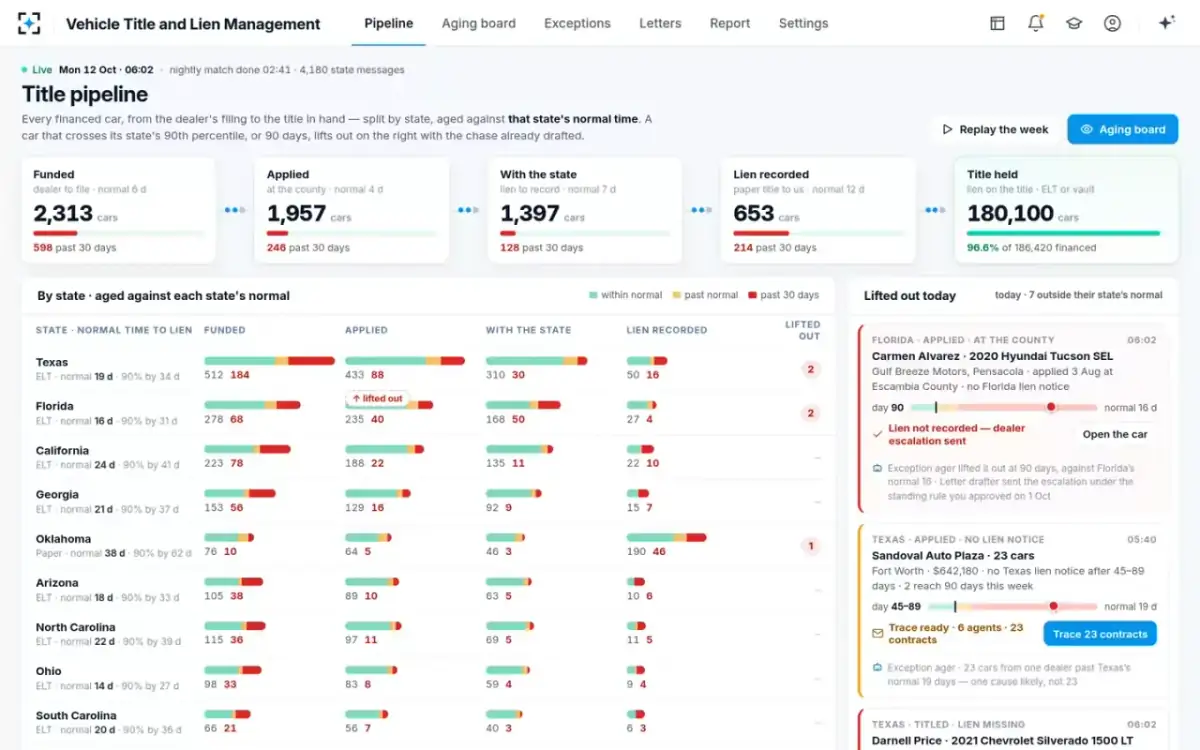
Read the bars in that order and the common complaint about slow DMVs mostly dissolves. The largest group of waiting cars has not reached a state office at all: the dealer has not filed. The next largest is sitting at a county counter. The state's own stage is the third, and the fourth is not a delay in perfection but a document in the post on a lien that already exists — which is why a car in that stage needs patience rather than a letter, and a car in the first needs a letter today. Which stage a car is in, and what each stage proves, is the subject of checking the title and lien status on one VIN.
How do you measure your own normal days to title?
Five steps, and the discipline is in the first and the fourth. Measure finished work, not open work; and report a percentile rather than an average, because a title book has a long right tail and an average is dragged around by cars nobody is waiting on any more.
How to compute a state's normal days to title from your own book
- Take every lien the state has actually recorded in the last 60 days
Not the open cars — the finished ones. An open exception has no end date yet, so a book of open cars measures impatience, not the state.
- For each one, count calendar days from funding to the recording date
Funding is the day your money left. The recording date is the state’s, not the day the notice reached you; in most titling states it is the day the application disclosing the lien was accepted.
- Group by the state that titles the car, never by the dealer’s state
A Fort Worth dealer selling to a buyer who lives in Oklahoma produces an Oklahoma title. Grouping by the selling dealer mixes two clocks and hides both.
- Report the median and the 90th percentile, not the mean
One car stuck at 180 days moves a mean by a week and a median not at all. The 90th percentile is the number you set a chase on, because it is the edge of normal rather than the middle of it.
- Recompute weekly, and keep the old line
A state that changes a form or a vendor moves its line within a month. Keeping last quarter’s number beside this one is how you notice.
Two decisions inside that calculation are worth arguing about. The first is the start date. Funding is the right one for a lender, because it is the day the money is at risk and the day your own systems can prove. The sale date is better for judging a dealer and worse for judging a state, since a car sold on Friday and funded on Monday has already lost three days that belong to nobody. The second is the end date: use the state's recording date rather than the day its message reached you, or you will measure your own file transfers as though they were the state's queue. Why the two differ, and which one a court uses, runs through the five steps of perfecting a lien on a vehicle.
What a percentile line does that a deadline cannot
A deadline answers "has this car broken a rule?" A percentile answers "is this car unusual?" They are different questions, and only the second one finds problems early. A Florida car at 28 days has not broken the dealer's 30-day deadline, but it is already past the point where nine Florida cars in ten are finished, so something has gone wrong and it is worth a look today rather than in three days. A California car at 31 days is inside its state's normal tail and almost certainly fine; chasing it costs a specialist ten minutes and the dealer a little goodwill, for nothing.
The same 30-day rule, measured against what each state actually does
| State | Dealer’s filing deadline | Median days to a recorded lien | 90% of cars done by | What a flat 30-day rule does here |
|---|---|---|---|---|
| Pennsylvania | 20 days from purchase (75 Pa.C.S. §1103.1) | 11 days | — | Far too slow. A Pennsylvania car at 25 days is already a long way outside normal and nothing has been said |
| Ohio | 30 days (lender’s rule library) | 14 days | 27 days | Too slow by a fortnight. Half the late cars will be found a month after they went wrong |
| Florida | 30 days from delivery, $20 late fee (Fla. Stat. §319.23) | 16 days | 31 days | Close to right, by accident. The rule and the state’s tail nearly coincide |
| Texas | 30 days from sale; 45 if the dealer financed it (43 Tex. Admin. Code §215.144) | 19 days | 34 days | Slightly tight. Cars that are normal for Texas arrive as exceptions in the fourth week |
| South Carolina | 45 days (lender’s rule library) | 20 days | 36 days | Tight. The rule fires six days before the state’s own tail ends and eleven before the dealer is late |
| North Carolina | 28 days from transfer (N.C. Gen. Stat. §20-73) | 22 days | 39 days | Too tight. A normal North Carolina car becomes an exception most months |
| California | 30 days (lender’s rule library) | 24 days | 41 days | Wrong by eleven days. A tenth of a healthy California book is flagged every month |
Reading down the last column is the argument of this guide in one view. The flat rule is wrong in six of the seven states, and wrong in both directions — months late in Pennsylvania and Ohio, a manufacturer of false exceptions in California and North Carolina. A lender working the California list is paying people to write to dealers who have done nothing wrong, while the Pennsylvania cars that really did stop sit quietly for another fortnight.
Every financed car, aged against the state that titles it
How often to recompute, and what moves a state's line
Weekly, over a rolling 60 days, is the setting the sample lender runs — long enough that a single bad week does not move a state's line, short enough that a real change shows up inside a month. Quarterly is too slow for a book this size: a state that swaps a vendor in April will have mis-aged every car in that state until July. Daily is noise.
Four things genuinely move a line, and each one leaves a different signature. A state moving a lien route on or off paper moves the last stage and nothing else. A county changing its counter process moves one state's second stage and shows up as a widening gap between the median and the 90th percentile. A dealer network change — a group that sells a quarter of your cars in a state and swaps its title service — moves the first stage and looks exactly like a state slowdown until you group by dealer. And your own change of funding cut-off moves the start date and therefore everything, which is why the line should be recomputed, and the old one kept, whenever you touch your own process.
What to do with the cars that cross the line
Crossing a state's 90th percentile is not a finding; it is a question. The right response is to read the state's record for that VIN before writing to anybody, because the answer is usually one of six things and only three of them call for a dealer letter. In the sample portfolio the 1,186 cars past 30 days without a recorded lien split into: 612 never filed, 214 waiting on a document, 173 rejected by a state or county office, 96 recorded with the wrong lienholder name or a VIN mismatch, 53 still with the state, and 38 titled to the buyer with no lien at all. Only the first, third and sixth need a letter today; the rest need either patience or a correction.
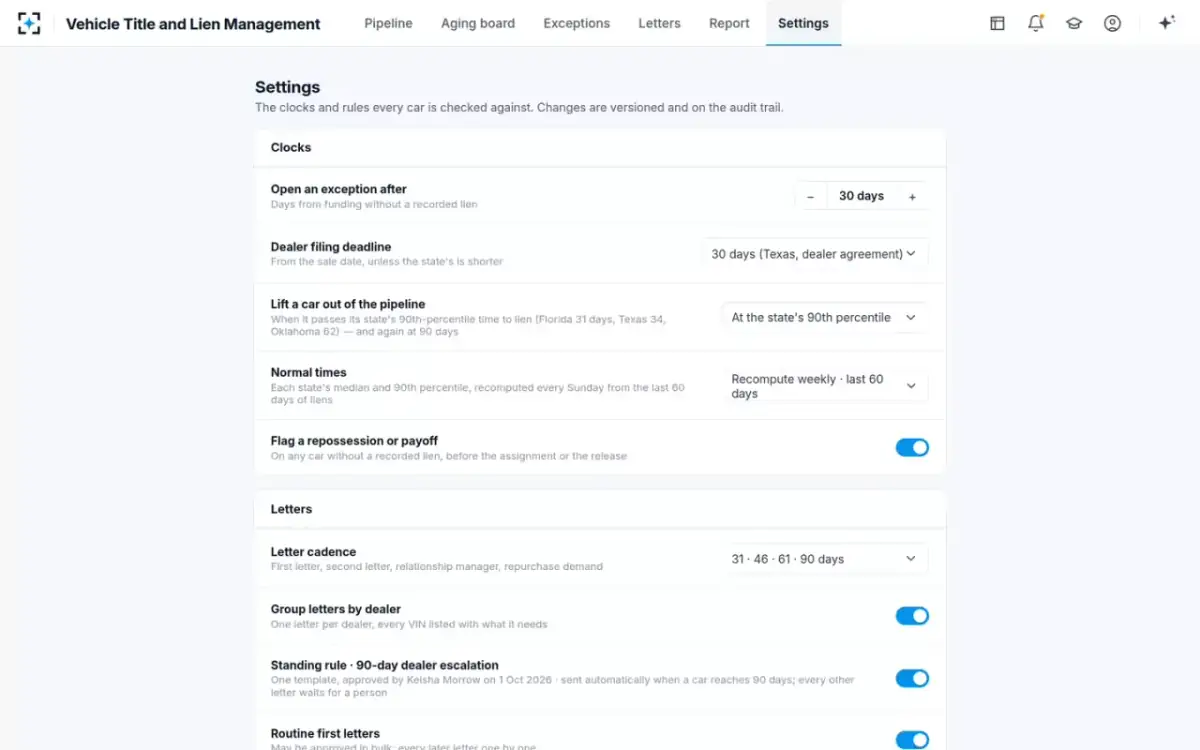
The sample lender's own settings make that split operational. An exception opens at 30 days without a recorded lien; a car lifts out of the pipeline when it passes its state's 90th percentile, and again at 90 days; letters run on a 31, 46, 61 and 90-day cadence, grouped so one dealer gets one letter listing every VIN with what each needs. A car that is merely slow for its state never reaches that cadence, which is the whole point of the percentile.
The clocks a title team actually sets
Three states, one Monday: the same car at three different ages
Take three cars funded on the same day, each at day 28, in Ohio, Texas and California. Under a flat 30-day rule all three are quiet and all three will become exceptions together on Wednesday. Under each state's own line they are three different cars.
The Ohio car is a fortnight past the point where nine Ohio cars in ten are finished. It has almost certainly stopped — not filed, or rejected and never resubmitted — and it should have been read on day 14. The Texas car is six days inside the state's tail: worth a glance at the state's record, not worth a letter. The California car is seventeen days inside its tail and entirely unremarkable; writing to that dealer would be the third unnecessary letter they had from you this month, which is how a title desk loses the standing it needs when a letter does matter.
That is the practical case for measuring: not a better dashboard, but a shorter and truer list. A specialist working 60 to 80 exceptions a day can only act on the ones that are real, and the only way to know which are real is to know what normal looks like in each of 31 places. What it costs when the list is wrong in the other direction — a car that quietly never got its lien — is the subject of what an unperfected lien on a vehicle costs in the courts' own words. To see the pipeline, the per-state clocks and the lift-out list together, start from Vehicle Title and Lien Management.
Questions people ask
How long does it take for a lien to be recorded on a car title?
In a state that records liens electronically, usually one to four weeks from funding, of which the state's own part is often only a few days; the rest is the dealer preparing and filing the application. No state publishes a service level for it, so the only reliable number is the one you measure from your own recently recorded liens in that state.
Is 30 days a reasonable title deadline in every state?
No. In the fictional sample portfolio a flat 30-day rule fires about a fortnight too late in Ohio and Pennsylvania and about eleven days too early in California, where nine cars in ten are not finished until day 41. It is defensible as a policy floor — it matches the federal 30-day preference window on a purchase-money lien — but as the trigger for chasing a dealer it is wrong in most states.
How long should a lender wait before chasing a dealer?
Until the car passes the point where the great majority of that state's cars are already finished, and then only after reading the state's record for that VIN. In the sample portfolio that is the state's 90th percentile — 27 days in Ohio, 34 in Texas, 41 in California — with a second, absolute line at 90 days regardless of state.
Why do two states with the same deadline take different times?
Because the deadline governs the dealer and the processing time governs the state. Two states can both give a dealer 30 days and differ by ten in practice, depending on whether the filing goes through a county counter or straight to the state, whether the lien is notified electronically or on paper, and how much work the state's offices are carrying.
Should you measure from the sale date or the funding date?
From funding, if you are a lender. Funding is the day your money is at risk and the day your own records can prove without relying on the dealer's paperwork. The sale date is the right start when you are judging a dealer against its filing deadline, which is a different measurement with a different owner.
What is the 90th percentile time to lien, and why use it?
It is the number of days by which nine cars in ten in that state have a recorded lien. It is better than an average because a title book has a long tail — a handful of cars stuck for six months pull a mean up and tell you nothing — and better than a flat deadline because it adapts to the state rather than to a policy written once.