When a title comes back and the lienholder is not listed on it, the useful question is not what to send but what happened. Six things produce the same blank field: nothing was ever filed; the application was filed with the lien section empty; the office rejected the filing and nobody resubmitted it; the lien was recorded under a name that is not yours; the car on the record is not quite your car; or the state has simply not got there yet. Botminds' Vehicle Title and Lien Management reads the state's own record for each car and sorts the exceptions by which of those it is, before a single letter is drafted.
The difference matters because the six need different documents from different people, and the two most expensive ones look identical from the outside. In the fictional sample portfolio used throughout this solution — Tamarack Auto Credit, 186,420 financed cars in 31 states — 1,186 cars were past 30 days without a recorded lien, and reading them as one problem would have produced 1,186 copies of the wrong letter.
One title, read field by field
Title number
03319871254
A title exists. The state did process an application for this car.
Issued
21 Aug 2026 · Tarrant County
The date and the office that issued it — the two facts that tell you which filing produced this document.
Owner
Darnell Price
The buyer, correctly. Ownership transferred; only the security interest did not.
First lienholder
None recorded
The field the whole case turns on. Not blank in error on the print: empty on the state’s record.
Odometer
41,226 · actual
Present and accepted, so the filing was not rejected for a missing odometer disclosure.
Why is the lienholder not listed on the title?
Because one of six things happened between the signature and the state's record, and the document in your hand cannot tell you which on its own. Three of the six are the dealer's to fix, two are a state office's, and one needs nothing but time. Sorting them is the whole job, and it is done by reading three things together: the title record, the filing history behind it, and the state's own normal time to record a lien in that state.
What a missing lienholder field does not automatically mean is that the lien was never perfected. A federal court made that point directly when a state issued a duplicate title and left the lienholder off: the lien "was perfected on November 29, 2006, the date upon which the Application for Certificate of Title was delivered to the Knox County Clerk, irrespective of when the lien was noted on the certificate of title", and the faulty duplicate was "nothing more than an administrative error" (Fitzpatrick v. Toyota Motor Credit Corp.). A blank field is a question. The filing history is the answer — and if the filing history shows nothing, what an unperfected lien actually costs is the next thing to read.
Read the record before you write the letter
Four facts decide which of the six cases you are in, and all four are obtainable without asking the dealer anything. Is there a title at all, and what is its number? What date was it issued, and by which office? Who is shown as owner? And is there a filing in the state's history for this VIN that the title did not come from — a rejected application, an earlier submission, a correction?
The order matters. A lender that starts from the dealer gets the dealer's account of what happened, which is usually sincere and often wrong; the dealership's own clerk may not know that a county returned a filing six weeks ago. A lender that starts from the record gets the facts, and can then ask the dealer for exactly one thing.
From a blank lienholder field to one letter
Agent
Title document readerReads the title record, any paper title and every county notice for the VIN: title number, issue date and office, owner, each lienholder and its position, brands and odometer.
Never: Never accepts a title that does not show the lender as first lienholder.
Agent
Lien notice matcherChecks the state’s lien messages for the VIN since funding, including any that named a different lienholder.
Never: Never matches on VIN alone when the make differs.
Agent
State title rules checkerApplies that state’s filing deadline, correction form and route, and its current normal time to a recorded lien.
Never: Never guesses a rule it does not hold — it asks the title lead.
Agent
Exception agerPlaces the car in one of the six cases, and looks for the same cause across the dealer’s other cars.
Never: Never closes an exception without the recorded lien.
Agent
Letter drafterWrites one letter per dealer listing every VIN with what that VIN needs — a corrected application, a first filing, or a resubmission with the county’s notice attached.
Never: Never sends without a person’s approval; a repurchase demand needs two.
A person decides
Title operations leadReads the sorted cases, decides the order, and approves the letter with her name and password.
Cause one: nothing was ever filed
The commonest cause and the simplest to prove: there is no title record for the VIN at all, no rejection notice, and nothing in the state's history since the sale. In the sample portfolio 612 of the 1,186 open cars were in this state — more than half — and at one dealer fourteen cars sat between sixteen and sixty days past the state's filing deadline with $357,940 financed against them.
The fix is a first filing, and the leverage is the dealer agreement plus the state's own deadline, which is a legal duty rather than a commercial preference. Pennsylvania, for instance, requires a dealer to deliver the application "within 20 days of the date of purchase" and makes a dealer who misses it guilty of a summary offence carrying a $50 fine for each violation (75 Pa.C.S. §1103.1). Naming the deadline in the letter changes the conversation from a favour to an obligation.
Cause two: the dealer filed, with the lienholder section blank
This is the expensive one, and the one that defeats a chasing process built around "has the dealer filed yet?". The application went in, the state accepted it, a title was issued — to the buyer, with no lienholder. Everything the dealer will tell you is true: they filed. In the sample portfolio 38 cars were in this condition, and six of them belonged to a single dealer, $195,340 financed.
The states are specific about whose job that field is. In Texas, "the lienholder's name and address and the date of the first lien must be included in the first lien information" on the application, and the manual adds that an erasure of the lienholder's name "is not acceptable" (Motor Vehicle Title Manual, §12.5). Pennsylvania requires the application to "contain the names and addresses of any lienholders in order of priority and the amounts and the dates of the security agreements" (75 Pa.C.S. §1103.1). The information is mandatory; nothing in the process catches its absence, because an application without a lien is a perfectly valid application.
The fix is a corrected title application naming the lender as first lienholder — in Texas a corrected Form 130-U. It needs the buyer's signature, which is straightforward while the buyer is happy and close to impossible once they have stopped paying. That is why this case escalates fastest: if the correction cannot be obtained, the remaining options are a repurchase demand under the dealer agreement or a car the lender cannot sell.
Cause three: a state office rejected the filing, and nobody resubmitted
A rejection is a silent event for a lender. The office returns the application to whoever filed it with a notice saying why — a missing odometer disclosure, an unsigned form, a fee short — and if that party does nothing, nothing else happens. Nobody chases. In the sample portfolio 173 cars were in this state, three of them at one dealer, returned by Tarrant County on 2 and 9 September and never sent back.
The scale of the checking that produces these notices is easy to underestimate. Florida's Auditor General found that in nine quality reviews the department's programme examined "51,456 driver's license and 6,939 motor vehicle title and registration transactions" (Report No. 2023-046), and Texas processed "7.7 million vehicle title transactions" through 254 county offices in a single year (TxDMV Chairman's Annual Report). Filings are checked, filings are returned, and the return is a local decision made in one of hundreds of offices.
The fix is a resubmission, and the letter should carry the county's own notice back to the dealer rather than describing it. States have a defined route for this: Texas processes a corrected lien through a specific rejection-correction event and reissues the receipt, and waives the application fee where the office itself made the error (Motor Vehicle Title Manual, §12.5).
Cause four: the lienholder name on the title is wrong
A lien is recorded, just not yours. "Tamarack Auto Finance" and "Tamarack Auto Credit LLC" are two different lienholders to a title office, and a lender whose dealer packet, loan documents and electronic enrolment do not all carry one exact legal name will collect these steadily. In the sample portfolio 96 cars carried a wrong lienholder name or a VIN mismatch, and a batch of seven Florida notices naming "Tamarack Auto Finance" was queued as a single correction to the state title office.
The states treat a name change on an application as a serious alteration rather than a typing fix. Texas requires a statement of fact from the lienholder explaining the alteration and confirming who the correct lienholder is, and will not accept an erased lienholder name at all (Motor Vehicle Title Manual, §12.5). The practical lesson is upstream: settle one legal name, put it in the dealer packet and the electronic enrolment, and audit for near-misses rather than for blanks.
Cause five: the car on the record is not quite your car
A single transposed character in a seventeen-character VIN produces a title record that exists, carries a lien, and belongs to no contract you hold. Matching by VIN alone will either miss it or — worse — attach it to the wrong car. The guard in the solution is deliberate: the matcher never accepts a match on VIN alone when the make differs, which turns a silent wrong answer into an exception a person looks at.
This case is rarer than the others and is usually found from the other direction: a state message arrives that matches nothing. Those unmatched messages are worth a queue of their own, because each one is a lien recorded somewhere for someone, and occasionally it is yours.
Cause six: nothing is wrong yet
The sixth reading is the one a chasing-first process gets wrong most often. The application was filed, correctly, and the state has not finished. In the sample portfolio 53 cars were with the state inside its own normal time and a further 214 were waiting on a document from a state that still sends one. Neither group should receive a letter, and a lender that sends one anyway spends its dealer relationships on cars that were always going to be fine.
Telling this case from the others needs a per-state clock rather than a single rule: a car at day 25 in a state whose median is eleven days is late, while the same car in a slower state is not. That clock has to be built from the lender's own recent liens, because no state publishes the distribution.
1,186 cars with no recorded lien, by which of the six it is
How do you correct a lien on a car title?
By filing the correction the state defines for the case you are in, through the party the state will accept it from. There is no general remedy; each state has a named form and a named route, which is why a multi-state lender has to hold the route as a setting rather than as knowledge in someone's head.
The six cases, and what each one actually needs
| What the record shows | What happened | What fixes it | Who has to send it | What it is worth chasing |
|---|---|---|---|---|
| No title record and no notice for the VIN | The application was never filed | A first filing with the lien on it | The dealer | Immediately. The state’s filing deadline has usually already passed, and the federal 30-day window with it |
| A title issued to the buyer, first lienholder empty | Filed with the lien section blank | A corrected title application naming the lender as first lienholder | The dealer, with the buyer’s signature | Fastest of all. The signature gets harder every week the loan is unpaid |
| A county or state rejection notice, and no later filing | Returned for a defect and abandoned | A resubmission, with the office’s own notice attached | The dealer, through the state’s correction route | High. The defect is usually trivial and the car has lost weeks |
| A lien recorded in a name close to yours | The wrong lienholder name was filed | A correction to the state, with a statement of fact from the lienholder where the state requires one | The lender, to the state title office | Batch them. One letter per state office beats one per car |
| A record that does not match the contract’s vehicle | A VIN or vehicle mismatch | A corrected application, after establishing which record is really this car | The dealer or the state, depending on where the error entered | Carefully. Acting on the wrong record is worse than waiting |
| No answer, and the car is inside its state’s normal time | Nothing. The state has not finished | Time | Nobody | Not at all. Age it against its own state and look again |
Look for the cause behind the cases
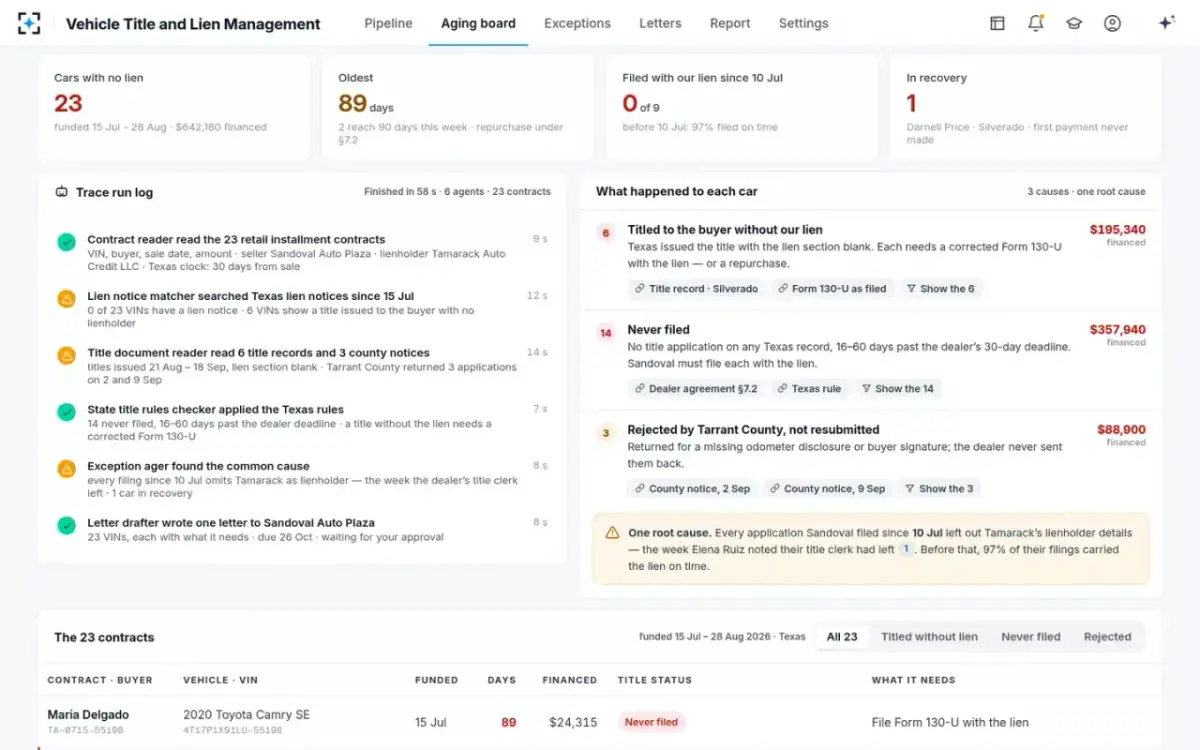
Sorting one car by cause is useful. Sorting a dealer's cars by cause is where the money is, because the same mistake repeats until someone names it. At the fictional sample dealer the trace put 23 cars into three of the six cases — fourteen never filed, six titled without the lien, three rejected and abandoned — and then found what sat behind all three: every application that dealership filed after 10 July left the lender's lienholder details out, which was the week its own title clerk left. Before that date 97% of its filings carried the lien on time.
That is a fixable fact about one small business, and it is invisible to a process that works VINs. It is also the difference between twenty-three letters and one letter with twenty-three VINs on it, each saying what that VIN needs — which is what the dealer can actually act on.
Twenty-three cars at one dealer, sorted by what happened to each
What to change upstream, so there are fewer of them
Four of the six causes are made before the car is funded, and they are cheaper to prevent than to correct. One exact legal name everywhere, including the electronic enrolment, removes most of cause four. The state's lienholder identifier in the dealer packet removes the quiet downgrade from an electronic title to paper. A check on the application as filed, rather than only on the answer that comes back, catches cause two in days instead of months. And a queue for state messages that match no contract catches cause five from the other side.
The rest is detection speed. The association that represents the state agencies recommends that participation in electronic lien programmes be mandatory for dealers and lenders alike, partly so that agencies are not running "two programs" with two sets of failure modes (AAMVA) — and a lender enrolled everywhere it can be has fewer blind channels to watch. Which states give it that option is set out state by state. To see the six cases sorted on a real portfolio, with the letters they produce, start from Vehicle Title and Lien Management.
Questions people ask
The title came back without our lien — is the lien gone?
Not necessarily. A missing lienholder field may mean the lien was never recorded, or that the document is a faulty reprint of a record that is correct. A federal court treated exactly that situation as an administrative error that did not touch a lien perfected years earlier when the application was delivered. Check the filing history for the VIN before you treat the lien as lost — and get the record corrected either way, because the next party to rely on it will read the document.
What is a corrected title application?
The state's route for changing what is on a title record after it has been issued — in Texas a corrected Form 130-U, in Florida Form HSMV 82040. For adding a lien that was left off, it generally needs the owner's signature as well as the lienholder's details, and the new lien is perfected on the day the correction is accepted rather than retrospectively.
How long does it take to correct a title?
Longer than the original filing, because the clock restarts and the correction usually needs a signature from someone who has no reason to hurry. Plan for at least the state's normal time to a recorded lien again, and treat any car where the borrower has stopped paying as a case that will not be corrected at all.
Can we add our lien without the buyer's signature?
Generally not, where the correction changes the title record of a car already titled in the buyer's name. That is why this case escalates to the dealer so quickly: the remedies that do not need the buyer are commercial — a repurchase demand under the dealer agreement — rather than administrative.
What if the lien is recorded under a slightly different company name?
Treat it as a defect and correct it. States do not regard a near-miss as close enough: Texas requires a statement of fact from the lienholder explaining any alteration of the name and confirming who the correct lienholder is, and will not accept an erasure. Batch these by state office rather than sending one letter per car.
How do you stop the same cause producing twenty more cars next month?
Group the exceptions by dealer before you group them by age, and look for a date. A dealership that was filing correctly and then stopped has had something change — a person left, a title service was swapped, a packet was updated — and the fix is one conversation rather than twenty letters. In the fictional sample portfolio the change was a title clerk leaving in the second week of July.