A title clerk gets a financed car onto a state's title record with the right owner and the right lienholder on it, and then fixes the ones that did not land. The job description changes completely depending on which side of the transaction the desk sits: a dealership's title clerk prepares and files the application, a lender's title operations specialist watches for the state's answer and chases what never comes, and a county or state clerk accepts, rejects or corrects the filing. Botminds' Vehicle Title and Lien Management sits on the lender's desk, matching every state message to its contract overnight and handing the specialist a list where each car already says why.
This guide describes all three seats, because the thing that makes the work expensive is that one missing lien has to cross every one of them. The examples come from a fictional sample lender used throughout this solution, Tamarack Auto Credit: 186,420 financed cars in 31 states, 1,186 of them past 30 days without a recorded lien, worked by a team of five.
The five seats one missing lien crosses
Today
Works 60–80 exceptions a day in the state portal and the county sites, looking up one VIN at a time, most of them to find that nothing has happened.
With agents
Opens a list where every car already says why — never filed, no lien on the title, rejected, wrong name or VIN, document still due — and what was last sent.
Still theirs: Deciding whether a car’s record really shows what the system thinks it shows.
Today
Owns 1,186 open exceptions across 441 dealers and 31 states, and sees them as VINs rather than as causes.
With agents
Starts on the cars that crossed their own state’s line overnight, each with the cause traced and a letter drafted.
Still theirs: Approving every letter, with her name and password, and signing the one standing rule.
Today
Hears about a dealer’s title problem late, usually from the dealer.
With agents
Gets a dealer’s cars at 61 days, traced to one cause, and co-approves any repurchase demand before it goes out.
Still theirs: The conversation with the dealer principal, which no letter replaces.
Today
Finds out at the auction that a car has no lien on its title and cannot be sold clean.
With agents
Sees lien status before an assignment or a sale; a car with no recorded lien is flagged and held.
Still theirs: The call on whether to recover at all.
Today
Reports the 30-day perfection rate from a spreadsheet, a month late, with no explanation for a dip.
With agents
Receives the monthly figures by funding month, within 30, 60 and 90 days, with the dealers furthest behind and the reason for each move.
Still theirs: The dealer network decisions the numbers argue for.
What does a title clerk do?
On a lender's desk, four things. Confirm that every funded contract has a title application on its way, with the lender named correctly as first lienholder. Match what comes back from the states — electronic lien notices, title messages, paper titles, county rejection notices — to the right contract, usually by VIN. Work the gap between those two lists: the cars with no answer yet, the cars whose answer is wrong, the cars whose application was rejected and never resubmitted. And hold the documents, where the state still sends one, until the loan is paid and the lien released.
Almost all of that is lookup. In the sample portfolio a specialist covering Texas and Oklahoma works sixty to eighty exceptions a day, and the honest description of most of them is: open the state portal, type a VIN, find that nothing has happened, write a note, move on. The judgement in the job — is this car late for a reason the dealer can fix, or is it just in a slow state? — arrives only after the looking up is done, which is why it so often does not arrive at all.
Title clerk job description, in three versions
The same two words name three jobs with different employers, different software and different legal duties. Confusing them is how a lender ends up with a dealer agreement that assumes the dealership's clerk is doing something that is actually the county's job, or an escalation path that chases the wrong party for a month.
Three jobs called title clerk, and what each is accountable for
| The seat | What this clerk actually does | What they are accountable for | What they cannot do |
|---|---|---|---|
| At the dealership | Prepares the state title application, names the lienholder, collects signatures and the odometer disclosure, remits the fees and files with the state or county | Filing inside the state’s deadline — 20 days in Pennsylvania, 28 in North Carolina, 30 in Florida — and putting the right lienholder on the form | Nothing after the filing. Once the application is accepted the dealership has no further control over the record |
| At the lender | Matches state notices and titles to contracts, works the exceptions, drafts and sends chases, holds the documents, releases the lien at payoff | Knowing which financed cars have a recorded lien, and getting the rest there | File the application. In almost every retail deal the lender is not the applicant and cannot correct a form it never touched |
| At the county or state office | Accepts or rejects the application, keys the lien, updates the record, issues the title or the electronic message, processes corrections | Applying the state’s own rules to each filing, including rejecting one that is incomplete | Chase anybody. A rejected application sits until the party who filed it comes back |
The middle row is the uncomfortable one. A lender's title clerk is accountable for an outcome — the lien on the record — produced almost entirely by two parties the lender does not employ. Everything the role can do is therefore about speed of detection and quality of the ask, which is also why the date a lien is actually perfected is the first thing a new specialist should be taught.
A day on a lender's title desk
A specialist's day splits into three unequal parts: finding out what happened, working out what it means, and asking someone to fix it. By hand the first part eats the day. The split below is for one dealer's two dozen cars past 30 days with no lien notice — one morning's work in the fictional sample portfolio, drawn as it runs by hand and as it runs when the lookups are done overnight.
One dealer’s missing liens: where the working days go
- Looking up each VIN in the portal and the county sites0.8 d
- Pulling title records and rejection notices0.4 d
- Working out why each car has no lien, and the shared cause0.5 d
- Writing the letter, then review and approval0.4 d
- Reading what the night’s matching found0.2 d
- Cause, letter, review and approval0.3 d
Read the two lanes together and the shape of the job changes rather than shrinks. The lookup bands collapse; deciding what a title record means and what to ask the dealer for does not, because that is the work. Nor does the approval inside the last band, which takes the same tenth of a day either way. In the solution a trace of 23 contracts at one dealer finished in 58 seconds, and what came back was not an answer but a sorted question: fourteen never filed, six titled to the buyer with the lien section blank, three rejected by the county and never resubmitted.
How much does a title clerk make?
There is no federal occupation code called title clerk, which is why published salary figures for the role vary so widely. The two nearest official occupations give a useful bracket. Loan interviewers and clerks — the lender's side of this work — had a median wage of "$24.05 hourly, $50,020 annual" in 2025, with 169,100 people employed nationally (O*NET, 43-4131.00). Court, municipal and license clerks — the county counter — had a median of "$23.41 hourly, $48,700 annual", with 187,000 employed (O*NET, 43-4031.00).
Both sit within a couple of dollars an hour of each other, and both are clerical rates for work that decides whether a five-figure asset is secured. That mismatch is the quiet argument of this whole job: the fictional sample lender has $3.86 million financed across 141 cars that are more than 90 days past funding with no recorded lien, and the cost of finding them was never the salary. It was the fact that nobody had the hours to look.
The seat nobody counts: the dealership's title clerk
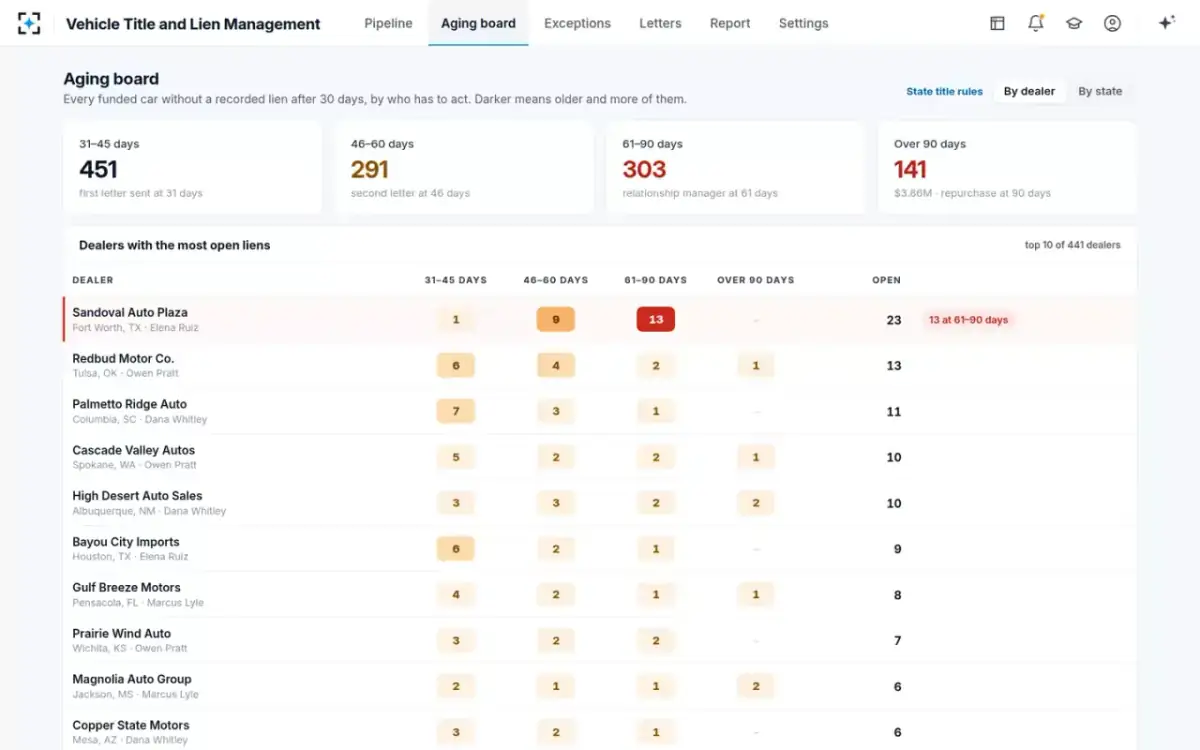
The person with the most influence over a lender's perfection rate is not on the lender's payroll. In the sample portfolio, one dealer — Sandoval Auto Plaza in Fort Worth — accounted for 23 open liens, thirteen of them already at 61 to 90 days. The trace found one cause behind all of them: every application the dealership filed after 10 July left the lender's lienholder details out, which was the week its own title clerk left. Before that date, 97% of its filings carried the lien on time.
That is not a dealer behaving badly; it is a small business losing one person. But a lender that reads its exceptions as 23 separate VINs will send 23 separate chases and never find the week in July. Reading them as one event is the difference between a letter and a fix, and it is why the aging board in the solution groups by dealer before it groups by anything else.
The same portfolio seen by who has to act next
The other side of the counter
The county seat is the least visible and the largest. Texas alone "issued nearly 27 million registrations and 7.7 million vehicle title transactions" in its 2025 fiscal year, and those title transactions are processed by the state's "254 county tax assessor-collectors" on the department's behalf (TxDMV Chairman's Annual Report). The department's own description of why the work matters names the lender explicitly: proper titling protects owners and buyers "by ensuring the lawful transfer of ownership, preventing fraud and theft, and safeguarding the interests of lenders."
Two things follow for a lender's title desk. First, a rejection is a local decision made by one of hundreds of offices, so the correction route is local too — and a county that returned an application for a missing odometer disclosure will not chase anyone for the fix. Second, processing time is a property of the office and the season, not of the lender's relationship, which is why a single national deadline fits so badly — and why the desk's own measured median for each state is worth more to it than any published figure.
What the work looks like when the lookups are already done
The useful test of any change to this job is what the morning list looks like. By hand it is a list of VINs with ages. When the matching has already run, it is a list of causes with counts — and a list of causes can be worked in priority order by one person, while a list of VINs can only be worked in order.
1,186 open exceptions, sorted by what is actually wrong
Each band is a different conversation. Never filed is a dealer letter. Rejected is a resubmission with the county's own notice attached. Wrong name is a correction to the state. Titled to the buyer with no lien is the expensive one: it needs a corrected application signed by a buyer who may have stopped paying, or a repurchase demand under the dealer agreement. Telling those apart from the record itself is the skill the job is really built on.
Will agents replace title clerks?
Not in any version of this work that a lender should want. What is automatable here is the part the job holder likes least and the part that fails most reliably at scale: typing a VIN into a portal, reading a title record, matching a nightly file of state messages, noticing that twenty-three cars share a cause. What is not automatable is the judgement about what a record means and the authority to ask a dealer for money. In the solution no letter leaves without a person's approval, and a repurchase demand needs two.
The pressure on the role is coming from volume rather than from software. The Federal Reserve Bank of New York reported "$211 billion in new auto loans appearing this quarter" in the second quarter of 2026, with balances up "$28 billion to $1.71 trillion" (Household Debt and Credit). Supervisors are paying attention to the back end too: CFPB examiners found servicers committed unfair acts when they "failed, through service providers, to timely deliver the titles to vehicles after a loan or lease payoff" (Supervisory Highlights, auto finance). More cars, more documents, more scrutiny, and a clerical pay band — the shortage is of attention, not of people willing to do the work.
The honest description of the change, then, is a narrower job done better: fewer lookups, more decisions, and an exception that arrives already explained. To see the morning list, the causes and the letters, start from Vehicle Title and Lien Management.
Questions people ask
What is a title operations specialist?
The lender-side version of the title clerk role, usually covering a set of states. The specialist matches incoming state notices and titles to funded contracts, works the cars that have no answer or the wrong one, drafts the chases and keeps the documents. In the fictional sample portfolio one specialist covers Texas and Oklahoma and handles 60 to 80 exceptions a day.
What skills does a title clerk need?
Reading a state title record accurately is the core one: knowing what a title number, an issue date, a first-lienholder field and a brand actually mean, and spotting when a name is close but not right. After that, familiarity with several states' forms and correction routes, patience with portals, and the judgement to tell a car that is merely in a queue from one where nothing was ever filed.
What is the difference between a dealership title clerk and a lender's title clerk?
The dealership's clerk prepares and files the title application and is accountable for meeting the state's filing deadline with the right lienholder on the form. The lender's clerk cannot file anything in a retail deal; they are accountable for knowing whether the lien reached the record and for getting the dealer or the state to fix it when it did not.
How many title exceptions can one person work in a day?
Sixty to eighty when each one starts with a portal lookup, which is the figure the fictional sample lender's specialist reports. The number is set almost entirely by how long it takes to find out what happened rather than by how long it takes to act, which is why removing the lookup changes throughput more than adding staff.
Is title clerk a good job to move into?
It is a route into secured lending operations that teaches something durable: how collateral is actually perfected and lost. The pay bands for the nearest official occupations sat near $48,700 to $50,020 a year in 2025. The people who move on from it tend to go into dealer relationship management, recovery or collateral risk, because they are the ones who can read a title record.
Who should approve a chase letter to a dealer?
A named person, every time, and two when money is being demanded. In the fictional sample portfolio the title operations lead approves each letter with her name and password, routine first letters may be approved in bulk, and a repurchase demand also needs the dealer relationship manager's approval. The one standing exception is a single 90-day escalation template the lead signed for, and every send under it is recorded.