To perfect a lien on a vehicle you do not file anything with a secretary of state. You get the lien written onto the title record of the state that titles the car, by putting it on the title application before that application is accepted — and from that moment the lien is good against the rest of the world. Every other step a lender takes, including receiving the title itself, is confirmation. Botminds' Vehicle Title and Lien Management follows every financed car from the dealer's filing to the state's answer, ages each one against its own state's normal time, and traces the ones that stop.
The distinction between the date a lien is perfected and the date a lender learns of it is the whole subject. It is why a lender can hold a portfolio that looks fine and discover, at a repossession, that the security it priced is not there. The examples below come from a fictional sample lender used throughout this solution, Tamarack Auto Credit, with 186,420 financed cars in 31 states; the law, the deadlines and the court records are linked where they appear.
The numbers that decide whether a lien holds
30days
after the buyer takes the car, to perfect a purchase-money lien and keep it out of reach of a bankruptcy trustee
45days
Texas gives a dealer-financed sale to file the title application — fifteen days past that federal window
7.7M
vehicle title transactions Texas alone processed in its 2025 fiscal year, through 254 county offices
How to perfect a lien on a vehicle, in five steps
The sequence is the same in every titling state, and only the forms and the clocks change. One: the buyer signs a retail installment contract that grants the lender a security interest in the car. Two: whoever is filing — almost always the selling dealer — prepares the state's title application with the lender named as first lienholder, in the lender's exact legal name. Three: the application, the fees and the supporting documents reach the state or its agent, and are accepted. Four: the state records the lien on its title record. Five: the state tells the lender, by an electronic message or by sending the title, and in a few states by sending a paper title the lender then has to hold.
Step three is perfection. Steps four and five are the state catching up with itself, and they can take a day or six weeks. A lender that treats step five as the moment of perfection has moved its own clock weeks later than the law's, in the one direction that hurts.
Who does what between the signature and the recorded lien
A person decides
The buyer and the dealerSign the retail installment contract, and prepare the title application naming the lender as first lienholder.
Agent
Contract readerReads each funded contract — VIN, buyer, sale date, state, dealer, lienholder name — and starts that state’s clock.
Never: Never edits the contract. Differences are reported, with the page they came from.
A person decides
The county or state officeAccepts the application with its fee, or rejects it. Acceptance is the moment the lien is perfected.
Agent
Lien notice matcherMatches every state lien notice and title message to its contract by VIN, each night.
Never: Never marks a lien recorded without the state’s notice or the title itself.
Agent
Title document readerReads titles, state title records and county rejection notices: title number, owner, every lienholder and its position, brands, odometer, reason for rejection.
Never: Never accepts a title that does not show the lender as first lienholder.
Agent
Exception agerAges each car against its own state’s normal time to lien and lifts out the ones past it.
Never: Never closes an exception without the recorded lien.
A person decides
Title operations leadApproves every letter to a dealer or a state office before it goes.
Why a car is different: the title replaces the filing
For most business collateral a secured lender files a financing statement and the filing is the perfection. For a car it is the opposite. Article 9 of the Uniform Commercial Code steps aside: "the filing of a financing statement is not necessary or effective to perfect a security interest in property subject to" a certificate-of-title statute, and compliance with that statute "for obtaining priority over the rights of a lien creditor is equivalent to the filing of a financing statement under this article" (UCC §9-311). A UCC-1 on a titled car buys nothing.
There is one exception worth knowing, because it is the reason a dealer's floor plan and a retail lien behave differently: §9-311 does not apply while the car is "inventory held for sale or lease" by someone in the business of selling cars. Texas puts the same rule in its own words — a retail lien "may only be perfected by recording the lien on the certificate of title", while a floor plan lien on a dealer's inventory "may only be perfected by filing a financing statement in the office of the Secretary of State" (TxDMV Motor Vehicle Title Manual, §12.3).
The consequence of getting it wrong is set out two sections later. A security interest "is subordinate to the rights of … a person that becomes a lien creditor before" it is perfected (UCC §9-317(a)). Until the state's record carries the lien, a judgment creditor who reaches the car first outranks the lender who financed it. What that is worth in practice, and what courts have actually done about it, runs through the cases on an unperfected lien on a vehicle.
Compliance with the requirements of a statute, regulation, or treaty described in subsection (a) for obtaining priority over the rights of a lien creditor is equivalent to the filing of a financing statement under this article.
UCC §9-311(b)
When is a lien perfected — the application date, not the title date?
The application date, in the states that say so plainly. Texas is the clearest: "Recordation of a lien under this chapter is considered to occur when: (1) the department's titling system is updated; or (2) the county assessor-collector accepts the application of title that discloses the lien with the filing fee" (Motor Vehicle Title Manual, §12.4, quoting Tex. Transp. Code §501.113). The manual puts it again in the definitions: disclosing the lien on an application filed with the county office "constitutes the notation or perfection of the lien as of the date the application is accepted, and a receipt for title application is issued."
Florida reaches the same place by a different route. A lien is unenforceable against creditors and later buyers "unless a sworn notice of such lien has been filed in the department and such lien has been noted upon the certificate of title," and then: "Such notice shall be effective as constructive notice when filed" (Fla. Stat. §319.27(2)). Filed, not printed.
Two federal courts have had to decide the question with money on it, and neither used the date printed on the title. In a 2009 Tennessee case the lien "was perfected on November 29, 2006, upon delivery of the Application for Certificate of Title" to the county clerk — irrespective of when the lien was noted on the title — and the trustee's preference claim was dismissed (In re Hartline). In a 2020 Texas case the parties agreed the lender "actually recorded the title on October 15, 2018," even though "the certificate of title shows that the 'Date Title Issued' was October 22, 2018" — and the court decided the case on the earlier date (Viegelahn v. Ruben's Auto Sales). Even that date was 32 days after the buyer took the car; the lien survived only because the thirtieth day was a Saturday, and the bankruptcy rules roll a deadline that ends on a weekend to the Monday.
Two dates sit on every financed car, and only one of them is the law's
The date most lenders watch: The electronic lien notice lands, or the paper title arrives in the vault.
The date the state wrote down: The county or state office accepts the application that discloses the lien, with its fee.
The date most lenders watch: The state’s print queue, its message schedule, and the post.
The date the state wrote down: The dealer, who prepares and files the application.
The date most lenders watch: In the sample portfolio, a median of 19 days in Texas and 16 in Florida from funding to the lien notice, and far longer when a document has to travel.
The date the state wrote down: Nothing. It is a single moment, and it is already in the past when the lender hears of it.
The date most lenders watch: Chase the state, which is rarely the problem.
The date the state wrote down: Chase the dealer inside the filing deadline, which is where almost every missing lien is made.
The date most lenders watch: Nothing. In Ruben’s Auto Sales both parties set the printed title date aside.
The date the state wrote down: The recording date, and the day count that runs to it.
How long does a dealer have to file, state by state?
Between about twenty and forty-five days, set by each state and not by the lender's dealer agreement. Pennsylvania is the tightest of the states quoted here: a dealer "shall mail or deliver the application to the department within 20 days of the date of purchase", with a ten-day allowance for the post, and a dealer who misses it commits a summary offence carrying a $50 fine for each violation (75 Pa.C.S. §1103.1). Florida requires the application "within 30 days after the delivery of the motor vehicle", with a $20 penalty for filing late (Fla. Stat. §319.23(6)(a)). North Carolina gives 28 days from the transfer (N.C. Gen. Stat. §20-73).
Texas is the one to read twice, because its rule is longer than the federal window that matters most. The statute only says a dealer "has a reasonable time to comply … and is not in violation of that provision during the time the seller is making a good faith effort to comply" (Tex. Transp. Code §501.0234(e), quoted in the Motor Vehicle Title Manual §25.2). The regulation then defines reasonable: "a title or registration is considered filed within a reasonable time if filed within: (A) 30 days of the vehicle sale date; or (B) 45 days of the vehicle sale date for a dealer-financed transaction" (43 Tex. Admin. Code §215.144(f)(3)).
Read that beside the bankruptcy rule below and the problem is obvious: a Texas dealer who finances its own paper can file on day 44, entirely within the law, and leave the lien fifteen days outside the federal safe harbour. A lender whose dealer agreement simply adopts "the state's deadline" has adopted that gap.
Three clocks run on one financed car, and they do not line up
The reason title operations is hard is not that any one rule is complicated. It is that three independent clocks run on the same car, each owned by someone else, and only one of them has a consequence the lender feels.
The three clocks on a financed car, and what happens when each runs out
| The clock | What it measures | Where it comes from | What happens when it runs out |
|---|---|---|---|
| The dealer’s filing deadline | The sale date to the title application reaching the state or its agent | 20 days in Pennsylvania, 28 in North Carolina, 30 in Florida, 30 or 45 in Texas | A late-filing penalty on the application, a summary offence in Pennsylvania, and whatever the dealer agreement allows the lender to demand |
| The state’s processing time | Acceptance of the application to the lien appearing on the record and a notice going out | The state’s own throughput. It is not a deadline and nobody owes the lender anything | Nothing happens. The lender waits, usually without knowing it is waiting |
| The federal 30-day window | The day the buyer takes possession of the car to the day the lien is perfected | 11 U.S.C. §547(c)(3)(B), the enabling-loan exception to preferences | If the buyer files for bankruptcy within 90 days, the trustee can avoid the lien and the loan becomes unsecured |
| The lender’s own exception clock | Funding to a recorded lien, measured against that state’s normal time | Policy. In the sample portfolio an exception opens at 30 days and a car lifts out at its state’s 90th percentile, and again at 90 days | A letter is drafted for a person to approve — the only clock the lender both sets and can answer |
The federal clock is the sharpest and the least visible, because it starts earlier than anything the lender can see. A purchase-money security interest survives a trustee's attack only if it is "perfected on or before 30 days after the debtor receives possession of such property" (11 U.S.C. §547(c)(3)(B)), and the general rule treats a transfer perfected after those 30 days as made on the day it was perfected, not the day of the sale (§547(e)(2)). Possession, not funding, not the contract date, not the filing.
One car, ninety days: where the time actually went
Darnell Price bought a 2021 Chevrolet Silverado 1500 LT from Sandoval Auto Plaza in Fort Worth on Wednesday 15 July and the fictional lender funded $38,940 the next day. Nothing was filed for thirty-five days after the sale. On 19 August the dealer's temporary title service filed Form 130-U at Tarrant County with the lienholder section blank, and on 21 August Texas issued title 03319871254 to Darnell Price with no lienholder recorded. The first payment, due 14 August, was never made, and recovery asked for a repossession on 9 October.
The same ninety days, as the law counts them and as the lender saw them
- Sale, funding, and nothing filed anywhere35 d
- Filed with the lien section blank, then titled to the buyer54 d
- Funded, then the 30 days before an exception opens32 d
- Exception open: letters, an escalation, no answer until the trace57 d
Two clocks had already run out before anyone looked. The federal window closed on 14 August, five days before the application reached Tarrant County, and the Texas 30-day rule closed the same day; only the 45-day allowance for a dealer-financed sale was still open. The one clock that worked was the lender's own: an exception opened at 31 days and letters went out — but letters chase a dealer who has not filed, and this dealer had filed. The application was there; the lien was not on it. Reading that difference is what a title that comes back without your lien is telling you.
One car, from the sale to the title the state issued
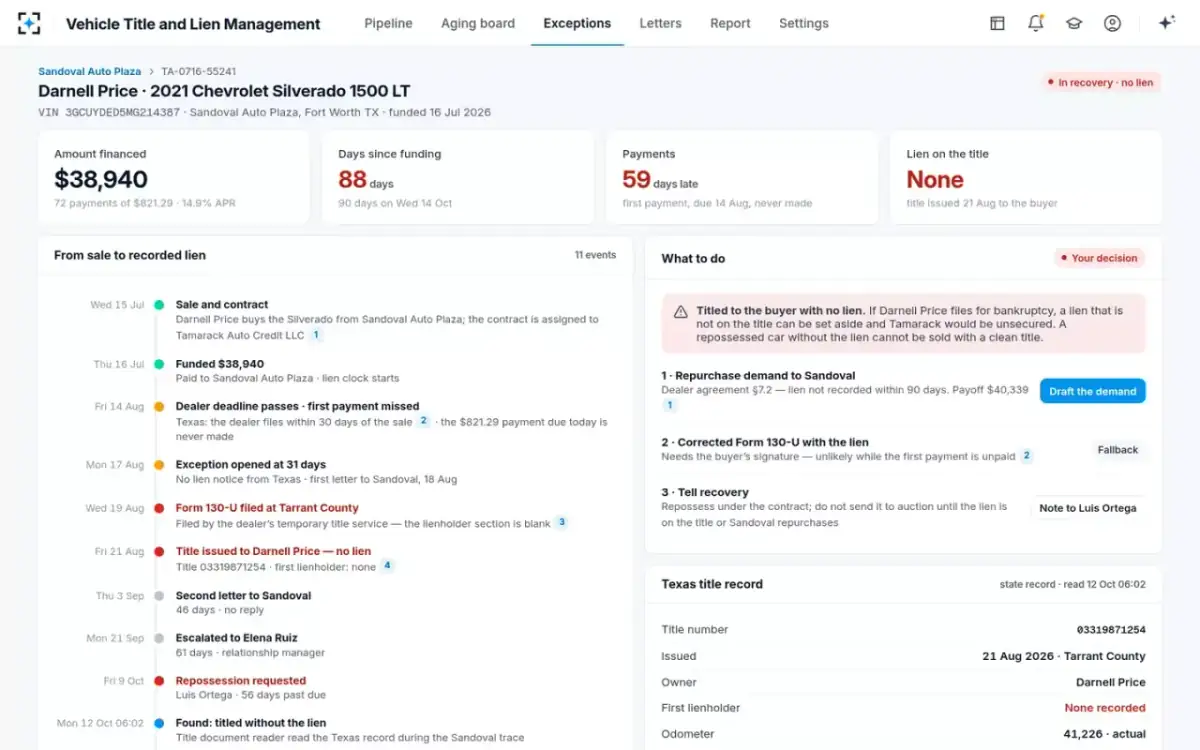
What the lender actually sees, and when
Perfection is invisible from the lender's side. In an electronic state the lender learns of it when the motor-vehicle agency sends a lien notice — in Texas, among the data transmissions between the department and enrolled lienholders is a "message to lienholder that title was issued and lien has been perfected" (Motor Vehicle Title Manual, §12.14). In a state where the lender still receives a document, it learns of it when the document arrives. In every state, the gap between the two is time the lender cannot see into.
Which means silence has two meanings and they are opposite. A car with no lien notice may be perfectly fine — filed on time, sitting in a queue, four days from its notice. Or nothing may ever have been filed. Those two cars look identical in a spreadsheet, and the only thing that separates them is the state's own record, read by VIN. That is why the trace matters more than the chase, and why whether a state runs a mandatory or a voluntary electronic lien programme changes a lender's exposure as much as any credit policy.
What a title operations desk should measure
Three numbers, and none of them is the count of open items. First, the share of each funding month's cars with a recorded lien within 30 days of funding — measured from funding, reported by funding month, never restated. In the sample portfolio that figure was 90.6% for August against a 95% target, with 96.9% by 60 days. Second, the time from funding to recorded lien in each state, as a median and a 90th percentile, so a car can be aged against its own state rather than against one national rule. Third, every car in recovery, payoff or bankruptcy without a recorded lien, which in the sample portfolio was three cars and is the only number that should ever be zero.
The first two are lagging measures of the dealer network; the third is the one that costs money this week. The solution flags a car without a recorded lien before a repossession assignment, an auction or a payoff release, and holds it from sale until the lien is on the title or the dealer repurchases.
Every state’s rule, and how fast it actually records a lien
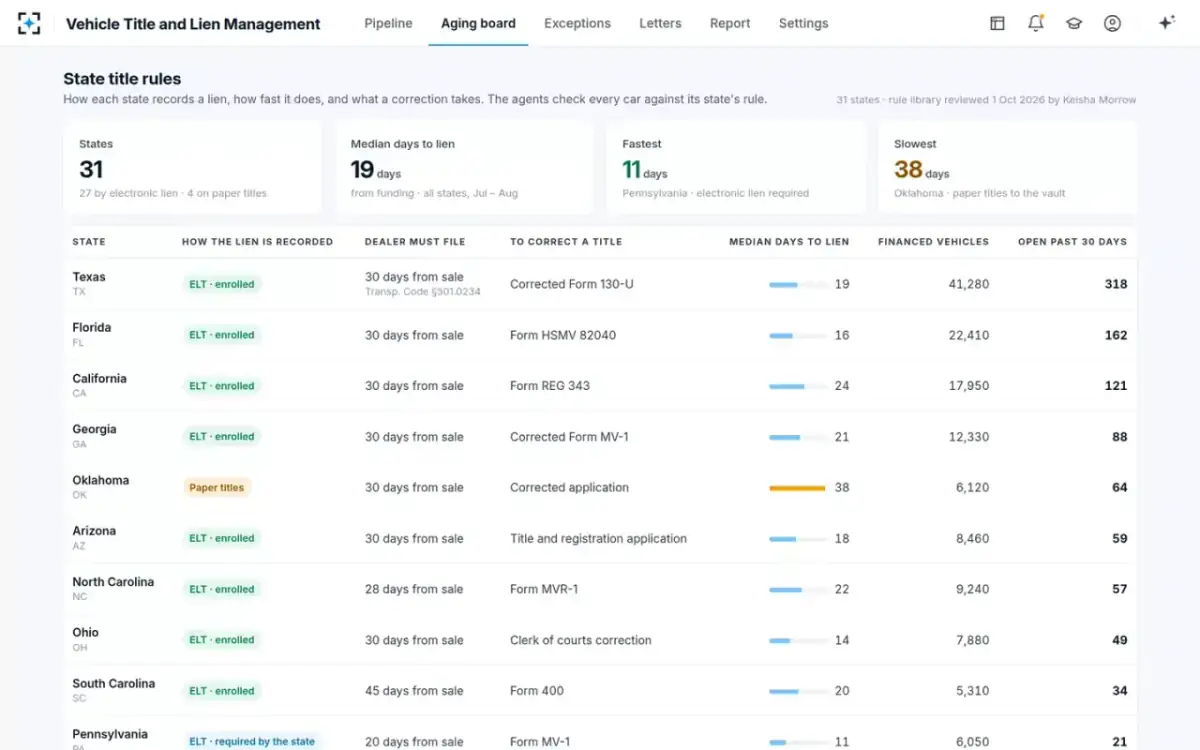
Perfecting a lien is a one-line act in the law and a thirty-day supply chain in practice. The part a lender controls is not the state's queue; it is knowing, on day seven rather than day ninety, which cars have left the road to a recorded lien and why. To see the pipeline, the per-state clocks and the letters together, start from Vehicle Title and Lien Management.
Questions people ask
Do you file a UCC-1 to perfect a lien on a car?
No. UCC §9-311 says the filing of a financing statement "is not necessary or effective" for property covered by a certificate-of-title statute, and that complying with that statute instead is what gives priority over a lien creditor. The one place a financing statement is still right is a dealer's floor plan, because §9-311 does not apply to cars held as inventory for sale.
What does it mean to have a perfected lien?
It means the lien is good against third parties, not just against the borrower. An unperfected security interest is still enforceable between the lender and the buyer, but UCC §9-317(a) subordinates it to anyone who becomes a lien creditor first, and in bankruptcy it can be set aside altogether. Perfection is the difference between a secured loan and a promise.
Is a lien perfected when the title is issued or when the application is filed?
In the states that say so plainly, Texas and Tennessee among them, when the application disclosing the lien is accepted. Texas says recordation occurs when the titling system is updated or the county accepts the application with its fee; Florida makes a filed lien notice effective as constructive notice when filed. Two federal courts have decided preference cases on the filing or recording date and set the printed title date aside. Check your own state's code: others word it differently.
How long does a lender have to perfect a lien on a vehicle?
There is no general lender deadline, but there is one that matters: 30 days from the day the buyer takes possession. A purchase-money lien perfected inside that window is protected from a trustee by 11 U.S.C. §547(c)(3)(B). Outside it, §547(e)(2) treats the transfer as made on the day of perfection, which drops it squarely into the 90-day preference period.
What happens if a lien is not recorded?
The loan is unsecured in every way that matters to a third party. A judgment creditor who reaches the car first outranks the lender, a buyer without notice can take it free of the lien, a trustee can avoid it in bankruptcy, and a repossessed car cannot be sold with clean title. The practical loss is usually the last one: the car is recovered and then cannot be remarketed.
Can a lien be added to a title after it has been issued without one?
Usually yes, by a corrected title application — in Texas a corrected Form 130-U naming the lender as first lienholder, in Florida Form HSMV 82040 — but it needs the owner's signature, which is hard to get from a buyer who has stopped paying. And the new lien is perfected on the day the correction is accepted, not retrospectively, so it does not rescue a transfer that has already fallen outside the 30-day window.