Title management software is the layer that tells a lender which of its financed cars do not have a recorded lien today, why each one does not, and what to send to whom about it. It is not a titling system — states run those — and it is not an electronic lien connection or a document vault, which most lenders already have and should keep. The question worth asking before buying anything is therefore narrower than it looks: what, exactly, is missing from what you already run? Botminds' Vehicle Title and Lien Management is built to be the missing part rather than a replacement for the working parts.
That framing matters commercially, because the programmes that fail are the ones that start by replacing a working state connection and spend six months rebuilding what already worked. The figures below come from a fictional sample lender, Tamarack Auto Credit, with 186,420 financed cars in 31 states; the supervisory and statutory sources are linked where they appear.
What a title desk is actually deciding on a Monday morning
30letters
waiting for a person’s approval on one morning, of which 26 are routine first letters that may be approved together
$40,339
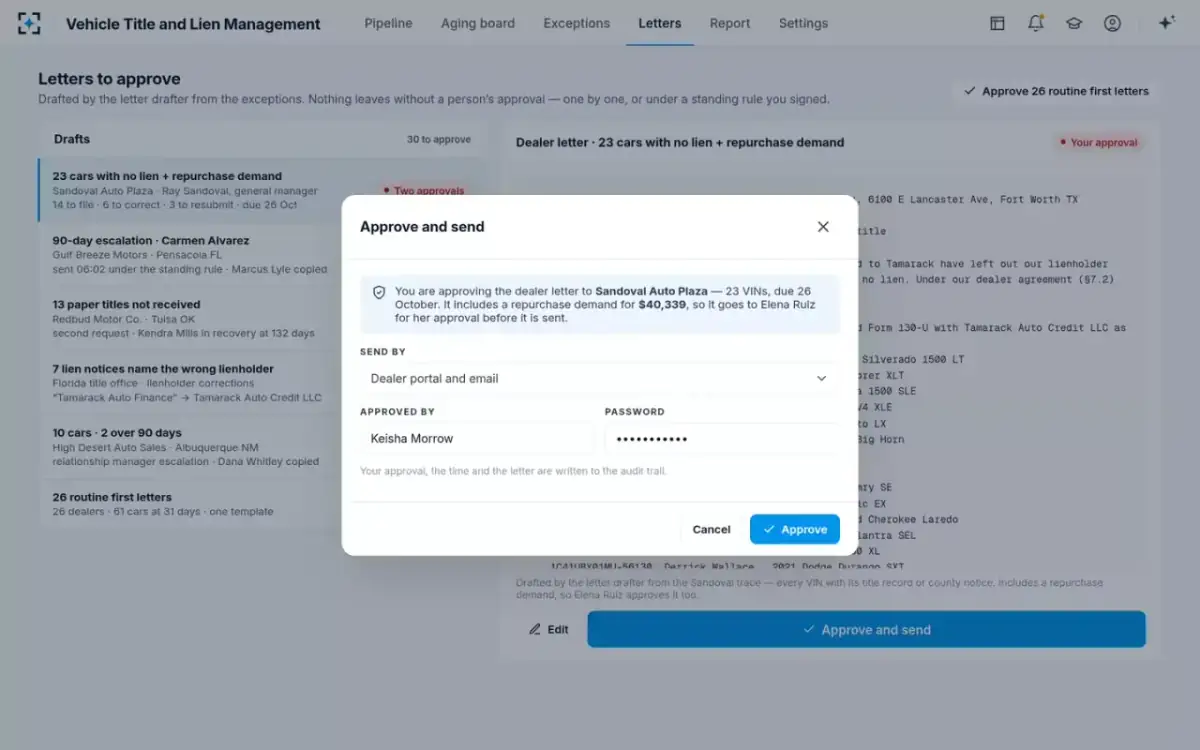
the repurchase demand on a single car, which needs two named approvals before it can leave the building
0
cars that should ever reach a repossession, an auction or a payoff release without a recorded lien — the target the whole system exists to hold
What is title management software?
Three jobs, and a serious product does all three. The first is a clock: for every funded car, how long it has been without a recorded lien, measured against what is normal in the state that titles that car rather than against one portfolio-wide rule. The second is a trace: when a car is late, an explanation built from the state's own records — never filed, rejected, titled without the lien, wrong lienholder name — rather than a status of "pending". The third is a letter: a draft to the dealer, the state office or the relationship manager, with every VIN and what each one needs, held until a person approves it.
Everything else sold under the name is either one of those three done partially, or a piece of infrastructure that belongs somewhere else. A product that stores documents is a vault. A product that sends and receives state messages is an electronic lien connection. A product that shows the age of open items without explaining them is a report. The test for the category is whether it can answer, this morning, which cars have no recorded lien and why — which is the question checking the title and lien status of a VIN sets out in full.
What you already have and should keep: do we have to replace our ELT provider?
No, and a vendor that requires it should be asked why. A state's electronic lien and title programme is the messaging layer between lienholders and the motor-vehicle agency — the route by which lien information is perfected, updated and released electronically (AAMVA) — and the enrolments, the certifications and the per-state quirks behind it are a utility, not a differentiator. Rebuilding that is months of work to arrive back where you started.
The same goes for three other things. The funding or origination system is the source of truth for what was funded, to whom and in which state, and it should stay that way. The paper-title vault, wherever it physically sits, keeps doing what it does. And the dealer portal and email route that letters go out through is already connected to the people who have to act. What changes is not where any of these live; it is that something is now reading all four together, every night, against each state's own clock.
A title programme that lands, against one that takes a year
Replace the stack: The electronic lien connections and the vault — the two things that already work
Add the missing layer: Nothing. A read-only feed of funded contracts and whatever state messages you already receive
Replace the stack: After the new connections are certified in each state, one state at a time
Add the missing layer: As soon as one state’s history is loaded, because the first output is a measurement rather than a transaction
Replace the stack: A certification slips and filings queue behind it, in a function where a week is a preference risk
Add the missing layer: The measurement disagrees with the old report, which is the point, and is settled by reading the state’s record
Replace the stack: Runs the old process and tests the new one, at double cost
Add the missing layer: Runs the old process and reads a second opinion about it
Replace the stack: That the new connections work
Add the missing layer: That you know, by funding month, how many liens were recorded in 30 days and why the rest were not
What is actually missing
Four things, in the order a lender usually discovers them. First, each state's own normal time to a recorded lien, measured from your own recently recorded liens rather than assumed — without it every exception list is either noise or a month late. Second, a cause for each late car, read from the state's records rather than from a dealer's reply. Third, the ability to see that twenty-three cars at one dealer share one cause, which turns twenty-three letters into one conversation. Fourth, an independent measurement: a perfection rate by funding month that nobody in the chain can improve by sending more letters.
Notice what is not on that list. Filing is not on it, because in most states the dealer files. Storage is not on it. Sending messages to the states is not on it. The missing pieces are all forms of knowing, which is why this is a layer and not a replacement — and why the measurement discipline behind measuring each state's own normal processing time is the part to evaluate hardest.
Collateral management software, title tracking and title management: what each covers
Four categories that get confused in the same conversation
| Category | What it covers | What it does not do | Who usually owns it |
|---|---|---|---|
| Collateral management software | All secured collateral across a bank: property, equipment, receivables, vehicles — values, insurance, documents and exceptions | Know what a state’s title record says about one VIN today, or what a corrected Form 130-U is | Credit administration |
| Title tracking | A list of expected titles and their status, usually from a provider’s file or a vault count | Explain a gap. A status of “pending” is the answer it was built to give | The title desk, often in a spreadsheet beside it |
| An electronic lien and title connection | Sending and receiving lien, title and release messages with each state that runs a programme | Age a car, find a shared cause, or draft anything to a dealer | A provider, or the lender’s own enrolment |
| Title management | The clock, the cause and the letter: every funded car aged against its own state, traced to the state’s record, with a draft for a person to approve | File at a county counter or hold a document — it reads and explains, it does not stand in the queue | Title operations, with dealer funding watching the rate |
What to pilot first: 30 days on your own open titles
Pilot on the cars you already know are a problem, not on new funding. A pilot on new funding cannot produce a result for thirty days by definition; a pilot on the open list produces one in week one, and it has the useful property that everybody already has an opinion about those cars, so the output is immediately checkable.
A four-week pilot that ends with a letter a person actually sent
- Funded contracts and the last 60 days of recorded liens, read-only3 d
- Each state’s own median and 90th percentile computed and compared with the rule in use4 d
- Trace a single dealer’s open cars to the state’s records2 d
- The title team disputes the causes, case by case, against the state’s own record5 d
- Letters drafted for every traced car and read line by line by the people who would sign them7 d
- One approved letter goes out through the normal route3 d
- Perfection rate by funding month recomputed and compared with the incumbent report4 d
What to insist on in the pilot, and why each one is there
- Your own data, not a sample set
Your dealers, your states, your lienholder name with its exact spelling. A pilot on prepared data tests nothing except the preparation.
- Read-only, with nothing sent
For three of the four weeks the system should be unable to contact a dealer at all. Buying confidence in a measurement is the point.
- Two states, chosen for contrast
One fast electronic state and one where documents still travel. A product that handles only the first will look excellent and tell you nothing.
- The worst dealer you have
Pick the one with the most open cars and the least cooperative history. The useful question is whether the trace survives a dealer who disagrees.
- Every cause checked against the state’s record
Not against the incumbent report. Where the two disagree, the state wins, and the frequency of disagreement is itself a finding.
- The people who sign read the letters
A drafted letter that a title lead would not put her name to is not a saving; it is a review task that has moved.
- One number at the end
The share of a funding month’s cars with a recorded lien inside 30 days, computed the same way by both systems, with the differences explained.
How do you evaluate title software before you decide?
Eight questions, and the answer that should satisfy you
| Ask | The answer that should satisfy you | What a weak answer sounds like |
|---|---|---|
| Where does a “lien recorded” status come from? | The state’s own message or title record, with the state’s recording date stored beside it | “From the status in our workflow” — which is an opinion with a timestamp |
| How is a car aged? | Against that state’s measured median and 90th percentile, recomputed from recent liens on a stated cadence | “Against your configured threshold” — one number for 31 states |
| What happens when nothing is found? | The absence is reported as an absence, with the places searched and the period covered | “The car stays pending” — which hides a never-filed car behind a slow one |
| Can we see the records behind a cause? | Yes: the title record, the county notice, the application as filed, one click from the finding | “We summarise it for you” — unusable in a dispute with a dealer |
| Who can send something to a dealer? | Nobody, without a named person’s approval; standing rules are written, signed and limited | “It automates your dealer communications” — ask what the limit is |
| What does it do with a wrong lienholder name? | Treats it as its own category with its own correction route, not as a missing lien | “It shows as an exception” — the wrong letter follows |
| How does it handle a car in recovery or payoff? | Flags it the moment it appears, before the assignment or the release, regardless of age | “It appears in the over-90 list” — too late by definition |
| What can we take with us if we leave? | Your measurements, your evidence, your rule library, in a form you can read without the product | “We can discuss an export” — a bad sign in a function with a seven-year memory |
Two measurements belong in the evaluation itself rather than in a reference call. First, run the incumbent report and the candidate over the same funding month and explain every difference; a product that cannot explain its own disagreement is not ready. Second, take ten cars the incumbent calls perfected, ask the states directly, and see which system matches. Supervisors have made the stakes of that second test clear: examiners found servicers repossessing vehicles without a valid lien because nobody verified one existed at the moment of assignment (CFPB, Supervisory Highlights: Auto Finance, §2.2.2).
Going live: what you bring on day one
Six things, and five of them are already in your building. A daily feed of funded contracts with VIN, buyer, sale date, titling state, dealer and amount financed. Whatever state lien messages and title documents you receive today, in whatever form you receive them. At least sixty days of recently recorded liens per state, which is what the clocks are built from. Your lienholder name exactly as the states must show it — the single most common quiet failure is a name that was right in 2019 and is now a predecessor entity. Your dealer agreement, because a repurchase demand cites a clause in it. And your own thresholds: when an exception opens, when a car lifts out, what the letter cadence is and who approves what.
The sample lender's settings are a reasonable starting point rather than a default: an exception at 30 days without a recorded lien, a lift-out at the state's 90th percentile and again at 90 days, normal times recomputed weekly from the last 60 days, letters at 31, 46, 61 and 90 days, and a repurchase demand available at 90 days. One early decision is worth making deliberately: whether the dealer deadline you age against is the one in your dealer agreement or the one in the state's code, which can be shorter. Texas, for instance, treats a filing as made within a reasonable time at 30 days from the sale, or 45 where the dealer financed it (43 Tex. Admin. Code §215.144(f)(3)), while a lender's own agreement may say 30 everywhere.
What “going live” actually produces: letters waiting for a person
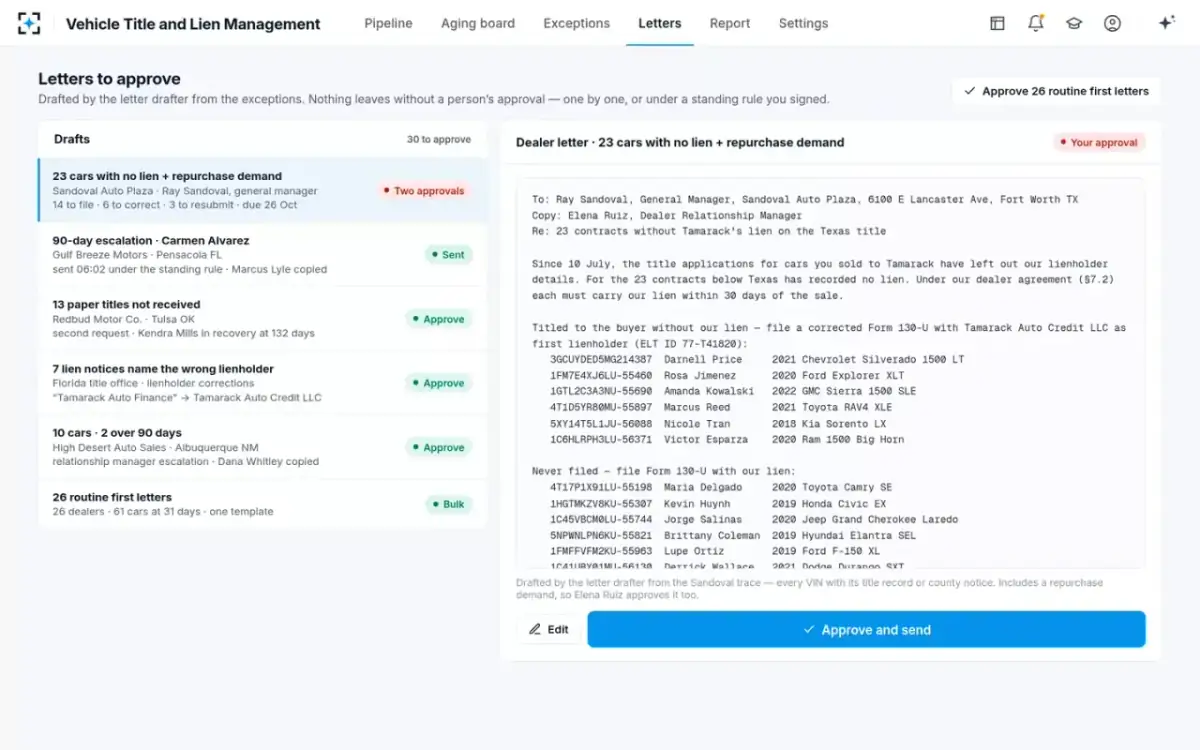
What to ask about approvals and the audit trail
This is the part of a title system that a second line of defence will read, and it is worth being specific about. Three rules carry most of the weight: nothing leaves the building without a named person's approval; a standing rule is a written, signed, limited exception rather than a setting someone switched on; and anything that demands money — a repurchase demand under a dealer agreement — takes two people. In the sample portfolio routine first letters may be approved in bulk while every later letter waits for a person one by one, which is the right way round, because the first letter is a reminder and the fourth is a commercial act.
The record of those approvals matters as much as the approvals. Electronic approval records are not a weaker form of evidence: under the federal E-SIGN statute, a signature, contract or other record relating to a transaction in interstate commerce "may not be denied legal effect, validity, or enforceability solely because it is in electronic form", and a statutory retention requirement is met by an electronic record that accurately reflects the information and "remains accessible to all persons who are entitled to access" it for as long as required (15 U.S.C. §7001(a), (d)). What that puts the weight on is accessibility and accuracy — who approved, what they saw, when, and whether you can still produce it in five years.
If a provider runs any part of this for you, the supervisory expectation is that your contract gives you the ability to check. The interagency guidance on third-party relationships notes that a contract "often establishes the banking organization's right to audit and provides for remediation when issues are identified", and that such provisions "may also reserve the banking organization's right to conduct its own audits" (Interagency Guidance on Third-Party Relationships: Risk Management, June 2023). A title system should make exercising that right cheap: the evidence for any finding should be readable without asking anybody.
Two names on the one letter that asks a dealer for money
Buying well here is mostly a matter of narrowing the purchase. Keep the state connections, the vault and the funding system; add the clock, the trace and the letter; prove it on your own open titles in four weeks; and judge it on one number computed the same way by both systems. What that number is worth, and what the work behind it costs, is set out in the guide to the lien perfection fee, and where a service provider fits beside it in what to outsource and what never leaves. To run the four-week version on your own book, start from Vehicle Title and Lien Management.
Questions people ask
What should title management software do?
Three things: age every funded car against the normal time to a recorded lien in the state that titles it, explain each late car from the state's own records rather than reporting it as pending, and draft the letter or correction that follows for a person to approve. If it does the first two and not the third it is a report; if it does the third without the first two it is a mail merge.
How does title software integrate with a loan origination system?
Through a one-way daily feed of funded contracts — VIN, buyer, sale date, titling state, dealer, amount financed and the lienholder name to be used — plus whatever state messages and documents already arrive. The origination system stays the source of truth about the loan; the title layer never writes back to it, which is what keeps the integration small enough to do in days.
How long does it take to implement title management software?
A useful pilot on your own open titles takes about four weeks: a week to load and measure two states, a week to trace one dealer's cars and argue about the causes, a week of drafted letters nobody sends, and a week to send one and recompute the rate. Full coverage of a 31-state book takes longer, but it is additive — each state becomes useful as soon as its own history is loaded.
What does title management software cost?
No government or non-profit source publishes prices for this category, so any figure quoted here would be unsupported. The comparison that can be made honestly is against your own numbers: the clerical time spent chasing cars whose filings did not stick, and the amount financed against cars past 90 days with no recorded lien — in the sample portfolio, 141 cars and $3.86M.
Do we have to replace our ELT provider or our vault?
No. State electronic lien enrolments and document custody are utilities that already work, and replacing them is the most common reason these programmes run long. The layer worth buying sits above them: it reads what they produce, measures it against each state's own normal, and explains the gaps.
Who should approve a repurchase demand?
Two named people, and in practice the title operations lead plus the manager who owns the dealer relationship. A repurchase demand cites a clause in the dealer agreement and asks for the payoff amount, so it is a commercial act rather than a reminder — in the sample portfolio $40,339 on a single car — and the second approval is there to make sure the relationship owner is not reading about it afterwards.