An unperfected lien on a vehicle is a security interest the state's title record does not show: the lender has a signed contract and a car it believes it is secured by, and no entry anywhere that a third party has to respect. It is still enforceable against the borrower. Against everybody else — a judgment creditor, a later buyer, a bankruptcy trustee — it is close to worthless, and three decided cases below show exactly how close. Botminds' Vehicle Title and Lien Management follows every financed car to the state's own record, so an unperfected lien is found in the week it happens rather than at a repossession.
The reason this goes wrong so often is that nothing announces it. A car with an unperfected lien behaves exactly like a car with a perfected one, right up until the moment the lender needs the security. In the fictional sample portfolio used throughout this solution — Tamarack Auto Credit, 186,420 financed cars in 31 states — 141 cars were more than 90 days past funding with no recorded lien, $3.86 million financed, and three of them were already in recovery.
What an unperfected lien costs, in the three cases below
45days
from purchase to the title application reaching the state in the Alabama case — the lien was avoided and the claim went unsecured
32days
in the Texas case, saved only because the thirtieth day fell on a Saturday
3
cars in recovery with no recorded lien in the fictional sample portfolio — the one number that should be zero
What is an unperfected lien on a vehicle?
It is a lien that exists in the loan file and not on the state's title record. For a car, perfection runs through the certificate-of-title statute rather than through a financing statement: the Uniform Commercial Code provides that filing a financing statement "is not necessary or effective" for property covered by such a statute, and that complying with the statute instead "is equivalent to the filing of a financing statement" (UCC §9-311). So there is exactly one way to perfect, and exactly one place to look to see whether it happened — the state’s own title record, on the date it accepted the application.
In practice a lien ends up unperfected by one of a small number of routes. The dealer never filed the application. The dealer filed it with the lienholder section blank. The county rejected the filing and nobody resubmitted it. The lien was recorded in a name that is not the lender's. Or the car is titled in a state the lender never enrolled in and the document went astray. Each looks the same in a portfolio report: a car with no recorded lien. Telling them apart needs the record, which is a different piece of work from chasing.
Is an unperfected security interest enforceable?
Between the lender and the borrower, yes. Against third parties, it loses to almost everyone who gets there first. The rule is short: a security interest "is subordinate to the rights of … a person that becomes a lien creditor before the earlier of the time … the security interest or agricultural lien is perfected" (UCC §9-317(a)). A judgment creditor who levies on the car on Tuesday outranks a lender who perfects on Wednesday, however long the loan has been outstanding.
Several states say the same thing in their own code, with the enforcement consequence attached. Florida makes a lien unenforceable in its courts "against creditors or subsequent purchasers for a valuable consideration and without notice, unless a sworn notice of such lien has been filed in the department and such lien has been noted upon the certificate of title," and then fixes the moment: "such notice shall be effective as constructive notice when filed" (Fla. Stat. §319.27(2)). The lender's protection begins at filing and not before.
Who beats an unperfected lien, and in what order
Four parties, and a lender will meet them in roughly this sequence. A lien creditor — typically a judgment creditor who has levied — takes priority under §9-317(a). A buyer in the ordinary course takes the car free of a lien that is not on the record; Texas puts it bluntly, warning that an unrecorded security agreement "is neither enforceable against the buyer of a vehicle, even if the buyer knows of its existence" (Motor Vehicle Title Manual, §12.3). A bankruptcy trustee has the rights of a hypothetical lien creditor as of the petition date under 11 U.S.C. §544(a), which means an unperfected lien is avoidable on the day the case is filed without any need to argue about preferences. And a later lienholder who did record takes first position.
That §544 point deserves emphasis because it is the harshest and the least discussed. The preference analysis below only matters for liens that were perfected, just late. A lien that is still unperfected when the petition is filed does not need the 90-day window at all; the trustee simply stands in front of it.
Can a bankruptcy trustee avoid a car lien?
Yes, when it was perfected late. The trustee's preference power reaches transfers made in the ninety days before the petition, and the Bankruptcy Code decides when a lien was "made" by reference to when it was perfected: a transfer perfected within 30 days counts as made when it took effect, but one perfected after those 30 days counts as made "at the time such transfer is perfected" (11 U.S.C. §547(e)(2)). A lien perfected on day 45 of a loan taken out two months before bankruptcy is therefore a transfer made two weeks before bankruptcy, on account of a debt that already existed — a textbook preference.
The defence is the enabling-loan exception, and it has one hard edge: it protects a purchase-money security interest only if it is "perfected on or before 30 days after the debtor receives possession of such property" (§547(c)(3)(B)). Possession, not funding, not the contract date, and not the date the title printed. Courts have read possession as physical control of the car, which for a retail sale is usually the day the buyer drives away.
Three cases, three day counts
What happened when the day count was tested
Reding v. T.R. Motors and Tefco Payment Center (In re Baker)
Court and dateBankr. M.D. Ala., 17 February 2009
Car2003 Pontiac Grand Am
Days to perfection45 days
OutcomeLien avoided. The claim stood as unsecured.
Fitzpatrick v. Toyota Motor Credit Corp. (In re Hartline)
Court and dateBankr. E.D. Tenn., 9 September 2009
Car2007 Toyota Matrix
Days to perfection11 days
OutcomeLien held. A later duplicate title that omitted the lien was "an administrative error".
Viegelahn v. Ruben’s Auto Sales (In re Daniel)
Court and dateBankr. W.D. Tex., 5 August 2020
Car2010 Mazda CX-7
Days to perfection32 days
OutcomeLien held, because day 30 was a Saturday and Rule 9006(a) moved the deadline.
The Alabama case: forty-five days, and an industry excuse
Desitin Baker bought a 2003 Pontiac Grand Am on 15 January 2008 and granted the selling dealer a security interest, which was assigned on. The state did not receive the title application until 29 February — "more than thirty days after the Debtor purchased and obtained possession of the vehicle" — and the debtor filed a Chapter 13 petition on 18 April. Because the lien was perfected on 29 February, it fell inside the ninety days before the petition and the court avoided it: the claim survived, but as an unsecured claim (Reding v. T.R. Motors and Tefco Payment Center).
The defendant's argument is the part a lender should read twice. Counsel suggested that failing to perfect on time is standard practice in the motor trade, and asked the court to treat the purchase date as the perfection date anyway. The court's answer was one sentence long.
This excuse is not a recognized exception to the 30 day time requirement.
Reding v. T.R. Motors and Tefco Payment Center (In re Baker), Bankr. M.D. Ala., 2009
The Texas case: thirty-two days, saved by a Saturday
Jon Donald Daniel bought a 2010 Mazda CX-7 on 13 September 2018 for $9,722.90, borrowing $6,771.43 from the seller, and filed for bankruptcy on 1 November — seven weeks later. The lender "perfected the security interest 32 days after Debtor received the car, but it did so on the first business day after the thirtieth day, because the thirtieth day was a Saturday." The court held that Rule 9006(a) of the Federal Rules of Bankruptcy Procedure applies to the §547(c)(3) deadline, so the period rolled to the Monday and the lien survived (Viegelahn v. Ruben's Auto Sales).
Two lessons sit in that one sentence. The first is how fine the margin was: a thirty-day statutory window, a weekend, and a claim of $7,887.90 decided by which day of the week the deadline landed on. The second is in the opinion's first footnote, where the court records that "the certificate of title shows that the 'Date Title Issued' was October 22, 2018, but both parties to this adversary agree that Defendant actually recorded the title on October 15, 2018". Even the litigants treated the printed title date as irrelevant — a week's difference that would have changed nothing about whether the lien was timely, and everything about a report that measures from the title's arrival.
The same thirty days in three cases, drawn to scale
- Inside the 30-day window30 d
- Late — perfected inside the preference period15 d
- Perfected on day 32 — the first business day after a Saturday deadline32 d
- Delivered to the county clerk11 d
The Tennessee case: why a title without the lien is not always an unperfected lien
The third case is the one that stops a lender over-reacting. A 2007 Toyota Matrix was financed on 18 November 2006, and the application for the certificate of title was delivered to the Knox County Clerk on 29 November. Years later the original title was lost; the state issued a duplicate on 14 March 2008 and left the lienholder off it. The trustee argued the lien was unperfected.
The court disagreed, and the reasoning is worth holding onto: the lien "was perfected on November 29, 2006, the date upon which the Application for Certificate of Title was delivered to the Knox County Clerk, irrespective of when the lien was noted on the certificate of title", and the faulty duplicate was "nothing more than an administrative error which does nothing to affect the integrity of the Defendant's lien" (Fitzpatrick v. Toyota Motor Credit Corp.).
So a document that does not show the lien is a question, not a verdict. It may mean the lien was never perfected; it may mean the state made a mistake on a reprint. The only way to tell is the filing history behind the document, which is exactly what a lender should be able to produce on demand for any car in its book.
Can you repossess a car if the lien is not on the title?
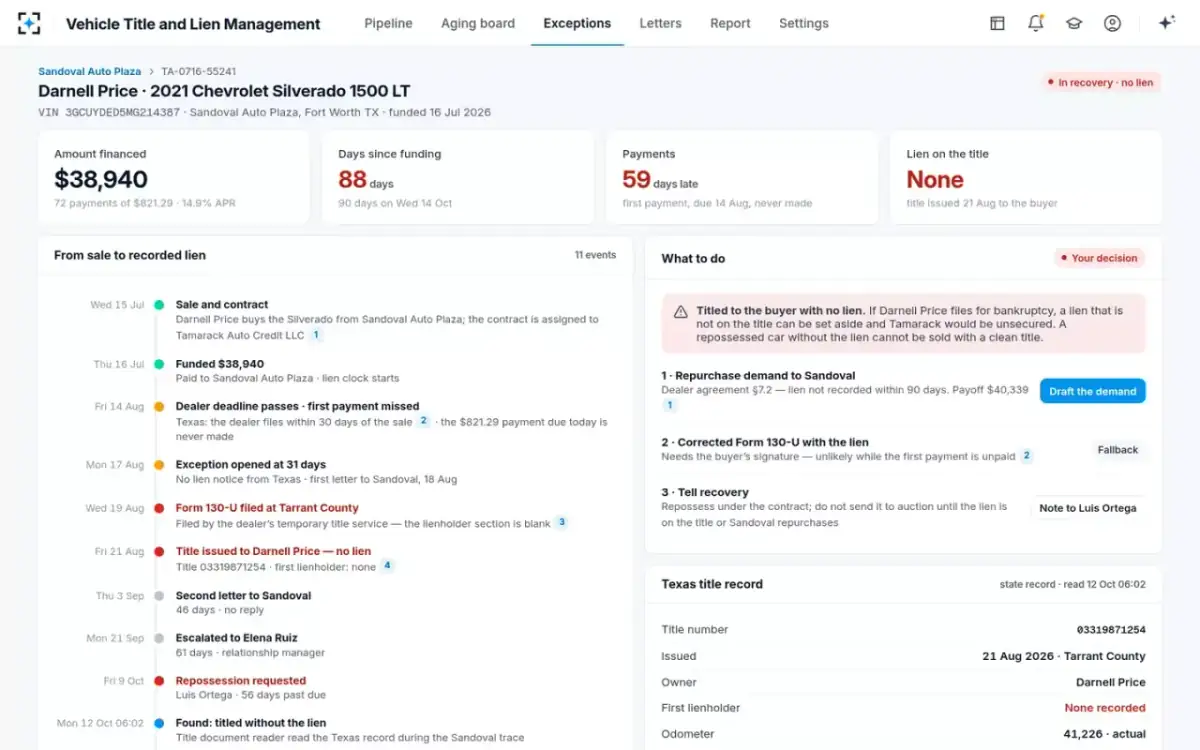
Recovering the car is one question and selling it is another, and the second is where the loss lands. A repossessed car has to be sold with title that a buyer, and usually an auction, will accept — and a certificate showing someone else as owner with no lienholder recorded does not give the lender anything to convey. In the fictional sample portfolio the solution flags any car without a recorded lien before a repossession assignment, an auction or a payoff release, and holds it from sale until the lien is on the title or the dealer repurchases.
There is a worse version. If the borrower has filed for bankruptcy, the car is in the estate, the automatic stay applies, and an unperfected lien gives the lender no better position than any unsecured creditor queuing behind it. The Alabama case is what that looks like at the end: the loan is still owed, and the car is gone.
A car in recovery, and the state record that says the lien is not there
What an examiner expects, and what a defensible file holds
Supervisors treat perfection as a basic control rather than a sophistication. The NCUA's examiner guide has a heading for it — "Transfers Not Promptly Perfected or Recorded" — and states the position without hedging: "Under most circumstances, a credit union that fails to promptly perfect its security interest runs great risk of losing its security," and "prudence clearly dictates that the credit union properly obtain liens and promptly file them to eliminate the possibility of losing the protection provided by collateral" (NCUA Examiner's Guide, Chapter 10).
"Promptly" is doing the work in that sentence, and it is the one word an institution has to turn into a number of its own. The checklist below is what a file should hold when someone — an examiner, a trustee's lawyer, an auction — asks the lender to prove the lien.
What a file needs to prove the lien, and the day it was perfected
- The contract, with the security agreement and the exact lienholder name
A lien recorded under a trading name the lender does not legally hold is a different lienholder to a title office.
- The title application as filed, or the receipt for it
In the states that date perfection at acceptance, this document is the evidence. The Tennessee case turned on the delivery of the application, not the title.
- The state’s own answer
The electronic lien notice, the title record read by VIN, or the certificate. The lender’s own system saying "perfected" proves nothing by itself.
- The possession date, not just the funding date
The federal 30-day window runs from the day the buyer took the car. If the file only records funding, the day count cannot be defended.
- Every county rejection notice, and what was done about it
A rejected application that was never resubmitted is the most avoidable cause of an unperfected lien, and the notice is the proof of when the clock restarted.
- The chase trail, with who approved each letter and when
It shows the control was operating, which is what an examiner is testing even when a particular car went wrong.
What this means for how a lender watches its book
Three decided cases, three day counts: 45, 32 and 11. The differences between them are not legal subtleties; they are operational. Nobody at the Alabama lender knew on day 31 that the application had not reached the state, and by the time it mattered the question was only how large the unsecured claim would be. The useful control is therefore not a quarterly exception report but a clock that runs on every car from the day the buyer takes it, with a different line in each state, and a person deciding what to do when one crosses.
In the fictional sample portfolio that clock produced a worked morning: 23 cars at one dealer traced to three causes and one root cause in 58 seconds, with a letter drafted for a person to approve — and separately, every car in recovery, payoff or bankruptcy without a recorded lien surfaced at once, which is the set the Alabama case came from. To see the clocks, the trace and the letters together, start from Vehicle Title and Lien Management.
Questions people ask
What is the 30-day preference rule on a car loan?
It is the enabling-loan exception in 11 U.S.C. §547(c)(3). A purchase-money security interest cannot be avoided as a preference if it is perfected on or before 30 days after the debtor receives possession of the car. Miss it and §547(e)(2) treats the lien as created on the day it was perfected, which usually drops it inside the 90-day preference window.
Does the 30 days run from the sale, the funding or the delivery?
From possession — the day the buyer takes physical control of the car. Courts have read possession as physical control rather than the acquisition of ownership rights. In most retail deals that is delivery day, which can be earlier than funding and is rarely the date a lender's system stores.
What happens to the loan if the lien is avoided?
The debt survives; the security does not. In the Alabama case the finance company's claim was allowed on an unsecured basis, which in a Chapter 13 plan means it is paid alongside everyone else's unsecured claims at whatever percentage the plan provides.
Can a lender perfect a lien after the borrower has filed for bankruptcy?
No. The automatic stay bars acts to perfect a lien against property of the estate once a petition is filed, and the trustee already holds the rights of a hypothetical lien creditor as of that date under §544(a). A lien that is unperfected on the petition date is avoidable without any preference analysis at all.
Does a title that does not show our lien always mean the lien is unperfected?
No. In the Tennessee case a duplicate title was issued without the lienholder on it, and the court treated that as an administrative error that did not touch a lien perfected two years earlier on the day the application was delivered. The test is the filing history, not the face of the document — though a lender should still get the record corrected, because the next person to rely on it will read the document.
How quickly should a lender know that a lien has not been perfected?
Inside the federal window, which means the useful check is at about three weeks rather than at ninety days. That is only possible if each car is aged against what is normal in its own state — a car at day 25 in a state whose median is eleven days is already a problem, while the same car in a slower state is not.