A lien perfection fee is the charge a lender applies to cover getting its lien recorded on a car's title: the state's own fee for noting the lien, the work of preparing and filing the application, holding the document where a state still issues one, and releasing the lien at payoff. Only the first of those is published anywhere — Florida charges $2 to note a lien on a title certificate — and it is by far the smallest part. The rest is labour, and most of the labour is spent on the minority of cars where the first filing did not stick. Botminds' Vehicle Title and Lien Management is aimed squarely at that minority.
That is the whole argument of this guide, and it has a practical consequence for anyone pricing the function: three of the four parts are near-fixed per car and the fourth is driven entirely by your own perfection rate. The figures below come from a fictional sample lender, Tamarack Auto Credit, with 186,420 financed cars in 31 states; the state fees are quoted from the states' own current schedules and dated.
What one recorded lien is made of
$2
Florida’s statutory charge for noting a lien on a title certificate — which also pays for cancelling it when the loan is paid
90.6%
of August’s funded cars with a recorded lien inside 30 days in the fictional sample portfolio, against a 95% target
141cars
past 90 days with no recorded lien — $3.86M financed, and the reason the fee is not the real number
What is a lien perfection fee?
It is a lender's charge for the act of getting its security interest onto the state's title record, usually taken once at origination and disclosed on the loan documents under a name like lien recording fee, title fee or lien perfection fee. It is not the same thing as the state's title fee, it is not the registration, and it is not the dealer's documentary fee. It exists because perfection is a supply chain with four participants — the buyer, the dealer, a state or county office and the lender — and the lender is the only one of the four who loses if the chain breaks.
What makes the fee hard to price honestly is that the expensive part is invisible at the moment it is charged. On a car where the dealer files a complete application on day three and the state records the lien on day eleven, the lender's own cost is a few minutes of matching a message to a contract. On the car where the lienholder section was left blank, the same fee has to cover weeks of lookups, letters, a correction and sometimes a repurchase demand. The fee is an average over both, and the mix is the variable.
What a lien perfection fee pays for: the four things inside it
One recorded lien, as a sum of four terms
The state’s own charge
statutory lien fee, where one exists
Published, fixed and small: $2 to note a lien in Florida, with a $1.25 service charge only when the lien is noted other than at purchase. Texas charges no separate lien fee — the lien goes on the title application the buyer already pays for.
Set by statute. Identical for every lender in that state
Getting the filing right, once
minutes per car × every funded car
Preparing or checking the application, naming the lienholder exactly, matching the state’s acknowledgement to the contract. The only term that touches 100% of the book.
The dealer or the filing agent, paid for by the lender
Custody and release
per document held + per payoff release
Only in the states that still issue a document to the lienholder: 21,346 titles sit in the fictional sample lender’s vault across four such states. In an electronic state there is nothing to hold.
The vault, or the title service that runs it
The chase
share of filings that do not stick × work per chased car
Lookups, title records, county notices, letters, corrections, escalations. In the sample portfolio this is about one car in ten, and it is where most of the lender’s own money goes.
The lender — and the only term it can move
What the state charges, and the difference between a title fee and a lien perfection fee
They are different charges with different payers, and conflating them is an easy error in a pricing conversation. The title fee pays for issuing a certificate of title and is normally the buyer's. The lien charge pays for noting a lienholder on it and is normally the lender's. In Florida the two sit in the same statute and differ by a factor of thirty-five: $70 for each original certificate of title, and $2 "for noting a lien on a title certificate", a fee that "includes the services for the subsequent issuance of a corrected certificate or cancellation of lien when that lien is satisfied", and $3 "for each assignment by a lienholder". A further $1.25 service charge applies to an application "in connection with the recordation or notation of a lien" only where it is "not in connection with the purchase of such vehicle" — a lien added at a refinance, not at the sale (Fla. Stat. §319.32).
Texas does not charge separately for the lien at all. The lien is disclosed on the title application the buyer is already paying for, and that application fee is "$33 if the applicant's residence is a county located within a nonattainment area … or $28 if the applicant's residence is any other county" (TxDMV Motor Vehicle Title Manual §3.1, August 2026, quoting Tex. Transp. Code §501.138). Which makes a point worth carrying into any pricing model: in a state that works like Texas, the marginal state charge for perfecting a lien is zero, and everything you are charging for is your own work.
Where a $28 Texas title application fee actually goes
The statutory distribution of the fee, Tex. Transp. Code §501.138(b)
- To the comptroller, credited to the Texas emissions reduction plan fund · 54%
- To the department · 28%
- To the county treasurer, for the officers’ salary fund · 18%
There is one more state charge worth building into a model, because it is avoidable and lands on the lender more often than anyone expects: the penalty for filing late. Florida adds a $20 fee "for failing to file such application within the specified time" (Fla. Stat. §319.23(6)(a)). That is ten times the lien fee itself, payable because somebody missed a date — a good illustration of the general rule that in title work the errors cost more than the transactions.
The state fees a pricing model can actually name, with their source and date
| Charge | Amount | When it applies | Source, as published |
|---|---|---|---|
| Florida · noting a lien on a title certificate | $2 | Every lien noted; covers the cancellation at payoff | Fla. Stat. §319.32(1), 2026 statutes |
| Florida · service charge on a lien recordation or notation | $1.25 | Only a lien noted other than at purchase, such as at a refinance | Fla. Stat. §319.32(2)(a), 2026 statutes |
| Florida · assignment by a lienholder | $3 | When a lienholder assigns the title | Fla. Stat. §319.32(1), 2026 statutes |
| Florida · original certificate of title | $70 | Every new title | Fla. Stat. §319.32(1), 2026 statutes |
| Florida · late filing of the title application | $20 | An application filed more than 30 days after delivery | Fla. Stat. §319.23(6)(a), 2026 statutes |
| Texas · title application fee, which carries the lien | $28, or $33 in a nonattainment or affected county | Every title application | Tex. Transp. Code §501.138, in the TxDMV title manual of August 2026 |
| Texas · separate charge for recording the lien | None | — | The lien is disclosed on the title application itself |
What the chase costs, and why it is the variable part
Here is the arithmetic, from the fictional sample portfolio and a published wage, and every step of it is an estimate you should redo with your own numbers. One dealer with twenty-three cars past 30 days and no lien notice takes about 2.1 working days to work by hand: looking each VIN up in the state portal and the county sites, pulling title records and rejection notices, working out why each car has no lien, writing the letter, and getting it reviewed. That is roughly 44 minutes per car. Loan interviewers and clerks — the nearest published occupation to this desk — had a median wage of about $24 an hour in 2025 (O*NET, 43-4131.00), so the direct clerical time in one chased car is on the order of $17, before anything loaded on top of a wage.
Now the volume. The sample lender funds roughly 7,000 contracts a month and perfected 90.6% of August's within 30 days, so about 650 cars a month enter some form of chase. Lift that rate to the 95% target and about 310 of those cars never need touching — roughly $5,400 a month of clerical time, or $65,000 a year, on the same arithmetic. That is the honest size of the operating prize, and it is worth saying plainly that it is not enormous. The real number is the one beside it: 141 cars over 90 days with no recorded lien and $3.86M financed against them, which is an exposure rather than an expense and does not appear in any fee at all.
What the chase is actually spent on: 1,186 cars past 30 days, by cause
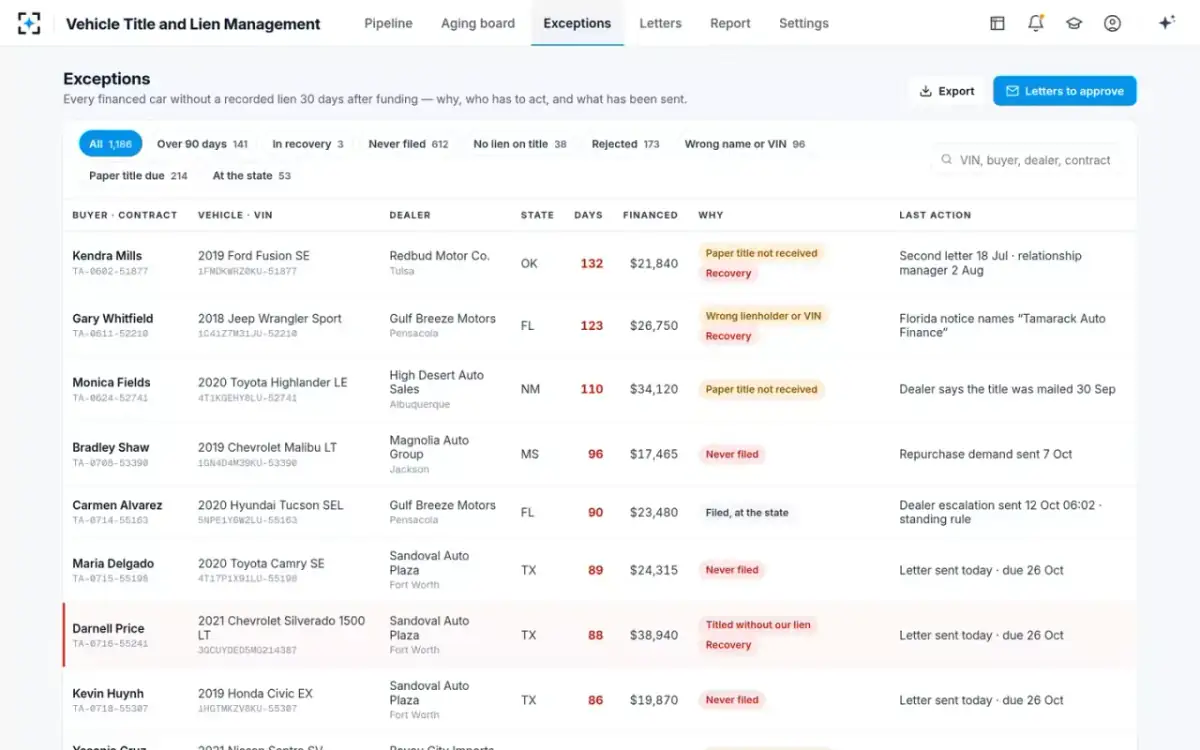
Read that figure as a cost driver rather than as a problem list. Six hundred and twelve cars were never filed at all: no state fee was incurred, no document was handled, and every minute spent on them is pure chase. A hundred and seventy-three were rejected and nobody resubmitted them, which means the filing cost was paid twice or not at all. The two causes that produce the most work also produce the least value, and both are upstream of the lender — which is why the practical lever on this fee is the dealer network rather than the title desk. The six specific causes behind a title that comes back without a lender's name are worked through in the guide to a lienholder not listed on the title.
Every open car, with its cause and what was last sent
Paper and electronic are not the same unit of work
A pricing model that uses one cost per car across a multi-state book will be wrong in both directions. Where a state runs an electronic lien programme — the messaging layer that lets lienholders "perfect, update, and release lien information on vehicle titles" electronically (AAMVA) — there is no document to receive, store, insure, find at payoff or replace when it is lost. Where a state still issues a document to the lienholder, every one of those steps exists, and the release at payoff becomes a physical errand with a deadline attached to it.
In the sample portfolio that difference is 21,346 titles held as documents across four states, against the rest of the 186,420-car book, held electronically. There is no authoritative published cost per paper title, so the right way to model it is to price your own: count the titles, count the people and the storage, and divide. The structural point stands without a number — the paper states carry a per-car cost that the electronic states simply do not have, and a single blended fee hides it. Which states require, allow or still ignore the electronic route is set out in the electronic lien and title states guide.
What a rise in the 30-day perfection rate is worth
Three things, and only the first shows up in a fee. The operating saving is the arithmetic above: about 310 fewer chased cars a month between 90.6% and 95%, which is real but modest. The second is the late-filing penalties and the duplicate filing costs that come with rejections and corrections, which scale with the same share. The third is the one that justifies the work: fewer cars reaching the far end of the tail, where a missing lien stops being an expense and becomes a loss — a repossessed car that cannot be sold with clean title, a payoff released against no security, a trustee avoiding a lien perfected too late.
A pricing model that only counts the first of those three will conclude that title operations is a rounding error and should be run as cheaply as possible. A model that counts all three usually concludes the opposite: that the cheapest version of this function is the one that finds the broken filings in week two rather than week twelve. What the tail costs when it is left alone is the subject of what an unperfected lien on a vehicle costs.
What to put in a pricing model
Seven inputs, and where each one honestly comes from
- The state’s own charge, per state, dated
From the state’s current fee schedule, not from last year’s model. In some states, Texas among them, the marginal charge for the lien is zero because it rides on the title application.
- Your filing route, per state
Whether the dealer files, you file, or a provider files changes who bears the first-filing cost and who you can hold to it.
- The share of filings that do not stick
Your own 30-day perfection rate by funding month, never a target. This single number drives the largest controllable term.
- Minutes per chased car, by cause
A never-filed car and a wrong-name car take different amounts of work. One blended average will under-price the states where rejections are common.
- A loaded hourly rate, stated as an assumption
Start from a published wage for the occupation — about $24 an hour for loan interviewers and clerks in 2025 — and say what you loaded on top, rather than hiding it inside a per-car number.
- The paper-title count, separately
Storage, retrieval, insurance, loss and the physical release at payoff exist only for documents. Blending them across an electronic book understates both halves.
- The tail, as an exposure rather than a cost
Cars past 90 days with no recorded lien, and the amount financed against them. It belongs in the paper beside the fee, not inside it.
What a lender should be able to tell a borrower about a title fee
What the fee is called, what it covers, and which part of it the state actually receives, and each answer should be easy. A borrower who finds a lien or title fee on a loan agreement is entitled to all three, and in the states quoted above the last is a published number anyone can look up. Charges that are passed through from a state should match the state's schedule; anything above them is the lender's own charge for its own work and should be described as such in the documents the borrower signs. State law and the contract govern what may be charged and how it must be disclosed, so the specific answer is a question for the lender's own counsel rather than for a guide.
The related question borrowers ask more often is why the title took so long, and there the answer is usually about the deadline rather than the fee: a Texas filing counts as made within a reasonable time if it is filed with the county tax assessor-collector within 30 days of the sale, or 45 when the dealer financed it (43 Tex. Admin. Code §215.144(f)(3)), and most of the wait a borrower notices happens before anything reaches a state at all.
The fee is the small, visible end of a function whose real economics sit in the tail. To price your own version of it — the chase, the causes and the cars past 90 days — start from Vehicle Title and Lien Management.
Questions people ask
Who pays to record a lien on a car title?
The statute sets the charge, not who bears it; that is a matter for the sale and the loan contract. Florida charges $2 to note a lien and $70 for the certificate of title, and the $2 also pays for cancelling the lien when the loan is paid. In Texas there is no separate lien charge — the lien is disclosed on the buyer's title application. Anything a lender adds on top is its own charge for its own work.
When may a lender charge a lien perfection fee?
Fees of this kind are generally permitted where state law and the loan contract allow them and they are disclosed as required, but the rules differ by state and by product, and some states cap or prohibit particular charges. The parts that are passed through from a state are published and checkable; anything above them is the lender's own charge and should be described as what it is. For a specific loan, that is a question for counsel.
How much is a title and lien fee?
The state's own part is usually a few dollars. Florida charges $2 to note a lien, and $1.25 more only when the lien is added other than at purchase; Texas charges nothing extra because the lien rides on the title application, which is $28 or $33 depending on the buyer's county. What a lender charges on top varies with its own filing route, its paper-title exposure and its perfection rate, and no public source publishes a market figure.
What does an ELT transaction cost?
No government or non-profit source publishes per-transaction prices for electronic lien and title services, and the figures that circulate come from trade press, so any single number quoted here would be unsupported. What can be said is structural: an electronic state removes the storage, retrieval, insurance and physical release that a paper title carries, so the per-car cost in an electronic state is lower and far less variable.
Why does a lender charge a title fee at all?
Because the lender's security in the car only exists once the state records its lien, and getting that done costs something: a state charge in some states, the preparation and filing of the application, holding a document where one is issued, and releasing the lien when the loan is paid off. The fee is an average across all those cars, including the ones that take four letters and a correction.
What is the biggest cost inside the fee?
The work that happens when a filing does not stick. In the fictional sample portfolio about one funded car in ten needs some chase, at roughly 44 minutes of clerical time each by hand, against a state charge measured in single dollars. That is also the only part of the fee a lender can change — by finding the broken filings in week two rather than week twelve.