Electronic lien and title — ELT — is the exchange of lien information between a lender and a state motor-vehicle agency without paper, and there is no national one. Each state decides whether to run a programme, who has to join it and what it covers, and AAMVA's own survey of jurisdiction law lists 39 jurisdictions with an electronic-titling statute or rule, 27 of them naming a specific system or programme. Botminds' Vehicle Title and Lien Management holds each state's rule beside each state's measured time to a recorded lien, so a car in a slow state is not chased as though it were in a fast one.
That variation is not administrative trivia. A lender financing cars in 31 states is dealing with 31 different answers to one question — when will I know my lien is on the record? — and the answer depends far more on which adoption model the state picked than on anything the lender does. The fictional sample lender used throughout this solution, Tamarack Auto Credit, has 186,420 financed cars across those 31 states, and its fastest and slowest states are three and a half weeks apart.
The state of the state programmes
39
jurisdictions with an electronic-titling law or rule on AAMVA’s December 2024 list
27
of those naming a specific electronic lien or titling system, rather than general enabling language
3
adoption models the association describes: optional, partially mandated and fully mandated
What is electronic lien and title (ELT)?
In the association's own words, "an Electronic Lien and Title (ELT) application provides an electronic means of transferring information between lienholders and jurisdiction motor vehicle agencies to perfect, update, and release lien information on vehicle titles" (AAMVA). Three verbs, and they matter: perfect, update, release. A programme that carries all three replaces the printed title for the whole life of the loan. One that carries only the release still leaves a lender waiting for a document at the start.
What ELT does not change is the law of perfection. The lien is still perfected under the state's certificate-of-title statute, and the Uniform Commercial Code still steps aside for it: compliance with that statute "is equivalent to the filing of a financing statement" (UCC §9-311(b)). ELT changes the medium and the speed of the message, not the legal event. Which date that event carries is worked through in how to perfect a lien on a vehicle.
Which states are electronic lien and title states?
The honest answer is that the question has three different meanings and they give three different lists: states whose law authorises electronic titling at all, states that run a named programme a lender can enrol in, and states that require a lender to use it. AAMVA's survey separates the first two. Only the state's own statute answers the third.
How six states wrote their programme, and what each one asks of a lender
| State | The law | Who must participate | What that means for a lender |
|---|---|---|---|
| North Carolina | N.C. Gen. Stat. §20-58.4A | "All individuals and lienholders who conduct at least five transactions annually shall utilize the electronic lien system" | Partially mandated on a volume test. Any lender with a dealer network is over the line |
| Pennsylvania | 75 Pa.C.S. §1151.1 | "Except for individuals and lienholders who are not normally engaged in the business or practice of financing vehicles, lienholders shall participate" | Mandated by character of business, not by volume. A finance company has no election |
| South Carolina | SC Code §56-19-265 | "All businesses and commercial lienholders who are regularly engaged in the business or practice of selling motor vehicles as dealers … or in the business or practice of financing motor vehicles shall utilize the electronic lien system" | Mandated for both sides of the transaction, which is why fewer filings arrive incomplete |
| Florida | Fla. Stat. §319.27(7) | "Lienholders shall electronically transmit liens and lien satisfactions to the department", with an exemption for those "not normally engaged in the business or practice of financing vehicles" | Mandated, and the department sets the format |
| Illinois | 625 ILCS 5/3-100.1 and 92 Ill. Adm. Code 1010.100 | The statute refers to "the mandatory electronic lien and title system"; the administrative rule says "Lienholder participation in the program is voluntary" | Read both before you plan. The statute and the rule do not say the same thing |
| Texas | Tex. Transp. Code §501.117 and 43 T.A.C. §217.104 | The rule "clarifies the ELT Program is voluntary" | Voluntary in the second-largest titling state. A lender that does not enrol waits for paper |
The Illinois line is the one worth keeping. A statute that calls the system mandatory and a rule that calls participation voluntary is exactly the kind of difference that a title operations policy written from a summary will get wrong, and a lender's exposure is decided by the version its own state office applies.
Is ELT mandatory? The thresholds states actually wrote
AAMVA describes three adoption models, and the wording of each explains why lenders see such different behaviour across a book. Under optional adoption, "dealers and lenders are not required to participate", and the agency has to run a paper programme and an electronic one side by side. Under partial mandating, "dealers and lenders are required to participate if they service a specified number of liens annually" — North Carolina's five is the clearest example. Under full mandating, "dealers and lenders are required to participate regardless of the number of loans serviced annually", including every add, change and release (AAMVA).
The association does not sit on the fence about which it prefers: "it is recommended ELT participation be mandatory for all dealers and lenders", and that all lien actions run through the programme "to eliminate the potential for fraudulent paper lien releases, provide for error reduction, and to eliminate the MVAs from having to manage two programs". The argument is about fraud and cost at the agency. For a lender the benefit is different and larger: in a fully mandated state there is no second channel in which a filing can quietly go wrong.
To fully realize the benefits of ELT and to provide the highest level of fraud prevention, it is recommended ELT participation be mandatory for all dealers and lenders.
AAMVA, Electronic Lien and Title
Where one lender’s 186,420 financed cars sit, by what the state asks of it
Cars by the state’s adoption model
- Mandated for lenders like this one · 58%
- Mandated above a volume threshold · 21%
- Voluntary, enrolled · 14%
- Still a document in the post · 7%
Cars open past 30 days, by the same split
- Mandated for lenders like this one · 34%
- Mandated above a volume threshold · 18%
- Voluntary, enrolled · 24%
- Still a document in the post · 24%
What is a title-holding state, and why it matters to a lender
A title-holding state sends the certificate of title to the lienholder rather than to the owner while the loan runs. Service Oklahoma states the rule for its own state plainly: "Oklahoma is a title-holding state, meaning that if there is an active lien, the title will be held by the lienholder once issued" (Service Oklahoma). In a non-title-holding state the owner keeps the document and the lender holds only the notation on the record.
It is a separate question from ELT, and the two get confused constantly. A state can be title-holding and electronic, so the lender holds an electronic title; title-holding and paper, so the lender holds a document in a vault; or non-title-holding and electronic, so the lender holds nothing at all and relies entirely on the state's record. Oklahoma shows how fast this can move: it has issued all titles electronically since 1 July 2025, and the state's own guidance is careful to add that "lien processes will not change. Paper and electronic lien processing will both remain available". Electronic titles and mandatory electronic liens are not the same reform.
How to read a state's programme from its own law
A lender does not need a survey to answer the question for a single state; it needs four readings of that state's own text, in this order. First, the enabling statute: does it direct the agency to run a system, or merely permit electronic records? AAMVA's survey separates exactly this, marking an entry SP where the law names a system or programme and G where it is general enabling language, and 27 of its 39 jurisdictions fall in the first group.
Second, the participation clause, which is where the mandate lives and where the test differs — a transaction count in North Carolina, a description of the business in Pennsylvania and Florida, a category of licensee in South Carolina. Third, the administrative rule, because it can contradict the statute's own language, as Illinois shows. Fourth, the agency's current enrolment material, for the identifier, the approved providers and the fields a dealer has to complete. Three of those four are free to read and none of them is the summary a provider will hand you.
Two reading habits save most of the mistakes. Check the date on whatever you are reading: several of these programmes changed in 2025, and a 2023 note is a liability. And read the release side as carefully as the perfection side, because a programme that records a lien electronically and releases it on paper leaves a manual step at exactly the moment a borrower is waiting for a document.
What ELT does not do
Enrolling in a state programme solves exactly one problem: the speed and reliability of the message once a lien is on the record. It does not file the application, which is the dealer's job and where most missing liens are made. It does not notice that the lienholder section of the application was left blank. It does not resubmit a filing a county rejected. And it does not tell a lender why a car has no notice, because the absence of a message is not a message.
There are mechanical limits too. Texas allows an electronic title to carry only one security interest: an application "can include only one security interest (lien) if an electronic lien title is requested. If multiple lienholders are required then a paper certificate of title must be issued" (Motor Vehicle Title Manual, §12.14). A second lien drops the car back onto paper. And a notice that names the wrong lienholder is still a notice; the state has recorded a lien, just not the lender's. Reading those cases apart is what to do when the lienholder is not listed on the title.
Each state’s rule, beside how fast that state actually records a lien
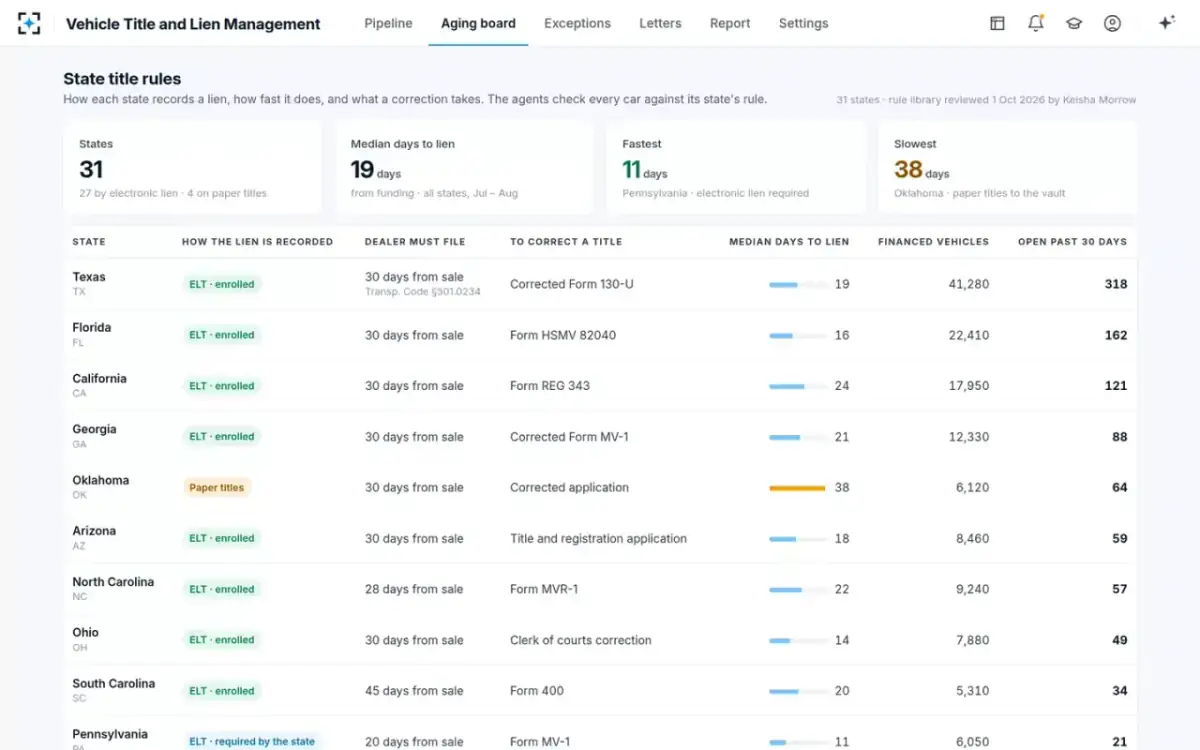
The pattern in that column is not a coincidence. Pennsylvania, which requires every finance company to participate, records fastest; the states where a document still travels are slowest; and the gap between them is larger than anything a lender can win by writing better letters. No state publishes that column, which is why a multi-state lender has to measure its own from its recent liens rather than from a service level anyone promised it.
Enrolling in a state: what it actually takes
Enrolment is a small project repeated once per state, and the parts that go wrong are the same every time: the exact legal name, the identifier the state issues, and the service provider in between. In Texas, for example, an application requesting an electronic title has to carry two extra fields — the electronic-title request marked yes, and the lender's eleven-digit certified lienholder identifier — and the county office has to pick the electronic-title option when it keys the lien (Motor Vehicle Title Manual, §12.14). Any of those three missing and the car comes back on paper.
Before a state’s first electronic lien lands
- Settle one legal name, and use it everywhere
The state records the name on the application. "Tamarack Auto Finance" and "Tamarack Auto Credit LLC" are two different lienholders to a title office, and only one of them is you.
- Get the state’s lienholder identifier into the dealer packet
Where a state issues one, the dealer has to put it on the application. A missing identifier is the commonest reason a car that should have been electronic arrives as paper.
- Read the statute and the administrative rule, not a summary
Illinois shows why: the statute calls the system mandatory and the rule calls participation voluntary.
- Decide what happens to a second lien
In Texas a second lienholder forces a paper title. Know which of your products can create one before it happens.
- Agree how a release will travel
A programme that carries perfection but not release leaves a paper step at payoff, which is where consumer complaints about late titles come from.
- Measure the state from the first month
Start the median and 90th-percentile days to lien for the new state immediately, so the first slow month is visible as a change rather than as a feeling.
What a multi-state lender should hold centrally
Four things, and they are all settings rather than code: each state's filing deadline and the statute it comes from; how a lien is recorded there and whether the lender is enrolled; the correction route and the form it takes; and the measured median and 90th-percentile days from funding to a recorded lien, recomputed from recent liens rather than fixed at onboarding. The fourth is the one most lenders do not hold, and it is the one that turns a rule library into a working clock.
Keeping those current is maintenance, not a project. Programmes change — a state moves from voluntary to mandated, a neighbour switches its default title to electronic — and each change moves a whole lane of the portfolio. In the solution the rule library is reviewed by the title operations lead, and every change is versioned and on the audit trail, so a shift in a state's numbers can be read against the date the rule changed rather than guessed at. To see the state rules, the clocks and the exceptions together, start from Vehicle Title and Lien Management.
Questions people ask
Which states require electronic lien and title?
Enough of them that most finance companies have no real choice, but the tests differ. North Carolina mandates participation for anyone doing at least five transactions a year. Pennsylvania and Florida mandate it for lienholders normally engaged in the business of financing vehicles, exempting those who are not. South Carolina mandates it for dealers and financers alike. Texas, by contrast, keeps its programme voluntary by administrative rule.
Is there a national ELT programme?
No. Participation in electronic vehicle titling is at each agency's discretion and there is no federal mandate, which is why AAMVA publishes a framework and a jurisdiction survey rather than a standard everyone follows. A lender enrols state by state, with a separate identifier and often a separate service provider arrangement in each.
What is an ELT service provider?
A vendor approved by the state to move lien and title messages between the agency and lienholders, to the agency's technical specification. Using one is normal and in several states it is the only route in. It does not transfer any of the lender's responsibility: the lien is still the lender's to perfect, and the state's record is still the only proof that it happened.
Can a lien be perfected electronically?
Yes, and in a programme state that is the ordinary way. The perfection event is still the state recording the lien under its certificate-of-title statute; the electronic programme is how the information arrives and how the confirmation comes back. UCC §9-311 treats compliance with that statute as the equivalent of filing a financing statement, whatever medium carried it.
What happens in a state that still issues a paper title to the lender?
The lien is perfected the same way, at the same moment, but the lender's evidence arrives as a document that has to be posted, checked and stored, and the gap between perfection and knowledge grows by whatever the post adds. In the fictional sample portfolio the states where a document still travels hold 7% of the cars and 24% of the backlog past 30 days.
Does an electronic title mean the lender holds nothing?
It means the lender holds a record rather than a document, and in a title-holding state that record is held for the lender by the agency until the lien is released. The practical test is the same in both cases: does the state's own record show the lender as first lienholder, in the lender's exact name? If it does not, nothing the lender holds will help.