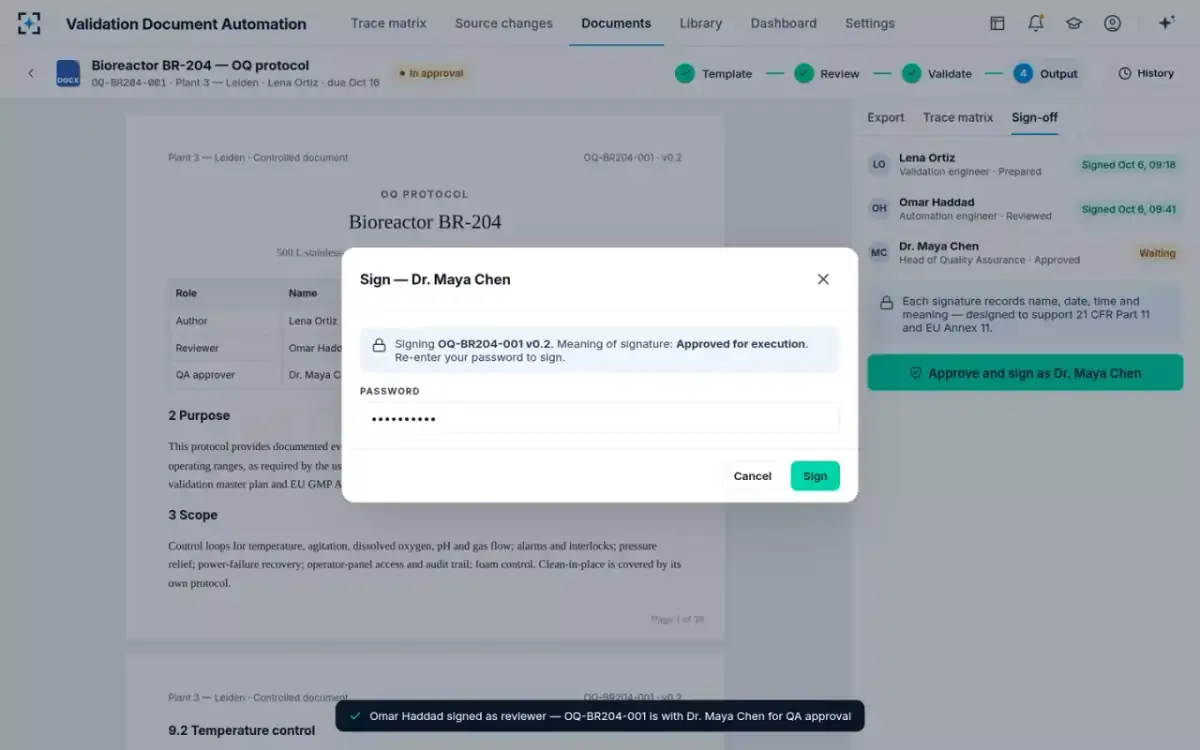
The electronic signature requirements that GMP imposes are short to state and easy to under-build: a signature must say who signed, when they signed, and what the signature means, and it must be bound to the record so tightly that it cannot be lifted off and put on another one. That third element, the meaning, is the one most systems reduce to a button labelled Approve — and it is the reason three different people sign one qualification protocol, because the author, the reviewer and the quality unit are certifying three different things. Botminds' Validation Document Automation treats the signature as part of the document rather than a workflow step: agents draft and trace, and every signature on the protocol records a name, a date, a time and a meaning, with the password re-entered.
The worked example is the sample bioreactor protocol that runs through the solution, OQ-BR204-001 for a 500 litre unit at a fictional plant. The people in it — Lena Ortiz, who authors, Omar Haddad, who reviews, Dr. Maya Chen, who approves for quality, and Dana Okafor, who owns the templates — are characters in the product's sample data, not customers. The regulatory requirements are quoted from the regulations themselves and linked where they appear.
What a GMP electronic signature has to carry, in Validation Document Automation and anywhere else
Who
The printed name of the signer
Not an initial, not a user code on its own. A name a reader can take to a training record. And under 21 CFR 11.100(a) that identity belongs to exactly one person: each electronic signature is unique to one individual and may never be reused by, or reassigned to, someone else.
When
The date and time the signature was executed
System time, not typed. Annex 11 expects a signature to "include the time and date that they were applied", and the draft revision adds the time zone where it matters — which is what a two-site review needs when the author is in Leiden and the reviewer is in Galway.
What it means
The meaning associated with the signature
Review, approval, responsibility or authorship, in Part 11's own words. This is the element that distinguishes three signatures on one document, and the one a system that records only "approved" has thrown away.
What does a GMP electronic signature have to record?
Three things, and the regulation is unusually direct about it. 21 CFR 11.50(a) requires that a signed electronic record contain information that clearly shows the signer's printed name, the date and time the signature was executed, and the meaning attached to it — review, approval, responsibility or authorship being the rule's examples. Paragraph (b) adds that those three items are subject to the same controls as the record itself and must appear in any human-readable form of it — so they belong on the printed page and the PDF, not only in a log an auditor has to ask for.
The European requirement arrives from a different direction and lands in the same place. Annex 11 section 14 says electronic records may be signed electronically, and that signatures are expected to "have the same impact as hand-written signatures within the boundaries of the company", to "be permanently linked to their respective record", and to "include the time and date that they were applied". Neither text says anything about a workflow, a queue or a task list. Both are about what the signed document itself carries.
The three signatures on a qualification protocol, and what each certifies
A qualification protocol is signed before it is executed, and the reason there are three signatures rather than one is that no single person can honestly certify everything the document asserts. The author knows where the content came from; only someone who knows the equipment can say whether the tests prove the requirements; and only the quality unit can say that the result meets the site's quality system. WHO's validation guidance states the end of that chain plainly: "The protocol should be approved by responsible persons, including the quality unit, prior to use. Any changes to a protocol should be approved prior to implementation of the change."
Three signatures, three meanings, three things each one does not say
Author
Who holds itThe validation engineer who wrote the protocol
The meaning recordedPrepared
What it certifiesThat the content is the author’s own work, drawn from the stated revisions of the stated sources, and that every flagged value has been decided and the reason recorded.
What it does notNot that the tests are adequate, and not that the commissioning values have been seen on the equipment.
Reviewer
Who holds itA second technical person, usually the engineer who knows the equipment
The meaning recordedReviewed — test content and commissioning values checked
What it certifiesThat the tests actually prove the requirements they are linked to, that the instrument accuracies are adequate, and that values taken from elsewhere have been verified on the unit.
What it does notNot approval for execution. A reviewer can sign and the protocol still not be usable.
Quality approver
Who holds itThe quality unit — a Head of Quality Assurance or a delegate named in the quality system
The meaning recordedApproved for execution
What it certifiesThat the protocol meets the site’s quality system, that every critical requirement is traced to a test or justified, and that the document may now be executed.
What it does notNot that the equipment passes. The approval releases the protocol, never the result.
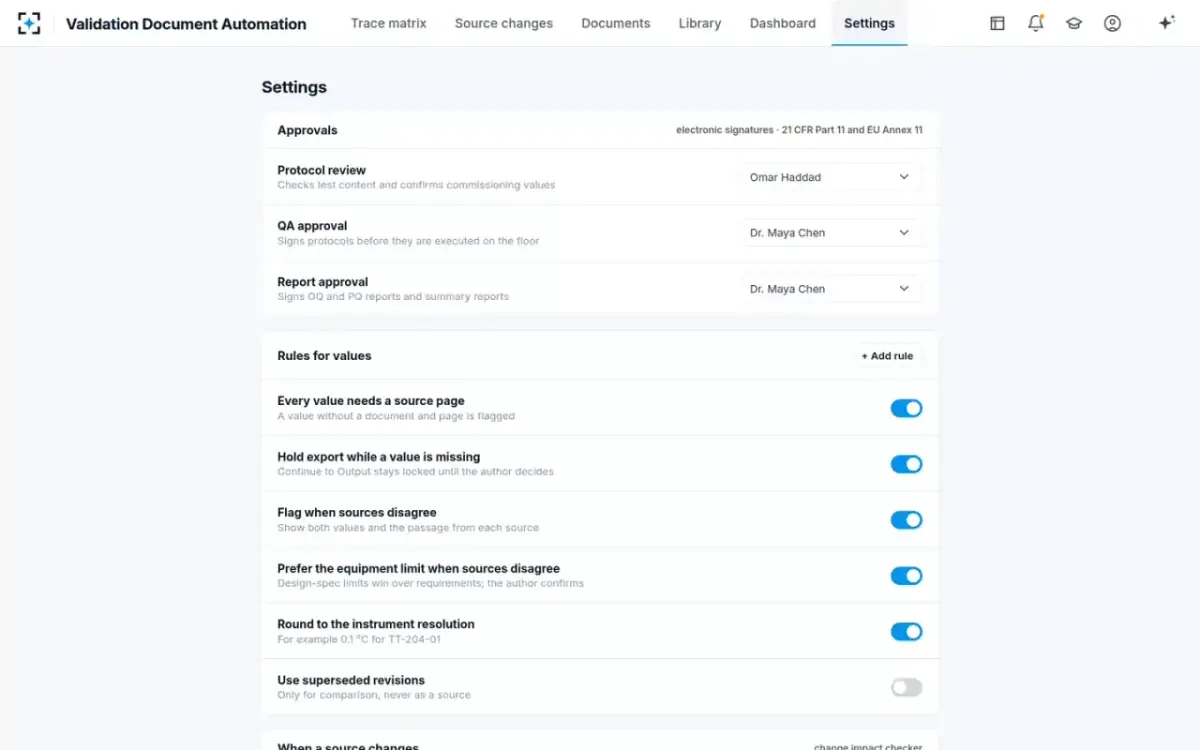
Annex 15 keeps the requirement general enough to cover every document in a qualification: "All documents generated during qualification and validation should be approved and authorised by appropriate personnel as defined in the pharmaceutical quality system." The phrase that carries the weight is "as defined in the pharmaceutical quality system". The regulations do not name your approvers. Your quality system does, and a validation system that hard-codes a role is making a decision that was never its to make.
What "the meaning of the signature" actually means
It means the specific assertion the signer is making about this document, written down at the moment of signing. "Approved" is a meaning; so is "Reviewed — test content and commissioning values checked"; so is "Prepared". The test of whether a system records a meaning is simple: read the three signature lines on a printed protocol and ask whether a reader who was not there can tell what each person was saying.
The European draft revision of Annex 11, published for consultation on 7 July 2025, makes the behaviour explicit rather than leaving it to interpretation. Its clause 13.5 says it "should be clear when a user is executing an electronic signature and where applicable, systems should prompt the user for the meaning of the signature (e.g. reviewer or approver)", and clause 13.6 lists what the signature's manifestation must show: the full name, the username, the role of the signer where applicable, the meaning, the date and time, and the time zone where it is needed. That is a consultation draft, not law, and the final text may move. The direction of travel is plain enough.
Meaning is also what makes a signature useful a year later. An inspector reading a qualification file does not ask whether a document was approved; that much is obvious from the version number. The question is who checked what. A protocol whose three signature lines all read "Approved" answers it with silence.
Why do you have to re-enter your password to sign?
Because the login proved who was at the keyboard when the session started, and the signature has to prove who is at the keyboard now. Part 11 draws the line at the session: where a signature is not based on biometrics, the system must employ at least two distinct identification components, and "when an individual executes one or more signings not performed during a single, continuous period of controlled system access, each signing shall be executed using all of the electronic signature components". Inside one continuous session, the first signing uses all components and later ones may use a single component that only that individual can execute.
The draft Annex 11 is stricter, and worth knowing about now if you are configuring a system you expect to keep. Clause 13.3 requires full re-authentication at the moment of signing, "providing at least the same level of security as during system login", and rules out three shortcuts by name: authentication by smart card alone, by a PIN code alone, or by relying on the previous system authentication. Only for later signatures in immediate sequence does it allow a password or biometrics on their own. A system whose approve button simply posts the current session's identity would not meet that draft, however carefully the audit trail is kept.
There is a human reason too, and it is the better one. Re-entering a password is a deliberate act. It is the difference between clearing a queue and signing a document, and the three seconds it costs are the three seconds in which a reviewer remembers that the name going onto the page is theirs.
The reviewer's job, and why it is never the author's
The reviewer answers a question the author structurally cannot: does this document do what it claims? An author who has spent a day assembling a protocol knows where every value came from and is, by that point, the worst available judge of whether the tests prove the requirements. GMP builds that separation into its oldest document rules. For master production and control records, 21 CFR 211.186(a) requires that they be "prepared, dated, and signed (full signature, handwritten) by one person and independently checked, dated, and signed by a second person". One person prepares; a second checks. A qualification protocol is not a master production record, but the principle a site writes into its own procedures is the same one.
On the sample protocol, the reviewer's meaning says what the second pair of eyes was actually for: "Reviewed — test content and commissioning values checked". The second half of that is the part a desk-bound review would miss. One value in the protocol — the high dissolved-oxygen alarm — appears in none of the six source documents, because the design specification leaves it "to be set at commissioning". The author took 60% air saturation from the identically designed sister unit and marked it for verification. The reviewer's signature is what says someone went and looked at the panel before the test could run.
Four people around one protocol in Validation Document Automation, and what each decides
Today
Spends days copying setpoints out of PDFs into a locked template, and minutes thinking about the test itself.
With agents
Opens a drafted protocol with every value cited to its page, decides the one missing value and the one disagreement, and signs as author.
Still theirs: Every decision about what a test should prove, and the reason behind any value taken from elsewhere.
Today
Hears that a requirement changed and has to work out for himself which tests moved.
With agents
Receives the version with the rewritten tests and the reason, checks the test content, verifies the commissioned value on the panel and signs as reviewer.
Still theirs: The judgement that a test actually proves the requirement it is linked to.
Today
Approves protocols and cannot sign what she cannot trace.
With agents
Sees every requirement traced to a test or to another approved protocol, every value with its page, and re-enters her password to approve for execution.
Still theirs: The release of the document, and the right to send it back.
Today
Owns the templates, and finds locked wording changed inside someone’s draft.
With agents
Owns the approved templates; authors tick sections and write instructions, and the wording changes only through change control.
Still theirs: The wording itself, which no author and no agent may alter.
What the quality unit cannot sign, and what happens then
The quality approver cannot sign a protocol she cannot trace, and that is a feature rather than an obstacle. If a critical requirement has no test and no justification, approving the protocol would certify something untrue. If a stated value has no source, the expected result in the test is an assertion nobody can stand behind. If the protocol was drafted from a revision that has since been superseded, the document tests yesterday's requirement.
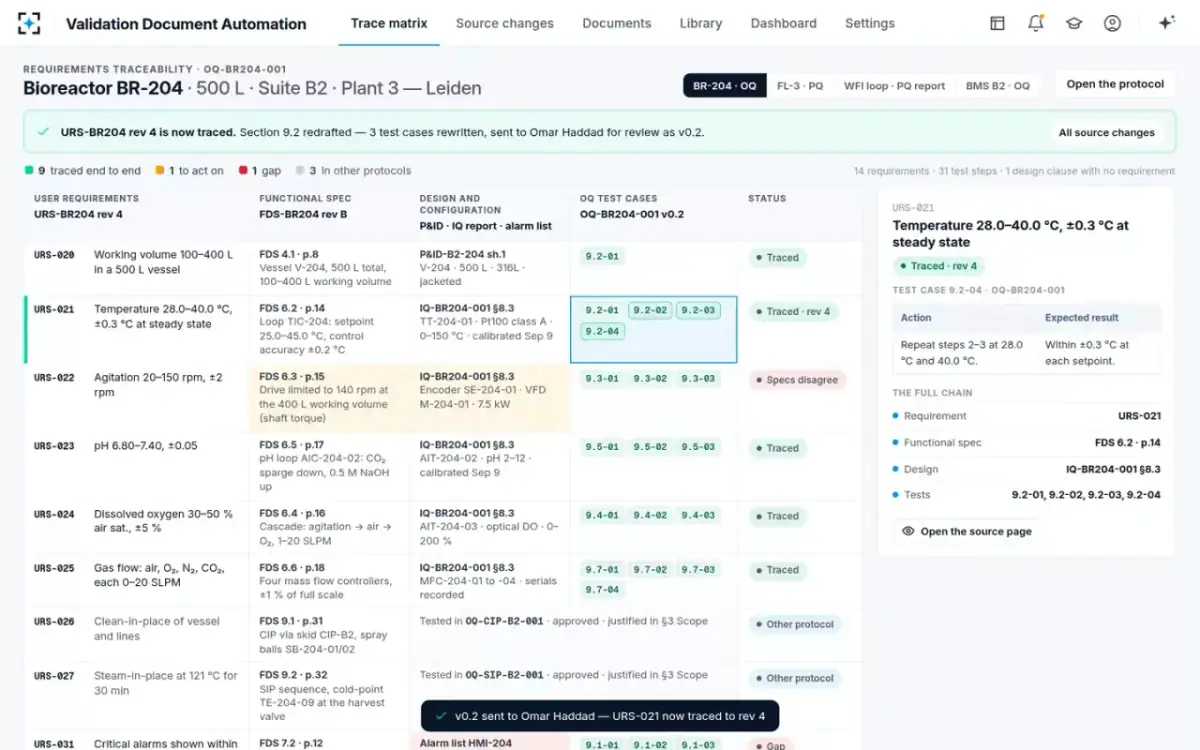
Each of those has a defined consequence rather than a conversation. In the solution, export is held while a value is missing — a setting, and one most sites will leave on. A requirement with no test is reported as a gap for the author rather than quietly dropped from the matrix. And an approved document is never edited in place: when a source gets a new revision, the change opens a new version under change control, the linked tests are marked, and the signatures that applied to the old version stay with the old version. Which tests a changed source rewrites follows that path in detail.
The send-back is as much a part of the design as the approval. A quality unit whose only recorded action is approval is a quality unit whose refusals are invisible, and an inspector reading a file with no send-backs in it will wonder what the review was for. What inspectors cite in validation documents comes back to the same point from the other side.
Who signs, in what order, and what the agents never do
Agent
The agents draft and traceFind the current approved records, pull each value with the passage it came from, draft every ticked section into the locked template wording, and link each requirement to the tests that prove it.
Never: Never a superseded revision, never locked wording changed, never a value written without a source page.
A person decides
Author signs · PreparedDecide the flagged values, record the reason for each, read the draft and sign as author.
Never: Cannot also sign as reviewer on the same document.
A person decides
Reviewer signs · ReviewedCheck that the tests prove the requirements, that instrument accuracy is adequate, and that borrowed values were verified on the equipment.
Never: Cannot approve the protocol for execution.
A person decides
Quality approves · Approved for executionConfirm the trace is complete, re-enter the password, and release the version for execution.
Never: Never signs on behalf of anyone else; the signature cannot be delegated by sharing a login.
Draft, reviewed, approved, executed: when each signature happens
Signatures cluster at the boundaries between states, and the boundary that matters most is the one before execution. A protocol that is executed first and approved afterwards is not a protocol; it is a report of what somebody did. The table below is the ordinary sequence for an equipment qualification, with the document's own status at each step.
One protocol's life, and the signature at each boundary
| State | Who signs, and with what meaning | What the document says about itself | What cannot happen yet |
|---|---|---|---|
| Drafting | Nobody. The author works, and the activity trail records every step. | A working version. Every page carries a draft watermark. | No execution, and no issue to the floor. |
| Ready for review | Author · Prepared | The version the author stands behind, with every flagged value decided and the reason recorded. | The reviewer cannot be the author; a single person cannot close both. |
| Reviewed | Reviewer · Reviewed — test content and commissioning values checked | A second technical person has checked that the tests prove the requirements. | Still not executable. Review is not release. |
| Approved for execution | Quality unit · Approved for execution | The released version, watermark removed, trace appendices approved with it. | A change to a source no longer edits this document; it opens a new version. |
| Executed | The people performing each test, as the protocol itself requires. | Results, deviations and their resolution, recorded as the work is done. | A deviation cannot be closed without the retest or justification it is linked to. |
| Reported | Author, reviewer and quality unit again, on the report. | What happened, against what was approved before it happened. | A conclusion cannot rest on an acceptance criterion changed after the fact. |
The sign-off screen: three signatures in order, each with its meaning
Can a signature be moved, copied or re-used?
No, and the regulation says so in one sentence rather than leaving it to a system's good behaviour. 21 CFR 11.70 requires that electronic signatures and handwritten signatures executed to electronic records "be linked to their respective electronic records to ensure that the signatures cannot be excised, copied, or otherwise transferred to falsify an electronic record by ordinary means". Annex 11 says the same thing as an expectation: permanently linked to their respective record.
In practice this is the clause that governs what happens when an approved document changes. If a signature is permanently bound to the version it was applied to, then a change cannot leave the old signatures sitting on the new text — which is exactly why an approved protocol opens a new version instead of being edited, and why the new version has to be signed again. The draft Annex 11 spells out the alternative it will accept: controls ensuring that a signed record cannot be modified, or that if a later change is made, the record "will clearly appear as unsigned".
The same clause explains why a wet-ink signature on a printout of an electronic record is an awkward arrangement rather than a free one. The draft guidance's answer, for sites that keep that practice, is to calculate a hash of the electronic record and print it on the signature page, so a later change to the file is detectable from the paper. That is a workable control, and it is also a good argument for not splitting the document and its signatures across two media in the first place — one of several threads in what going paperless really changes.
What the activity trail has to show beside the signature
A signature says who certified what, at a moment. The audit trail says what happened around it. Annex 11 asks for consideration, based on risk, of a system-generated record of all GMP-relevant changes and deletions, with the reason documented for a change or deletion of GMP-relevant data, and requires that those trails be available, convertible to an intelligible form and regularly reviewed. Part 11 puts the same control in 11.10(e), as "secure, computer-generated, time-stamped audit trails to independently record the date and time of operator entries and actions that create, modify, or delete electronic records", adding that record changes must not obscure previously recorded information.
For a qualification protocol, the entries that matter are the ones a reader would otherwise have to reconstruct: which draft the author accepted, which flag was cleared and on what reason, which revision of which source each section was drafted from, when a new revision arrived and which tests it marked, and who sent the document back. In the solution, every agent step, redraft, decision and signature is recorded with who, what and when — including the reason behind a value the author typed or took from another unit. The reason is the part a hand-built process often fails to capture, because the only place to write it is an email.
Accepted: the version moves, and the step is recorded
Configuring the signatures on your own system
Most of what goes wrong with GMP signatures is configuration rather than software. The list below is what to check on a system you already own, and what to ask for in a demonstration of one you do not.
What to check in a GMP electronic signature configuration
- Does the printed document show all three elements?
Name, date and time, and meaning, in the PDF and on paper — not only on screen. 21 CFR 11.50(b) requires them in any human-readable form of the record.
- Is the meaning chosen, or assumed?
A system that stamps "approved" on every signature has one meaning for three different acts. Ask to see two signatures on one document with different meanings.
- Is the password asked for at the signature, not at login?
And ask what happens on a second signature minutes later. Part 11 allows a single component inside one continuous session; the draft Annex 11 would require full re-authentication, easing only to a password or biometrics for signatures in immediate sequence.
- Can one person hold two roles on the same document?
An author who can also sign as reviewer removes the second pair of eyes. Configure the rule, then test it by trying to break it.
- Are approvers people, or hard-coded roles?
Your quality system names them. If the software insists on its own hierarchy, the quality system has been rewritten by a vendor.
- What happens to the signatures when the document changes?
They must stay with the version they were applied to. A change should open a new version and need new signatures, never silently carry the old ones forward.
- Is a send-back recorded as plainly as an approval?
A file with no refusals in it tells an inspector that review is a formality.
- Does the trail hold the reason, not just the action?
Why a value was taken from a sister unit, why a flag was cleared, why a test was judged still valid after a change. The reason is the part people reconstruct from memory a year later.
Approvers and rules as settings, not as the software's opinion
A last point that is easy to lose in the detail. The reason a protocol carries three signatures is not that three approvals are safer than one. It is that three different assertions are being made, and collapsing them into one button destroys the information an inspector, a colleague or a future version of yourself will need. Everything else here — the meaning, the re-entered password, the permanent link, the trail — exists to keep those three assertions distinguishable. To see them on one protocol, start from Validation Document Automation.
Questions people ask
What are the GMP requirements for electronic signatures?
In the United States, 21 CFR part 11: the signed record must clearly indicate the printed name of the signer, the date and time of signing and the meaning of the signature; the signature must be unique to one individual and never reassigned; and it must be linked to its record so it cannot be excised, copied or transferred. In the European Union, Annex 11 section 14 expects an electronic signature to have the same impact as a handwritten one within the company, to be permanently linked to its record and to include the time and date it was applied.
Who signs an IQ, OQ or PQ protocol?
Ordinarily three people before execution: the author who prepared it, a technical reviewer who checks that the tests prove the requirements, and the quality unit, which approves it for execution. WHO's validation guidance requires approval by responsible persons including the quality unit before use. The execution itself is signed by whoever performs each test, as the protocol specifies.
Can the quality unit be the author of a validation protocol?
Not on the same document, in any arrangement worth defending. The quality approval certifies that someone independent of the work has judged it against the quality system, and an approver reviewing their own draft certifies nothing. Where quality staff do write protocols — which happens on small sites — the approval has to move to another person in the quality unit, and the quality system should say who.
Does Annex 11 allow electronic signatures?
Yes. Section 14 states that electronic records may be signed electronically and sets out what is expected of such a signature. Section 15 goes further for batch release, requiring that where a computerised system records certification and release, only Qualified Persons may certify release and the system must identify and record the person doing it — using an electronic signature.
Does every electronic signature need the password typed again?
Under Part 11, yes for the first signature of a session and for any signature not performed during a single continuous period of controlled system access; subsequent signings within that session may use one component only. The draft revision of Annex 11 published in July 2025 would require full re-authentication when a signature is executed — a password or biometrics alone only for further signatures in immediate sequence — and would not accept reliance on the previous system login.
Can an AI agent sign a protocol?
No. A GMP signature belongs to a named individual who can be held accountable for it, which is why the identity may never be reused or reassigned. In this solution the agents draft, extract, trace and mark; the author accepts, the reviewer checks and the quality unit approves, and no agent clears a flag or signs anything.