A GMP AI agent is software given one narrow job on a regulated document and a published limit it will not cross — and in validation work the limit is the interesting half. An agent that drafts a qualification protocol section is useful; an agent that will not write a value without the page it came from, will not change locked template wording, and will not clear a flag it raised is auditable, because each of those sentences can be tested on its own. Botminds' Validation Document Automation runs six such agents over one protocol, and this guide takes them one at a time: what each does, what it may not do, and which named person can override it.
The figures below are sample data from a fictional 500 L bioreactor, BR-204, and its OQ protocol. The rules and quotations are real and linked where they appear.
Six agents on one sample bioreactor protocol
157pages
indexed across 6 source records, so every value can be cited to a page
19values
extracted with their document, page and passage; 17 matched, 1 to check, 1 missing
52s
to a first draft of 19 ticked template sections
1
requirement reported as a gap, for the author to close
What is a GMP AI agent, and how is it different from a chat assistant?
Three differences, and only the third is about the model.
Scope. An agent has one job on one kind of object. The value extractor reads sources and returns values with pages; it does not write prose, does not judge whether a requirement is covered, and cannot be asked to. A chat assistant has whatever scope the last message gave it, which means its scope cannot be described in a procedure.
Limits that hold whatever anyone types. An agent's limits are properties of the software, not instructions in a prompt. "Never fill an unreadable value" is enforced where the draft is written, so no phrasing of a request produces a filled value. A chat assistant's guardrails are text competing with other text, which is a weaker thing.
A record of what it did. Each agent step is recorded with what it read, what it produced and what the person then decided — the thing the EU's draft AI annex asks for when a model gives an input to a human decision. A chat transcript is not that record: it shows what was said, not what reached the document.
This is also why the number of agents matters. Six narrow agents can each be described, tested and audited; one assistant that writes the whole protocol has one limit — "a human reviews it" — which is the limit that fails quietest, because a reviewer facing fluent, plausible text has nothing to catch the error on. The European Medicines Agency's reflection paper names exactly that failure: generative models are "prone to include plausible but erroneous or incomplete output", so quality review mechanisms have to ensure model-generated text is correct before it goes forward (EMA reflection paper on AI in the medicinal product lifecycle).
The six agents in the order they run, with the line each will not cross
Agent
Source finderFinds the current, approved records for the unit and indexes every page.
Never: Never a superseded revision as a source
Agent
Value extractorPulls every setpoint, range, tolerance, tag and calibration date, with its page and passage.
Never: Never fills an unreadable value
Agent
Section writerDrafts each ticked section from the sources and the author's plain-English instructions.
Never: Never a value without a source page
Agent
Consistency checkerCompares every value with every other source that mentions it, and with the rules for values.
Never: Never clears a flag
Agent
Trace-matrix builderLinks each requirement to its clause, its design record and its test cases.
Never: Never leaves a requirement neither covered nor justified
Agent
Change impact checkerCompares a new revision with the one the document was drafted from and marks the test cases it reaches.
Never: Never edits an approved document
A person decides
AuthorResolves every flag and gap, supplies what no source holds, and accepts each drafted section.
Never: The only one who can clear a flag
A person decides
Reviewer and quality approverThe automation engineer signs for test content; the head of quality approves for execution.
Never: Never signed while a value is unresolved
Source finder: only the current, approved revision
The first agent does the job that takes a validation engineer half a day and produces nothing anyone can see: assembling the right revision of every source. On the sample unit that is six records and 157 pages — requirements, functional design spec, the approved IQ report, the P&ID, the alarm list, the calibration certificates — each indexed by page so a value can later be pointed at rather than retyped.
Its limits are about what counts as a source. It will not take a superseded revision, which sounds obvious and is an easy error for a person in a hurry, because a superseded revision is usually the one already open on the desk. And records belonging to another unit are never a source: the sister bioreactor BR-203's alarm list can be offered as a flagged suggestion, so the author knows what the neighbouring machine does, but it can never fill a value for this one. The agent is read-only on every source record it touches.
That last point is the quiet one. A tool that can write back into the source documents has a failure mode no amount of review catches, because the thing a reviewer would check against has itself changed.
Value extractor: the unit as written, the page as found
The second agent pulls the numbers: setpoints, ranges, tolerances, instrument tags, calibration dates, from body text, from tables and from scanned test sheets. Nineteen values on the sample protocol, each with the document, the page and the passage it was read from.
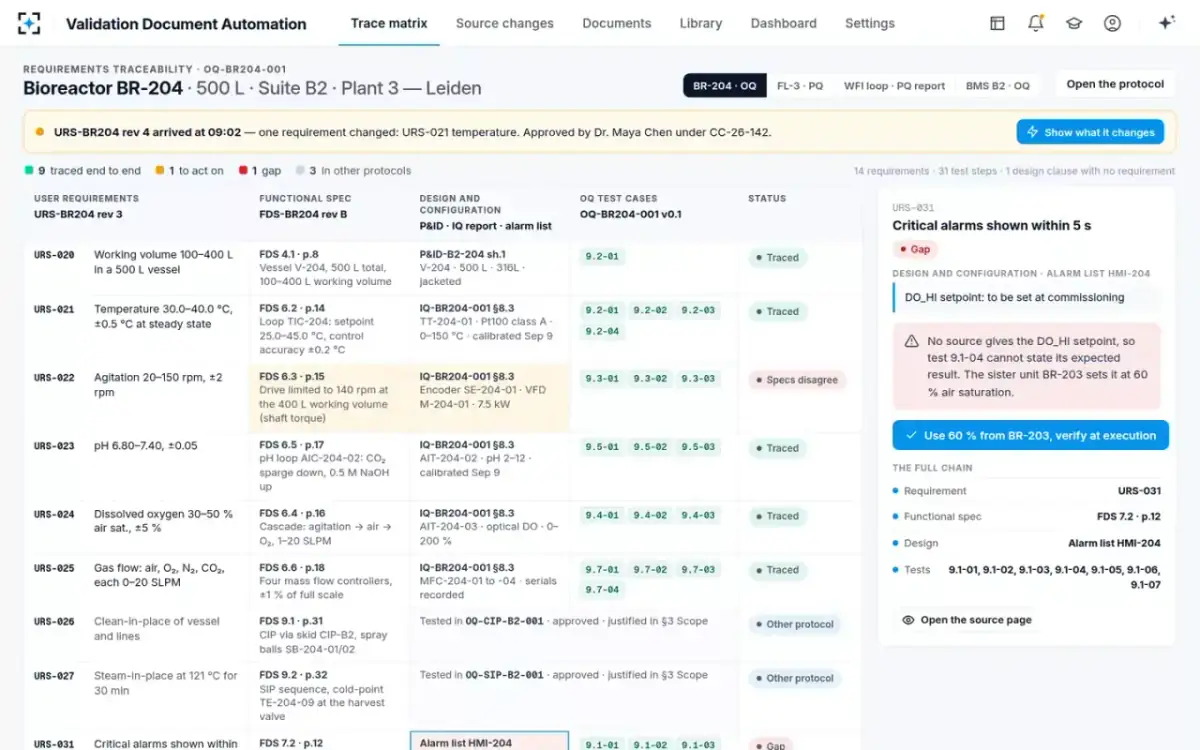
Two rules govern it. The unit is recorded as written — not normalised, not converted — because a conversion is an interpretation, and an interpretation in a qualification document needs an author. And a value it cannot read is reported as unreadable rather than guessed. On the sample unit that produced one missing value: the high dissolved-oxygen alarm setpoint, which the design spec's alarm table leaves "to be set at commissioning" on page 12. The extractor says so, the section writer leaves the expected result empty, and export waits.
It is worth being blunt about why that matters more than it sounds. Across the sample site’s documents, eleven of twenty-three flags were values no source held, most of them alarm setpoints deferred to commissioning. A tool that filled eleven plausible numbers would produce a complete-looking protocol with eleven unsourced values in it — and the reviewer would have nothing to notice, because a plausible setpoint reads exactly like a correct one.
The limits matrix: one row per agent, and who can override it
Source finder
Finds the current, approved records for one piece of equipment — requirements, design spec, IQ report, drawings, alarm list, calibration certificates — and indexes every page so a value can be cited by document, page and passage.
What it may not do
- Never uses a superseded revision as a source
- Another unit's records only as a flagged suggestion
- Read-only on the source records
Who resolves it
The author adds or removes a source and accepts a suggestion.
Value extractor
Pulls setpoints, ranges, tolerances, tags and calibration dates out of the sources, including tables and scanned test sheets, with the unit exactly as written and the page and passage it was read from.
What it may not do
- Never fills an unreadable value — it says so
- Records the passage for every value
Who resolves it
The author supplies a value no source holds, with a reason.
Section writer
Drafts each ticked template section from the sources and the author's plain-English instructions, and redrafts a section when a source changes, citing the new page.
What it may not do
- Never changes locked template wording
- No value without a source page — a missing one is left empty and flagged
Who resolves it
The template owner changes locked wording, through change control.
Consistency checker
Compares every value with every other source that mentions it and with the site's rules for values: missing, disagreeing, out of range or in the wrong unit, showing the passage from each source.
What it may not do
- Never clears a flag — only an author can
Who resolves it
The author resolves each flag, and the resolution is recorded.
Trace-matrix builder
Links each requirement to its specification clause, its design record and the test cases that prove it, and builds the requirement-to-test and value-to-source appendices.
What it may not do
- Never leaves a requirement neither covered by a test nor justified
- Never invents a test to close a gap — it reports the gap
Who resolves it
The author closes a gap by adding a test, citing another protocol, or justifying an exclusion.
Change impact checker
When a requirement, design spec, drawing or certificate reaches a new revision, compares it line by line with the revision each document was drafted from, marks every linked test case and lists what still holds.
What it may not do
- Never edits an approved document — a change opens a new version
- Marks; never clears a mark
- Shows the old and new wording side by side
Who resolves it
The author accepts or overrides each mark; quality approves the new version.
Section writer: locked wording stays locked
The third agent writes. The author ticks the template sections that apply — nineteen of twenty-one on the sample protocol — and says in plain English how each should be written: the run setpoint, how many readings per setpoint, which ends of the range to demonstrate. The agent drafts each ticked section from the indexed sources.
Its first limit protects the template. An approved protocol template carries wording that was itself approved: the statement of purpose, the scope, the safety and documentation sections, the signature meanings. That wording does not change in a draft, whatever an author's instruction says, because changing it is a change to a controlled document and belongs in change control with the template owner. A drafting tool that rewrites locked text to make a section read better has quietly made every protocol a template variant.
Its second limit protects the numbers: no value without a source page. This is the rule that makes the whole design work, because it converts the model's weakness — fluent text that may be wrong — into a visible gap. A section that cannot be completed is completed to the point where the sources run out, and the rest is flagged.
It also suggests. On the sample unit it proposed a section 9.10 on foam control, because the design spec lists antifoam pump P-204-05 and foam probe LS-204-07 while no requirement mentions foam — a design feature with no requirement behind it, which is a decision for the author rather than an omission to fix. What to do with a design clause nobody asked for works that case through.
Consistency checker: it marks, and it never clears
The fourth agent compares. Every value is checked against every other source that mentions it, and against the site's own rules for values: missing, disagreeing, out of range, wrong unit. Where two sources disagree it shows both passages as written rather than deciding between them — on the sample unit, URS-022's 150 rpm against the design spec's 140 rpm limit at the 400 L working volume, with the factory test's measured 140.4 rpm beside them.
Its one limit is the most important sentence in the product: it never clears a flag. Only an author can. The reason is not caution for its own sake. A flag is a statement that the document is not yet safe to approve, and clearing it is a decision with consequences — a protocol approved for execution with a disputed acceptance criterion in it produces results nobody can use. A system in which the component that raises concerns can also dismiss them has no concerns, only noise.
This is also the point where an existing rule already bites, with no AI annex required. Annex 11 asks for an additional accuracy check on critical data entered by hand, done either by a second operator or by validated electronic means (EudraLex Volume 4, Annex 11 §6). The US regulation says the same in its own words: what goes into and comes out of a computer system holding formulas, records or data is to be checked for accuracy (21 CFR 211.68(b)). A site using extracted values has to decide which of those two routes it is relying on — a second person, or a validated electronic check — and write the decision down.
The drafting run, step by step, with what each agent read
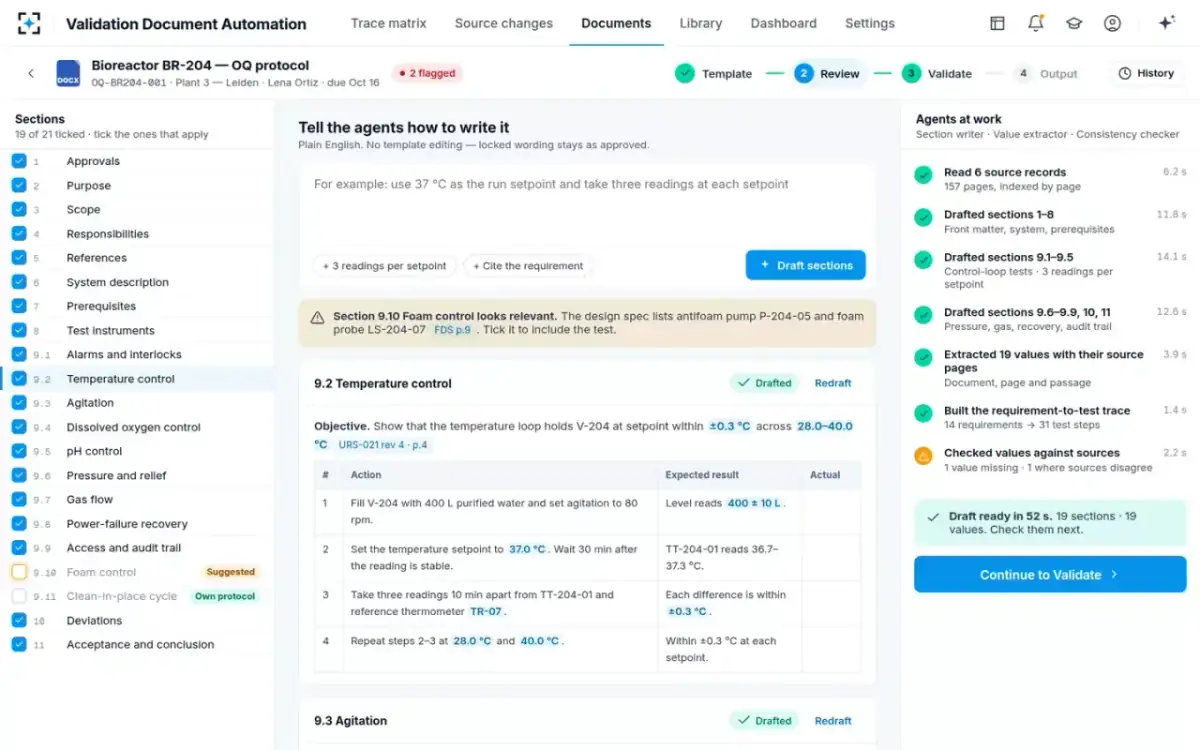
Tell the agents how to write it — no template editing; locked wording stays as approved
Trace-matrix builder: every requirement covered or justified
The fifth agent links. Each requirement runs across to its specification clause, its design or configuration record and the numbered test cases that prove it, and the result becomes the protocol's two appendices: the requirement-to-test trace and the value-to-source trace.
Its limit is stated as a completeness condition rather than a prohibition: every requirement must be covered by a test or justified. Three of the sample unit's fourteen requirements are justified by pointing at their own approved protocols for clean-in-place, steam-in-place and batch backup; one is a gap and is reported as one. The agent does not invent a test to close the gap, and it does not quietly leave the cell blank, which is the spreadsheet version of the same evasion.
The completeness condition is not a product opinion. The 2025 draft revision of Annex 11, out for consultation and not in force, states the other direction of the same rule: a test case that cannot be traced to a requirement or an applicable specification fails the requirements for qualification and validation (draft revision of Annex 11). Both directions matter, and the traceability matrix guide works through each of the rows that stop a protocol.
Change impact checker: old and new, side by side
The sixth agent watches the sources. When a requirement, design spec, drawing or certificate reaches a new revision, it compares that revision line by line with the one each affected document was drafted from, marks every linked test case and lists what still holds.
It has three limits, and the first is structural. It never edits an approved document: a change opens a new version, which goes through the approvals the original needed. The second repeats the consistency checker's rule — it marks and never clears a mark — because an assessment that can retract its own findings is not an assessment. The third is about presentation: it shows the old and the new wording side by side rather than a summary of the difference, because a summary is an interpretation and the reviewer's job is to judge the difference, not the summary of it.
On the sample unit, one temperature requirement moving from 30.0 – 40.0 °C at ±0.5 °C to 28.0 – 40.0 °C at ±0.3 °C marked three of four linked test cases and left the fourth untouched with its reason recorded. Which tests a changed source rewrites follows that change all the way through.
What should an agent never do in a GMP document?
Eight lines, drawn from the six agents above and stated generally, so they can be asked of any product rather than only this one.
What to demand of any agent allowed near a GMP document
- Never write a value it cannot cite
Every number in a draft carries the document, page and passage it came from, and a value no source holds is left empty and flagged — never filled with a plausible one.
- Never use a superseded revision, or another unit's records
Sources are the current, approved revisions for this equipment. A sister unit's value may be offered as a suggestion with its origin, and may not become a value by itself.
- Never change approved wording
Locked template text is not rewritten in a draft, however the instruction is phrased. Changing it is a change to a controlled document, with the owner and the approvals that implies.
- Never clear its own flag
The component that raises a concern cannot dismiss it. Only a named author resolves a flag, and the resolution is recorded with the reason.
- Never edit an approved document in place
A change opens a new version through change control. An approved protocol that can be edited silently makes every executed result unprovable.
- Never decide, release or approve
Agents draft, extract, link and mark. Accepting, signing and approving for execution are acts by named people, each recorded with its meaning.
- Never hide its working
What each agent read and produced is on the record beside what the person then decided, so a reviewer can check the chain rather than the conclusion.
- Never let an incomplete document leave
Export waits while a value is missing or disputed, so an unfinished draft cannot become a document through inattention.
The draft EU annex on artificial intelligence is useful here even though it is only a draft, because it states the condition under which a generative model may touch non-critical GMP work at all: a qualified, trained person must always carry responsibility for judging whether the model's outputs are fit for the intended use — a human in the loop (draft Annex 22). Responsible for the outputs being suitable. A design in which the person can only accept or reject a finished document does not let anyone discharge that responsibility; a design in which every value sits beside the page it came from does. What the draft allows and does not sets out the rest of it.
Where the person stands in every one of the six
Count the decisions on the sample protocol and there are five, each belonging to a named person: which sources are right, what to do about the disputed agitation value, what to do about the missing alarm setpoint, whether to add a section for foam control, and whether the draft is good enough to send for review. The agents produced nineteen sections and nineteen cited values in fifty-two seconds, and not one of those five.
The four people around one protocol, and what each still decides
Today
Spends days copying setpoints out of PDFs into a locked template, and minutes on the test itself.
With agents
Opens a drafted protocol with every value cited to its page, and spends the time on the disputed value, the missing one and the gap.
Still theirs: The only person who can accept a draft or clear a flag.
Today
Hears that a requirement changed and works out for himself which tests moved.
With agents
Receives the new version with the rewritten test cases and the reason for each, and checks the test content against the equipment.
Still theirs: Signs as reviewer, and verifies a commissioned value on the panel before the test runs.
Today
Approves protocols she cannot trace back to the requirements they rest on.
With agents
Sees every requirement traced to a test or to another approved protocol, and every value beside its page.
Still theirs: Approves for execution, with the meaning of her signature recorded.
Today
Owns the templates, and finds locked wording altered in someone's draft.
With agents
Owns the approved templates; authors tick sections and write instructions, and the wording changes only through change control.
Still theirs: The only route by which locked wording changes.
One number deserves care. Fifty-two seconds to a first draft is what the agents took on this sample, and it is not the time to a protocol. The protocol was ready when a validation engineer had resolved a disagreement, sourced a commissioned value and marked it for verification, and an automation engineer and a head of quality had signed. Presenting the agents' time as the process's time is an easy misreading, and it sets a tool up to disappoint a quality system when the first protocol takes a week anyway.
The matrix the builder produced, with the gap it refused to close
To see the six agents run, and the five decisions they leave for a person, start from Validation Document Automation.
Questions people ask
Can AI write a validation protocol?
It can produce a draft of one, and a draft is not a protocol. What makes the difference is whether every value in it can be traced to the page it came from, whether the approved template wording survived, and whether the things no source answers are visibly unanswered rather than quietly filled. A protocol becomes a protocol when a named author accepts the draft, a reviewer checks the test content and quality approves it for execution — three acts no software performs.
How do you stop AI inventing a setpoint?
By making a citation a condition of writing a value, rather than asking the model to be careful. If the drafting step cannot emit a number without a document and page behind it, a value no source holds comes out as an empty field and a flag, not as a plausible figure. On the sample bioreactor that produced one visibly missing alarm setpoint rather than one invisible wrong one, and export waited until the author decided what to do about it.
Who approves an AI-drafted protocol?
The same people who approve any other protocol, and that is the point. On the sample protocol the validation engineer signs as author, the automation engineer signs as reviewer with the meaning that the test content and commissioning values were checked, and the head of quality approves for execution — each signature recording name, date, time and meaning. Nothing about the draft having been machine-written changes who is accountable for the document.
How does AI extract values from a design spec?
By reading the document page by page — body text, tables, and scanned sheets through optical character recognition — and returning each value with the passage it came from, rather than summarising the document. The important design decision is what happens at the edges: a unit is recorded as written rather than converted, because a conversion is an interpretation, and a value that cannot be read reliably is reported as unreadable rather than estimated.
Is an AI agent different from a chatbot for GMP work?
In the ways that matter for an audit, yes. An agent has one scope that can be written into a procedure, limits that hold in the software rather than in a prompt, and a record of what it read and produced beside what the person then decided. A chat assistant's scope is whatever the last message asked for, which makes it hard to describe in a procedure and harder to test. That is a statement about design, not about which underlying model is cleverer.
What limits should an AI agent have in validation?
At minimum: no value without a source page; only current, approved revisions as sources; no change to approved template wording; no clearing of its own flags; no editing of an approved document in place; and no decision, release or approval. Ask a supplier to state each limit as a sentence that could be tested, and ask which named role can override each one. A limit nobody can name an owner for is not a limit.