Annex 22 is the draft EU GMP annex on artificial intelligence, published for consultation on 7 July 2025, and the short answer to what it allows is: static, deterministic machine-learning models in critical GMP applications, under a heavy regime of intended-use description, acceptance criteria, independent test data, explainability and monitoring — and generative models and large language models nowhere near a critical application at all. In non-critical applications it lets generative models in on one condition, that a qualified person is responsible for every output. Botminds' Validation Document Automation is built for the second case: agents draft, extract, mark and flag on a qualification document, and a named validation engineer accepts, a reviewer signs and a head of quality approves before anything is executed.
Two things to fix before reading on. Annex 22 is a draft out for consultation, not law; the current EudraLex Volume 4 index still carries Annex 11's January 2011 revision and no Annex 22 at all (EudraLex Volume 4). And nobody can be compliant with a text that has not been adopted — including us. What a draft is good for is designing towards, and knowing what to ask a supplier.
Annex 22 so far: two dates that happened, and one that has not
- Consultation open7 Jul – 7 Oct 2025
- Comments assessed, experts convenedto 30 Jun 2026
- Still a draftsince the workshop
What is Annex 22, and when does it apply?
It is an annex to the EU GMP guide that sits on top of Annex 11, the computerised-systems annex, for systems with an AI model inside them. Its own scope paragraph is careful about where it bites: it applies "where Artificial Intelligence models are used in critical applications with direct impact on patient safety, product quality or data integrity, e.g. to predict or classify data", and it describes itself as guidance that supplements Annex 11 wherever an AI model is embedded in a computerised system.
Three consequences follow from that sentence, and they are easy to miss.
First, the annex is scoped by application, not by technology. The same model can be inside scope on one system and outside it on another, because what decides is what the output is used for. Second, Annex 11 does not go away: the annex is additional guidance, so every ordinary computerised-system obligation — risk management across the life cycle, user requirements, accuracy checks on critical data, periodic evaluation, audit trails — still applies in full. Third, "critical" has a definition in the text, and it is the definition that does all the work: direct impact on patient safety, product quality or data integrity.
The draft then narrows further. It applies only to machine-learning models that "have obtained their functionality through training with data, rather than being explicitly programmed"; only to static models, frozen after training, with dynamic models that keep learning in use excluded from critical GMP applications; and only to models with a deterministic output, with probabilistic models — identical inputs, possibly different outputs — likewise excluded from critical applications.
Does Annex 22 ban large language models?
In critical GMP applications, the draft's answer is as close to a ban as a guideline gets. The exclusion is not an aside; it is the conclusion of the scope section, and it follows directly from the static and deterministic requirements above.
The sentence itself is plain. Having confined itself to static, deterministic models, the draft says it does not apply to generative AI and large language models, and that such models "should not be used in critical GMP applications" (draft Annex 22 §1, Scope — out for consultation, not in force).
Outside critical applications the draft does not ban them, and it does not wave them through either. The same paragraph turns to uses with no direct impact on patient safety, product quality or data integrity, and puts a condition on them: personnel with adequate qualification and training are always to be responsible for making sure the outputs are suitable for the intended use — the draft's own label for this is a human in the loop.
Every clause there is load-bearing. Personnel, not the system. Adequate qualification and training — the person is a qualified reviewer, not whoever is at the keyboard. Always — not when the output looks unusual. Responsible for ensuring the outputs are suitable — responsible for the content, not merely for clicking accept. A design that routes a model's output into a document through someone who cannot judge it has met the form and missed the rule.
Critical and non-critical: the line the draft draws, and who draws it
The definition is in the scope paragraph and nowhere else: direct impact on patient safety, product quality or data integrity. The draft does not publish a list of critical applications, and it should not, because criticality is a property of a use rather than of a category of software. What it does mean is that the site has to classify, in writing, with a rationale that would survive a question.
Two tests make the classification concrete. Ask what happens if the model is wrong and nobody notices: if the answer reaches a patient, a batch or a record that cannot be reconstructed, the application is critical. Then ask what stands between the model's output and that consequence: if the only thing in the way is a person who could not reasonably detect the error, the barrier is decorative and the classification should not lean on it.
What the draft demands of a model, by what the application is for
Critical GMP application: Direct impact on patient safety, product quality or data integrity.
Non-critical GMP application: No direct impact on any of the three — which the site classifies and justifies, in writing.
Critical GMP application: Static, deterministic machine-learning models only. Dynamic, adaptive and probabilistic models are excluded, and so are generative models and LLMs.
Non-critical GMP application: Generative models and LLMs are not excluded.
Critical GMP application: Intended use described in detail and approved before acceptance testing; acceptance criteria fixed in advance; independent test data; explainability and confidence handling; monitoring in operation.
Non-critical GMP application: The annex's principles "may be considered where applicable" — a lighter regime, not an absent one.
Critical GMP application: Where a human is in the loop and the testing effort has been reduced accordingly, the operator's responsibility is part of the described intended use, and the operator's performance is monitored like any other manual process.
Non-critical GMP application: A qualified, trained person is always responsible for ensuring the outputs are suitable for the intended use.
Critical GMP application: Everything: risk management across the life cycle, user requirements, accuracy checks on critical data, audit trails, periodic evaluation.
Non-critical GMP application: Everything. The annex is additional guidance to Annex 11, not a replacement for it.
What changed after the consultation closed
The consultation closed on 7 October 2025, and the comments pushed hard in one direction. The European Medicines Agency's report of the June 2026 multistakeholder workshop records it plainly: comments "indicated support for allowing manufacturers to use Large Language Models and generative AI systems in GMP applications, whether critical or non-critical".
The drafting group's response is the sentence a buyer should read twice: it "has therefore discussed the scope of Annex 22 to allow dynamic or adaptive models, probabilistic models, and Generative AI/LLMs in GMP applications, provided they comply with the requirements of the annex and are supported by a fully documented, robust, risk-based control strategy" (EMA workshop report, EMA/156789/2026).
Note what that is and is not. It is a discussion recorded in a workshop report, not an amended annex — the group's own stated concern is that "concerns remain about the elements needed for such a control strategy", which is why it convened AI experts in the first place. It is also the clearest available signal about where the text is heading: the door opens on the strength of a control strategy, which means the thing that will decide whether a tool is usable is not the model but the controls around it. A supplier who says a product is ready for Annex 22 should be asked to show the control strategy, not the model card.
Does Annex 22 cover software that drafts a qualification protocol?
Apply the draft's own test rather than an instinct about AI. A drafted protocol is a document that a person reads, edits, accepts and signs before it is executed; it releases nothing, decides nothing and touches no batch. Its errors are caught by the review and approval the document already requires — which exists for human-written protocols too, because human-written protocols also contain mistakes.
That reasoning puts protocol drafting outside the critical bucket, and three conditions have to hold for it to stay there. Nothing may be exported or executed while a value is unresolved, so an incomplete draft cannot become a document by inattention. The person who accepts must be able to judge the content — a validation engineer reading a test step against the source page, not an administrator clearing a queue. And the acceptance must be recorded as a decision with a name, a time and what was accepted.
What would move the same software into the critical bucket is clear enough to state. Letting a model decide whether an executed result passes. Letting it write directly into an approved document. Letting it clear a flag it raised. Letting it release anything. Those are the lines; the next section is about why they are the lines.
It is worth noticing that the drafting side of this work is where the other 2025 draft, the revision of Annex 11, is the more demanding text. It names a requirements traceability matrix and says that a test case tracing to nothing does not meet the requirements of qualification — an obligation about the document, not about the model that helped write it. The traceability matrix guide works through what that asks for.
The draft's ten sections in one line each, with the ones that reach document drafting marked
1
Scope
Which models the annex covers, and which are shut out of critical GMP applications.
Reaches drafting
2
Principles
Who must be involved, what documentation must exist, and that the effort follows the risk.
Reaches drafting
3
Intended Use
A detailed description of the task, the input sample space and its limitations, approved before acceptance testing — including the operator's responsibility where a human is in the loop.
Reaches drafting
4
Acceptance Criteria
Performance metrics fixed in advance, with the rationale for the thresholds.
—
5
Test Data
Test data that represents the input sample space, with its origin and its quality established.
—
6
Test Data Independency
Test data kept apart from training and tuning data, so the test measures generalisation.
—
7
Test Execution
How acceptance testing is run and recorded, and what happens when a metric is missed.
—
8
Explainability
Being able to show why a model produced a given output, to a degree that matches the risk.
Reaches drafting
9
Confidence
How confidence in an output is established and what is done with a low-confidence one.
Reaches drafting
10
Operation
Running the model in production: change control, monitoring for drift, and records of human review.
Reaches drafting
Does EU GMP allow AI, and where does Annex 11 still rule?
EU GMP has never prohibited software for being clever. It regulates computerised systems through Annex 11, and Annex 11's obligations are indifferent to how a system produces its output. The reason AI felt unregulated is that Annex 11 was written for systems whose behaviour can be specified and tested exhaustively, and a trained model is not one of those — which is precisely the gap Annex 22 is drafted to fill.
So the honest statement of the position today is this. Annex 11 applies now, in full, to any computerised system used in GMP, including one with a model inside it. Its own first principle sets the frame: "Risk management should be applied throughout the lifecycle of the computerised system taking into account patient safety, data integrity and product quality" (EudraLex Volume 4, Annex 11). Annex 22 does not replace any of that; it adds what Annex 11 does not say about models. And a site that treats an AI feature as outside its computerised-systems procedures because no AI annex is in force has the position exactly backwards.
What the EMA expects of any text a model wrote
One adopted European text speaks directly to generative models writing regulatory documents, and it is worth more to a validation team than the draft annex, because it is final. The European Medicines Agency's reflection paper on AI in the medicinal product lifecycle, adopted by the CHMP on 9 September 2024, covers the use of AI in drafting product information and is explicit about the risk.
Its reasoning is that generative language models tend to produce output that is plausible but wrong or incomplete, so review mechanisms are needed to make sure every piece of model-written text is correct in fact and in form before it is submitted for regulatory review (EMA reflection paper on the use of artificial intelligence in the medicinal product lifecycle, adopted 9 September 2024).
Plausible but wrong is the exact failure a qualification protocol cannot survive, because a protocol is nothing but numbers in a particular form: a setpoint, a range, a tolerance, a tag, a calibration date. A fluent sentence containing the wrong tolerance looks exactly like a fluent sentence containing the right one. That observation is the reason the design in this product is not "write well" but "write nothing without a page": every value in a draft carries the document, page and passage it came from, and a value no source holds is left empty and flagged rather than filled. What each agent may not do sets out the rest of the limits.
The reflection paper's companion sentence asks for the same work to be supervised: AI applications used for "drafting, compiling, editing, translating, tailoring, or reviewing medicinal product information documents should be used under close human supervision". Close supervision of the content, by someone who can tell a right tolerance from a wrong one.
What does human in the loop mean in GMP?
In ordinary usage it means a person is involved. In the draft annex it means something considerably more specific, and the specificity is the point.
Section 3.3 ties the human to the testing: where a model feeds a decision that a human operator makes, and the model's testing has been reduced on that account, the statement of intended use has to include what the operator is responsible for. If you lean on the person to justify testing the model less, the person's responsibility becomes part of the specification — and the draft goes further, asking that "the training and consistent performance of the operator should be monitored like any other manual process".
Section 10.5 ties the human to the record: in the same circumstances, "records should be kept from this process", and depending on criticality and the level of testing "this may imply a consistent review and/or test of every output from the model, according to a procedure". Every output, according to a procedure. Not a sample, not a spot check, unless the site can justify less.
So human-in-the-loop in GMP is three obligations, not a reassurance: a named, qualified person with a described responsibility; a procedure saying what that person reviews; and records of the review. A product that cannot show who accepted what, and when, has a person in the workflow and not in the loop.
Where the person stands: every value beside the page it came from
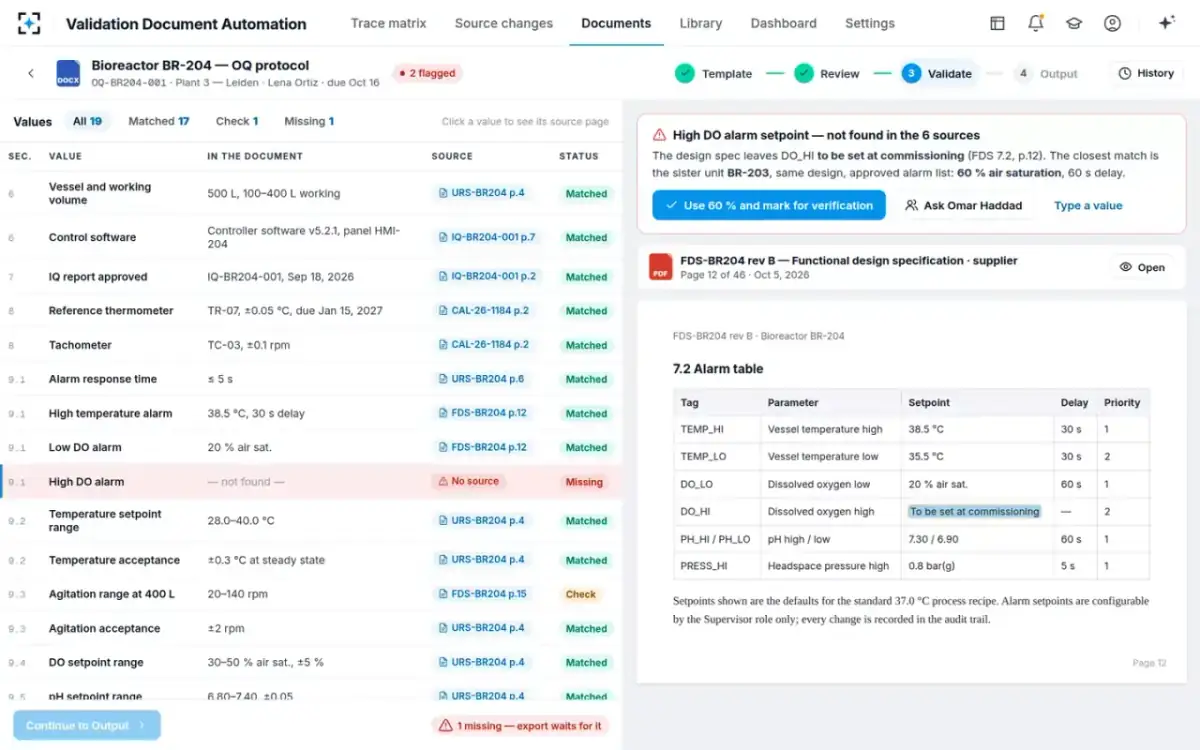
Nothing is exported while a value is unresolved
A control strategy you could put in front of an inspector
Since the drafting group's recorded position is that generative models might be allowed where a documented, robust, risk-based control strategy supports them, it is worth being concrete about what such a strategy contains for document drafting. The items below are our reading of the draft annex, Annex 11 and the EMA reflection paper, not a regulatory checklist.
What to be able to show, if a model drafts a GMP document
- The classification, with its reasoning
Why this application has no direct impact on patient safety, product quality or data integrity — and what would change that.
- The intended use, in detail
What the model is asked to do, on what inputs, with its limitations and the failure modes named. The draft asks for this to be approved before acceptance testing, by a process subject matter expert.
- The named person and their responsibility
Who accepts, what they are responsible for judging, and the qualification and training that makes them able to. Where the testing effort was reduced because of them, the draft asks for their performance to be monitored.
- The procedure for review
What the reviewer checks on every output, not on a sample — for a protocol, each value against its cited source page, and each locked section against the approved template.
- The limits that hold without the person
What the software will not do whatever anyone clicks: no value without a source page, no superseded revision as a source, no edit to an approved document, no flag cleared by a model, no export while a value is missing.
- The records
Who accepted what, when, and what they were shown — every agent step, redraft, decision and signature, with its meaning.
- The accuracy check on critical data
Annex 11 already requires an additional check on critical data entered manually, by a second operator or by validated electronic means. Decide which one applies to a value a model extracted, and say so.
- What happens when the model is wrong
How an error is detected, who it is reported to, and how the document in flight and any document already approved are handled.
How Validation Document Automation keeps a protocol on the right side of the line
0
values written into a draft without the document and page they came from
0
flags an agent can clear — only the author can
3
named people sign one protocol: author, reviewer, and quality approving it for execution
Held
export waits while any value is still missing or disputed
The record of who accepted, who reviewed and who approved
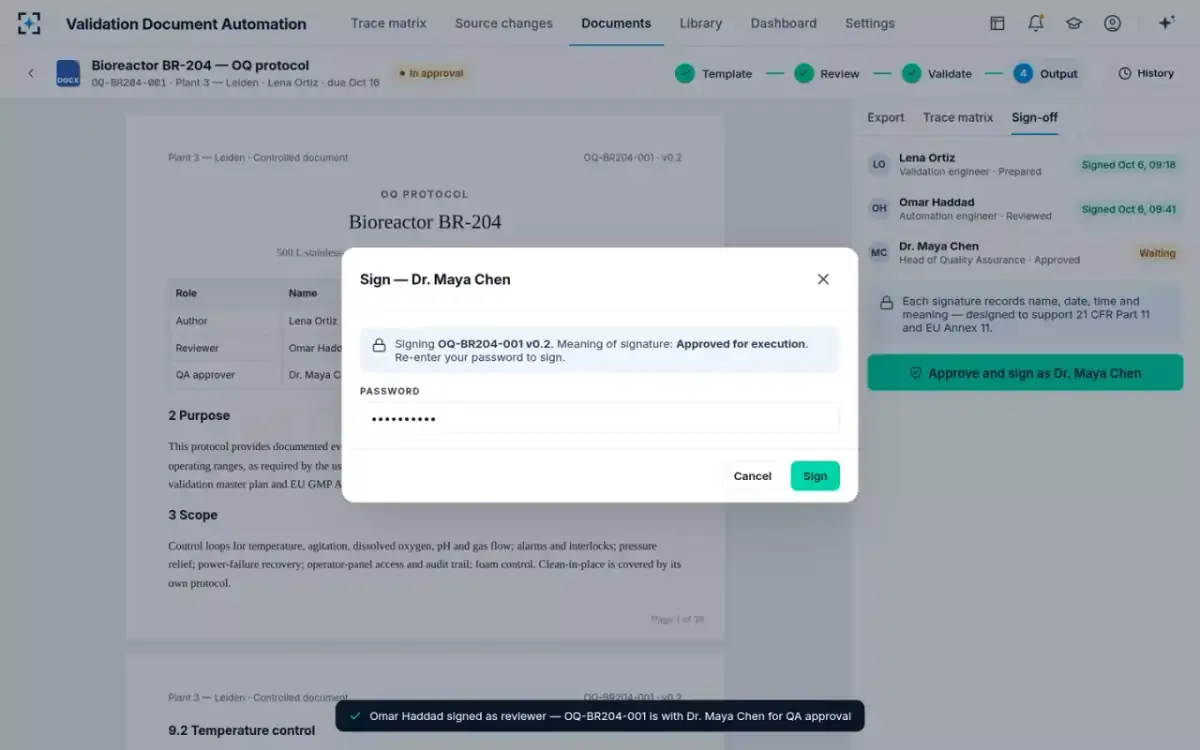
To see a drafted protocol with every value beside its source page, and the three signatures that turn it into a document, start from Validation Document Automation.
Questions people ask
When does Annex 22 come into force?
No date has been set. The text was published for consultation on 7 July 2025 with a deadline of 7 October 2025, and the European Medicines Agency held a multistakeholder workshop with AI experts on 30 June 2026 to work through the comments on scope. The current EudraLex Volume 4 index still lists Annex 11 in its January 2011 revision and carries no Annex 22, so anyone quoting Annex 22 today is quoting a draft.
Can you use ChatGPT in a GMP environment?
Not in a critical GMP application, on the draft's terms: generative models and large language models "should not be used in critical GMP applications". In a non-critical one the draft does not forbid them, provided qualified, trained personnel are always responsible for ensuring the outputs are suitable for the intended use. A general-purpose chat tool used ad hoc also has to clear the ordinary Annex 11 obligations — what happens to the data, what is recorded, how the output is checked — which is usually where that conversation actually ends.
What is a critical GMP application?
One with direct impact on patient safety, product quality or data integrity. The draft gives that definition and deliberately gives no list, because the same software can be critical in one use and not in another. The practical classification is a site decision that has to be written down with its reasoning: what happens if the model is wrong and nobody notices, and what stands between that error and the consequence.
Does Annex 11 apply to AI systems?
Yes, and it applies now. Annex 22 describes itself as providing additional guidance to Annex 11 for computerised systems in which AI models are embedded, which means every Annex 11 obligation stands: risk management across the life cycle, user requirements, accuracy checks on critical data, audit trails, periodic evaluation, change control. A site cannot treat an AI feature as unregulated because no AI annex has been adopted.
Does the draft allow a model to approve a document?
Nothing in it suggests so, and the structure argues against it. Where a model gives an input to a decision made by a human operator, the draft asks for the operator's responsibility to be described and for records to be kept of the review — a model that approved its own output would remove both the operator and the record. In GMP generally, approval is an act by a named person with a recorded meaning, which is not something a model is in a position to do.
What should we ask a supplier who says their product is ready for Annex 22?
For the control strategy, in writing, and for the limits that hold without a person. Ask how the application is classified and why; what the model is and whether it is static and deterministic; what the product will not do whatever a user clicks; what every output carries that lets a reviewer check it; and what is recorded about who accepted what. A claim of compliance with a draft is not an answer — nothing can be compliant with a text that has not been adopted.