Paperless validation software promises to take the binders out of equipment qualification, and much of the market sells it as a filing change: documents in a system instead of a cabinet, signatures on screen instead of in ink. That is the least interesting part of it. The expensive thing paper does to a validation file is not storage — it is that paper cannot hold a link. It cannot bind a setpoint in a protocol to the page of the design specification it was copied from, and it cannot keep a requirements traceability matrix in step with the protocol it sits beside. Botminds' Validation Document Automation is built around those two links: it drafts IQ, OQ and PQ protocols from the current approved sources, cites each value to its document and page, and keeps the requirement-to-test trace as an appendix inside the approved protocol. Everything else paper did, the regulators still require, and the MHRA says so in one sentence.
This page is written for a validation lead or head of quality running a paper or hybrid process with a budget to defend. The time and cost figures from the product are estimates and demonstration figures from sample data, tagged where they appear; the regulatory requirements are quoted from the regulators' own texts and linked.
"Organisations should be aware that reverting from automated or computerised systems to paper-based manual systems or vice-versa will not in itself remove the need for appropriate data integrity controls."
MHRA, 'GXP' Data Integrity Guidance and Definitions, revision 1, section 3.7
What does paperless validation actually mean?
It means that the authoritative copy of each qualification document — the protocol, its trace matrix, its executed results, its report — is an electronic record, and that the controls over those records are built into the system holding them rather than into a routing of paper between desks. Printing does not stop. What stops is the printout being the thing that matters.
That distinction is worth insisting on in a selection, because three quite different products are sold under the same phrase. The first is a document management system: it stores, versions and routes documents that somebody wrote in Word. The second is an execution system: it turns an approved protocol into an electronic form that a technician completes on the floor, capturing results and deviations as they happen. The third drafts the content — reading the requirements, the design specification, the drawings and the certificates, and writing the protocol from them. A site can buy all three, and most large sites have the first already. Only the third changes how long a protocol takes to write.
The four things paper costs you that software can fix
Not four things paper does badly — four things paper cannot do at all, because it has no way to represent a link.
It cannot bind a value to its source. An OQ protocol is largely values copied out of other controlled documents: setpoints, ranges, tolerances, instrument tags, calibration dates. On paper, the only evidence that a value came from a particular page of a particular revision is that the author remembers putting it there. An electronic record can carry the document, the page and the passage behind every number, which is what makes the input check that 21 CFR 211.68(b) asks for something a reviewer can actually perform.
It cannot keep the trace matrix in step. In a paper or hybrid process the requirements traceability matrix lives in a spreadsheet beside the protocol, and it drifts the moment either one changes. Inside the approved document it cannot: it is approved, versioned and superseded with the protocol. How a validation traceability matrix is built takes that apart row by row.
It cannot tell you what a change touches. When a new revision of a requirement arrives, paper offers one method: read every open protocol again. An electronic record of what each section was drafted from lets the comparison run line by line, marking the tests the change affects and listing what still holds — the subject of which tests a changed source rewrites.
It cannot show you the file across sites. A validation lead with plants in two countries cannot see, from paper, which protocols are open, which are waiting on a value nobody can find, and which are drafted from a revision that has since moved on.
One OQ protocol by hand, before Validation Document Automation touches it
4days
to write one OQ protocol by hand, in the sample document log
demonstration figure
0.5days
of that spent only finding the current approved revision of every source
estimated
1.5days
copying setpoints, ranges, tags and calibration dates across by hand
estimated
11of 23
flags in the sample document log were values held in no source at all
demonstration figure
Half a working day per protocol spent establishing which revision of each source is current is the line that persuades finance, because it is pure loss. Nobody's judgement improves during it. It is also the easiest to verify in your own shop: ask three engineers how they last confirmed that the design specification they quoted was still the approved revision, and time the answer.
The controls going paperless does not remove
The MHRA's sentence at the top of this page is the whole of it: moving between paper and computerised systems does not, by itself, remove the need for data integrity controls. The controls change shape; they do not disappear, and a business case built on removing them is a business case that will be revised during an inspection.
Paper or hybrid against paperless, control by control
How the control works on paper: A signature and a date in ink on the front page, filed with the document.
How it has to work when the record is electronic: A signature carrying name, date, time and meaning, permanently linked to the version it was applied to, and visible in any printed copy.
How the control works on paper: An alteration signed and dated, with the original still readable underneath.
How it has to work when the record is electronic: A secure, computer-generated, time-stamped audit trail that does not obscure what was there before, available and reviewed.
How the control works on paper: A controlled distribution list, and a reconciliation of issued copies.
How it has to work when the record is electronic: Issue controlled by the system, superseded revisions kept for comparison but never usable as a source.
How the control works on paper: A reference in the text, and the author’s memory.
How it has to work when the record is electronic: The document, page and passage carried with the value, so a reviewer can open the source beside it.
How the control works on paper: Re-reading every open document.
How it has to work when the record is electronic: The new revision compared line by line with the one each document was drafted from, and every linked test marked.
How the control works on paper: Physical custody of the master copy.
How it has to work when the record is electronic: Authority checks in the system: 21 CFR 211.68(b) wants changes instituted only by authorised personnel.
How the control works on paper: A box, and a building that still exists.
How it has to work when the record is electronic: An archive checked for accessibility, readability and integrity, with migration validated so values and meanings are not altered.
One row deserves its own sentence, because it is the one sites discover late. Annex 11 section 4.8 requires that when data move to another format or system, validation includes checks that neither their value nor their meaning changed in the migration. A paperless programme is, by definition, a migration — of templates, of approved documents, sometimes of a decade or more of qualification history. That check is part of the project, and it is easy to leave out of the first budget.
Hybrid is a state, not a failure — but it has to be described
Almost every site that goes paperless passes through, or stays in, a hybrid state: authored and approved electronically, executed on paper. That is explicitly contemplated by the GMP guide. EudraLex Chapter 4 accepts that many instructions and records will exist in hybrid form, partly electronic and partly on paper, and asks that the relationships and control measures for master documents, official copies, data handling and records be stated for hybrid systems as well as for homogeneous ones.
The requirement is that the relationships be stated. The MHRA is more specific about what that means in practice: where hybrid systems are used, "it should be clearly documented what constitutes the whole data set and all records that are defined by the data set should be reviewed and retained", and where hybrid records are stored, references between the physical and the electronic records must be maintained so that full verification of events is possible throughout the retention period. In other words: say which parts are paper, say which are electronic, and keep the pointers between them working for as long as you keep the file.
The hybrid map a site owes its own procedures
The protocol itself
How it usually works todayAuthored and approved electronically, printed for execution on the floor.
What your procedures have to stateWhich copy is the master: the electronic one. The printout is an official copy, and how it is issued, numbered and reconciled has to be written down.
Executed results
How it usually works todayHandwritten into the printed tables by the person performing the test.
What your procedures have to stateThat the paper is the raw data for those results, how it is returned, and how it is bound back to the electronic protocol it came from.
Instrument printouts
How it usually works todayThermal tickets and chart traces attached to the executed protocol.
What your procedures have to stateHow a fading printout is preserved, and whether a verified copy is made and by whom.
Deviations
How it usually works todayRaised on paper during execution, resolved weeks later in the electronic system.
What your procedures have to stateWhere the open deviation lives while it is open, and how its resolution is linked back to the test that raised it.
Signatures
How it usually works todaySome electronic, some wet-ink on the printed signature page.
What your procedures have to stateWhich signature governs, and what stops the electronic record changing after the paper was signed.
The archive
How it usually works todayThe approved PDF in the document system, the executed paper in a room.
What your procedures have to stateThe references that let someone reconstruct the whole file from either end, for the whole retention period.
The signature row is the one the European regulator has now addressed directly. The draft revision of Annex 11, out for consultation in July 2025, says that where a wet-ink signature on paper is used to sign an electronic record, "measures should be implemented to provide a high degree of certainty that any change to the electronic record will invalidate the signature", and offers a method: print a hash of the electronic record on the signature page. That is workable. It is also a good reason to keep a document and its signatures in one medium, which who signs a qualification protocol follows through.
What the FDA now prefers as evidence
Something changed here recently enough that many validation procedures have not caught up. The FDA's Computer Software Assurance guidance, issued as final guidance in September 2025 and reissued on 3 February 2026 for the device quality management system regulation, states a preference for digital evidence over the screenshots and printouts that validation packages have been padded with for twenty years. Its words: "As a least-burdensome approach, FDA recommends incorporating the use of digital records, such as system logs, audit trails, and other data generated and maintained by the software, as opposed to paper documentation, screenshots, or duplicating results already digitally retained by the software" when establishing the record of an assurance activity.
Read that twice if your current OQ packages run to two hundred pages of screenshots. The guidance is addressed to production and quality management system software for medical device manufacturers rather than to drug equipment qualification, so it is not a rule for every reader of this page. But it is the clearest published statement that a wall of printed evidence is not what the agency is asking for, and it undercuts a common objection to going paperless — that an inspector will want to see the paper.
There is a limit on the other side, and it is in Annex 11. For records supporting batch release, "it should be possible to generate printouts indicating if any of the data has been changed since the original entry". Printing is not abolished; printing that cannot show whether the data moved is what has no value.
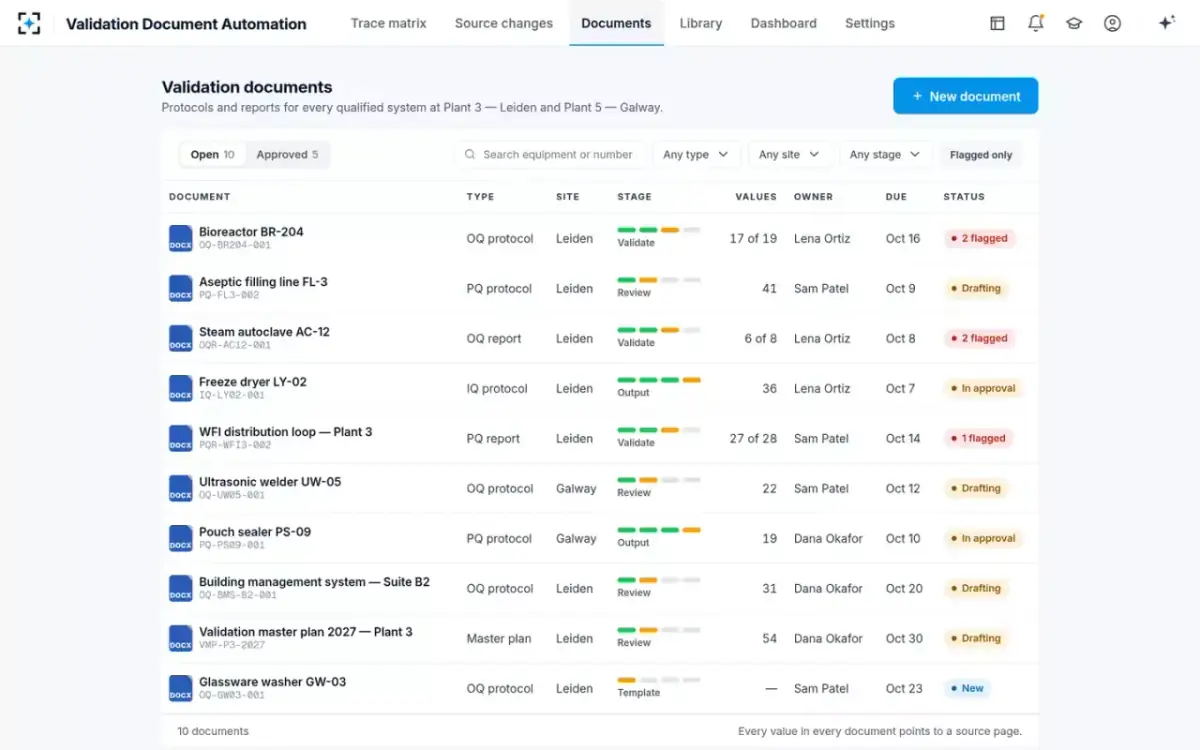
One list, two plants: every open document in Validation Document Automation
Execution and authoring are two different purchases
This is the distinction that can waste a selection. Electronic execution and electronic authoring solve different problems, cost different amounts, and fail in different ways. A site that buys execution because it wanted authoring ends up with a beautifully captured record of a protocol that still took four days to write.
Three purchases sold as one
| What it is | What it removes | What it does not touch | Who feels the difference |
|---|---|---|---|
| Document management | Cabinets, distribution lists, uncontrolled copies, and the question of which revision is current. | The writing. The protocol is still composed by hand in a word processor and uploaded. | Quality assurance and document control. |
| Electronic execution | Paper on the floor, transcription of results, illegible entries, and deviations that sit in a binder until someone types them up. | The authoring. It needs an approved protocol before it can do anything at all. | Technicians and the engineers supervising execution. |
| Authoring and traceability | The transcription of values between documents, the separate trace matrix, and the re-reading of every open protocol when a source changes. | Execution, and the judgement about what a test should prove. | Validation engineers, their reviewers and the quality unit. |
The pairing matters for sequencing too. Authoring pays back on every protocol a site writes from now on, including the ones feeding an execution system. Execution pays back per execution, which on a site qualifying a handful of units a year is a smaller number than the business case usually assumes. If you can only do one this year, count the protocols you will write and the protocols you will execute, and let the arithmetic choose — the method is set out in what validation documentation costs to write.
Does paperless validation reduce documentation?
Not the amount of it, and anyone selling that is selling a compliance problem. The documentation a qualification needs is set by risk and by the quality system, not by the medium: a protocol still has to define the critical systems, attributes and parameters and their acceptance criteria, and the validation documentation and reports still have to cover the relevant steps of the life cycle.
What falls is the effort of producing and maintaining it, and the places it can go wrong. The same test cases take less time to write when the values arrive with their sources attached; the trace matrix stops being a second document to maintain; and a requirement revision stops costing a re-read of everything. The page count may well go up, because the two trace appendices in the sample protocol are pages a hand-built file often does not contain at all.
What you still print, and why
Three categories, in most sites. The protocol issued for execution, where the floor works from paper — an official copy, numbered and reconciled. The signed approved copy for the archive, where a site's retention policy calls for one; in the solution that is a PDF/A file rather than paper, and the type is a setting. And anything a regulator, a notified body or a customer asks for in a form they can read without your system.
What stops being printed is evidence of things the system already holds: screenshots of configuration screens, printed audit trail extracts filed as proof that an audit trail exists, and duplicate copies of results the software retains. That is precisely the category the FDA's assurance guidance names as unnecessary duplication.
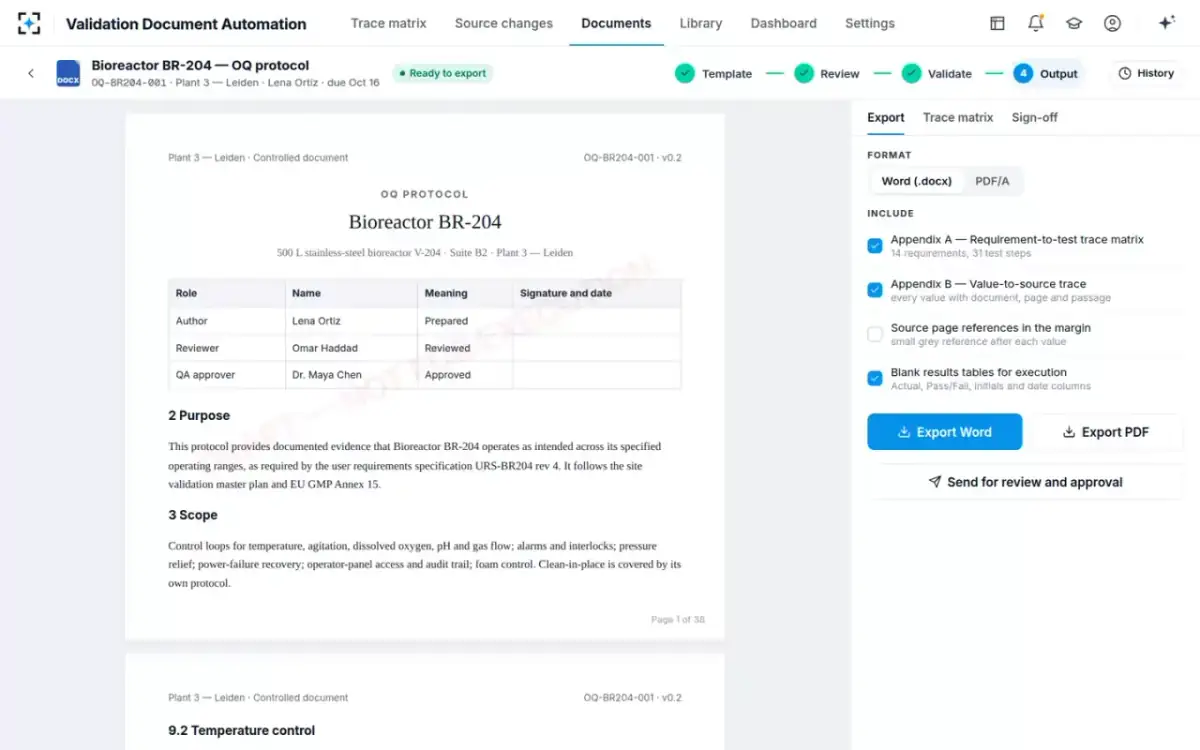
Export: the site's own controlled template, Word or PDF/A
Working with the document system you already have
Nobody replaces a validated document management system to buy an authoring tool, and no sensible authoring tool asks them to. The connection runs in two directions and both have to be specified before a contract is signed.
Inwards: the authoring system needs to know which revisions are current, and to be told when that changes. In this solution the integration takes in new revisions and closed change controls — which is what lets the change impact comparison run at all. If your document system cannot emit that, the authoring tool is working from a snapshot, and the whole argument about change collapses.
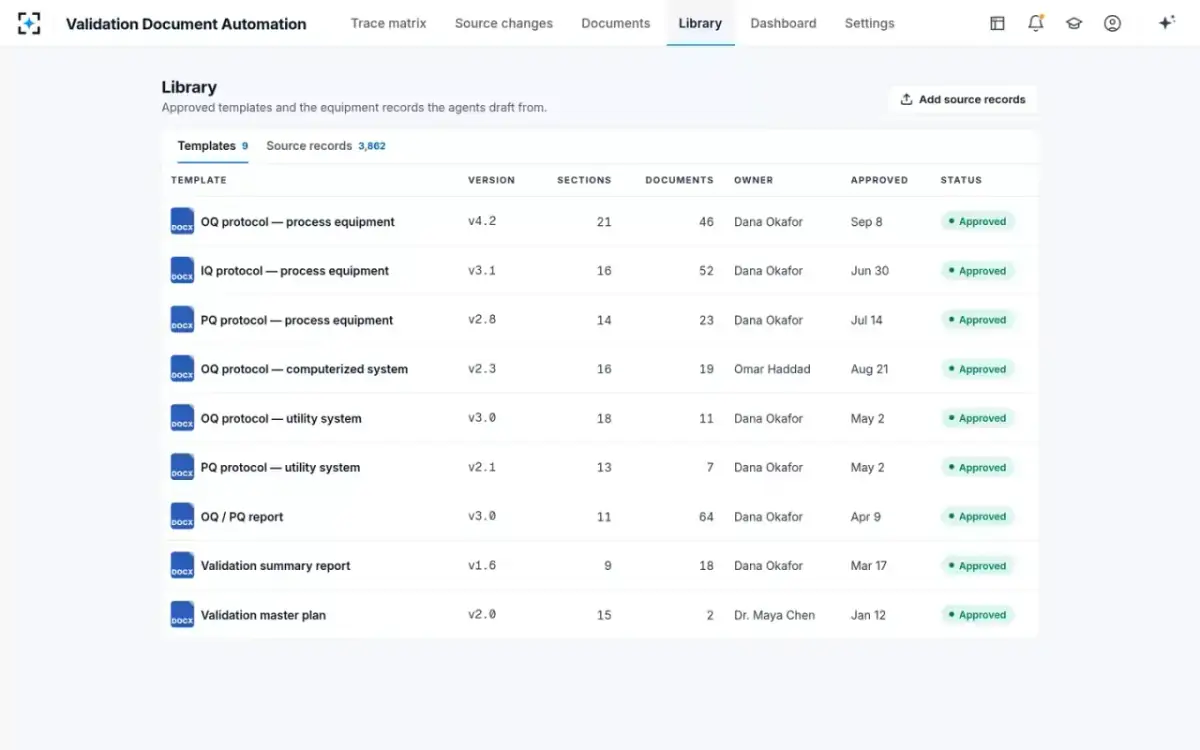
Outwards: the drafted protocol goes into the site's own Word template or a PDF/A file, and into the document system for review, approval and retention. The templates themselves stay owned by the person who owns them now. In the sample site, nine locked templates sit in the library with their version, sections, owner and approval date; authors tick the sections that apply and write instructions in plain English, and the wording changes only through change control.
The template library: locked wording, with its owner and approval date
What to insist on before signing a paperless validation contract
- A run on one of your own protocols, with your own template
Not a demonstration data set. Bring a user requirements specification, a design specification and the template you actually use, and watch the first draft appear.
- Open the source behind three values, at random
Document, page and passage. If the answer is a reference rather than the passage, a reviewer will still be opening PDFs by hand.
- Change a requirement during the demonstration
Then ask which test cases are affected, which are not, and what still holds. This is the capability that separates authoring from storage.
- Ask what happens when no source holds a value
The right answer is an empty field and a flag. A plausible number produced from a sister unit without a mark on it is the outcome to rule out.
- Make them show the signature on a printed page
Name, date and time, and meaning, in the PDF. Part 11 requires those three in any human-readable form of the record.
- Write the hybrid state into the contract
Which parts stay on paper during the transition, how the references between the two are maintained, and who writes the procedure that says so.
- Price the migration and its validation
Templates, open documents, and the history you intend to carry. Annex 11 requires checks that data are not altered in value or meaning when it moves.
- Agree what the exit looks like
If you stop paying, what do you still hold, and in what format? A qualification file has to outlive the contract that produced it.
Where this does not help
Being plain about this is part of the argument. Paperless authoring does not design a test, does not decide whether a requirement is critical, and cannot write a requirement nobody ever specified. It will not stop a finding: the published inspection data is about links and controls, and a system maintains those only as well as the people using it insist. It does not execute, so a site with a bottleneck on the floor rather than at the desk will see little of it. And where a value exists in no source at all — the alarm setpoint left to commissioning, in the sample protocol — the only thing software can honestly do is leave it empty and say so, which is what the agents in this solution do.
Whether the drafting itself is permissible under the coming European rules for AI in GMP manufacturing is a separate question, and a fair one to put to any vendor claiming it: what the draft Annex 22 allows, and what it does not sets out the text. To see the authoring, the trace and the export on one protocol, start from Validation Document Automation.
Questions people ask
What is paperless validation?
A qualification process in which the authoritative copy of each document — protocol, trace matrix, executed results, report — is an electronic record, with the controls over approval, change, access and retention built into the system holding it. Paper may still be printed for execution or for the archive, but the printout is an official copy rather than the master.
Can you run a hybrid paper and electronic validation process?
Yes, and the GMP guide expects it. EudraLex Chapter 4 recognises documents in hybrid forms and requires the relationships and control measures for master documents, official copies, data handling and records to be stated for hybrid as well as homogeneous systems. The MHRA adds that the whole data set must be clearly documented and the references between physical and electronic records maintained throughout the retention period.
Does the FDA prefer digital records over screenshots?
In its Computer Software Assurance guidance — final since September 2025, and reissued in February 2026 — yes: it recommends digital records such as system logs and audit trails as a least-burdensome approach, as opposed to paper documentation, screenshots or duplicating results the software already retains. That guidance addresses production and quality system software for devices, so treat it as the agency's thinking rather than a rule for drug equipment qualification.
What controls do you still need when you go paperless?
All of them, in a different shape. The MHRA states that moving between computerised and paper systems in either direction does not in itself remove the need for appropriate data integrity controls. Approval with a recorded meaning, an audit trail that does not obscure prior entries, control over who may change a record, control of the current revision, and an archive checked for accessibility and readability all survive the move.
Is paperless validation worth it on a small site?
It depends on which of the three purchases you mean. Electronic execution scales with the number of executions, which on a small site may be a handful a year. Authoring scales with the number of documents written and, more importantly, with the number of source changes that have to be traced into them — and that count is driven by how much your equipment and requirements move, not by how big the site is.
What do you still print in a paperless validation process?
The copy issued for execution where the floor works on paper, anything a regulator or customer asks for in a readable form, and the signed copy where a retention policy requires one on paper rather than as a PDF/A file. What stops being printed is duplicated evidence: screenshots of screens, extracts of audit trails filed to prove the trail exists, and copies of results the system already holds.