The difference between a URS and an FDS is the difference between a need and an answer to it. The user requirements specification is the regulated site's own document: what the equipment or system must do, in terms the site can test, with the GMP impact of each requirement considered. The functional design specification is the supplier's reply: how this particular machine, with this control system and these instruments, will deliver those functions. One says 150 rpm is required; the other says the drive reaches 140 rpm at the working volume. When they disagree, the protocol has to follow one of them, and which one is a decision somebody signs for — not a detail an author settles while typing. Botminds' Validation Document Automation reads both documents, extracts every value with the page it came from, and marks the rows where the two do not agree rather than picking a number.
The worked examples below use sample data: a fictional 500 L stainless-steel bioreactor, BR-204, its requirements document URS-BR204 and its supplier design spec FDS-BR204 rev B. The rules and quotations are real and linked where they appear.
URS against FDS, line by line
User requirements specification (URS): The regulated site's. Written by the user and process owner, with quality and validation input.
Functional design specification (FDS): The supplier's, for the machine it is selling, sometimes with the site's automation engineer.
User requirements specification (URS): Before selection and purchase. It is what the site buys against.
Functional design specification (FDS): After the order, against the design actually being built, and revised through the project.
User requirements specification (URS): What the equipment must do and to what limits: ranges, tolerances, alarms, data, access, cleaning.
Functional design specification (FDS): How the functions are implemented: instruments and tags, control loops, setpoint handling, screens, interlocks.
User requirements specification (URS): The site: process owner, engineering and quality. Not the supplier alone.
Functional design specification (FDS): The supplier, reviewed and accepted by the site — Annex 11 asks regulated users to check supplied documentation against their requirements.
User requirements specification (URS): Selection, design qualification, and as the reference point for the whole qualification life cycle.
Functional design specification (FDS): Build, factory acceptance testing, and the detail a test step needs: which tag, which screen, which limit the device can hold.
User requirements specification (URS): The left-hand column: the thing being proved.
Functional design specification (FDS): The link between requirement and design record: how the proof will be possible.
What is the difference between a URS and an FDS?
Annex 15 sets the frame in one sentence: "The specification for equipment, facilities, utilities or systems should be defined in a URS and/or a functional specification. The essential elements of quality need to be built in at this stage and any GMP risks mitigated to an acceptable level" (EudraLex Volume 4, Annex 15). The "and/or" is doing real work. A small, standard item can be specified once. A bioreactor with a control system, an alarm scheme and a batch record cannot, because the functions the site needs and the way a particular supplier implements them are different subjects with different authors.
The practical test for which document a statement belongs in is who would still care if the supplier changed. "The vessel shall control temperature between 30.0 and 40.0 °C to ±0.5 °C" survives a change of supplier; it is a requirement. "Temperature is controlled by PID loop TIC-204-01 reading from TT-204-01, with the setpoint entered on the Batch screen" does not; it is design. Teams that blur the two end up with a URS full of a particular supplier's tag numbers, which quietly makes the supplier the author of the site's requirements.
Annex 15 then ties the URS to everything downstream: "The URS should be a point of reference throughout the validation life cycle." That is why the disagreements matter. If the URS is the reference point, a protocol that tests something else has moved the reference without saying so.
Who writes the functional design specification, and when
The supplier writes it, after the order, against the design it is actually building — which is the root of most disagreements, because by then the requirement is months old and the machine is real. The site's job is not to write it but to review it. Annex 11 is explicit for bought-in systems: "Documentation supplied with commercial off-the-shelf products should be reviewed by regulated users to check that user requirements are fulfilled" (EudraLex Volume 4, Annex 11). The check is the site's, and it is a check against the site's own requirements, not an acceptance of the supplier's description.
That review has a name and a place in the sequence. Annex 15 puts it at design qualification: "The requirements of the user requirements specification should be verified during the design qualification." The World Health Organization's guideline says the same with the evidence attached: "DQ should provide documented evidence that the design specifications were met and are in accordance with the URS" (WHO Technical Report Series 1019, Annex 3). In accordance with — which means a disagreement found at design qualification is found at the right time, and a disagreement found during OQ execution is a late finding with a protocol already approved.
Where each document sits in one equipment qualification, drawn to scale
- URS approved8 wk
- Order6 wk
- FDS issued10 wk
- DQ3 wk
- Build14 wk
- FAT4 wk
- IQ3 wk
- OQ4 wk
Why the two documents disagree so often
Usually not through carelessness. Four structural reasons are worth knowing, and none of them is fixed by asking people to read more carefully.
Time. In the illustrative project above, six months separate the requirement from the design spec, and about a year separates the requirement from the test. The person who wrote "20 to 150 rpm" is not in the room when the supplier's engineer calculates shaft torque at the maximum working volume.
Different purposes. A URS states what is needed with margin, because it is a purchasing document as well as a quality one. A design spec states what the machine does at its limits, because it is an engineering document the supplier will be held to. The same number means something different in each.
Revisions that do not travel. The design spec is revised during the build, and each revision is reviewed against the thing it changed rather than against the whole requirements document. The sample unit's disagreement was born this way: FDS-BR204 rev A gave the agitator 150 rpm, and rev B limited it to 140 rpm at the 400 L working volume for shaft torque. The revision was correct engineering. Nobody read it back against URS-022.
Deferred values. Suppliers legitimately leave some settings to commissioning: alarm setpoints that depend on the installed instrument, tuning parameters, timings that depend on the utility. A deferred value is not a defect, but it leaves a requirement with no number to test against, and the protocol has to deal with it before execution.
The four kinds of disagreement, with a worked example of each
Put the two documents beside each other value by value and the disagreements fall into four shapes. They are worth naming separately because each needs a different person to do a different thing, and because only the first looks like a disagreement at all — the other three are silences, and silences are what protocols get wrong.
The four shapes a disagreement takes, and the right move for each
Number against number
Both documents answer the same question and give different answers.
On the sample unit
URS-022 asks for agitation from 20 to 150 rpm at ±2 rpm. FDS 6.3, page 15, limits the drive to 140 rpm at the 400 L working volume because of the shaft torque limit.
The move
The test is written to the limit the equipment can actually reach, and the row stays marked until the author either accepts 140 rpm in writing or raises a change to the requirement. Never average the two, and never test the easier number silently.
Requirement with no design
The URS asks for something the design spec is silent about.
On the sample unit
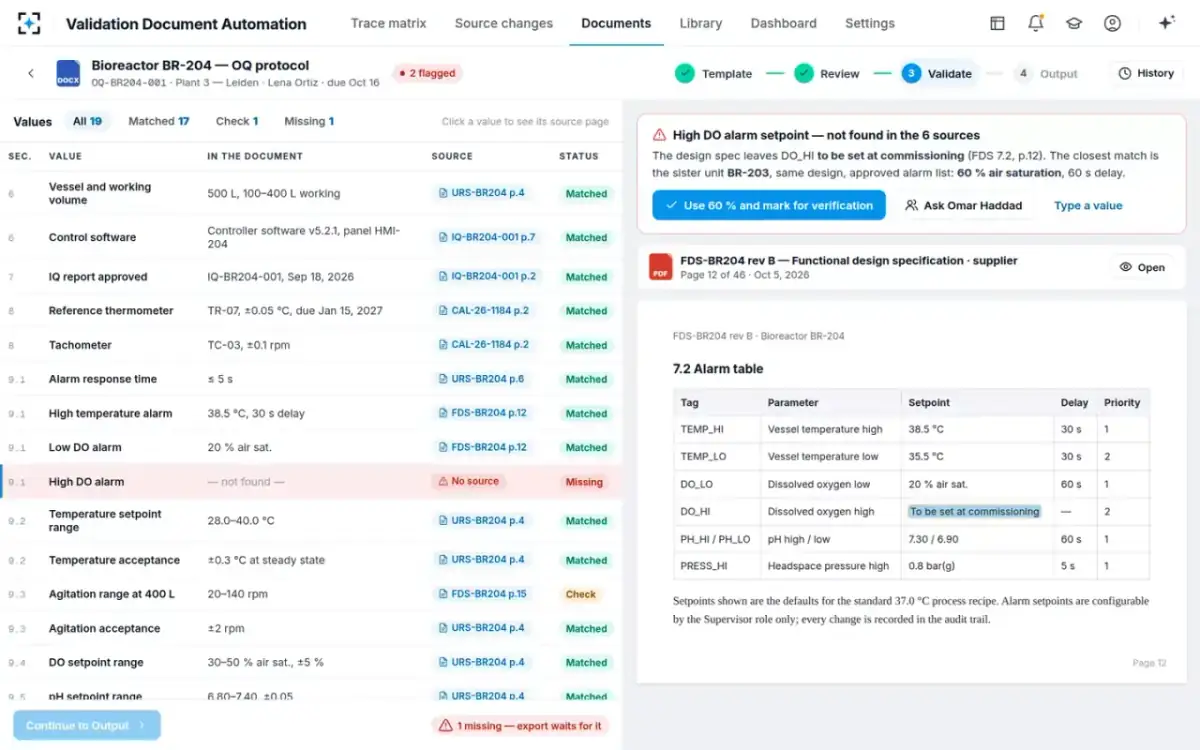
URS-031 asks for critical alarms to be shown within 5 s. FDS 7.2 on page 12 points at alarm list HMI-204, whose high dissolved-oxygen row reads "to be set at commissioning".
The move
A gap, not a disagreement. Either the supplier confirms the behaviour in a specification revision, or the value is commissioned and recorded with the person who set it, marked for verification before the test runs.
Design with no requirement
The machine has a function nobody asked for.
On the sample unit
FDS 5.4 specifies antifoam dosing, with pump P-204-05 and foam probe LS-204-07 in the instrument list. No user requirement mentions foam control.
The move
Decide and record: add the requirement if the site will rely on it, or state that the function is present and deliberately not qualified. Testing it with no requirement behind it produces evidence of nothing.
Value deferred to commissioning
The design spec answers the requirement with a promise instead of a number.
On the sample unit
The same alarm table leaves the high dissolved-oxygen setpoint open; the sister unit BR-203 runs its own at 60% air saturation.
The move
A sister unit is a suggestion, not a source. The number is set, recorded with whose decision it was and why, and verified on the panel before the test that depends on it is executed.
Does the URS or the FDS set the acceptance criteria?
The requirement sets what must be proved; the design spec and the instrument list decide what can be measured and to what resolution. An acceptance criterion that ignores either is not usable.
Take the sample unit's temperature requirement. URS-021 asks for 30.0 to 40.0 °C at ±0.5 °C. FDS 6.2 gives the controller a range of 25.0 to 45.0 °C at ±0.2 °C, and the reference thermometer TR-07 is calibrated to ±0.05 °C. The acceptance criterion comes from the requirement — ±0.5 °C — and the design spec is what tells you the test is possible, because a controller holding ±0.2 °C can demonstrate ±0.5 °C and a reference ten times better than the tolerance can measure it. Had the controller specified ±0.6 °C, the requirement could not have been met, and that is a design qualification finding, not an OQ one.
The FDA's software validation guidance states the discipline that makes this work at all: requirements must be "expressed in terms that are measurable or objectively verifiable" (FDA, General Principles of Software Validation). A requirement written as "shall provide adequate temperature control" cannot generate an acceptance criterion, so the author silently takes one from the design spec, and the site has let the supplier write its quality standard.
The sample unit's one number-against-number disagreement
150rpm
asked for in URS-022, from 20 rpm, at ±2 rpm
140rpm
the drive limit in FDS 6.3 page 15 at the 400 L working volume, set by shaft torque
140.4rpm
measured at the factory acceptance test, at the equipment limit
1
decision the author owes before the protocol can be approved for execution
What if the URS and the design spec disagree during execution?
Then the rule is strict and the practice is often loose. Annex 15: "Any significant changes to the approved protocol during execution, e.g. acceptance criteria, operating parameters etc., should be documented as a deviation and be scientifically justified" (EudraLex Volume 4, Annex 15). Acceptance criteria is the first example the annex reaches for, because that is the change people are most tempted to make at the bench.
The loose practice is to run the test at the number the machine can hold, mark the step pass, and write the discrepancy into the report's discussion. That is not a deviation record, it is a narrative, and it leaves an executed protocol whose acceptance criterion is not the one that was approved. The disciplined sequence is short: stop the step, raise the deviation, get the justification approved by the people who approved the protocol, then execute. If the right answer is to change the requirement rather than the test, that is a change to the URS under change control, and the protocol follows it.
The cheaper version of all of this is to find the disagreement before approval, which is the whole argument for extracting both documents' values and comparing them mechanically. The traceability matrix is where the comparison shows up as a row.
Two approved documents, two numbers, side by side
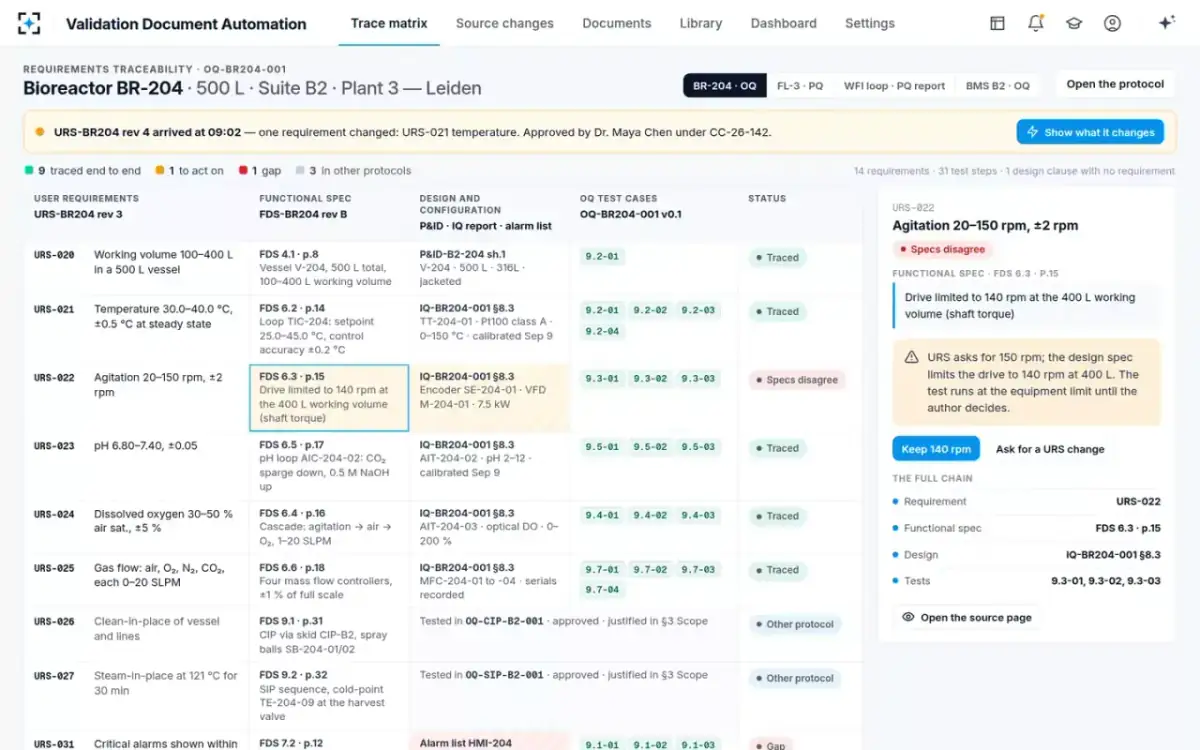
Marked, not resolved — the test runs at the equipment limit until the author decides
The design clause with no requirement
The disagreement that gets the least attention is the one where the URS is silent. On the sample unit it is antifoam dosing: FDS 5.4 specifies the function, the instrument list carries pump P-204-05 and foam probe LS-204-07, and the requirements document never mentions foam control. The machine will have it; the question is whether the site's quality system does.
Three endings are defensible and one is not. Add the requirement, and test it — correct if the process relies on antifoam. Record the function as present and deliberately outside the qualification scope, with the reason — correct if it will be locked out or unused. Have the supplier remove or disable it — correct if it must not be available. What is not defensible is writing a test for it anyway: a test case with no requirement behind it proves that a function works, not that anything the site needs is satisfied, and the 2025 draft revision of Annex 11 would treat such a case as not meeting the requirements of qualification at all.
This one is easy to miss because it is invisible from the requirement side. Reading down the URS and ticking off design clauses will never surface it; only reading the design spec back against the requirements will. That is a mechanical comparison, and it is exactly the kind of work that gets dropped when a protocol is due.
The value the design spec never gives you
A deferred value is the quietest of the four shapes, because the design spec looks complete. The alarm list HMI-204 on the sample unit carries every alarm, every priority and every annunciation route; page 12 of the design spec leaves the high dissolved-oxygen setpoint to be set at commissioning. Of the seven test cases traced to URS-031, six can state an expected result and 9.1-04 has a method, a tag and none.
Three things make the resolution safe. First, the missing value stays visibly missing: no agent fills it, no draft invents a plausible number, and export waits while it is empty. Second, a number taken from a sister unit is recorded as a suggestion with its origin — BR-203's 60% air saturation is evidence about another machine, not a source for this one. Third, the number is verified on the panel by the reviewer before the test that depends on it is executed, and that verification is recorded.
Across the sample site’s documents, eleven of twenty-three flags were values no source held, and most were alarm setpoints left to commissioning. That proportion is sample data, not a benchmark, but it is a strong argument for drafting from indexed sources: a draft that silently fills eleven plausible values is far more dangerous than one that stops eleven times.
Every value beside the page it came from, and the one with no page
Can you change a URS after the equipment is ordered?
Yes, and sometimes it is the only honest answer. A requirement that the equipment provably cannot meet, and that the site does not actually need, is better changed than quietly tested at a different number. What makes it legitimate is the route: a change under the site's change control, assessed, approved by the people who approved the requirement, and traced into everything built on it.
That last clause is where the work is. A changed requirement moves the matrix header, may change acceptance criteria in an approved protocol, and can touch documents nobody remembers linking to it. The 2025 Annex 11 draft puts the obligation plainly: requirements "should be updated and maintained throughout the lifecycle of a system to ensure that they continue to give a complete and accurate description of system functionality as the system undergoes subsequent changes and customisations". A URS that still describes the machine you hoped to buy is not a reference point. What a changed source rewrites follows one such revision through to the test cases.
What happens between finding a disagreement and executing the test
Agent
Consistency checkerCompares every extracted value with every other source that mentions it, and marks the row with both passages as written.
Never: Never clears a flag
A person decides
Author decidesThe validation engineer keeps the equipment limit with a recorded reason, or raises a change to the requirement.
Never: Never an average of the two numbers
A person decides
Change control or deviationA change to the requirement goes through the site's change control; a change at the bench during execution is a documented, justified deviation.
Never: Never a note in the report's discussion instead
Agent
Section writerRedrafts the affected test cases to the agreed criterion, citing the document and page the new number came from.
Never: Never changes locked template wording
A person decides
Reviewer and quality approverThe automation engineer checks the test content against the equipment; quality approves the protocol for execution.
Never: Never approved with the row still marked
To see both passages side by side on one requirement, with the decision still open, start from Validation Document Automation.
Questions people ask
Can the supplier write our URS?
A supplier can draft text, and the site cannot delegate the document. Annex 11 asks regulated users to review supplied documentation to check that user requirements are fulfilled, which presumes the requirements are the user's own; Annex 15 requires the essential elements of quality to be built in at the specification stage and the GMP risks mitigated there. A URS assembled from the supplier's brochure will agree with the design spec perfectly, and will not describe what the site needs.
What is design qualification for?
To verify, on paper and before anything is built or shipped, that the proposed design meets the requirements. Annex 15 states that the requirements of the URS should be verified during design qualification, and the WHO guideline asks for documented evidence that the design specifications were met and are in accordance with the URS. In practice it is the cheapest place to find all four kinds of disagreement, because nothing has been manufactured yet.
What do you do with a design feature that has no requirement?
Decide, and write the decision down. Either add the requirement, because the site will rely on the function, or record that the function is present and deliberately not qualified, with the reason and the approval. Writing a test for it without a requirement behind it adds pages to the protocol and proves nothing the site asked for.
Which document do you quote in the acceptance criterion?
The requirement, with its identifier and revision — the criterion is what the site needs proved. The design spec and the instrument list belong in the method and the trace: they say which tag is read, which screen the setpoint is entered on, and which reference instrument is used, and they are what tells you the criterion can be measured at all. A protocol that cites only the design spec has moved the reference point.
How do you find disagreements before a protocol is approved?
By comparing the documents value by value rather than reading them in sequence. Every setpoint, range, tolerance, tag and calibration date in each source is extracted with its page, and anything mentioned in more than one source is compared: missing, disagreeing, out of range or in the wrong unit. On the sample bioreactor that comparison produced one disagreement and one missing value out of nineteen extracted values, both before approval rather than at the bench.
Is an FDS the same as a functional specification or an FRS?
Close enough that the labels are not worth arguing about, and different enough to be worth checking on any given project. Sites use functional specification, FS, FDS and functional requirements specification for documents that sit between the user requirement and the detailed design, and some split them into a functional specification and a separate detailed design specification. What matters for qualification is that each requirement has an identified document and clause that answers it, and that the document saying what was actually built and set is identified too.