Validation lifecycle management software is sold to sites that are drowning in qualification paperwork, and much of it manages the lifecycle of documents that somebody still writes by hand. That is a real product and it solves a real problem — version control, routing, approval, retention — but it is a different problem from the one most validation teams actually have, which is that writing an IQ, OQ or PQ protocol means copying hundreds of values out of other controlled documents and then keeping the result in step as those documents change. Botminds' Validation Document Automation sits at that end: it drafts protocols from the current approved sources, cites every value to its document and page, keeps the requirement-to-test trace inside the approved protocol, and marks the tests a new revision touches. The twelve questions below are how to tell which end of the problem a given system is built for.
They are written for the person running the selection — a head of validation, a quality director or a computerised-system validation lead — and for the finance reviewer who will ask what is different about this one. Regulatory requirements are quoted from the regulators' own texts; the product figures used as illustrations are sample data from the solution's demonstration site, and are tagged where they appear.
What does validation lifecycle management software actually do?
In this category, four capabilities are sold under one name, and a system may have any combination of them.
It manages documents. Templates, versions, approvals, distribution, retention. Most sites already own something that does this, often the same system that holds standard operating procedures.
It plans and reports. A validation master plan, an inventory of systems and equipment with their qualification status, periodic review dates, a dashboard for the quality council. Useful for a validation lead; invisible to the engineer writing a protocol.
It executes. An approved protocol turned into an electronic form a technician completes on the floor, capturing results, deviations and signatures as the work happens.
It writes. Reading the user requirements, the design specification, the drawings and the certificates, and drafting the protocol's sections and expected results from them, with every value traceable to its source.
The fourth is the one this guide is mostly about, and it is the one the European regulator has started to point at. The draft revision of Annex 11, published for consultation on 7 July 2025, deals with traceability between requirements, design and test cases, and ends the clause with a sentence that reads like procurement advice: "The use of effective tools to capture and hold requirements and facilitate the traceability is encouraged." A consultation draft is not law. It is, however, a regulator saying out loud that doing this by hand is not the only option on the table.
A document store against a system that drafts, when one requirement changes
A validation document management system: A new revision of the requirements is checked in and the old one superseded.
A system that drafts and traces, such as Validation Document Automation: The same, and the new revision is compared line by line with the revision each open document was drafted from.
A validation document management system: A person reads the affected protocols again, section by section.
A system that drafts and traces, such as Validation Document Automation: Every test case linked to the changed requirement is marked, and the ones not affected are left alone and said to be.
A validation document management system: Re-established by re-reading the design specification and the calibration records.
A system that drafts and traces, such as Validation Document Automation: Listed: the controller range still covers the new setpoint, the reference instrument is still accurate enough.
A validation document management system: Manual, in a word processor, then re-uploaded.
A system that drafts and traces, such as Validation Document Automation: Drafted in the locked template wording, citing the new page, with the old and new expected results side by side for the author to accept or reject.
A validation document management system: A separate spreadsheet, updated by whoever remembers.
A system that drafts and traces, such as Validation Document Automation: An appendix of the protocol, versioned and approved with it.
A validation document management system: Control of documents. The writing is unchanged.
A system that drafts and traces, such as Validation Document Automation: The writing changes; document control still has to come from somewhere.
Questions 1 to 3: where the content comes from
Question 1 — does it read your source documents itself, or does a person paste the content in? The honest answers divide the market. A system that produces a protocol from a template and a questionnaire is a form filler; the engineer still opens six PDFs. Ask to watch a protocol drafted from documents the vendor has never seen.
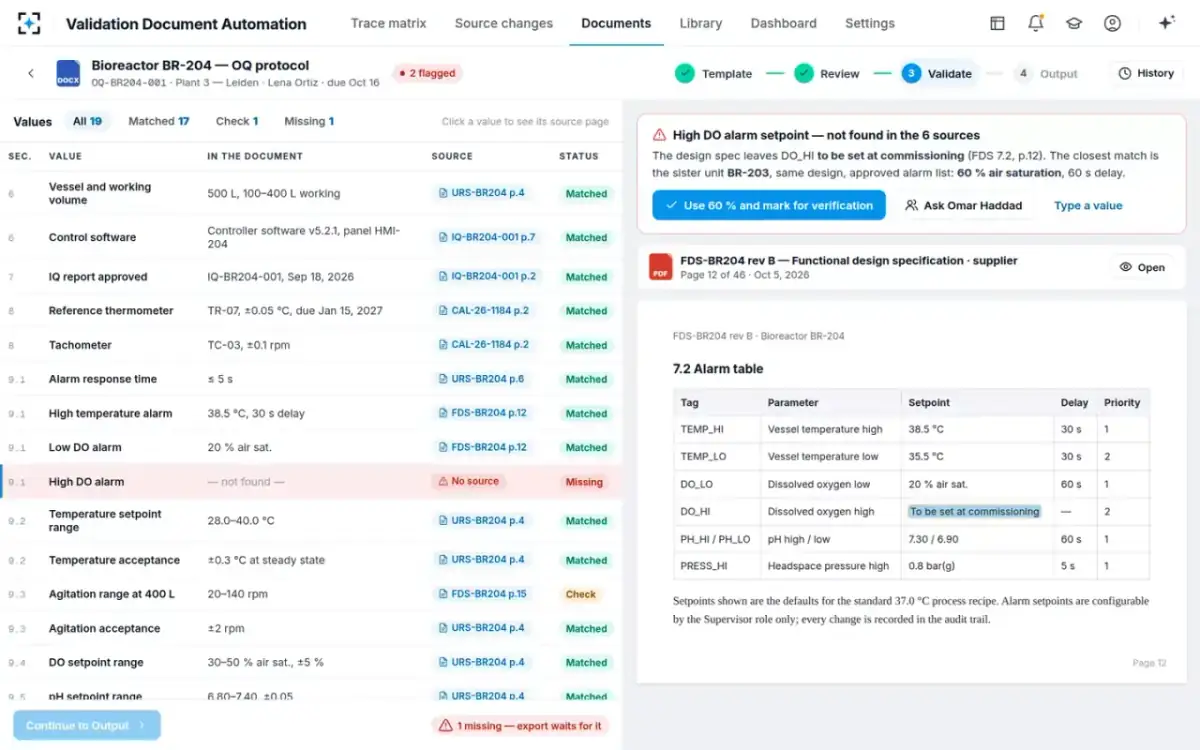
Question 2 — for any value on the page, can it show the document, the page and the passage? Not a reference in a footnote: the passage, opened beside the value. It is the most useful capability to test for, because it is what makes a technical review possible at the speed a review actually happens. In the sample protocol, nineteen values were extracted and listed with their source pages; seventeen matched, one disagreed with another source and one was held by no source at all.
Question 3 — what does it do when no source holds the value? There is exactly one acceptable answer, and it is that the field is left empty and flagged for a person. A system that produces a plausible number here — from a sister unit, from a typical value, from anywhere — has created the most dangerous kind of error in a qualification document: one that looks finished. In the sample protocol the high dissolved-oxygen alarm is exactly this case, because the design specification leaves it "to be set at commissioning"; the author takes 60% air saturation from the identically designed sister unit, marks it for verification on the panel, and the reason is recorded.
Every value beside the page it came from, in Validation Document Automation
Questions 4 to 6: what happens when a source changes
Question 4 — can it compare a new revision with the revision each document was drafted from? Not with the current one: with the one that particular protocol used. A site with four open protocols against three different revisions of a requirement needs three different comparisons, and a system that only knows "latest" cannot produce them.
Question 5 — does it mark the test cases the change touches, and leave the others alone? Precision in both directions matters. In the sample file a requirement's temperature range moves from 30.0–40.0 °C ±0.5 °C to 28.0–40.0 °C ±0.3 °C, and three of four linked test cases are marked while the fourth, the fill and setpoint step, is not. A system that marks everything linked to the document is a system whose marks will be ignored within a month.
Question 6 — does it tell you what still holds? This is the question nobody asks and everybody needs. After a change, the useful output is not only what broke but what survived: the controller's own range still covers the new setpoint; the reference thermometer at ±0.05 °C is still comfortably accurate against a ±0.3 °C tolerance. Without that, every change triggers a full re-read, which is the cost the software was bought to remove. When a source changes, which tests to rewrite works through one of these in full.
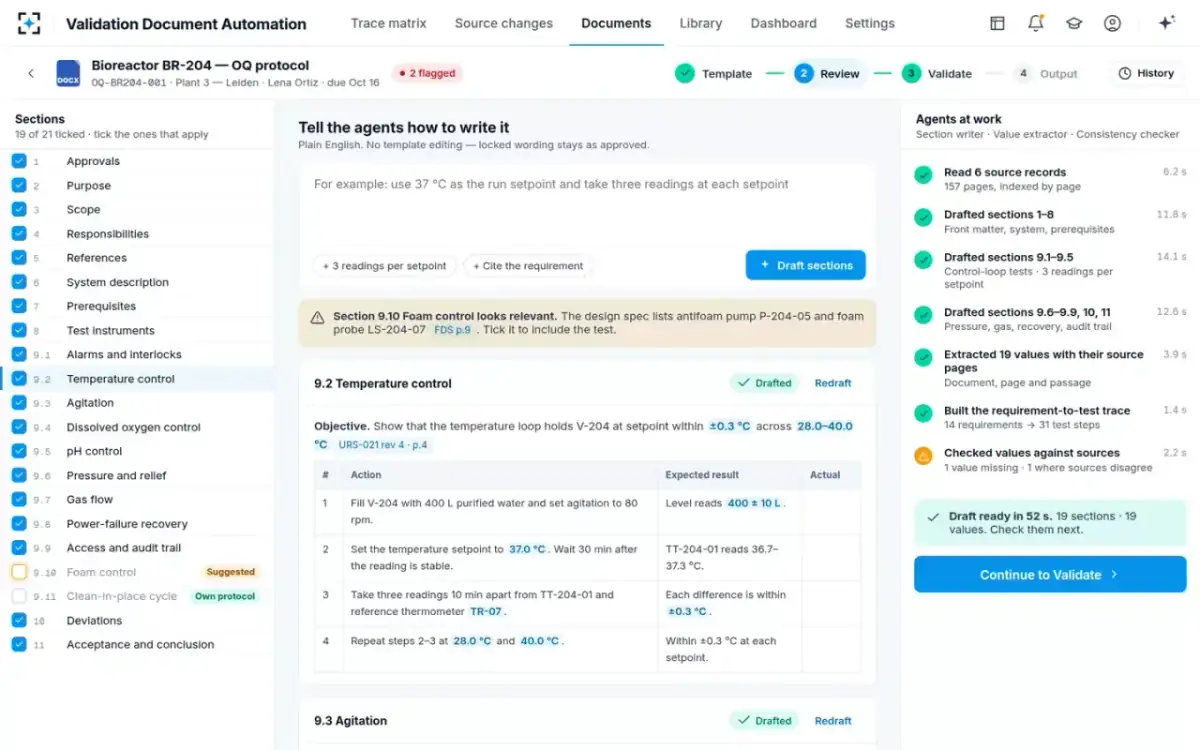
Sections ticked, instructions in plain English, and the run step by step
Questions 7 to 9: evidence, signatures and the audit trail
Question 7 — does each signature carry its meaning? Part 11 requires a signed electronic record to indicate the printed name, the date and time, and the meaning associated with the signature. Ask to see two signatures on one document with different meanings, printed on the same page. A system with one Approve button has three signatures that all say the same nothing; who signs a qualification protocol sets out why that matters.
Question 8 — does the audit trail hold the reason, not just the action? Part 11 calls for secure audit trails, generated by the computer and time-stamped, that independently log each operator entry or action creating, changing or deleting an electronic record, and Annex 11 asks that the reason be documented for a change or deletion of GMP-relevant data. For a qualification file the reasons are the valuable part: why a flag was cleared, why a value was taken from another unit, why a test was judged still valid after a change. Ask where that text is stored and whether it can be read without the vendor's help.
Question 9 — what happens to an approved document when its source changes? The answer you want is that the approved document is never edited in place: the change opens a new version under change control, and the old signatures stay with the old version. Ask the vendor to try to edit an approved document during the demonstration, and watch what the system does.
Questions 10 to 12: your templates, your approvers, your rules
Question 10 — can it write into your approved templates, without changing their wording? Site templates are controlled documents with an owner, a version and an approval date, and they exist because a quality system decided what a protocol says. A system that imposes its own template structure is asking the site to revalidate its documentation standard as part of a software purchase. In the sample site, nine locked templates sit in the library with their version, sections, owner and approval date, and the agents draft into them without touching the locked wording.
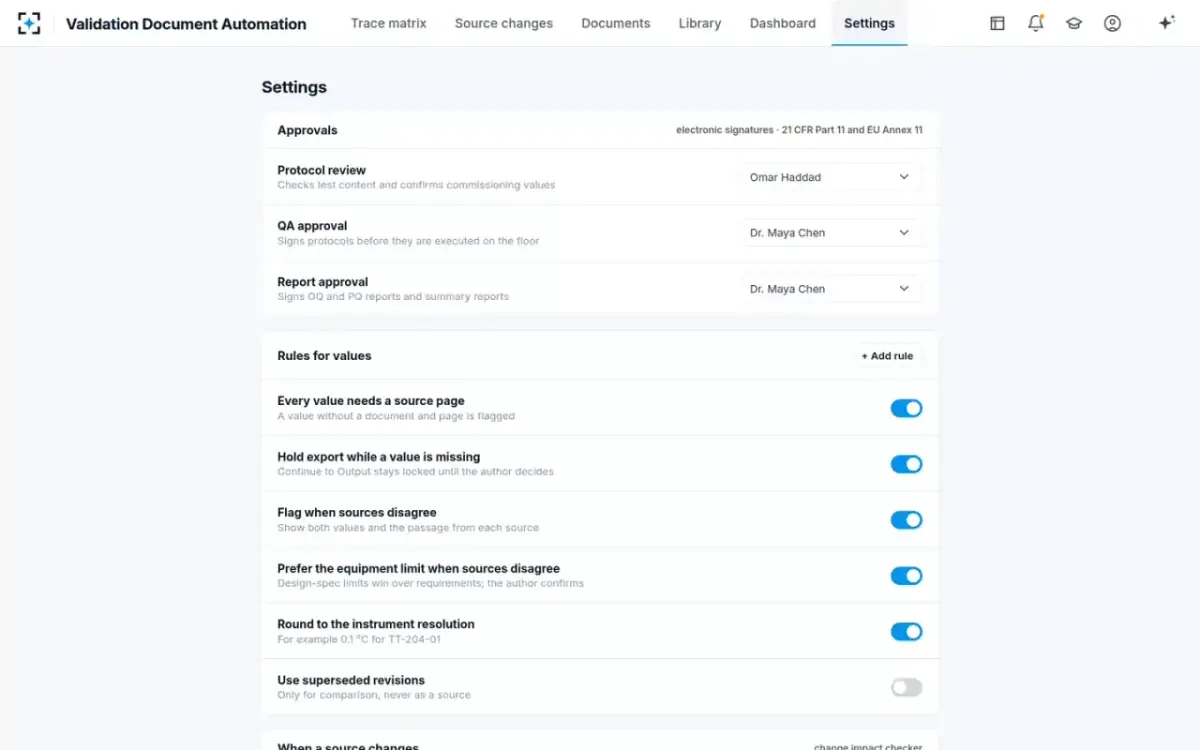
Question 11 — are the approvers people you name, or roles the software decided on? Your quality system names them. Protocol review and quality approval should be settings holding named members of your team, changeable without a support ticket.
Question 12 — are the rules settings, and can you see them? Whether export is held while a value is missing; whether the equipment limit is preferred when sources disagree, and whether the author must confirm it; whether superseded revisions can be used at all; what happens to approved documents when a source changes; who is told; what the signed copy is stored as. Each of those is a policy decision your quality system already has a view on, and each should be visible on one screen.
The rules as configuration: approvers, value rules, change behaviour, output
The twelve questions, and the answer that should worry you
- 1. Does it read my source documents itself?
Worrying answer: "you upload the content into our form." That is a template with a questionnaire attached.
- 2. Can it show the document, page and passage behind any value?
Worrying answer: a reference list at the end. A reviewer cannot check a reference list at the speed a review happens.
- 3. What happens when no source holds a value?
Worrying answer: anything other than "the field stays empty and is flagged." A plausible guess in a protocol is worse than a blank.
- 4. Can it compare a new revision with the one this document was drafted from?
Worrying answer: "it always uses the latest." Then it cannot tell you what changed for a document drafted three revisions ago.
- 5. Does it mark only the tests the change touches?
Worrying answer: every test linked to the document. Marks that are always wrong stop being read.
- 6. Does it list what still holds?
Worrying answer: silence. Without it, every change costs a full re-read and the saving disappears.
- 7. Does each signature record its meaning?
Worrying answer: one Approve button for author, reviewer and quality. Part 11 asks for the meaning, not the act.
- 8. Does the trail hold the reason as well as the action?
Worrying answer: a log of clicks. The reason is what a colleague needs a year later and what an inspector asks for.
- 9. What happens to an approved document when a source changes?
Worrying answer: it is edited. Approved documents open a new version; signatures stay with the version they signed.
- 10. Can it write into our approved templates unchanged?
Worrying answer: "our template is better." A documentation standard is a controlled document, not a preference.
- 11. Are approvers named people, or roles you decided on?
Worrying answer: a fixed hierarchy. Your quality system names the approvers; the software should hold what it says.
- 12. Are the rules settings I can see and change?
Worrying answer: "that is configurable, by us, as a project." A rule you cannot read is a rule you cannot defend.
A scoring sheet for three candidate systems
1
Reads the sources itself
2
Cites document, page and passage pass or fail
3
Leaves a missing value empty pass or fail
4
Compares revision against revision
5
Marks the tests a change touches
6
Says what still holds
7
Signature carries its meaning
8
Trail holds the reason, not just the act
9
Approved documents open a new version pass or fail
10
Your templates, wording untouched
11
Your approvers, as named people
12
Exports into your document system
What to ask about AI, specifically
Every system in this category now claims to use AI somewhere, and the claims range from a search box to a drafting engine. Three questions sort them out, and the European regulator has handed buyers the vocabulary for the third.
First: what exactly does the model produce, and what does a person still decide? "Drafts a section for the author to accept" is a different product from "answers questions about documents", which is different again from "classifies incoming documents". Get the sentence in writing.
Second: can it produce a value that no source contains? If the answer is anything but a flat no, stop. In this solution the rule is explicit in the agents' own limits: the value extractor never fills an unreadable value, the section writer leaves a missing value empty and flags it, and no agent clears a flag.
Third: what is the change control story for the model itself? The draft Annex 22 on artificial intelligence in GMP, published for consultation on the same day as the draft Annex 11, is blunt about this: "A tested model, the system it is implemented in, and the whole process it is automating or assisting should be put under change control before it is deployed in operation." It goes on to require that any change to the model, the system or the process — including changes to the physical objects the model uses as input — be documented and evaluated to decide whether the model needs retesting, with any decision not to retest fully justified. Ask a vendor how they will tell you when their model changes. What the draft Annex 22 allows, and what it does not works through the scope question in detail.
How do you validate the validation system itself?
The same way as any other computerised system used in a GMP activity, and Annex 11's Principle leaves no room to argue: "The application should be validated; IT infrastructure should be qualified." There is no exemption for software that happens to produce validation documents. Annex 11 also sets the shape of the evidence: "The validation documentation and reports should cover the relevant steps of the life cycle. Manufacturers should be able to justify their standards, protocols, acceptance criteria, procedures and records based on their risk assessment."
In practice, the risk-based argument for an authoring system is more comfortable than for an execution system, and it is worth making explicitly in your validation plan. The system drafts a document that a named author accepts, a named reviewer checks and the quality unit approves before any of it touches equipment. Three people stand between the software's output and a GMP decision. That is a lower-risk position than a system recording results from a sensor with nobody in the loop, and 21 CFR 11.10(a) describes what the validation has to establish either way: systems validated for accuracy, reliability and consistent intended performance, and able to tell when a record is invalid or has been altered.
The FDA's assurance thinking points the same way for the evidence. Its Computer Software Assurance guidance notes that "advances in digital technology may allow for manufacturers to leverage digital retention of results, automated traceability, automated testing, and electronic capture of work performed as objective evidence, reducing the need for manual or paper-based documentation". The guidance addresses production and quality system software for devices rather than drug equipment qualification, so treat it as the agency's direction of travel rather than a rule that binds you.
What a demonstration on your own protocol should show
Insist on your own documents. A vendor demonstration on a prepared data set tells you about the vendor's preparation. The sequence below takes about ninety minutes and can be run against any candidate in the category.
The demonstration to ask for, on your own protocol
A person decides
Bring your own documentsA user requirements specification, a supplier design specification, a drawing, a calibration certificate and the protocol template you actually use. Choose a piece of equipment whose requirements have changed at least once.
Never: Do not let the vendor pre-load them a week early.
Agent
Watch the first draft appearTick the sections that apply, give instructions in plain English, and time how long the draft takes and what it contains.
Never: Nothing should be written into locked template wording.
A person decides
Audit three values at randomPick three numbers in the draft and ask for the document, the page and the passage behind each. Open the source and read it.
Never: A reference without a passage does not count as an answer.
A person decides
Hand over the changed revisionGive them the newer revision of the requirements. Ask which test cases are affected, which are not, and what still holds.
Never: Do not accept a list of every test linked to the document.
A person decides
Export and read the resultTake the output into your own template, open it in Word, and read the trace appendices as a reviewer would.
Never: A demonstration that ends on screen has skipped the part your quality system will receive.
Four numbers to write down, with Validation Document Automation's own as the reference
52s
to a first draft of 19 sections, with 19 values extracted and checked against their sources
demonstration figure
8.4s
to redraft one section after a requirement revision, citing the new page
demonstration figure
3of 4
linked test cases marked by that change — the fourth left untouched
demonstration figure
40min
per protocol, from template to a checked draft — the author’s own checks included
design target
The limits, before you sign anything
A buyer who hears only the strong claims will be disappointed in the second quarter, so here are the limits plainly. It does not design a test or decide what a requirement means; it drafts from what the documents say, and where they say nothing it says nothing. It does not execute a protocol on the floor. It does not replace a document management system, and on most sites it feeds one. It cannot repair a requirements specification that was never written properly — a protocol drafted from a vague requirement is a vague protocol, produced faster. And it will not, by itself, prevent an inspection finding; the published citation data is about links and controls that people have to maintain, as what inspectors cite in validation documents sets out.
It also does not remove the need to qualify it. Budget the validation of the validation system, including the integration that brings new revisions in, and write the risk justification before the project starts rather than after someone asks for it.
The twelve questions reduce to one, and it is worth saying at the end as well as the beginning: can the system tell you where each value came from, what happens to the tests when that source changes, and who is allowed to clear a flag? Everything else in a selection is packaging. The honest way to find out is a run on your own user requirements, your own design specification and your own protocol template, which is exactly what we offer rather than a timeline — start from Validation Document Automation, or put the twelve questions to whoever else is on your list.
Questions people ask
What is validation lifecycle management software?
Software that manages the documents and activities of equipment and computerised-system qualification across their life: templates and versions, the validation master plan and inventory, protocol approval and retention, and in some products the execution of protocols or the drafting of their content. The four capabilities are sold under one name and rarely all present, so the first job in a selection is deciding which of them you are actually buying.
What should you ask a validation software vendor?
Whether it reads your source documents itself; whether it can show the document, page and passage behind any value; what it does when no source holds a value; whether it can compare a new revision against the revision each document was drafted from; whether it marks only the affected tests and says what still holds; whether signatures carry their meaning; whether the audit trail holds reasons; what happens to an approved document when a source changes; and whether templates, approvers and rules are yours.
How do you validate the validation system itself?
As a computerised system used in a GMP activity. Annex 11's Principle requires the application to be validated and the IT infrastructure to be qualified, and the validation documentation has to cover the relevant steps of the life cycle, with standards, protocols, acceptance criteria and records justified on a risk assessment. An authoring system whose output is accepted by an author, checked by a reviewer and approved by the quality unit before use carries lower risk than one acting unsupervised, and the plan should say so.
Can validation software use our own templates?
It should, and a system that cannot is asking you to change a controlled document to suit a purchase. Ask to see your own template loaded, the locked wording left untouched, and an author ticking sections and giving instructions without being able to edit the wording. Check who owns the template inside the system and how a change to it is controlled.
How does validation software handle a change to a requirement?
The useful behaviour is a line-by-line comparison against the revision each affected document was drafted from, a mark on every linked test case the change touches, an explicit list of what is unaffected and what still holds, and a redraft of the section that cites the new page — with a person accepting it and the approved document opening a new version rather than being edited.
What can validation software not do?
Design a test, decide which requirements are critical, invent a value no document holds, execute a protocol on the floor, or guarantee an inspection outcome. It can remove transcription, keep the links between documents current and show what a change affects — and those are the parts of a qualification file that break when the documents behind it change.