Validation documentation in pharmaceutical manufacturing is expensive in a way that rarely appears in a budget line, because it is paid in the working days of the engineers who write it. One operational qualification protocol for a piece of process equipment takes about four working days to produce by hand in the sample document log used in this solution, and only a small part of that is test design. The rest is transcription and reconciliation: establishing which revision of each source document is current, copying setpoints, ranges, tolerances, tags and calibration dates across into a locked template, rebuilding a traceability matrix in a spreadsheet, and chasing the values that are missing or that disagree. Botminds' Validation Document Automation attacks that part specifically — it drafts the protocol from the current approved sources with each value cited to its document and page, and keeps the requirement-to-test trace inside the approved document.
This page builds the cost model out loud, so a finance reviewer can change an assumption and watch the answer move. The wage comes from published United States government data; the error rates come from peer-reviewed and meta-analytic studies of data transcription in other settings, and are bracketed rather than borrowed; the per-protocol days are the solution's own sample data and are tagged as demonstration figures or estimates every time they appear.
The four numbers the model rests on
$102,440
median annual wage O*NET gives for validation engineers in the United States, reported for the broader industrial engineers group
O*NET OnLine, 2025 wage data
$394
direct wage cost of one engineer working day, at that median
our arithmetic: 8 hours at $49.25
3.7%
of manually entered point-of-care results differed from the interfaced result
JAMIA, 2019 — a different setting, used as an upper bracket
0.29%
pooled single-data-entry error rate across clinical research studies
systematic review and meta-analysis — lower bracket
What does one qualification protocol cost to write?
At the published median wage, four working days of a validation engineer is about $1,576 of direct labour — our arithmetic, wage only, with no employer taxes, benefits, equipment or floor space in it. A fully loaded rate is higher, and a site that knows its own loaded rate should use it. For a site writing forty protocols and reports a year, four days each, that is 160 working days: about three quarters of one engineer's year, spent largely on copying.
That number is almost never the number a business case is built on, because the days are already paid for. The cost shows up instead as a queue. Equipment waits for its protocol, the protocol waits for a reviewer, and a project waits for the qualification. If a plant's bottleneck is the validation desk, the real cost of four days per protocol is measured in commissioning dates, not in salary.
How long does it take to write an OQ protocol?
In the sample document log, four working days for one piece of process equipment — and the shape of those days matters more than their number.
Four days by hand, 0.6 with the agents: where one OQ protocol's time goes
- Finding the current approved revision of every source0.5 d
- Copying setpoints, ranges, tags and calibration dates1.5 d
- Writing test steps and expected results1.0 d
- Building and checking the trace matrix0.5 d
- Chasing missing and disagreeing values0.5 d
- The whole protocol, read, decided and checked0.6 d
Read the green block in the upper lane: that is test design, the part a regulator might argue with and the only part that needs a validation engineer's judgement. By hand it is one day in four. Everything to its left is transcription, and everything to its right is reconciliation. The lower lane does not shrink the judgement to nothing — within its 0.6 days, test design is estimated at 0.2, because the author is editing drafted test steps rather than writing them from a blank template, and another 0.2 stays for chasing, because some values genuinely have to be chased.
What does a validation engineer earn, and what is an hour of one worth?
O*NET, the United States Department of Labor's occupational database, lists Validation Engineers as occupation 17-2112.02 and describes the work in a sentence that happens to be exactly the subject of this page: "Design or plan protocols for equipment or processes to produce products meeting internal and external purity, safety, and quality requirements." Its task list is more specific still — "Prepare validation or performance qualification protocols for new or modified manufacturing processes, systems, or equipment for production of pharmaceuticals, electronics, or other products."
O*NET's 2025 wage data for the occupation — which it reports for the broader Industrial Engineers group that validation engineers belong to — gives a median annual wage of $102,440 and a median hourly wage of $49.25. Those are medians across every industry and seniority, so a senior computerised-system validation lead at a sterile site may cost more, and the figures are United States data. Use them as a published anchor, then substitute your own.
One OQ protocol, step by step, in direct wage cost
Where the working days go, step by step
Three of the five lines above are worth a sentence each, because they are the ones a finance reviewer will challenge.
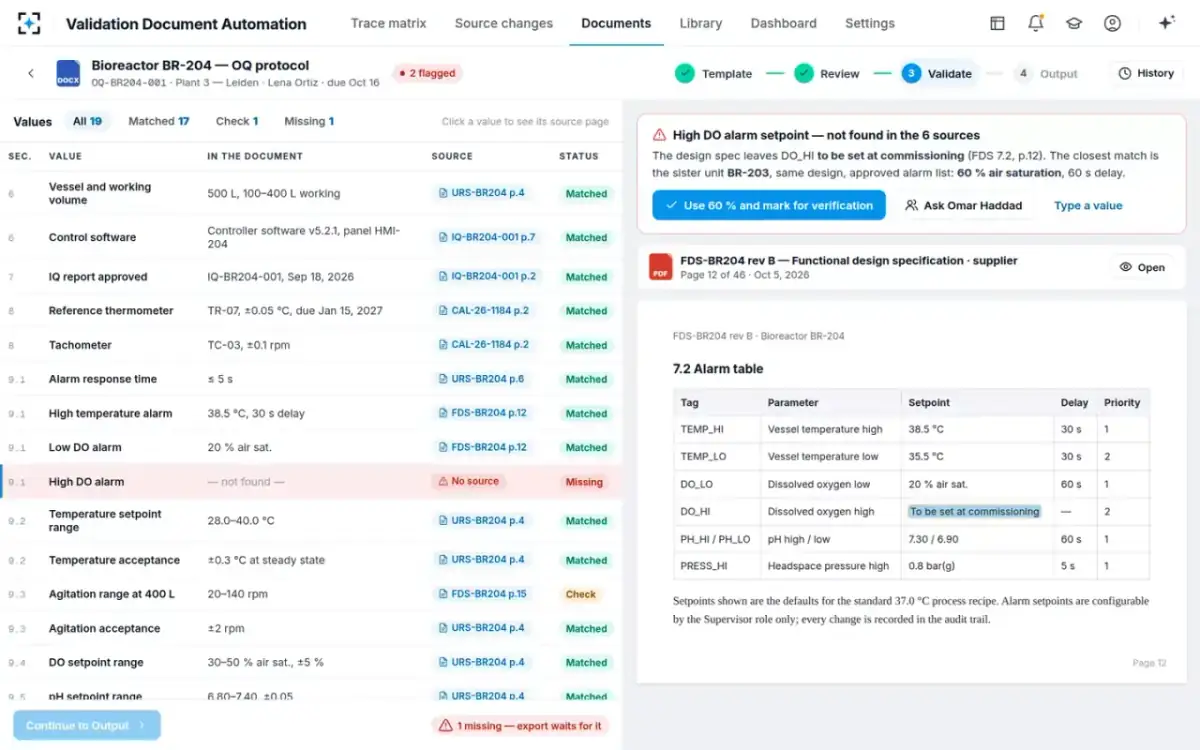
Half a day finding the current approved revision of every source. An OQ protocol for one bioreactor draws on the user requirements, the supplier's functional design specification, the piping and instrumentation drawing, the approved installation qualification report, the alarm list and the calibration certificates — six documents in the sample file, 157 indexed pages. Establishing that each is the approved revision, and not one superseded last quarter, is clerical work with no judgement in it at all.
A day and a half copying values. Nineteen values in the sample protocol, each needing to be found, read in context, transcribed with its unit exactly as written, and checked. This is the single largest line and the one with the least intellectual content.
Half a day on the trace matrix. Fourteen requirements against thirty-one test steps, built in a spreadsheet beside the protocol, where it drifts the moment either changes. Why that matrix belongs inside the approved document rather than beside it is the subject of the validation traceability matrix.
How many errors do people make copying values by hand?
The error rate for copying setpoints into a qualification protocol is not well measured. What exists is well-measured transcription error in adjacent settings, and it brackets the answer at both ends.
At the pessimistic end, a 2019 study in the Journal of the American Medical Informatics Association compared manually entered point-of-care glucose results with their interfaced counterparts across sixty outpatient clinics at two academic medical centres over nearly three years. "Of the 6930 events, 260 (3.7%) had a discrepancy between manual and interfaced results." Thirty-seven of those, 14.2% of the errors and 0.5% of all events, were markedly discrepant, defined as differing by more than 20%.
At the optimistic end, a systematic review and meta-analysis of error rates in clinical research data processing, published in the International Journal of Medical Informatics, pooled rates across 84 manuscripts and reported single data entry at 0.29% (0.24, 0.35) against double data entry at 0.14% (0.08, 0.20).
Neither measures a validation engineer copying a tolerance out of a design specification, and this page does not claim they do. What they establish is a bracket: somewhere between about one value in 345 and one value in 27 goes wrong when a human transcribes it. Applied to nineteen values in one protocol, that is between 0.06 and 0.7 wrong values per protocol; applied to forty protocols a year, between two and twenty-eight wrong values a year. In a qualification document a wrong value does not stay a typographical error. It becomes an expected result nobody can meet, discovered during execution with the equipment occupied and a deviation to raise, or it becomes a test that passes against the wrong limit.
There is a second, cheaper lesson in the meta-analysis. Double data entry roughly halves the single-entry rate, which is the arithmetic behind every independent-check requirement in GMP. The point is not that checking works; it is that checking costs a second person's time for every value, which is precisely the cost a system that cites each value to its source page removes.
Nineteen values, their source pages, and the two that need a person
The second cost: every change, re-read from the start
The per-protocol cost is the visible half. The invisible half is what a change costs after the protocol exists, and it can decide a business case.
In the sample site, six source changes arrived in fourteen days: new revisions of a requirements specification, a design specification and a drawing, a firmware change on an autoclave, and a calibration due date. Each had to be traced into open drafts and into already-approved documents. Done by hand, tracing one change means reading every potentially affected protocol again, section by section, because nothing in a paper file records which revision each section was drafted from.
The arithmetic is unforgiving. If a site has twelve open protocols and a requirement revision could plausibly touch four of them, a careful engineer re-reads four documents to find out — and the usual outcome is that one test case in one of them actually moves. In the sample file a temperature requirement changed, three of four linked test cases were marked, and the fourth was explicitly left alone. The saving is not in rewriting the one; it is in not reading the other three documents at all. Which tests a changed source rewrites follows that comparison in detail.
By hand against Validation Document Automation, per protocol and per change
Writing and maintaining by hand: A blank locked template, six source documents open, and a day and a half of copying.
With the agents drafting and tracing: Ticked sections and plain-English instructions; a drafted protocol with every value cited to its page, for the author to read.
Writing and maintaining by hand: The author remembers. A reviewer who wants to check opens the PDFs again.
With the agents drafting and tracing: The document, page and passage sit with the value, and the source page opens beside it.
Writing and maintaining by hand: A spreadsheet beside the protocol, maintained by whoever remembers.
With the agents drafting and tracing: An appendix inside the approved protocol, versioned and signed with it.
Writing and maintaining by hand: Discovered during execution, or filled with a plausible number.
With the agents drafting and tracing: Left empty and flagged; export is held until a person decides and records a reason.
Writing and maintaining by hand: Re-read every protocol that might be affected.
With the agents drafting and tracing: Compared line by line against the revision each document used; affected tests marked, unaffected ones named, and what still holds listed.
Writing and maintaining by hand: The same work again, with a different template and a different filing habit.
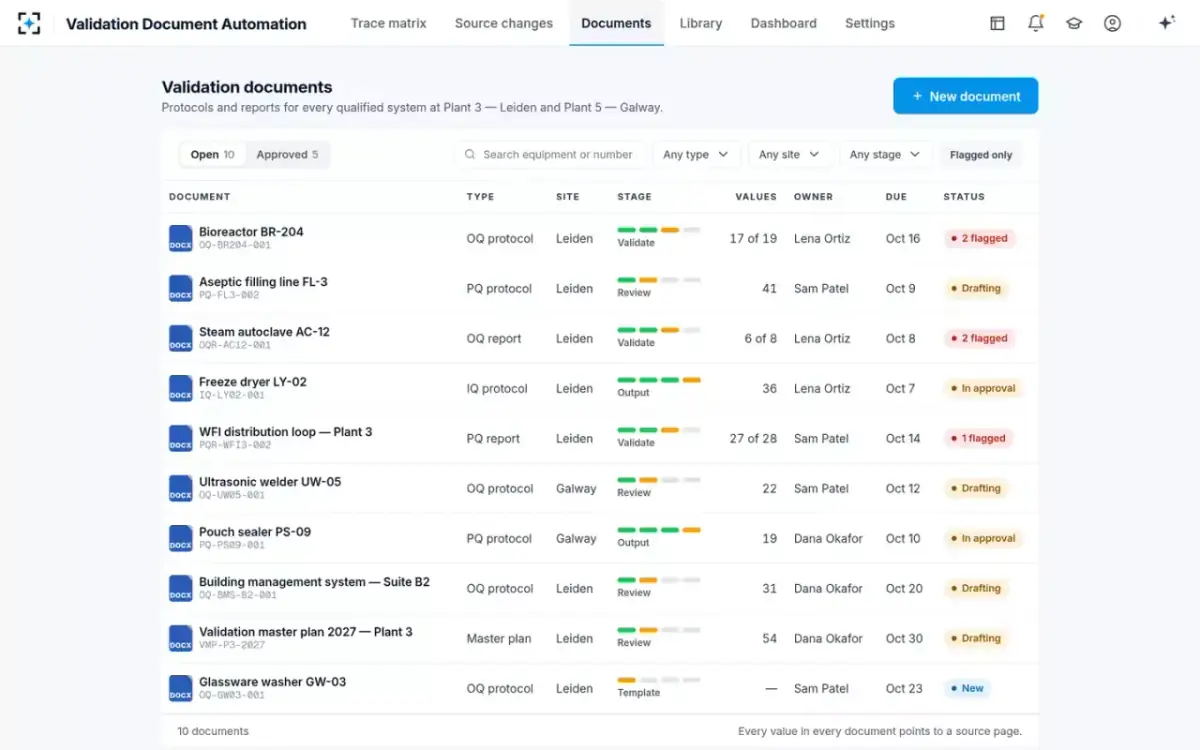
With the agents drafting and tracing: The site’s own template, the same rules, and one list of every open document across both plants.
How much documentation does a qualification actually need?
Less than many sites produce, and the regulators have been saying so for years. ICH Q9(R1) is built around the principle that effort should match risk, and it makes the efficiency argument explicitly: "An understanding of formality in quality risk management may lead to resources being used more efficiently, where lower risk issues are dealt with via less formal means, freeing up resources for managing higher risk issues and more complex problems that may require increased levels of rigor and effort."
The FDA's Computer Software Assurance guidance puts the same idea in the language of records: "Documentation of assurance activities need not include more evidence than necessary to show that the software feature, function, or operation performs as intended for the risk identified." It adds that the record should retain enough detail of the activity to serve as a baseline for improvements or a reference point if issues occur. That guidance addresses production and quality system software for devices rather than drug equipment qualification, so it is the agency's thinking rather than a rule binding every reader here.
What the rules do require is specific and modest. Annex 15 asks that "validation protocols should be prepared which defines the critical systems, attributes and parameters and the associated acceptance criteria". Critical ones. A protocol that tests everything the equipment can do, because nobody had time to decide what mattered, is expensive twice: once to write and once to execute.
And there is a limit on the other side, which belongs in any honest business case. ICH Q9(R1) is blunt about using cost as a justification for doing less:
"Resource constraints should not be used to justify the use of lower levels of formality in the quality risk management process."
ICH Q9(R1), Quality Risk Management, section 5.1
The saving this page describes is not a reduction in rigour. It is the removal of transcription, which no regulation ever asked for.
How do you build a business case for validation software?
Write the model with every assumption on a separate line, and let the reviewer change them. A business case that produces one number is a business case that will be argued about; one that produces a formula gets tested instead.
The cost model, one assumption per line
Median hourly wage, validation engineer
Value$49.25
Where it comes fromO*NET OnLine, occupation 17-2112.02, 2025 wage data, which O*NET reports for the broader Industrial Engineers occupation. A median across all industries and all seniorities, in the United States.
Working day
Value8 hours
Where it comes fromA convention, not a measurement. Change it if your site books 7.5.
Direct cost of one engineer-day
Value$394
Where it comes fromOur arithmetic: 8 × $49.25. Wage only — no employer taxes, benefits, equipment or floor space, so it understates the true cost of an hour.
Days to write one OQ protocol by hand
Value4.0
Where it comes fromA demonstration figure from the solution’s sample 2025 document log, for one piece of process equipment. Your own number is in your document history.
Days to write the same protocol with the agents
Value0.6
Where it comes fromEstimated, including the author’s own checks, decisions and chasing. Not a measured customer result.
Protocols written per year
Valueyour number
Where it comes fromCount the IQ, OQ and PQ protocols and reports your site issued last year. This is the multiplier that decides everything below.
Source changes traced per year
Valueyour number
Where it comes fromNew revisions of requirements, specifications, drawings and certificates that had to be traced into open or approved documents. Usually larger than people expect.
What is excluded
Value—
Where it comes fromExecution, deviation investigation, the validation of the authoring system itself, and the project to migrate your templates. None of those gets cheaper here.
Worked through for an illustrative site writing forty protocols a year: 40 × 4.0 days = 160 engineer-days by hand, about $63,000 of direct wage at $394 a day; 40 × 0.6 days = 24 engineer-days, about $9,500. The difference, roughly $53,500 a year of direct labour before any loading, is our arithmetic on the estimates in the table, not a promise. Against it set the things the model excludes: the licence, the validation of the authoring system, the integration that brings new revisions in, and the project to load your templates.
Then add the line many cases leave out, because it can carry the largest number. Ask how many source changes your site traced last year, and how many documents were re-read to find what they touched. If the answer is that nobody counted, that is itself a finding — and the count is usually available from the change control log in an afternoon.
Every open document, with its stage, its values and its flags
What does not get cheaper
Four things, and leaving them out of a business case is how a business case loses its credibility in the second quarter.
Execution. Running the tests, occupying the equipment, recording the results and investigating deviations costs what it costs. Nothing on this page touches the floor.
Judgement. Deciding which requirements are critical, what an acceptance criterion should be, and whether a test genuinely proves a requirement. That is the green band in the timeline, and it should not shrink to zero — a site whose test design time went to nothing has stopped designing tests.
Review and approval. Three signatures still have to be given by three people who have read the document. A faster draft gives them a better document to read; it does not read it for them. What each signature certifies sets out why none of them can be skipped.
Qualifying the system itself. An authoring system used in a GMP activity is a computerised system like any other, and validating it, qualifying its infrastructure and keeping it under change control is a real line in the project. The questions to ask about that before signing anything are in twelve questions before you buy.
The honest shape of the case, then, is narrow and large at the same time. It does not make qualification cheap. It removes the part of qualification that is copying, and the part that is re-reading documents to find out whether anything changed — which in the sample site is roughly three of every four working days a protocol costs. To put a number on your own, take one protocol you wrote last year, time the five lines in the table above, and multiply. To see the comparison on your own requirements, design specification and template, start from Validation Document Automation.
Questions people ask
How much does validation documentation cost?
Per document, it is engineer-days times a loaded rate. In the sample document log used here, one OQ protocol for a piece of process equipment takes about four working days to write by hand; at the United States median hourly wage for validation engineers that is about $1,576 of direct wage, before employer costs and overhead. The larger figure at most sites is the delay, because equipment and projects wait on the document.
How long does it take to write an OQ protocol?
About four working days by hand in this sample data, for one piece of process equipment with six source documents and nineteen values to extract. The split matters more than the total: roughly one day of test design, and three days of finding the current revisions, copying values, building the trace matrix and chasing what disagrees.
What does a validation engineer earn?
O*NET, the United States Department of Labor's occupational database, gives a median annual wage of $102,440 and a median hourly wage of $49.25 for validation engineers, occupation 17-2112.02, in its 2025 wage data — figures it reports for the broader industrial engineers group. That is a median across industries and seniorities; specialist computerised-system validation leads may sit above it, and the figures are United States data.
How many errors do people make copying values by hand?
It is not well measured for qualification protocols. Adjacent evidence brackets it: a 2019 study found 3.7% of manually entered point-of-care results differed from the interfaced result, while a meta-analysis of clinical research data processing pooled single data entry at 0.29% and double data entry at 0.14%. Between roughly one value in 27 and one in 345, depending on the task and the checking — which is why an independent check on critical values exists at all.
Where do the hours go in writing a qualification protocol?
In the estimated split used here: half a day establishing the current approved revision of every source, a day and a half copying setpoints, ranges, tags and calibration dates, one day writing test steps and expected results, half a day building and checking the trace matrix, and half a day chasing values that are missing or that disagree. Only the third of those needs an engineer's judgement.
What does not get cheaper when you automate validation documents?
Execution, judgement, review and the qualification of the authoring system itself. Running tests on equipment costs what it costs; deciding which requirements are critical and what a test should prove is the part that should not shrink; three people still have to read and sign; and a system used in a GMP activity has to be validated, qualified and kept under change control like any other.