Revalidation is required when a change could plausibly affect what a validated state proved — and the defensible answer to "could it?" is never a judgement about the change as a whole, but a decision taken one test case at a time. A new revision of a requirements document is not an instruction to rerun a protocol, and it is not nothing. It is a list of differences, each of which either touches a specific test case or does not, for a reason somebody can write down. Botminds' Validation Document Automation makes that list mechanically: when a requirement, design spec, drawing or certificate arrives at a new revision, it compares it line by line with the revision the protocol was drafted from, marks every linked test case, and lists what still holds.
The worked change below is sample data on a fictional 500 L bioreactor, BR-204, and its OQ protocol OQ-BR204-001. The rules and quotations are real and linked where they appear.
One requirement change, as Validation Document Automation resolves it
3tests
of the four linked to the changed requirement need rewriting
1
linked test case the change does not touch, and the reason is recorded
6
changes to sources arrived in 14 days — three specification revisions, a firmware version, a renamed tag and a calibration due date
28°C
the new low end of the required range, where revision 3 said 30.0 °C
When is revalidation required after a change?
The rules do not give a list of triggering events, and that is deliberate: a list would be either too short to be safe or too long to be useful. What they give instead is a method. Annex 15 states it directly: "Quality risk management should be used to evaluate planned changes to determine the potential impact on product quality, pharmaceutical quality systems, documentation, validation, regulatory status, calibration, maintenance and on any other system to avoid unintended consequences and to plan for any necessary process validation, verification or requalification efforts" (EudraLex Volume 4, Annex 15).
Read the verbs: evaluate, determine, plan. The output of the assessment is a plan with a scope — which qualification work is needed — not a yes or a no. ICH Q9, the quality risk management guideline the EU, the FDA and Japan all adopted, lists the same purpose among the uses of risk management in change control: "To determine appropriate actions preceding the implementation of a change, e.g., additional testing, (re)qualification, (re)validation or communication with regulators" (ICH Q9(R1)). Additional testing, requalification, revalidation: three different sizes of answer, and the assessment is what chooses between them.
So the honest form of "when is revalidation required" is: when the assessment shows that something the earlier qualification proved may no longer hold, and the evidence cannot be reconstructed from what is already approved. The two failure modes are symmetrical. Requalifying everything is expensive and tells an inspector that the site cannot reason about its own changes. Deciding that nothing really changed, with no record of what was considered, is the finding waiting to happen.
What triggers requalification of equipment?
In practice four families of event, and they behave differently.
A change to what is required. A new revision of the user requirements specification, an amended acceptance criterion, a process change that alters the operating range. This family is the subject of most of this guide, because it is the one that propagates into test cases through the traceability links.
A change to what was built. A modified control loop, a replaced instrument, a firmware or software version, a different utility connection. The test is whether the change can affect a function the protocol proved; a replaced temperature transmitter of the same type and accuracy class touches calibration records, not the control test.
Time and drift. Annex 15 handles periodic requalification carefully: "Where re-qualification is necessary and performed at a specific time period, the period should be justified and the criteria for evaluation defined. Furthermore, the possibility of small changes over time should be assessed." A calendar interval with no justification and no criteria is not a programme; it is a reminder.
Evidence from operation. Deviations, trends, failed batches, out-of-specification results. Annex 11 makes the computerised-system version of this an obligation in its own right: "Computerised systems should be periodically evaluated to confirm that they remain in a valid state and are compliant with GMP" (EudraLex Volume 4, Annex 11). A valid state is a claim about now, not about the day the protocol was signed.
What is the difference between revalidation and requalification?
Qualification is what you do to equipment, facilities, utilities and systems; validation is what you do to a process. So requalification re-establishes that a piece of equipment still does what it was qualified to do, and revalidation re-establishes that a process still produces what it was validated to produce. Annex 15 keeps the two words in those lanes, and its chapter on changes names "process validation, verification or requalification efforts" as three possible outcomes of one assessment, which is the clearest hint that they are different sizes of response.
The distinction matters because the scope of each is different, and because a change can require one without the other. Tightening a temperature tolerance on a bioreactor is an equipment question first: can the unit hold the new band? Only if the answer changes what the process experiences does process validation come into it. Conversely a change in batch size or a new product on the same line is a process question that may leave every piece of equipment qualification untouched.
Two more words float around the same space. Verification, the third outcome on Annex 15's list, is a narrower confirmation that something still holds. Periodic review is the scheduled look at whether the valid state still holds, which may conclude that no testing is needed at all — provided the conclusion is written down with what was examined.
How do you assess the impact of a change on a validation protocol?
By resolving the change into differences, and each difference into the test cases it reaches. The steps below are the ones that survive an inspection, in the order they pay.
Identify the revision the protocol was drafted from. Not the latest revision — the one actually used. A protocol drafted from revision 3 and compared against revision 5 will miss everything that changed in revision 4 and then changed back.
Compare line by line, not summary to summary. The change control record's description of the change is a summary written by the person requesting it, for a different purpose. The assessment needs the old and new wording side by side, because the difference that matters is often in a clause the summary did not mention.
Follow the traceability links. Each changed requirement resolves to the test cases it is linked to. This is the step that is impossible without a maintained matrix, and it is why a matrix that has drifted makes a change assessment unreliable rather than merely untidy.
Decide each linked test case, with a reason. Rewrite, re-justify as still covered, or untouched. The reason is the artefact: "9.2-01 names no range or tolerance" is checkable, "no impact" is not.
Record what still holds. Half of a good assessment is the list of things the change does not disturb, stated with the evidence that supports them. More on that below.
Which test cases need rewriting when a requirement changes?
The ones whose text carries a number the change moved, and only those — but the rule is harder to apply than it sounds, because acceptance criteria are often derived rather than quoted. A step that says "deviation within the required tolerance" moves when the tolerance moves, even though its words do not change. A step that quotes the number does change its words. And a step that proves a mechanism rather than a limit may be untouched by a change that looks dramatic.
One temperature change, four linked test cases, four different answers
9.2-01
UntouchedFill to the working volume and enter the temperature setpoint; confirm the controller accepts it.
The step proves the setpoint can be entered and read back. It names no range and no tolerance, so neither number in the revision reaches it.
Revision 3
Setpoint accepted and displayed
Revision 4
Setpoint accepted and displayed
9.2-02
RewriteHold at the operating setpoint and record temperature every minute for 30 minutes.
The acceptance band is derived from the tolerance. ±0.5 °C gave ±0.5 around 37.0; ±0.3 °C gives ±0.3. The old band would pass a result the new requirement fails.
Revision 3
Accept 36.5 – 37.5 °C
Revision 4
Accept 36.7 – 37.3 °C
9.2-03
RewriteStep the setpoint and record the deviation at steady state.
The criterion quotes the tolerance directly. It is the clearest kind of rewrite and the easiest to miss, because the step text does not change at all.
Revision 3
Deviation within ±0.5 °C
Revision 4
Deviation within ±0.3 °C
9.2-04
RewriteDemonstrate control at the low and high ends of the required range.
The range moved at one end. Executing the old step would leave the 28.0 – 30.0 °C band unproved, which is exactly the band the new cell line runs in from day 5.
Revision 3
Low end 30.0 °C, high end 40.0 °C
Revision 4
Low end 28.0 °C, high end 40.0 °C
Test 9.2-03 is the one worth staring at. Its step text is identical before and after; only the number behind the phrase "the required tolerance" has moved, from ±0.5 °C to ±0.3 °C. A reviewer scanning a redlined protocol sees no change on that line. A reviewer following the link from URS-021 sees it immediately. This is the difference between reviewing a document and reviewing a chain, and it is a strong argument for keeping the links live rather than rebuilding them when someone asks.
What the change did to the protocol's 31 test steps
OQ-BR204-001 after URS-BR204 revision 4
- Rewritten · 3 steps · 9.7%
- Linked but unaffected · 1 step · 3.2%
- Not linked to the changed requirement · 27 steps · 87.1%
A worked change: one temperature range, four test cases
Follow it from the beginning. On the morning of 6 October, URS-BR204 arrives at revision 4, approved by the head of quality under change control CC-26-142. Two things moved in one requirement: the low end of the temperature range, from 30.0 °C to 28.0 °C, and the tolerance, from ±0.5 °C to ±0.3 °C. The reasons are in the change record — a new cell line shifts to 28.0 °C on day 5, and quality tightened the band.
The traceability matrix links URS-021 to four test cases in section 9.2. Three of them change, for three different reasons, and the fourth does not, for a reason that has to be recorded rather than assumed. Then the section is redrafted: the test cases are rewritten with the locked template wording kept, each citing the new revision and the page it came from, and the old and new expected results sit side by side for the author to read. The author accepts, the matrix header moves to revision 4, and the protocol opens as a new version for review.
Two details in that sequence are not conveniences. The protocol does not move to revision 4 when the requirement does; it moves when the author accepts the redraft, because accepting is a decision and a decision has an owner. And the approved revision 3 of the protocol is not edited — a change opens a new version. PIC/S, the co-operation scheme of GMP inspectorates, is blunt about why in its guidance to inspectors: without proper change and version control over the life-cycle and validation documents, it tells inspectors, the validation status is suspect (PIC/S PI 011-3).
The section redrafted against the new page, old and new side by side
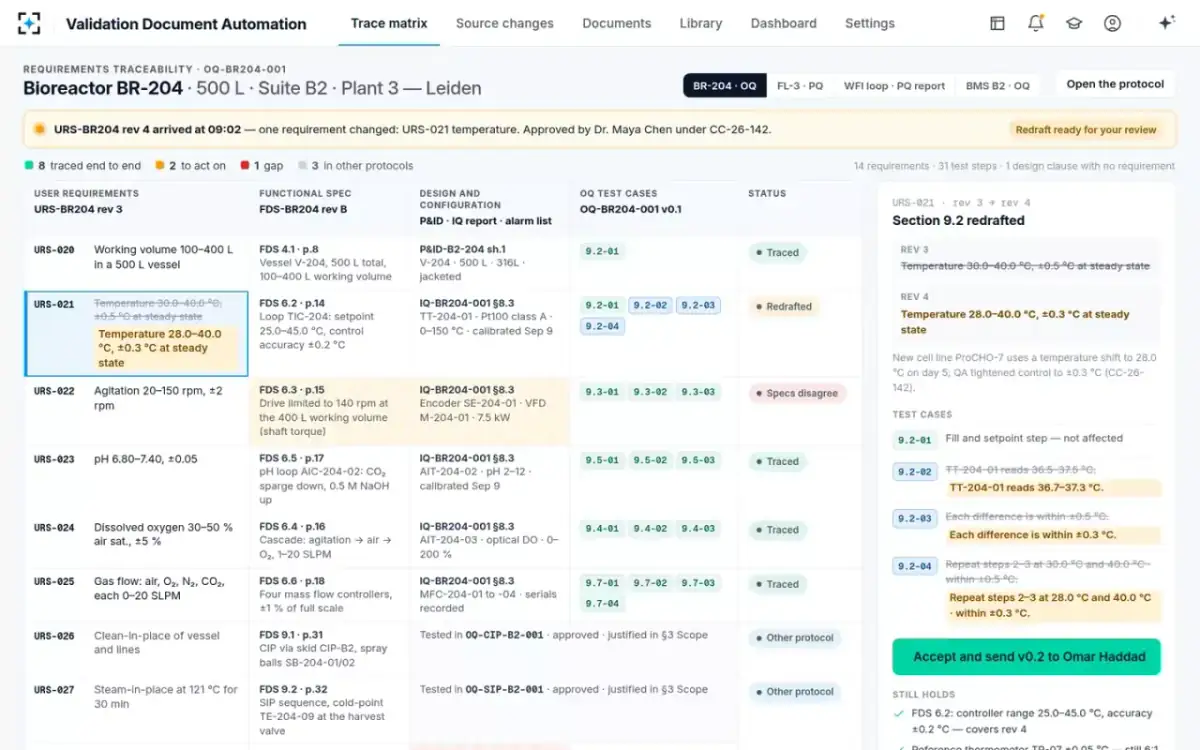
Revision 3 against revision 4, and the test cases each difference reaches
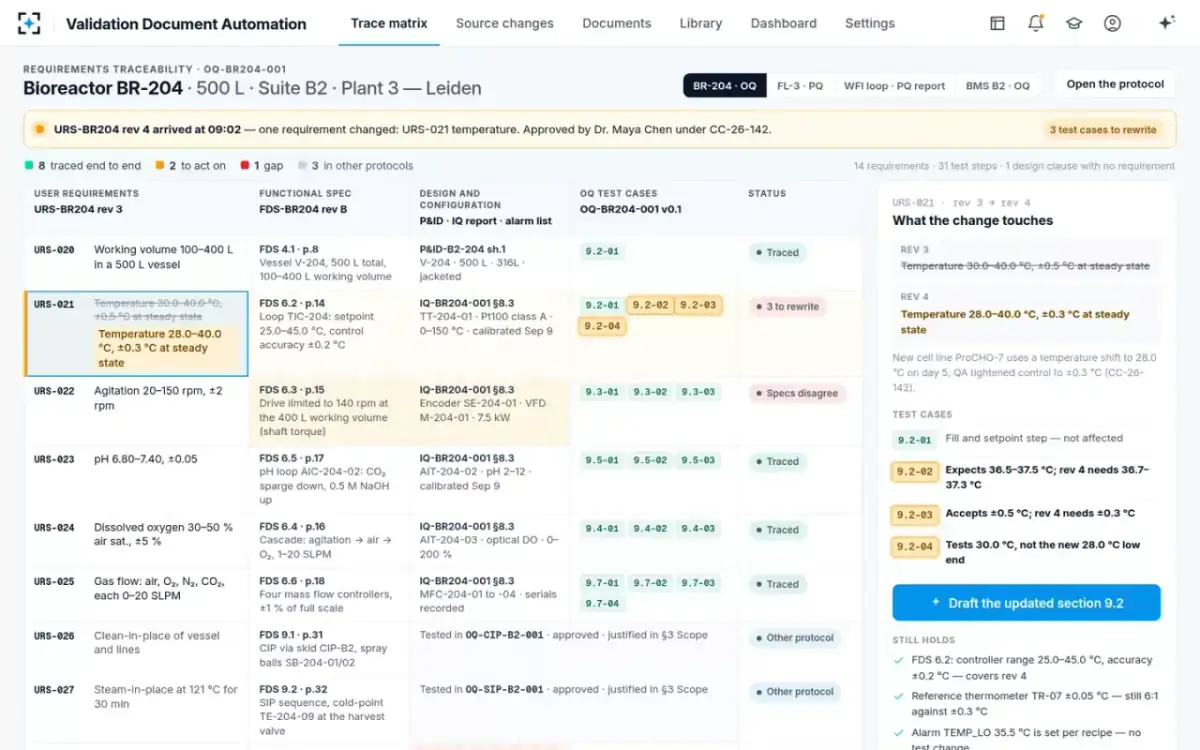
9.2-01 is linked and unaffected — the reason is recorded, not assumed
What still holds, and why saying so is half the work
An assessment that lists only what breaks is an assessment a reviewer cannot check. The things that still hold are the reason the scope is small, and each needs its own evidence.
On the sample change, two items carry the weight. The controller's specified range of 25.0 to 45.0 °C at ±0.2 °C, in FDS 6.2, covers the new 28.0 °C low end and is tight enough to demonstrate the new ±0.3 °C band — so no design question is opened, and the installation qualification is not disturbed. And the reference thermometer TR-07, calibrated to ±0.05 °C, is still six times better than the tolerance it is being used to judge, so the measurement remains fit for the tightened criterion.
That second one is an easy check to skip. Tightening a tolerance can quietly invalidate the measurement method: a reference instrument comfortable against ±0.5 °C may be marginal against ±0.1 °C. The ratio is not a regulatory number, and a site that uses one should say what its ratio is and apply it consistently. What is not defensible is tightening the criterion and never looking at the instrument.
The two halves of a change record, and what each must contain
What the change touches: One linked test case.
What still holds: One piece of evidence that is unaffected and relied on.
What the change touches: The test case, the specific difference, and the old and new expected result.
What still holds: The document, clause or certificate, and why the change does not reach it.
What the change touches: 9.2-04: the required low end moves from 30.0 °C to 28.0 °C, so the step must demonstrate control at 28.0 °C.
What still holds: FDS 6.2: the controller is specified 25.0 – 45.0 °C at ±0.2 °C, which spans the new range and is tighter than the new tolerance.
What the change touches: "Section 9.2 affected."
What still holds: "No impact on IQ."
What the change touches: The author, accepting or overriding each marked case.
What still holds: The author, reviewed by the engineer who knows the equipment.
What the change touches: To check nothing linked was missed.
What still holds: To check the small scope was earned, not assumed.
Changes that are not requirement changes: firmware, a renamed tag, a calibration date
Six changes reached the sample site in fourteen days, and only three were revisions of a specification. The other three are the kinds of change that slip past a document-centred assessment entirely.
A firmware change on the steam autoclave AC-12, from controller version 3.4 to 3.5, raised under change control on 2 October. Firmware is a version of what was built, so it belongs in the same assessment as a hardware change: which functions does this version affect, and were any of them qualified? Here it reached one place — the software-version step, test 6.6, in that unit's own qualification report — and the change was accepted on that basis. The supplier's release note is an input to the assessment, not a substitute for it.
A drain-valve tag renamed on the drawing, HV-204-12 to HV-204-14, when P&ID-B2-204 went to revision 5 on 26 September. Nothing physical changed; a label did. It is harmless until an approved document cites the old tag, which here it does: §6.2 of the approved IQ report. A tag reference is the cheapest kind of change to trace and the most embarrassing to miss, because an executed protocol then names an instrument that no longer exists under that name.
A calibration due date. The portable dissolved-oxygen meter DM-11 is due on 20 November, recorded on 30 September. Not a change to the equipment at all, and not a change to any document — a change to whether three test cases, 9.4-01 to 9.4-03, can be executed with valid evidence if they are run after that date. A protocol approved in October and executed in December can meet an instrument that fell out of calibration in between, which is why this one is marked to watch rather than accepted.
What unites the three is that each is a change to a source the protocol depends on, and none of them arrives as a revision of a specification. Treating sources as a set — documents, drawings, firmware versions, certificates — and watching all of them is what makes the assessment complete.
Six source changes in fourteen days, and how far each reached
- URS-BR204 rev 4 · 6 Oct3 tests to rewrite
- FDS-BR204 rev B · 5 Octauthor decides
- URS-FL3 rev 4 · 3 Octno impact
- Firmware 3.4 → 3.5 · 2 Octaccepted
- DO meter due 20 Nov · 30 Sepwatch
- Drain valve renamed · 26 Sepaccepted
Every new revision on the unit, with what it touches
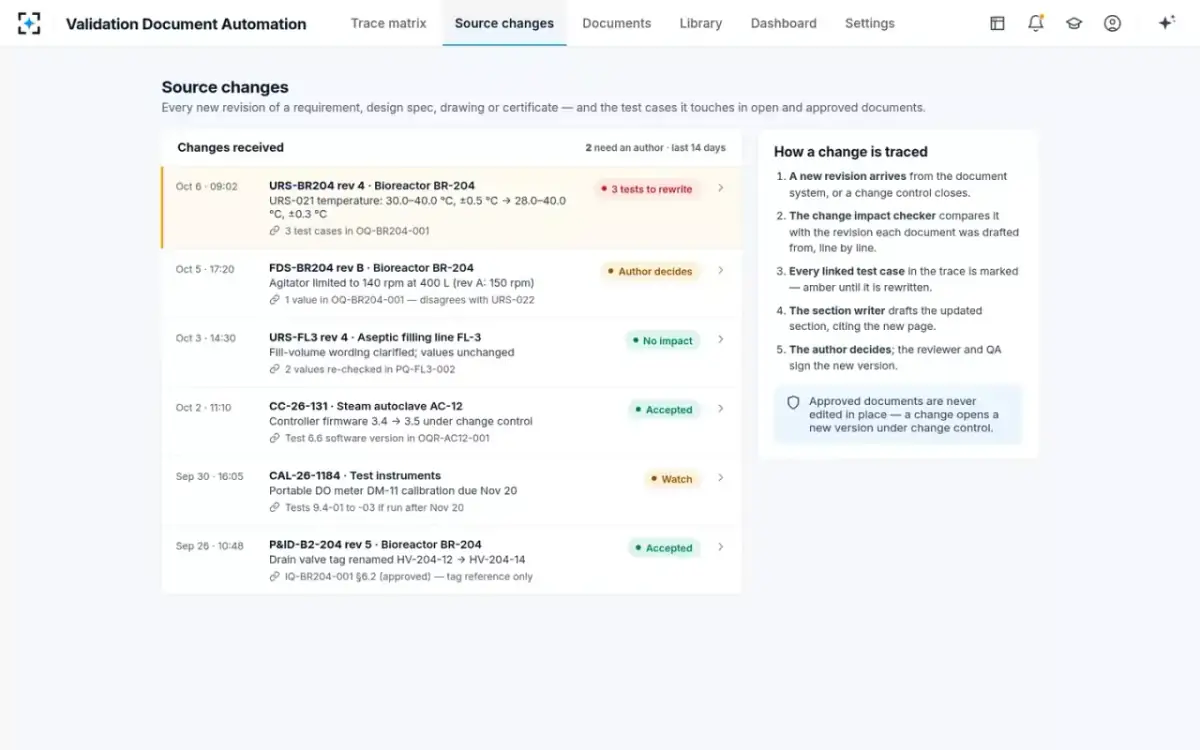
Can you edit an approved validation protocol?
No — not in place. An approved protocol is a controlled document, and a change to it opens a new version through change control, with the approvals the original needed. This is not a software convention; it is what makes the executed evidence meaningful, because an executed test result only means something against the exact criterion that was approved before execution.
Two situations are often confused with editing. The first is a change discovered during execution. Annex 15 allows it and constrains it: a significant change made to an approved protocol during execution, such as to an acceptance criterion or an operating parameter, is to be documented as a deviation and justified scientifically. The protocol is not edited; the deviation is recorded against it and justified by the people who approved it. The second is a correction to an obvious typographical error, which sites handle under their documentation procedure — and which stops being typographical the moment it touches a number.
The deeper obligation is on the requirements themselves. The 2025 draft revision of Annex 11, out for consultation and not in force, puts it this way: requirements are to be kept updated through the whole life of a system, so that they go on describing its functions completely and accurately as it is changed and customised (draft revision of Annex 11). A site that keeps its protocols under tight version control and lets its requirements document go stale has version control over the wrong document.
To see a revision arrive, a section redrafted against the new page, and the matrix move only when the author accepts, start from Validation Document Automation. What each agent may and may not do while that happens is set out in the guide to the six agents and their limits.
Questions people ask
How often should equipment be requalified?
There is no universal interval, and an interval alone is not a programme. Annex 15 asks that where requalification is performed at a specific time period, the period be justified and the criteria for evaluation defined, and that the possibility of small changes over time be assessed. In practice that means a site decides the interval per equipment class from risk and from its own data, writes the justification down, and says in advance what evidence will be examined and what would make it requalify early.
Does a firmware update require revalidation?
It requires an assessment, which frequently concludes that no testing is needed. The questions are which functions the version changes, whether any of them were qualified, and whether the change can affect data or records. A supplier release note is an input to that assessment, not a conclusion. What is not defensible is installing a new version without recording the assessment at all, because the system's valid state is a claim the site has to be able to support.
Can you edit an approved validation protocol?
Not in place. A change to an approved protocol opens a new version under change control with the same approvals. A change found during execution is handled differently again: Annex 15 requires significant changes made during execution, such as to acceptance criteria or operating parameters, to be documented as a deviation and scientifically justified, against the protocol as approved.
What is the difference between revalidation and requalification?
Qualification applies to equipment, facilities, utilities and systems; validation applies to processes. Requalification re-establishes that the equipment still does what it was qualified to do; revalidation re-establishes that the process still produces what it was validated to produce. One change can require either, both or neither, which is why the assessment comes before the label.
How do you prove a test case was not affected?
By naming what the step actually depends on and showing the change did not move it. "Test 9.2-01 proves the setpoint can be entered and read back; it states no range and no tolerance" is a reason a reviewer can check against the step's own text. The weak form — "no impact" — asserts the conclusion and gives the reviewer nothing to disagree with, which is why it draws questions rather than ending them.
Who decides the scope of a change assessment?
The author proposes it and the approvers own it: the same people who approved the protocol, with the engineer who knows the equipment on the test content. Software can produce the list of linked test cases and the differences behind each, which is the mechanical part, and it should not clear a mark it raised. The judgement that a difference does not reach a test case is the part with a name on it.