Search for FDA warning letters and computer system validation and you will find letters about shared passwords, missing audit trails and uncontrolled spreadsheets. The pattern underneath them is narrower than it looks, and the agency publishes the evidence for it: every fiscal year the FDA releases a data set of each regulation cited on a Form FDA 483, with the number of times it was cited. In fiscal year 2025, the drug sheet carries 316 citation lines and 2,837 observations. Read them against a qualification file and the citations cluster on written procedures, equipment controls and the controls over the computer systems that hold the records — not on the science in the test. Botminds' Validation Document Automation is built for that part of the file: it drafts IQ, OQ and PQ protocols from the current approved sources, puts the document and page behind every value, keeps the requirement-to-test trace inside the protocol, and marks the tests a new revision touches.
The counts on this page are the FDA's own published data for inspections ending between 1 October 2024 and 30 September 2025. The arithmetic across them is ours and is named where it appears. The protocol, people and plant used as the worked example are sample data in the solution, not a customer's file, and nothing here claims the solution prevents a 483.
One fiscal year of drug 483s, in the FDA's own data set
2,837
observations on the fiscal year 2025 drug sheet, across 316 citation lines
713
drug Form 483s issued from the system that feeds the data set
499
of those observations cite equipment, written procedures or computer controls
93
device citations for lack of or inadequate process validation
What does the FDA actually cite on a Form 483?
It cites a regulation and a short description of how the firm fell short of it. The published data sets give exactly that: the data contains, in the FDA's words, "the area of regulation and the number of times it was cited as an observation on an Form FDA 483 during inspections conducted by FDA and its representatives". There is no narrative, no plant and no product — a citation line, a plain-English label and a frequency. That is useful precisely because it is dull: it is the industry's own list of what inspectors wrote down, at a scale no single firm's experience can reach.
Two caveats come with it, and both are the FDA's. The sheets cover 483s generated from one system, and the agency says plainly that some 483s "were manually prepared and not available in this format", so the counts are a floor rather than a full tally of findings. And a single 483 can carry citations in more than one product area, so the per-area totals add up to more than the number of letters. Across the drug sheet, 2,837 observations against 713 drug 483s works out at about four citations on an average drug 483 — our arithmetic, and a reminder that a 483 is a list, not a verdict.
What are the most cited FDA 483 observations for drugs?
The top of the fiscal year 2025 drug sheet is procedures and investigations: 243 citations of 21 CFR 211.22(d), "Procedures not in writing, fully followed", and 164 of 211.192, the failure to thoroughly review a discrepancy. Below them sits the band that a qualification file lives in, and it is bigger than most validation teams expect.
Fiscal year 2025 drug citations that a qualification file has to answer
Notice what is not there. None of these lines says the test was badly designed, the acceptance criterion was wrong or the statistics were weak. The citations are about paperwork that could not be followed, equipment whose state was not established, calibration that was not recorded, and controls over the computer systems that hold the records. A validation engineer who spends a week arguing about whether three runs or five is the right number is defending a part of the file these lines do not reach.
The computer line is the one worth sitting with. Across its own sub-lines, 21 CFR 211.68(b) was cited 110 times in the year: 87 for control of master production and control records, 10 for input and output verification, 8 and 3 for backup data and backup files, and 2 for failing to keep a written record of the program with its validation data. The regulation itself is one sentence long.
What does 21 CFR 211.68(b) require of a protocol that quotes a value?
It requires that only authorised people can change the records, and that what goes into and out of the computer is checked. The first sentence reads: "Appropriate controls shall be exercised over computer or related systems to assure that changes in master production and control records or other records are instituted only by authorized personnel." The FDA's own short description for the most-cited line under it is blunter still — "Computer control of master formula records".
For a qualification protocol, that lands in two places. First, the protocol is itself a controlled document, so who may change it, and who approved the version that was executed, has to be visible and fixed. Second, almost every expected result in an OQ protocol is a value copied out of another controlled record: a setpoint from the design specification, a range from the alarm list, an accuracy from a calibration certificate. The regulation's requirement that input and output "shall be checked for accuracy" is, for a validation author, the requirement that each of those copies be checked against the record it came from. Doing that by hand for nineteen values across six source documents is where the afternoon goes, and where the errors live. The validation traceability matrix is the other half of the same job.
The device side: process validation and automated processes
The device sheet of the same data set is where validation itself is cited by name, because the quality system regulation says so directly. In fiscal year 2025 it carries 93 citations of 21 CFR 820.75(a) for lack of or inadequate process validation, 23 for the procedures that monitor and control a validated process, 9 for process changes not reviewed, evaluated or revalidated, and 17 of 820.70(i) for software validation of automated processes. A further 47 cite inadequate or missing risk analysis within design validation.
Those two numbers — 9 for changes not revalidated, 17 for software validation of automated processes — describe the same failure from opposite ends. Something changed, and the validation evidence did not move with it. On a drug site the equivalent is a new revision of a requirement or a design specification arriving while four protocols are open against the old one; which tests a changed source rewrites is the question that decides whether the file still holds.
One warning letter, read as a documentation failure
Counts tell you the shape; a letter tells you the texture. The FDA's warning letter to Persōn & Covey, Inc., dated 23 September 2025, cites the quality unit's responsibilities, the failure to investigate discrepancies, and the absence of adequate written procedures for production and process control. Inside it sits a single sentence that is hard to read twice: "Process validations for both drug products were last executed in 1999."
The same letter records that the firm acknowledged "There was never a formal procedure for Data Integrity", and that "laboratory personnel shared a common password for the Windows and [system] software systems". None of those three findings is about a wrong test result. One is a file that stopped being maintained, one is a procedure that was never written, and one is a control over who could change a record — the same 211.68(b) idea as the citation counts, arriving as a consequence rather than a line in a spreadsheet.
A shared password is worth a moment, because it is the cheapest finding to earn and the most expensive to argue away. If two people use one login, no record in the system can be attributed to a person, which means no signature on it carries a meaning and no audit trail can say who changed what. Every downstream claim in the validation file rests on that attribution. What a GMP signature has to record starts from the same point.
What do inspectors look for in a validation file?
They look for links. PIC/S, the co-operation scheme of GMP inspectorates, tells inspectors in its guidance to review the validation summary report and then look for evidence "that the qualification testing has been linked with the relevant specification's acceptance criteria", setting out the pairing explicitly: PQ against the user requirements, OQ against the functional specification, IQ against the design specification or design review. Then comes the sentence that names the real test of a file.
"Inspectors should look for the traceability of actions, tests and the resolution of errors and deviations in selected documents."
PIC/S PI 011-3, Good Practices for Computerised Systems in Regulated 'GXP' Environments, section 23.11
Traceability of actions, of tests, and of the resolution of errors. Not the existence of documents — the links between them. The same guidance warns that a lack of adequate validation evidence for GMP-related automated systems, coupled with weak assurance of how the software was developed, "may very well be either a critical or a major deficiency", with the ranking left to the inspector's risk judgement. A file whose documents are all present but whose links live in somebody's head is a file that can only be defended by the person who built it, on the day they happen to be in the building.
The qualification file an inspector works through, and where it usually thins out
User requirements
What it provesWhat the site asked the equipment to do, and which of those requirements are critical.
What gets askedShow me the revision this protocol was written from.
Where the file usually thins outThe protocol cites a revision that has since been superseded, and nobody traced the difference.
Functional and design specification
What it provesWhat the supplier built, with the setpoints, ranges and alarm limits the design allows.
What gets askedWhere does this expected result come from?
Where the file usually thins outA value the protocol states appears in no specification, because the design left it to commissioning.
Installation qualification report
What it provesThe unit as installed: tags, utilities, instruments and their calibration.
What gets askedWas IQ approved before OQ was executed?
Where the file usually thins outIQ is approved, but a drawing revision arrived after it and no one checked what it touched.
Operational qualification protocol
What it provesThe tests, their expected results and the acceptance criteria, approved before execution.
What gets askedWho approved this, and when, against which specification?
Where the file usually thins outApproved after the first test was run, or approved without the quality unit.
Requirement-to-test trace
What it provesThat every critical requirement is proved by a test, or justified where it is not.
What gets askedWhich test proves this requirement?
Where the file usually thins outKept in a spreadsheet beside the protocol, and last saved two revisions ago.
Executed results and deviations
What it provesWhat actually happened, including every deviation and how it was resolved.
What gets askedShow me the resolution of this deviation.
Where the file usually thins outThe deviation is recorded; the retest that closed it is not linked to it.
Every row in that table is a link rather than a document, and every gap in it is a link that was made once and then not maintained. That is the whole argument of the citation counts, restated at the level of one bioreactor.
Why is version control the thing that fails first?
Because it is the control in the file that decays on its own. A test design does not get worse while you are not looking. A requirement revision, a redrawn P&ID, a firmware update and a calibration due date all arrive whether or not anyone has time for them, and each one silently puts a protocol a revision behind the records it quotes. Annex 11 asks for the consequence to be visible in the file: "Validation documentation should include change control records (if applicable) and reports on any deviations observed during the validation process."
In a hand-built file, the trace matrix is the first casualty, because it is usually a spreadsheet sitting beside the protocol rather than inside it. The protocol is reissued; the spreadsheet is not. By the time an inspector asks which test proves a given requirement, the honest answer is that the matrix was right the week it was written. In the sample plant used in the solution, six source changes arrived in fourteen days — new revisions of a requirement, a design specification and a drawing, a firmware change on an autoclave and a calibration due date — each needing tracing into open and already-approved documents.
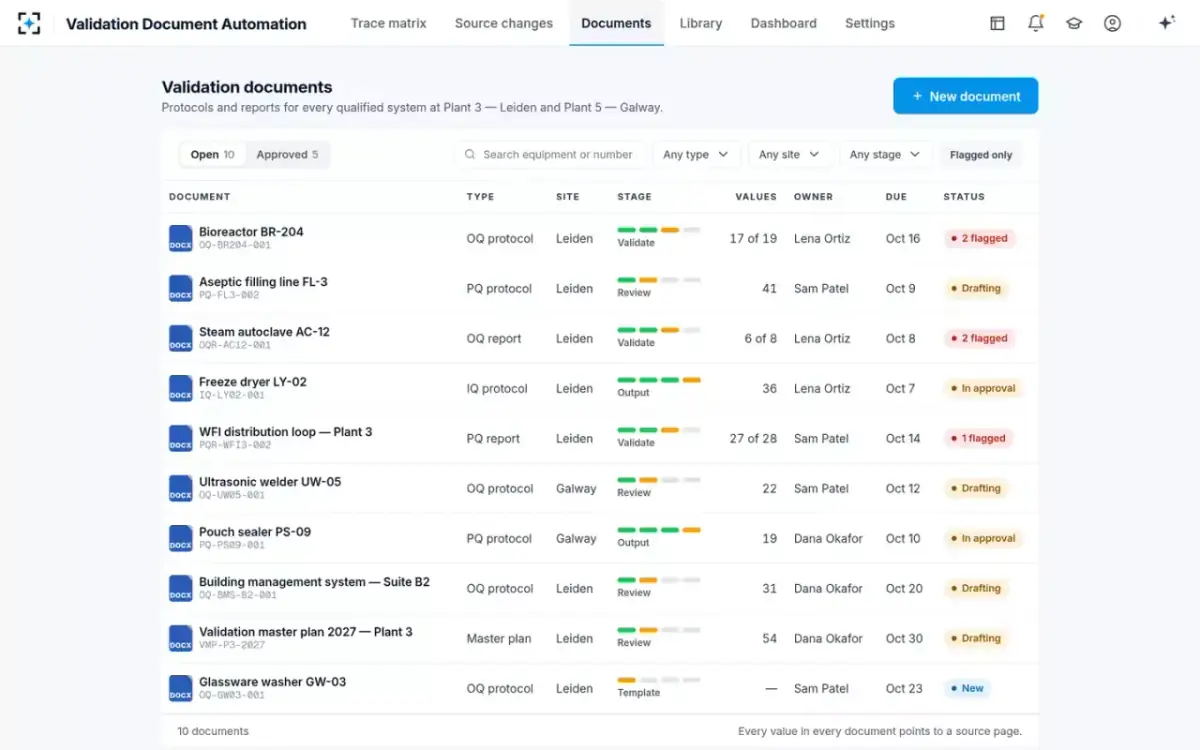
Every open protocol with its stage, its values and its flags, in Validation Document Automation
How do you prepare a validation file for an inspection?
Work backwards from the questions, not forwards from the documents. The sequence below is the one that survives an inspector picking a system at random, and most of it can be done by hand on a single piece of equipment in an afternoon — which is also how you discover how long it would take on four hundred.
The inspection-ready protocol, point by point
- Name the revision of every source on the protocol itself
Not "per the URS" but the document number and the revision the test was written from. An inspector comparing the protocol with the current revision will do this anyway; better that the file says which one it used.
- Put the requirement-to-test trace inside the approved document
As an appendix, approved and signed with the protocol. A matrix in a separate spreadsheet is a matrix with its own, unmanaged version history.
- Give every stated value its document, page and passage
Each setpoint, range, tolerance, tag and calibration date. This is the input check 211.68(b) asks for, written where it can be read.
- Leave a missing value visibly missing
A design specification that defers an alarm setpoint to commissioning should produce an empty expected result and a flag, never a plausible number. A guessed value is a finding waiting for an execution.
- Record the disagreements and the decision
Where a requirement asks for more than the equipment can do, say so, say which limit the test uses, and name who decided. An inspector who finds the disagreement before your file does will ask why nobody noticed.
- Show approval before execution, with the quality unit in it
21 CFR 211.100(a) requires written procedures to be "drafted, reviewed, and approved by the appropriate organizational units and reviewed and approved by the quality control unit"; a protocol approved after the first run is the cheapest finding on the list.
- Keep every deviation linked to its resolution
PIC/S directs inspectors to look for the resolution of errors and deviations, not just their existence. A deviation whose retest is not linked to it reads as unresolved.
- Have the change history ready for the last twelve months
Which sources got new revisions, which open documents they touched, and what was done. This is the question that separates a maintained file from a historical one.
The wording on a 483, and what Validation Document Automation can put in front of it
How the finding is usually phrased: Your firm failed to establish adequate written procedures for production and process control.
What the file should have been able to show: The protocol, in its approved revision, with the sections drafted into locked template wording and the author’s instructions recorded beside each one.
How the finding is usually phrased: Appropriate controls are not exercised over computers or related systems to assure that changes in records are instituted only by authorised personnel.
What the file should have been able to show: Approved documents never edited in place: a change opens a new version, and the activity trail names who proposed, who accepted and who signed.
How the finding is usually phrased: The validation file does not demonstrate that each requirement is tested.
What the file should have been able to show: An appendix inside the approved protocol linking 14 requirements to 31 test steps, with the gaps and the justified exclusions listed rather than omitted.
How the finding is usually phrased: The expected result in the protocol is not supported by the referenced specification.
What the file should have been able to show: Every value with its document, page and passage, and the one value no source holds left empty and flagged until an author decides and records a reason.
How the finding is usually phrased: A revised specification was not assessed for impact on the completed qualification.
What the file should have been able to show: Each new revision compared line by line with the revision the document was drafted from, every linked test marked, and what still holds listed.
What this changes about how a protocol is written
If the citations are about links rather than science, the economics of writing a protocol are the wrong way round. In the sample plant, the four working days an OQ protocol took by hand went mostly on transcription: finding the current approved revision of every source, copying setpoints and ranges and calibration dates, rebuilding the trace matrix, chasing values that disagreed. The test design — the part a regulator would actually argue with, and the part only a validation engineer can do — took a fraction of it.
What the solution changes is which of those the author spends the day on. Agents find the current approved records and index them by page, extract each value with its passage, draft the ticked sections in the site's locked template wording, and build the requirement-to-test trace as an appendix of the protocol rather than a spreadsheet beside it. In the sample protocol, 19 sections were drafted in 52 seconds with 19 values extracted and checked, 17 matched their sources, one disagreed and one was missing because the design specification left the high dissolved-oxygen alarm "to be set at commissioning". The author decides those two. No agent clears a flag, changes locked wording or signs anything.
The exported protocol, with both trace appendices
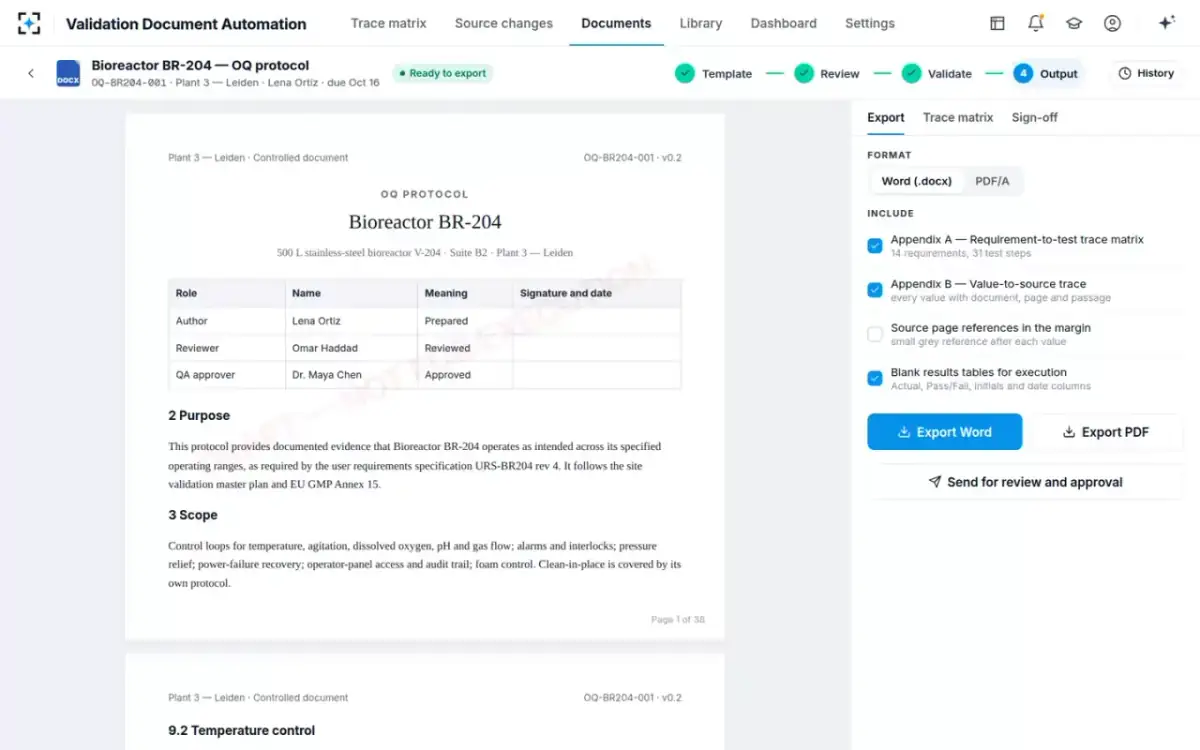
The two appendices are the point. A requirement-to-test matrix that is an appendix of the protocol is approved when the protocol is approved, superseded when it is superseded, and signed by the same people. A value-to-source appendix answers the question an inspector asks about every number on the page — where did this come from — without anyone going back to the specifications to work it out again. Both of them exist in a hand-built file too; they just exist somewhere else, at a different version.
Author, reviewer and quality approval, each signature with its meaning
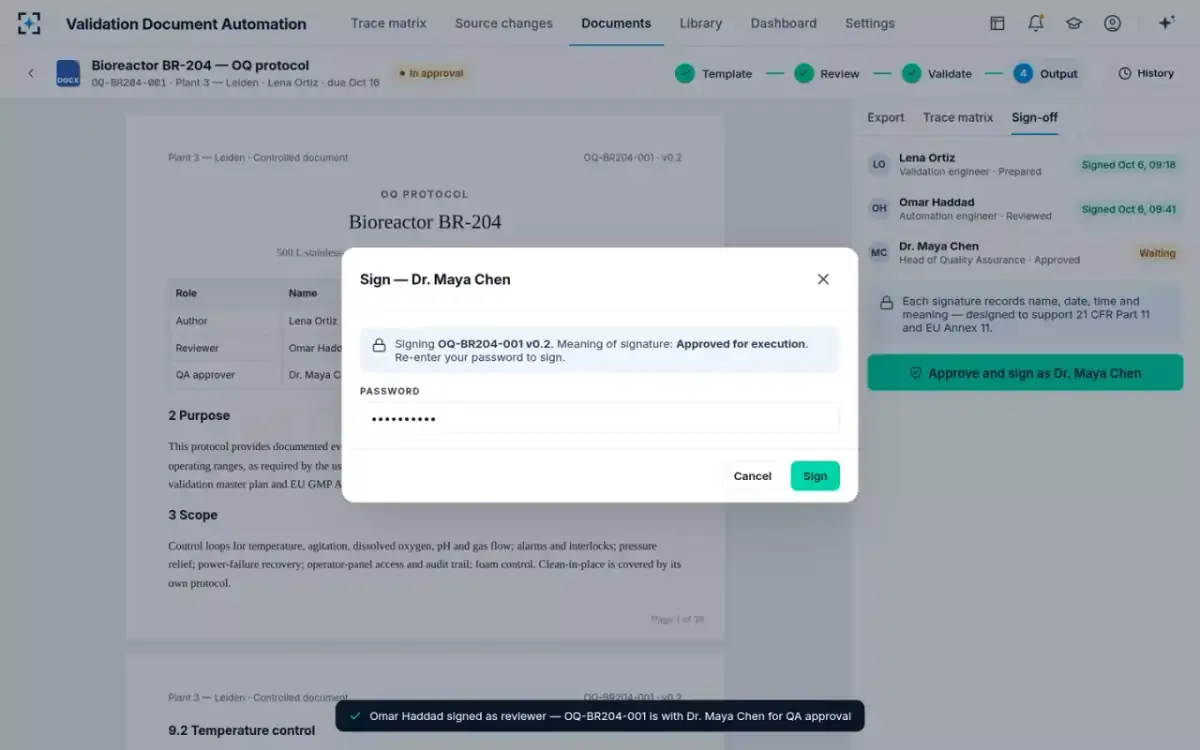
Where the solution does not help is worth saying plainly. It does not execute the protocol, does not stop a 483, and cannot make a requirement that was never written appear in the file. It drafts, cites, traces and marks; people decide, review and sign. Whether that split is allowed at all under the coming European rules on AI in manufacturing is a separate question, answered in what the draft Annex 22 allows.
The honest summary of the FDA's own data is that a validation file fails at its seams. If you want to know how your own file would read, pick one piece of equipment at random, ask the six questions in the table above, and time how long each answer takes. To see the same file assembled with the links already in it, start from Validation Document Automation.
Questions people ask
What do FDA warning letters say about computer system validation?
The letters quoted here find fault less with a test than with records that cannot be attributed, changed or retrieved under control. The fiscal year 2025 data set shows 21 CFR 211.68(b), the control over computer systems holding master and other records, cited 110 times across its sub-lines, 87 of them for control of master production and control records. Warning letters put the same idea in narrative form — shared logins, no data integrity procedure, validation last executed years earlier.
Does the FDA publish 483 observation counts?
Yes, once a fiscal year, as the Inspection Observations data sets. Each row gives the citation reference, a short and a long description and the number of times it was cited; the fiscal year 2025 workbook has separate sheets for drugs, devices, biologics, foods and others. The FDA notes that some 483s are prepared manually and are not included, so the numbers are a floor.
What is the most common validation finding?
On the drug side it is not phrased as a validation finding at all: the largest lines are written procedures and investigations, with 243 citations of 211.22(d) and 164 of 211.192 in fiscal year 2025. On the device side, where the regulation names validation directly, lack of or inadequate process validation leads at 93, with 17 more for software validation of automated processes.
How many 483 observations mention process validation?
In the fiscal year 2025 device data, 93 cite 21 CFR 820.75(a) for lack of or inadequate process validation, 23 cite 820.75(b) for the procedures monitoring a validated process, and 9 cite 820.75(c) for process changes not reviewed, evaluated or revalidated. The drug sheet has no single "process validation" line; the equivalent observations sit under written procedures, equipment and in-process controls such as 211.110(a), cited 36 times.
Who has to approve a protocol before it is executed?
The people responsible for the work, and the quality unit, before the protocol is used. Annex 15 puts it generally — every document a qualification or validation produces is to be approved and authorised by the appropriate personnel, as the pharmaceutical quality system defines them — and 21 CFR 211.100(a) requires written procedures to be reviewed and approved by the quality control unit as well as the relevant organisational units. A protocol signed after the first test has been run is an easy finding to earn.
Can software keep a validation file inspection-ready on its own?
No. Software can keep the links current — which revision each document was written from, which test proves which requirement, where each value came from, what a new revision touches — and that is the part the published citation counts keep landing on. It cannot write a requirement nobody specified, decide which limit a test should use, or sign anything. Those stay with the author, the reviewer and the quality unit.