A traceability matrix in validation is the table that carries every user requirement across to the specification that answers it, the design or configuration record that implements it, and the test cases in the IQ, OQ or PQ protocol that prove it. Read down a column it shows whether each requirement is covered; read across a row it shows the chain a reviewer follows from a sentence in the user requirements specification to an executed test result. It is the one document in a qualification pack that can be wrong without any individual test being wrong, and that is why inspectors reach for it. Botminds' Validation Document Automation builds that matrix out of the source documents themselves — requirements, functional design spec, design records, the protocol under draft — and marks the rows where a requirement has no test, a design feature has no requirement, or two approved documents give different numbers.
Everything below about equipment, documents, people and figures is sample data: a fictional 500 L stainless-steel bioreactor, BR-204 in Suite B2 at a Leiden plant, and its operational qualification protocol OQ-BR204-001. The rules and the quotations are real, and each is linked where it appears.
One sample bioreactor OQ, as Validation Document Automation traces it
14reqs
user requirements in URS-BR204, each traced across to design and to its test cases
31steps
test steps in OQ-BR204-001 that the fourteen requirements resolve to
3
requirements proved in their own approved protocols, not in this one
1
requirement with no expected result a test could state: a gap
What is a requirements traceability matrix in validation?
It is a matrix because it has two directions, and both matter. Forward, from requirement to test, it answers the question a quality approver has to be able to answer before signing: is every user requirement proved somewhere? Backward, from test to requirement, it answers the question an inspector asks: why is this test here, and what does passing it demonstrate? A list of requirements with tick boxes answers the first and not the second.
In equipment qualification the matrix spans more than two documents, because the chain has more than two links. A requirement is written by the user; a supplier's functional design specification says how the machine will meet it; a design or configuration record says what was actually built and set; and the protocol's test cases say what will be measured and what result will be accepted. Break the chain at any link and the matrix stops being proof. A requirement traced straight to a test case, with no design record in between, cannot tell a reviewer whether the thing tested is the thing built.
The vocabulary is not standardised, which causes most of the arguments about it. Software teams call it an RTM or a requirements traceability analysis; equipment teams call it a trace matrix or Appendix A; some sites keep one matrix per protocol and others one per system across its whole life. None of that is prescribed. What is prescribed, as the next sections show, is that the links exist, are documented, and are maintained.
The requirement-to-test matrix for one bioreactor OQ, with the gap row marked
User requirementURS-020 · Working volume 100–400 L in a 500 L vessel
SpecificationFDS 4.1 · p.8
Design recordP&ID-B2-204 sh.1 — V-204 · 500 L · 316L · jacketed
Test cases9.2-01
StatusTraced
User requirementURS-021 · Temperature 30.0–40.0 °C, ±0.5 °C at steady state
SpecificationFDS 6.2 · p.14
Design recordIQ-BR204-001 §8.3 — TT-204-01 · Pt100 class A
Test cases9.2-01 → 9.2-04
StatusTraced
User requirementURS-022 · Agitation 20–150 rpm, ±2 rpm
SpecificationFDS 6.3 · p.15 — drive limited to 140 rpm at the 400 L working volume
Design recordIQ-BR204-001 §8.3 — encoder SE-204-01 · VFD M-204-01
Test cases9.3-01 → 9.3-03
StatusSpecs disagree
User requirementURS-023 · pH 6.80–7.40, ±0.05
SpecificationFDS 6.5 · p.17
Design recordIQ-BR204-001 §8.3 — AIT-204-02 · pH 2–12
Test cases9.5-01 → 9.5-03
StatusTraced
User requirementURS-024 · Dissolved oxygen 30–50 % air sat., ±5 %
SpecificationFDS 6.4 · p.16
Design recordIQ-BR204-001 §8.3 — AIT-204-03 · optical DO
Test cases9.4-01 → 9.4-03
StatusTraced
User requirementURS-025 · Gas flow: air, O₂, N₂, CO₂, each 0–20 SLPM
SpecificationFDS 6.6 · p.18
Design recordIQ-BR204-001 §8.3 — MFC-204-01 to -04
Test cases9.7-01 → 9.7-04
StatusTraced
User requirementURS-026 · Clean-in-place of vessel and lines
SpecificationFDS 9.1 · p.31
Design recordTested in OQ-CIP-B2-001 · approved · justified in §3 Scope
Test cases—
StatusOther protocol
User requirementURS-027 · Steam-in-place at 121 °C for 30 min
SpecificationFDS 9.2 · p.32
Design recordTested in OQ-SIP-B2-001 · approved · justified in §3 Scope
Test cases—
StatusOther protocol
User requirementURS-031 · Critical alarms shown within 5 s
SpecificationFDS 7.2 · p.12
Design recordAlarm list HMI-204 — DO_HI setpoint to be set at commissioning
Test cases9.1-01 → 9.1-07
StatusGap
The four columns that carry the proof: requirement, specification, design record, test case
Each column has a job, and each has a failure mode worth naming.
The requirement column holds one testable statement, with its own identifier, at the granularity a test can address. A single URS line that reads "the vessel shall control temperature, pH and dissolved oxygen" is three requirements wearing one number, and it will be traced to a bundle of tests nobody can audit. The FDA's software validation guidance puts the bar on the requirement itself, asking that "All requirements are expressed in terms that are measurable or objectively verifiable" (FDA, General Principles of Software Validation). A requirement that cannot be measured cannot be traced to anything but an opinion.
The specification column holds the clause that answers the requirement, usually in the supplier's functional design spec, with its section number and page. This is the column that most often holds a surprise, because the supplier wrote it months after the requirement and against the machine it actually sells. On the sample unit, URS-022 asks for agitation from 20 to 150 rpm while FDS 6.3 limits the drive to 140 rpm at the 400 L working volume; what to do when the URS and the design spec disagree is a whole decision of its own.
The design record column holds the evidence of what was built and set: the configuration record, the as-built P&ID revision, the instrument list with tags and calibration status, the alarm list. It is the column teams drop first when the matrix is a spreadsheet, and the one that makes the matrix worth keeping, because it is where "what we asked for" meets "what is on the floor".
The test case column holds the specific numbered steps, not the section. "Section 9.2" is not traceability; "9.2-02, hold at 37.0 °C, accept 36.7–37.3 °C" is. Granularity here decides whether a change can be assessed later: a requirement traced to a section has to be re-read in full when anything in that section moves, while a requirement traced to four numbered steps tells you in one glance which of the four are affected.
The chain a reviewer follows, and who holds each link
A person decides
User requirementThe site writes what the equipment must do, one testable statement per identifier, with its GMP impact.
Never: Never written by the supplier alone
Agent
Source finderFinds the current, approved revision of the requirements, the design spec, the P&IDs, the alarm list, the IQ report and the calibration certificates, and indexes every page.
Never: Never a superseded revision as a source
Agent
Value extractorPulls each setpoint, range, tolerance, tag and calibration date with the unit exactly as written and the page and passage it came from.
Never: Never fills an unreadable value
Agent
Trace-matrix builderLinks every requirement to its specification clause, its design record and the numbered test cases that prove it, and reports a requirement with no test as a gap.
Never: Never a test case that traces to no requirement
A person decides
Author decidesThe validation engineer resolves each gap, disagreement and missing value, and accepts the drafted sections.
Never: Never cleared by an agent
A person decides
Reviewer and quality approverThe automation engineer signs for test content; the head of quality approves the protocol for execution against the matrix.
Never: Never signed on an unresolved gap
What the rules ask for today, from Annex 11 to the FDA
None of the current EU, WHO or FDA texts quoted below uses the phrase "traceability matrix", which helps explain why the practice drifted. What the current rules do say is that traceability must exist and must survive the system's life.
EU GMP Annex 11, in force since June 2011, is explicit about the requirement end of the chain: a user requirements specification describes the functions the computerised system must perform, rests on a documented risk assessment and GMP impact, and the requirements in it "should be traceable throughout the life-cycle" (EudraLex Volume 4, Annex 11 §4.4). Traceable throughout the life-cycle is a strong phrase: not traceable at qualification, traceable afterwards too, through every change.
Annex 15, which governs qualification and validation of equipment and processes, puts the user requirements specification at the centre of the same chain, as the reference point for the whole validation life cycle (EudraLex Volume 4, Annex 15). It then ties the design stage to it directly — design qualification is where the URS requirements are to be verified — which is the design-qualification half of the matrix written into the rule.
The World Health Organization's validation guideline takes the same line and extends it past purchase: the URS "should be used when selecting the required item from an approved supplier, and to verify suitability throughout the subsequent stages of qualification" (WHO Technical Report Series 1019, Annex 3). And the FDA's General Principles of Software Validation, a 2002 guidance written for medical device software, names the activity outright: "A software requirements traceability analysis should be conducted to trace software requirements to (and from) system requirements and to risk analysis results" (FDA, General Principles of Software Validation). To and from: both directions, in the agency's own words.
Put together, the current rules require the links and leave the format open. A spreadsheet satisfies them, if it is complete, current and reconcilable with the protocol it belongs to. That last condition is where most spreadsheets fail.
The 2025 draft that turns the matrix from good practice into evidence
On 7 July 2025 the European Commission opened a stakeholders' consultation on EudraLex Volume 4 Chapter 4, a revised Annex 11 and a new Annex 22, with a deadline of 7 October 2025 (European Commission, consultations on medicinal products). The revised Annex 11 draft names the matrix, and it does something sharper than naming it.
Test cases should be traceable to individual requirements or specifications, e.g. by means of a requirements traceability matrix. Test cases not referring (traceable) to requirements or applicable specifications do not meet the requirements to qualification and validation.
Draft revision of EudraLex Volume 4, Annex 11, §9.5 Traceability — out for consultation, not in force
Read the second sentence slowly. It is not a recommendation to keep a matrix; it is a statement that an untraceable test case fails. A protocol can be executed perfectly, with every result inside its limits and every page signed, and still contain test cases that prove nothing anyone asked for. Under the draft those cases do not count as qualification evidence. That moves the matrix from a courtesy appendix to the thing that decides whether the executed protocol is evidence at all.
The draft's §6.5 completes the picture from the other end: "Documented traceability between individual requirements, underlaying design specifications and corresponding qualification and validation test cases should be established and maintained." Three nouns — requirement, design specification, test case — and two verbs. Established is the easy one. Maintained is the one that defeats spreadsheets.
Two cautions on using any of this today. First, the draft is a draft: the consultation closed in October 2025, and the current EudraLex Volume 4 index still lists Annex 11 as its January 2011 revision. Second, a draft is a reasonable thing to design towards and an unreasonable thing to claim compliance with. Nobody can be compliant with a text that has not been adopted, including us.
Three rows that stop a protocol: the gap, the orphan and the disagreement
A matrix earns its keep on the rows that are not green. There are three such rows, and each needs a different person to do a different thing.
A gap is a requirement with no test that can prove it. On the sample unit, URS-031 asks for critical alarms to be shown within 5 seconds, and traces to seven test cases, 9.1-01 to 9.1-07. Six of them can state an expected result; 9.1-04 cannot, because the design record behind it, alarm list HMI-204, carries no high dissolved-oxygen setpoint: FDS-BR204 rev B page 12 leaves it "to be set at commissioning". The gap is not a missing test; it is a missing number that the test needs. The sister unit BR-203 runs its high alarm at 60% air saturation, and that is a suggestion, not a source: taking it means recording whose decision it was and marking it for verification on the panel before the test runs.
An orphan is the mirror image: a test case, or a design feature, with no requirement behind it. On the sample unit the orphan is on the design side — antifoam dosing in FDS 5.4, with pump P-204-05 and foam probe LS-204-07 in the instrument list, and nothing in the requirements asking for foam control. Two honest resolutions exist: add the requirement, because the site does rely on the function, or record that the function is present and deliberately not qualified. Testing it anyway, with no requirement behind it, is exactly the case the Annex 11 draft says does not count.
A disagreement is a row where two approved documents give different numbers for the same thing, so the matrix cannot say what the test should accept until somebody decides. URS-022's 150 rpm against FDS 6.3's 140 rpm at the 400 L working volume is one; the decision is either to keep the equipment limit and accept it in writing or to raise a change to the requirement.
How fourteen sample requirements actually resolve
URS-BR204 at first draft of OQ-BR204-001
- Traced end to end · 9 · 64.3%
- Proved in another approved protocol · 3 · 21.4%
- Waiting on a decision · 1 · 7.1%
- Gap · 1 · 7.1%
The proportion is the point. On a matrix built by hand, the nine easy rows absorb most of the effort, because every identifier, clause and page number is typed and checked by a person. The five rows that need judgement get whatever time is left. Inverting that ratio is the strongest argument for building the matrix mechanically.
The trace matrix, with the gap and its whole chain
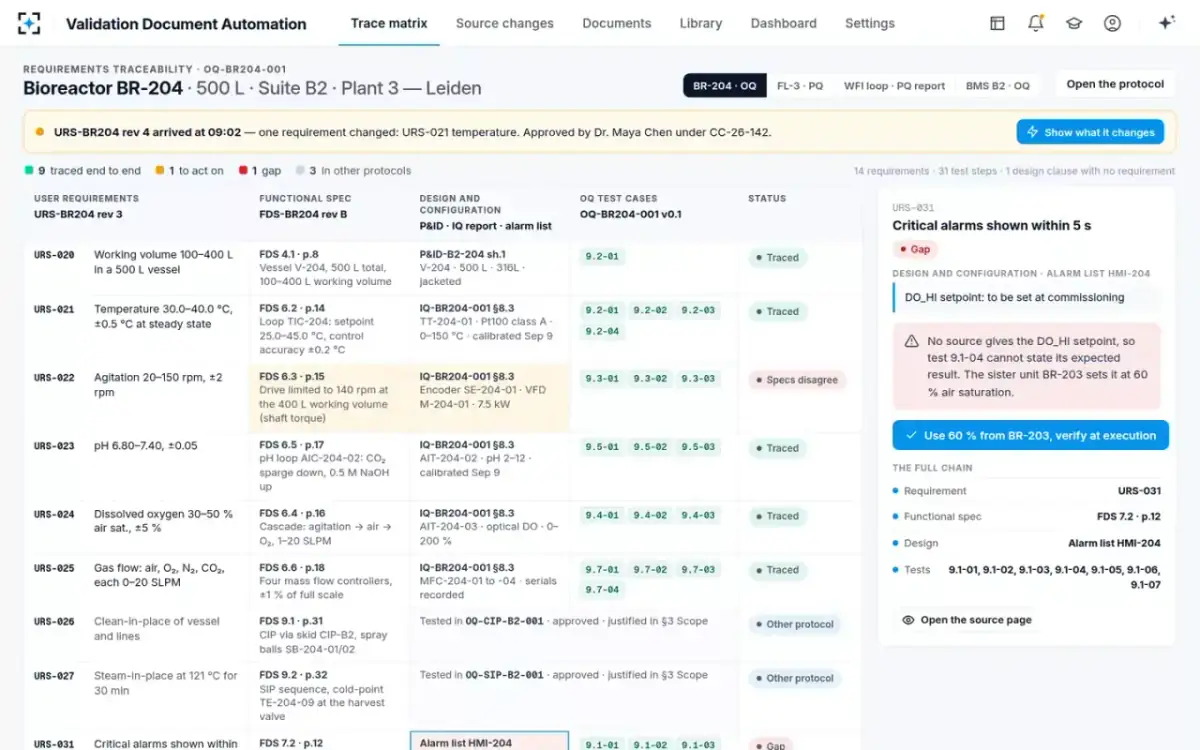
URS-031 · no source gives the high dissolved-oxygen setpoint, so test 9.1-04 cannot state its expected result
Requirements that are proved somewhere else
Three of the fourteen sample requirements are not tested in this protocol at all, and should not be. Clean-in-place of the vessel and lines is tested in OQ-CIP-B2-001; steam-in-place at 121 °C for 30 minutes in OQ-SIP-B2-001; batch data backup and restore in its own approved protocol. Writing a second, thinner test for each in the bioreactor OQ would duplicate the work and create two results that can disagree.
What the matrix has to carry instead is the pointer and the justification: the protocol identifier, its approval status, and where the scope statement that covers this requirement is written — on the sample unit, §3 Scope of the OQ itself. This part of a matrix is easy to mishandle, in two opposite directions. Some sites leave the cell blank, which reads as a gap. Others write "covered by CIP protocol" with no identifier and no pointer to the justification, which an approver cannot check and which silently breaks the day that protocol is superseded.
The useful discipline is to treat a cross-reference as a trace link with the same obligations as any other: identified, justified, and re-examined when the referenced document changes revision. If OQ-CIP-B2-001 is reissued, the bioreactor OQ's matrix is affected, and nothing but a maintained link will tell you so.
Why does the matrix drift away from the protocol?
Because the two documents are updated by different acts. The protocol is edited; the matrix is remembered. Every revision of the protocol that renumbers a test case, splits a step, tightens an expected result or adds a section is a change the matrix needs and does not get, unless the author stops and makes it.
Four drift mechanisms are worth knowing. A renumber: section 9.2 gains a step, and 9.2-03 becomes 9.2-04, so three rows of the matrix now point at the wrong test. A source revision: the requirements document moves to revision 4 and the matrix header still says revision 3, so the links are to sentences that no longer read the same way. A copied matrix: the appendix is reused from the sister unit's protocol, where the clause numbering of the design spec differed. And an execution deviation: a change made during execution, which Annex 15 requires to be "documented as a deviation and be scientifically justified", changes an acceptance criterion that the matrix still quotes in its old form.
PIC/S, the co-operation scheme of GMP inspectorates, whose guidance tells inspectors what to look for in computerised systems, draws the conclusion bluntly: a firm without proper change and version control over its system life-cycle and validation documents has a validation status that is, in PIC/S's word, "suspect" (PIC/S PI 011-3 §23.11). A drifted matrix is not a tidiness problem. It is the evidence that version control over validation documents is not working, which puts the status of everything the matrix supports in question. Which tests a changed source actually rewrites is the other half of this problem.
Building the matrix out of the documents instead of by hand
A matrix typed from documents is a second copy of them, and a second copy drifts. A matrix derived from them does not have that failure mode, because each cell is a reference rather than a transcription. That is the shape Validation Document Automation uses: the sources are indexed page by page, every extracted value carries the document, page and passage it came from, and the matrix is assembled from those links when the protocol is drafted and reassembled when either side changes.
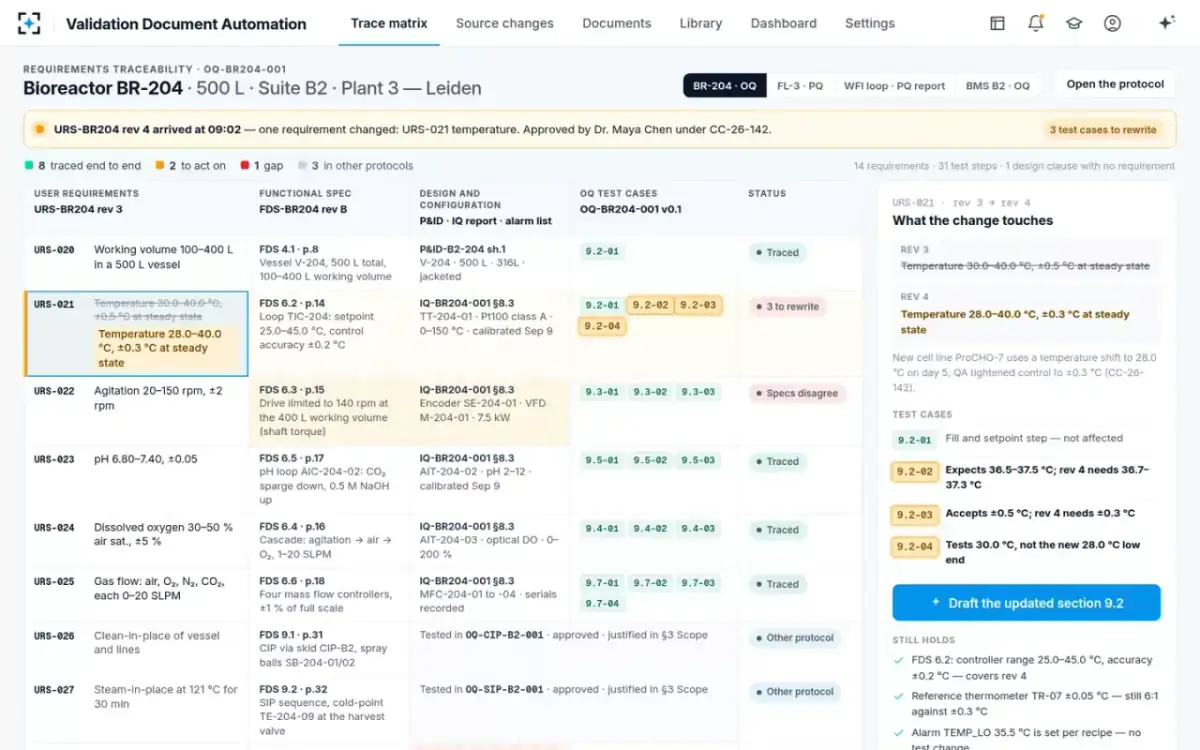
Three consequences follow from deriving rather than typing, and they are the reasons to bother. First, a cell can be checked: a reviewer clicks a value and reads the passage, instead of trusting that the author read it right. Second, coverage is computed rather than asserted — a requirement with no numbered test case is reported as a gap by construction, not noticed by someone reading down a column. Third, a change on either side is a recalculation: when the requirements document arrives at a new revision, the links tell you which test cases it touches before anyone re-reads the protocol.
The limits matter as much as the capability, and they are deliberate. The builder reports a gap; it does not invent a test to close one. It never fills an unreadable value, so a missing alarm setpoint stays visibly missing and export waits. It marks a disagreement and leaves it marked until the author decides — no agent clears a flag. In the EU draft's own vocabulary this is a human-in-the-loop design, and what each agent may and may not do on a GMP document sets out each limit in turn.
What a change does to the matrix, before anyone re-reads the protocol
What a reviewer checks before signing the matrix
A quality approver signing against a matrix is not re-doing the author's work. The checks below are the ones that find real defects fastest, in roughly the order they pay.
Does the header name the revision each source is traced to? A matrix without the revision numbers of the requirements document, the design spec and the drawings is untestable: there is no way to know whether its links are current. Do the counts reconcile? The number of requirements should match the requirements document, and the number of distinct test cases referenced should match the protocol's own numbering. A matrix with 14 requirements against a URS with 16 is a matrix with two silent gaps.
Is every non-green row resolved in writing? Each gap, orphan and disagreement should end in a decision, a deviation or a change — never in an empty cell. Are cross-references identified and dated? "Tested in OQ-CIP-B2-001, approved, justified in §3 Scope" can be checked; "covered by CIP" cannot. Are the test references numbered steps? Section-level references hide the change impact you will want next quarter.
And the one that catches the most embarrassing class of error: spot-check three cells against their sources. Open the design spec at the page the matrix cites and read the clause. On a matrix built by typing, three cells are enough to find the one that was copied from the sister unit.
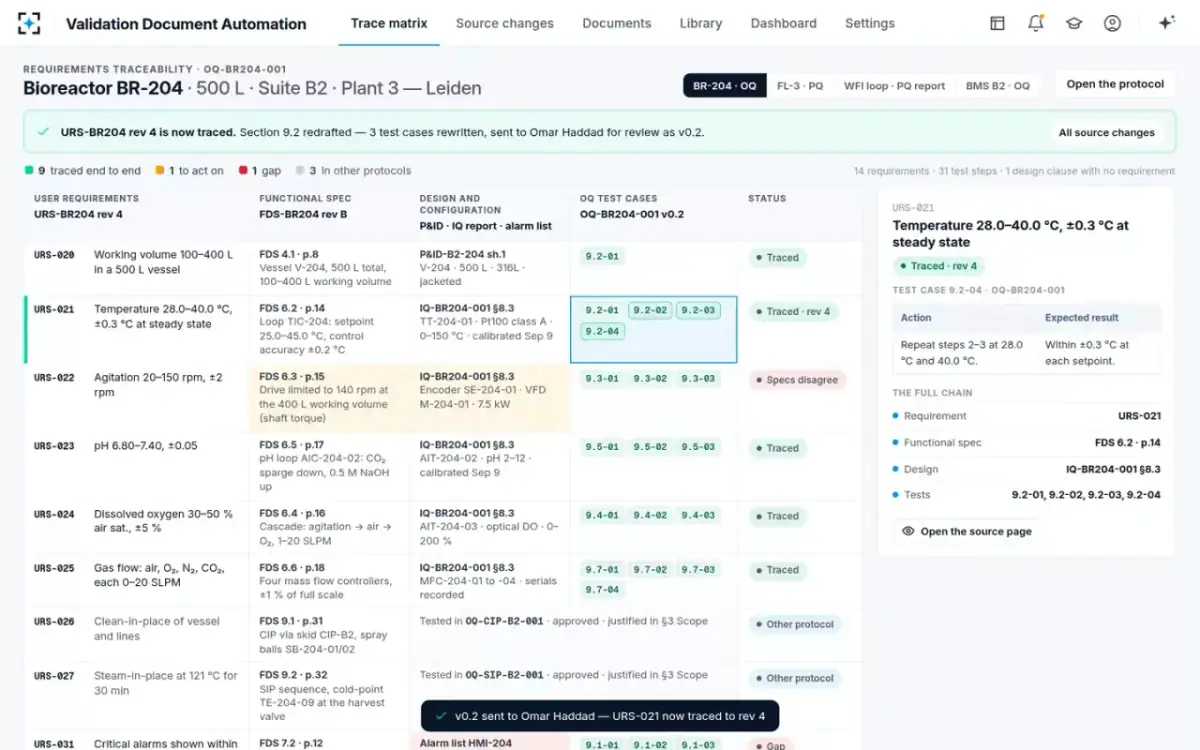
The matrix after a decision, traced to the new revision
To see the matrix, the gap, the disagreement and the change assessment on one protocol, start from Validation Document Automation.
Questions people ask
Does Annex 11 require a traceability matrix?
Not by that name. The Annex 11 in force since 2011 requires that user requirements "should be traceable throughout the life-cycle", and Annex 15 requires that the requirements of the URS be verified during design qualification — both describe the links without prescribing a format. The 2025 draft revision of Annex 11 names a requirements traceability matrix, and it is still a draft: the consultation closed on 7 October 2025.
What is an orphan test case?
A test case that traces to no requirement or specification. It is usually inherited: copied from a template or a sister unit's protocol, or written to prove a feature the supplier was proud of. The 2025 Annex 11 draft is unusually direct about it, saying that test cases not traceable to requirements or applicable specifications "do not meet the requirements to qualification and validation" — so an orphan is not harmless padding, it is evidence that does not count.
What happens if a requirement has no test?
One of three things must be written down. The requirement is tested, by adding the test case; it is proved elsewhere, by citing that protocol with its identifier and approval date; or it is deliberately not qualified, with the justification and the approval for that decision. What cannot stand is an empty cell, because an approver has no way to tell a deliberate exclusion from an oversight.
Who builds the requirements traceability matrix?
The author of the protocol owns it — usually the validation engineer or CSV lead — because the links are decisions about what proves what. Quality approves it, and in practice the automation or process engineer is the person who can say whether the design record cited is the one that reflects the equipment as built. Software can assemble and maintain the links; it cannot own the judgement that a particular test proves a particular requirement.
How do you keep a traceability matrix up to date?
By deriving it rather than copying it, and by treating every source revision as an event the matrix has to answer. If the links are references to identified documents and numbered test cases, a new revision of a requirement resolves to a specific list of affected test cases. If the links are typed text, the only honest method is to re-read both documents at every revision, which is why spreadsheet matrices drift.
Is a traceability matrix the same thing in equipment qualification and in software validation?
The idea is the same and the chain is longer for equipment. Software validation traces requirements to design and to tests, and the FDA guidance asks for the analysis to run in both directions. Equipment qualification adds the design or configuration record of the physical machine — tags, setpoints, calibration status, as-built drawings — between the specification and the test, because what was built and what was specified are not always the same thing.