TRID tolerance buckets are the three categories Regulation Z uses to judge whether a closing cost on the Loan Estimate was estimated in good faith. In the zero tolerance bucket the charge at closing may not exceed the estimate at all. In the 10% bucket a group of charges may rise by up to 10% in total. In the unlimited bucket the estimate only has to rest on the best information the lender had. Which bucket a fee falls into depends less on its name than on who is paid and who chose them: the lender, an affiliate or a provider the borrower had to take puts a fee in zero; a provider from the lender's written list puts it in 10%; a provider the borrower found alone takes it out of the comparison. Sorting fees correctly is the first step of every comparison a disclosure desk makes between the Loan Estimate and the Closing Disclosure, and it is the first thing Botminds' TRID Fee Tolerance Monitoring does when a fee moves.
The work is hard because fees move. A lock, a low appraisal or a new title invoice can change a charge after the Loan Estimate goes out, and whether the lender may pass the increase on depends first on the bucket, then on the reason and the timing. A fee sorted into the wrong bucket makes every later step wrong. The chart below is the decision a desk makes for each line.
Who is paid, and who chose them, decides the TRID tolerance bucket
What are the TRID tolerance buckets?
There are three, and zero is the default. Regulation Z says an estimated closing cost is in good faith "if the charge paid by or imposed on the consumer does not exceed the amount originally disclosed", except as paragraphs (e)(3)(ii) through (iv) provide (12 CFR 1026.19(e)(3)(i)). Paragraph (ii) is the 10% bucket, paragraph (iii) the unlimited one, and paragraph (iv) the six reasons that let a lender use a revised estimate as the new baseline. Everything that is not carved out lands in zero.
That structure tells a desk how to sort: start from the exceptions, not from zero. A fee is in the 10% bucket only if it is a recording fee, or a charge for a third-party service that is not paid to the lender or an affiliate and that the lender let the borrower shop for. A fee is unlimited only if it is one of five named kinds. If neither exception fits, the fee is zero tolerance, whatever the fee sheet calls it.
The CFPB's own consumer answer puts the same three groups in plain words: some costs "can increase at closing, but others can't" (Ask CFPB #172). The rule lets the 10% group rise in total, the unlimited group move with the facts, and the zero group not at all, unless one of the reasons for revision applies and a revised Loan Estimate goes out in time. That second question, whether a reason is valid, is the subject of the changed-circumstance rule in plain words.
Which fees are zero tolerance?
Zero tolerance covers every charge paid to the lender, a mortgage broker or an affiliate of either, every third-party service the borrower was not allowed to shop for, and transfer taxes. In practice that means the origination charges and discount points in section A of the Loan Estimate, the "services you cannot shop for" in section B (appraisal, credit report, flood determination, tax service), and the transfer taxes in section E. The CFPB lists "Fees paid to the lender, mortgage broker, or an affiliate of either the lender or mortgage broker for a required service" and "Transfer taxes" among the charges that cannot increase (Ask CFPB #172).
The affiliate test is the one that surprises people. Paragraph (e)(3)(ii)(B) admits a third-party charge into the 10% bucket only if it "is not paid to the creditor or an affiliate of the creditor". A title agency owned by the lender's holding company stays in zero even when the borrower was told to shop and chose it from the list. The commentary's own appraisal example uses "an affiliated appraiser" for exactly this reason (comment 19(e)(3)(iv)(A)-1.i).
Lender credits sit in zero too, in reverse. A smaller credit at closing than on the Loan Estimate is "an increased charge to the consumer" under the commentary, so a drop in a lender credit is treated exactly like a rise in a lender fee. The section below on credits shows when that is allowed.
Common closing costs and their usual TRID tolerance bucket
| Fee | Usual bucket | What can move it |
|---|---|---|
| Origination charges, discount points | Zero | Points reset only through a revised Loan Estimate after a lock or another valid reason |
| Appraisal, credit report, flood determination, tax service | Zero | Nothing about the name: they are zero because the borrower cannot shop for them |
| Title services and lender’s title policy, provider from your list | 10%, in total | An affiliated title agent makes it zero; a title company off the list makes it unlimited |
| Survey or pest inspection you require and let the borrower shop for | 10%, in total | Requiring a pick from your list makes it zero |
| Recording fees | 10%, in total | Named in the rule; always in the 10% group |
| Transfer taxes | Zero | Cannot increase, per the CFPB; the 2026 request for information asks whether that should change |
| Owner’s title policy, home inspection you do not require | Unlimited | Becomes zero or 10% if you make it a condition of the loan |
| Prepaid interest, homeowner’s insurance, escrow deposits, property taxes | Unlimited | Still must rest on the best information you had when you disclosed |
| Lender credits | Zero, in reverse | A decrease is an increased charge unless a valid reason is re-disclosed in time |
Which fees are in the 10 percent tolerance bucket?
Only two kinds of charge belong in the 10% bucket. The commentary says the rule "permits this limited increase for only the following items: i. Fees paid to an unaffiliated third party if the creditor permitted the consumer to shop for the third-party service … ii. Recording fees" (comment 19(e)(3)(ii)-1). Title settlement, closing protection letters, endorsements, the lender's title policy and a required survey are the usual members, when the borrower may shop and uses a provider on the lender's written list.
Recording fees are the odd member: they go to the county, nobody shops for them, and the rule puts them in the 10% group anyway. Transfer taxes, which also go to a government, do not join them. That asymmetry is one of the questions the CFPB put to the industry in July 2026, asking whether it should "consider adjusting tolerances for transfer taxes because transfer taxes cannot be determined within three business days of application" (91 FR 42382, Question 10). As of October 2026 no proposal has followed, so the rule stands.
How do you calculate the 10 percent tolerance?
Add up every charge in the 10% group on the baseline Loan Estimate, multiply by 1.10, and compare the total of the same group on the Closing Disclosure. If the closing total is higher, the excess over the limit is owed back; no single fee is tested on its own. The commentary is explicit: good faith "depends on whether the sum of all charges subject to § 1026.19(e)(3)(ii) increases by more than 10 percent, regardless of whether a particular charge increases by more than 10 percent. This is true even if an individual charge was omitted from the estimate" (comment 19(e)(3)(ii)-2).
Two consequences follow. A recording fee can jump by half and owe nothing, if the title fees came in under. And a charge that was missing from the Loan Estimate does not escape the test: it enters the closing total against a zero estimate. Take a sample loan from the solution's fictional pipeline, the Hensley purchase, where four charges sit in the 10% group.
The 10 percent tolerance is one sum, not four
Fee by fee (the wrong test): $745 to $895: up 20.1%, looks like a violation
In aggregate (the rule's test): Counts toward the total: +$150
Fee by fee (the wrong test): $225 to $375: up 66.7%
In aggregate (the rule's test): +$150
Fee by fee (the wrong test): $308 to $480: up 55.8%
In aggregate (the rule's test): +$172
Fee by fee (the wrong test): $1,862, unchanged: passes
In aggregate (the rule's test): +$0
Fee by fee (the wrong test): Three of four fees "fail", with no single amount owed
In aggregate (the rule's test): Baseline $3,140 × 1.10 = $3,454 limit. Closing $3,612, 15.0% over. Excess over the limit: $158
The baseline matters as much as the arithmetic. On the sample loan the title commitment revealed a planned unit development on 1 October, which is new information about the property and a valid reason, but no revised Loan Estimate followed within three business days, so the baseline for the 10% group stayed where it was. A calculator that compares the Closing Disclosure with the latest Loan Estimate instead of the right one gets the bucket right and the answer wrong. What a TRID tolerance calculator needs to know covers that second half.
What is unlimited tolerance?
Unlimited tolerance means the amount may change by any amount, so long as the original estimate was "consistent with the best information reasonably available to the creditor at the time it is disclosed" (12 CFR 1026.19(e)(3)(iii)). It covers five kinds of charge: prepaid interest; property insurance premiums; amounts placed in escrow; charges paid to providers the borrower chose who are not on the lender's list; and property taxes and other charges for services the lender does not require. It applies even when the charge is paid to the lender or an affiliate, "so long as the charges are bona fide".
Unlimited is not the same as unexamined. The commentary gives two failures. A lender that requires homeowner's insurance and leaves the premium off the Loan Estimate has not met the standard. And "if the creditor knows that the loan must close on the 15th of the month but estimates prepaid interest to be paid from the 30th of that month, then the under-disclosure does not comply" (comment 19(e)(3)(iii)-1). Leaving out flood insurance on a house outside a required flood zone, by contrast, is in good faith. The test is diligence at the moment of disclosure, not accuracy at closing.
Services you can shop for vs services you cannot: the written list decides
Whether the borrower could shop is a question of fact, and the written list of service providers is the evidence. Regulation Z says the lender permits shopping when it lets the borrower "select the provider of that service, subject to reasonable requirements", and that a lender who requires the borrower to choose from its own list has not permitted shopping at all (comment 19(e)(1)(vi)-1). A list that is really a menu of required providers puts every fee on it back into zero.
When shopping is allowed, the list has its own rules, and missing it was one of the first findings in the CFPB's first round of examinations after the rule took effect: entities "failed to provide consumers with a list identifying at least one available settlement service provider" (CFPB Supervisory Highlights, Summer 2017).
Five things the written list of service providers must get right
- Name at least one provider for each service the borrower may shop for
The rule requires "at least one available provider for each settlement service for which the consumer is permitted to shop".
- Say the borrower may choose someone else
The list must state "that the consumer may choose a different provider for that service". Without it, the list reads as a requirement.
- Go out separately, on the Loan Estimate’s timing
Separate from the Loan Estimate itself, within three business days of the application.
- Match section C of the Loan Estimate
The services the borrower can shop for are identified on the Loan Estimate; the list and that section should name the same services.
- Note which provider the borrower actually chose
A provider from the list keeps the fee in the 10% bucket; one off the list moves it to unlimited. The bucket on the Closing Disclosure depends on this one detail.
Title, appraisal and transfer taxes: the fees that change buckets
Three lines cause most of the arguments at a disclosure desk, because the same fee can sit in different buckets on different loans. Title fees are 10% when the borrower may shop and uses a title company from the list, zero when the title agent is an affiliate or when the lender in practice dictated the choice, and unlimited when the borrower brought a title company the list did not name. The same fee on the same Closing Disclosure line can therefore be in any of the three buckets, and the fee sheet alone cannot tell which.
The appraisal fee is zero tolerance on almost every loan, because lenders do not let borrowers pick the appraiser. That is why an appraisal rush fee is such a common problem: the fee can only rise through a valid reason and a timely revised estimate, and a rush the loan officer ordered is not the borrower's request. The CFPB's examiners found exactly that pattern in 2022, and the documentation it calls for is set out in what an examiner needs to see in a changed circumstance form.
Transfer taxes are zero. They are not a third-party service and not a recording fee, so no exception reaches them, and a seller-paid tax that shifts to the buyer late in the negotiation has to be justified like any other increase. The CFPB's 2026 request for information asked about both: tolerances for transfer taxes, and guidance on changed circumstances "where a purchaser continues to negotiate with the seller for payment of charges customarily paid by the borrower" (Questions 10 and 11).
Lender credits run the other way
A lender credit may rise freely and may fall only like a zero-tolerance fee may rise. The commentary's example: "if the creditor discloses a $750 estimate for 'lender credits' … but only $500 of lender credits is actually provided to the consumer, the creditor has not complied" (comment 19(e)(3)(i)-5). The CFPB's FAQ adds when a decrease is allowed: only alongside a changed circumstance or another reason for revision, with a revised estimate within three business days (CFPB TRID FAQs).
Rate locks are where credits most often fall. A floating Loan Estimate that showed a credit, followed by a lock at a different price, can reduce it, but only on a revised Loan Estimate sent within three business days of the lock. The commentary also blesses the reverse case: a $750 credit that grows by $150 to pay for a $150 increase in the appraisal fee is not a violation, because the credit rose with the cost.
Tolerance and Loan Estimate errors stay near the top of FDIC findings
40%+
of TILA violations the FDIC cited in 2019 were TRID-related
#1
§1026.19(e), the Loan Estimate and good-faith rule, was the most-cited TILA provision in 2021
#1
and again among the FDIC’s three most-cited TILA violations in 2025
How TRID Fee Tolerance Monitoring sorts each fee into its bucket
The solution does the sorting before it does any arithmetic. Its disclosure reader maps every fee on every Loan Estimate, Closing Disclosure and settlement fee sheet to its section and line, and its tolerance calculator puts each fee in a bucket from who is paid, whether the service is required, and the provider list. One limit is built in: the calculator never moves a fee to a looser bucket without the provider list proving it. A title fee is not treated as 10% because it usually is; it is 10% on this loan because the borrower chose a title company the list named.
Then each fee is set against the right baseline: the original Loan Estimate, or a revised one if a valid reason was re-disclosed in time. On the Hensley sample loan that gives nine fees in zero tolerance, four in the 10% group and six unlimited, with a $175 problem in zero (an appraisal rush fee) and the $158 excess in the 10% group shown above. The disclosure desk sees each fee, its bucket and its result before anything is drafted.
Every fee in its bucket, against its own baseline
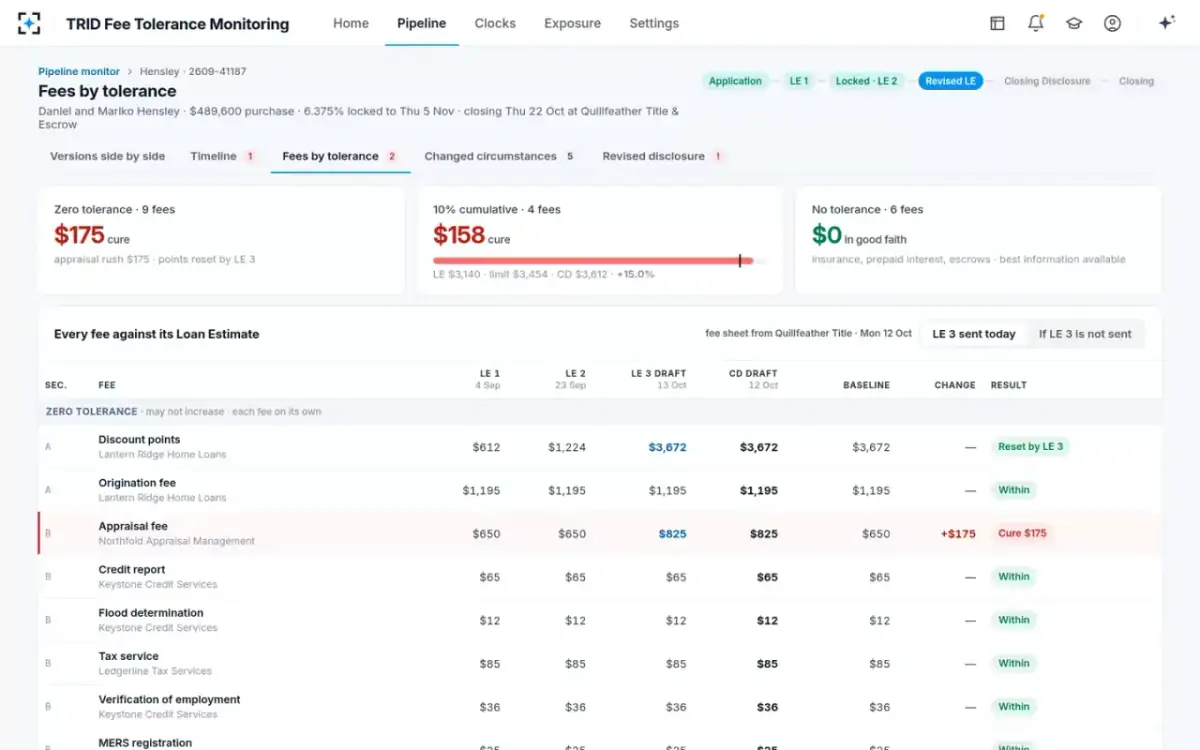
The baseline column is the point: the discount points are measured against the revised Loan Estimate that resets them, the appraisal fee against the original.
The agents recommend and the desk decides. A named person accepts each result, and nothing is sent, changed or credited without that person's approval. When a fee is over tolerance at closing, the remedy is a refund, which is a post-closing question covered in why a loan must be tested before day 60. The rest of the solution, from changed circumstances to the disclosure clocks, is on the TRID Fee Tolerance Monitoring page.
Questions people ask
Are title fees zero or 10 percent tolerance?
Usually 10%, in total with the other shoppable services and recording fees, when the borrower may shop and uses a title company from the lender's written list. They are zero if the title agent is the lender's affiliate or if the borrower had to use the lender's choice, and unlimited if the borrower picked a title company the list did not name.
Is the appraisal fee zero tolerance?
Almost always, because the borrower cannot shop for the appraiser. It can rise only for one of the six reasons for revision, with a revised Loan Estimate within three business days; otherwise the commentary measures the actual fee against the original estimate.
Are transfer taxes zero tolerance?
Yes. The CFPB lists transfer taxes among the charges that cannot increase, because they are neither a third-party service nor a recording fee. The CFPB asked in July 2026 whether that should change; as of October 2026 there is no proposal, so the rule is unchanged.
Does the 10 percent tolerance apply to each fee separately?
No. The test is the total of the whole group against 110% of the baseline total, "regardless of whether a particular charge increases by more than 10 percent". A fee that was left off the Loan Estimate is added to the closing total against an estimate of nothing.
What happens when a bucket is over tolerance at closing?
The lender refunds the excess, usually as a lender credit on the Closing Disclosure, and Regulation Z allows the refund to be made no later than 60 days after consummation. The refund is the remedy, not a defence against the examination finding.
Do lender credits count in the tolerance test?
Yes, as negative charges in the zero-tolerance bucket. A lender credit may go up at any time, but a smaller credit at closing than on the Loan Estimate is an increased charge, allowed only with a valid reason and a revised estimate within three business days.