A mortgage disclosure desk is the team that prepares and sends a lender's TRID disclosures: the initial Loan Estimate within three business days of an application, every revised Loan Estimate after a rate lock or a changed circumstance, and usually the initial Closing Disclosure. Each disclosure it sends starts a clock and each change it learns about starts another, so the desk's real job is less filling in forms than deciding, many times a day, whether a fee may move and by when the borrower must hear about it. Almost nine loans in ten get at least one revised disclosure before closing, which makes the desk one of the busiest compliance points in mortgage lending. Botminds' TRID Fee Tolerance Monitoring is built for that desk: it watches every fee change, judges it against the rule and counts each clock, and leaves every decision and every send to the specialist.
The day below is a composite with fictional names: Imani Clarke, a disclosure specialist at a mid-size lender, working about forty open loans on a Tuesday in October.
A disclosure specialist's Tuesday: every block starts or stops a clock
- Locks8:00
- New LEs9:00
- Invoices10:15
- Extension11:45
- Lunch12:30
- CDs1:00
- Evidence2:30
- Cut-off4:00
What does a mortgage disclosure desk do?
It owns the disclosures between application and closing, and the clocks attached to them. The initial Loan Estimate goes out by the third business day after the application. A revised Loan Estimate goes out within three business days of a rate lock or of any other valid reason for revision, and must reach the borrower at least four business days before closing. The Closing Disclosure must be received three business days before consummation, and a corrected one goes out whenever the terms change, with a fresh three-day wait if the APR becomes inaccurate, the product changes or a prepayment penalty is added (12 CFR 1026.19(e)–(f)).
Regulators favour putting this work in one place. In its 2020 supervisory highlights the FDIC suggested that lenders with TRID problems consider "implementation of a centralized process to complete or review disclosures to ensure accuracy and consistency", alongside "a secondary review of applicable loans prior to consummation to self-identify and correct deficiencies" (FDIC Consumer Compliance Supervisory Highlights, April 2020). A disclosure desk is that centralised process. Loan officers and processors feed it; the closer and the settlement agent take over at the Closing Disclosure.
8:00 to 5:00: the day, clock by clock
8:00, the overnight locks. Three borrowers locked their rates after the desk closed yesterday. Each lock sets a three-business-day deadline for a revised Loan Estimate showing the rate, the points, any lender credit and the other rate-dependent charges. A lock that lowers a credit counts as an increased charge, so Imani checks each credit against the last Loan Estimate before she drafts.
9:00, new applications. Four applications arrived on Friday and Monday. Each has its own day-three deadline on the lender's office calendar, and each needs a written list of settlement service providers sent with it. A file with a missing property address waits; one with all six pieces of information does not, and the desk cannot later claim the address as news.
10:15, the invoices. An appraisal invoice is $175 above the estimate, with a processor's note: "rush, borrower closing date". A title commitment shows a planned unit development, so the endorsements will cost more. Each is a question with two parts: is it a valid reason, and if so, when did the lender first have enough to know it? The second part is where most of the deadline is spent before anyone notices.
11:45, a lock extension. A borrower whose closing slipped asks to extend the lock. The extension fee may go on a revised Loan Estimate as a borrower request, at the lender's usual price; nothing else may ride along on the same form. 1:00, the Closing Disclosures. Three loans close next week. Imani balances each draft against the settlement agent's fee sheet, finds a recording fee $172 higher than estimated, and checks the 10% group in total rather than line by line.
2:30, the evidence. The rush note needs the email behind it; the planned unit development needs the date the title commitment arrived. Neither is in the disclosure system, and both decide whether the fees reset.4:00, the cut-off. Everything that must count as sent today goes out before the desk's cut-off. Imani notes which disclosures were opened, because an unopened e-delivery is presumed received three receipt days later, and that date decides when the Closing Disclosure can follow.
How many revised Loan Estimates does a loan get?
On most loans, at least one, and on about a fifth, two or more. The CFPB's analysis of about 50,000 loans originated between March 2016 and November 2017 found: "Almost 90 percent of mortgages received at least one revision (either a revised Loan Estimate or a corrected Closing Disclosure). About 62 percent received at least one revised Loan Estimate, and about 49 percent received at least one corrected Closing Disclosure" (CFPB Data Point, 2020). Its TRID assessment adds that about 22% received two or more revised Loan Estimates.
Almost every loan's disclosures change before closing
~90%
of loans received at least one revised Loan Estimate or corrected Closing Disclosure
62%
received at least one revised Loan Estimate
49%
received at least one corrected Closing Disclosure
40%+
saw the APR change between the first Loan Estimate and the last Closing Disclosure
Lenders' own answers point the same way. Asked how many revised Loan Estimates they provided per consumer in 2018, the respondents to the CFPB's survey for its TRID assessment answered as below. The survey is not a representative sample, but the shape matches the loan data: a revision is normal, and a third or fourth is not rare.
Revised Loan Estimates per borrower, as lenders reported them for 2018
What is the hardest part of the disclosure desk?
Not the forms: the evidence and the calendar. Drafting a revised Loan Estimate is a few minutes in any disclosure system. Deciding whether the reason is valid means finding who asked for the change and when the lender knew, which lives in emails, lock confirmations and vendor portals, not in the disclosure system. Counting the deadline means knowing which of two calendars the clock uses and which days the office was open. The CFPB's examiners have found both failing: rush appraisal fees blamed on borrowers when the documentation showed the loan officer had asked and, under the rule before TRID, revised estimates sent after their three-day window.
Lenders feel it as cost. In the CFPB's assessment survey, 87.6% of lender respondents said the number of revised disclosures had increased their ongoing costs, and 55.1% said significantly (TRID Rule Assessment, Table 17). Many protect themselves by padding: more than three-quarters said they at least sometimes estimated fees at the top of their range to avoid tolerance violations, which is why costs on the Closing Disclosure often come in below the estimate. In July 2026 the CFPB asked the industry how "to reduce the incidence of revised disclosures" without closing delays (91 FR 42382, Question 5); as of October 2026 the rule is unchanged.
How are redisclosures tracked?
A redisclosure tracker that works has to hold, for every change, five things: what changed, when the lender knew, which reason it rests on, the deadline counted on the right calendar, and whether the revised disclosure went out and was received. Disclosure and loan origination systems are built to hold the last of these, because they produce the documents. The first four sit outside them, which is where side spreadsheets of due dates come from, and where calendars get mixed. The TRID date calculator guide shows the two calendars a tracker must keep apart.
The document that matters most to an examiner is the changed-circumstance file: the original estimate, the reason, how it changed the cost, that the increase went no further, and the timing. The desk builds it as it goes or rebuilds it later from memory; what an examiner needs to see in a changed circumstance form sets out its parts.
Who hands the disclosure desk its work?
Five roles feed the desk, and each holds a piece of the evidence the desk needs. The loan officer has the borrower's requests, the lock desk the pricing events, the processor the orders and invoices, the closer the settlement agent's figures, and compliance the policy on exceptions. A change that reaches the desk late, or without its evidence, has already used part of its three days.
Five roles, five pieces of the evidence
Today
Takes the application, relays borrower requests and sometimes orders rush services to protect a lock
With agents
Sees, the day it happens, when a rush they ordered will not reset a fee
Still theirs: The borrower relationship and the request itself
Today
Locks, extends and re-prices; each event starts a three-business-day clock the desk must notice
With agents
Every lock event opens a check on the loan within minutes
Still theirs: Pricing and lock decisions
Today
Orders the appraisal and title, receives the invoices, writes the change notes
With agents
Notes are read against the email and invoice behind them
Still theirs: Orders, conditions and vendor contact
Today
Balance the Closing Disclosure against the fee sheet days before closing, and find the cure then
With agents
Receive a Closing Disclosure whose cure was worked out a week earlier
Still theirs: Balancing, signing and funding
Today
Learns a reason was never written down when a post-closing test finds it
With agents
Co-approves overrides and larger cures with the evidence in front of them
Still theirs: Policy and the final say on exceptions
Disclosure desk specialist: the job description behind the title
There is no government occupation called disclosure specialist. The Bureau of Labor Statistics files the work under loan interviewers and clerks, a group whose duties include to "complete transactions between loan establishment, borrowers, and sellers upon approval of loan"; it counted 203,940 people in the occupation in May 2023, at a mean wage of $48,660 (BLS Occupational Employment and Wage Statistics). That figure covers processors and closers too. The postings behind the search term ask for more than clerical skill, and the checklist below is what the job actually holds.
What a disclosure desk specialist is responsible for
- Initial Loan Estimates on time
By the third business day after a complete application, with the written list of service providers.
- Revised Loan Estimates after every lock
Points, credits and rate-dependent charges within three business days of the lock.
- Judging changed circumstances
Which of the six reasons applies, what it caused, and when the lender first knew.
- Counting every clock on the right calendar
Office days for sending; every day but Sundays and federal holidays for receipt.
- Tolerance comparison by bucket
Zero tolerance fee by fee, the 10% group in total, the rest on best information.
- The initial Closing Disclosure
Received three business days before closing, balanced with the settlement agent.
- Documentation an examiner can follow
The original estimate, the reason, the effect on cost and the timing, for each change.
- Escalation
Overrides and cures above the desk’s limit to compliance, with the evidence.
Where agents take the counting off the desk
TRID Fee Tolerance Monitoring keeps the specialist's judgement and takes over the parts of the day that are finding and counting. A fee change watcher opens a check minutes after the lock desk re-prices or an invoice lands, and logs the time the change became known. A disclosure reader lays every Loan Estimate, Closing Disclosure and fee sheet side by side. A tolerance calculator sorts the fees into buckets against the right baseline; a changed-circumstance judge reads the note and the email behind it; a clock keeper counts each deadline; and a drafter prepares the revised Loan Estimate or the cure.
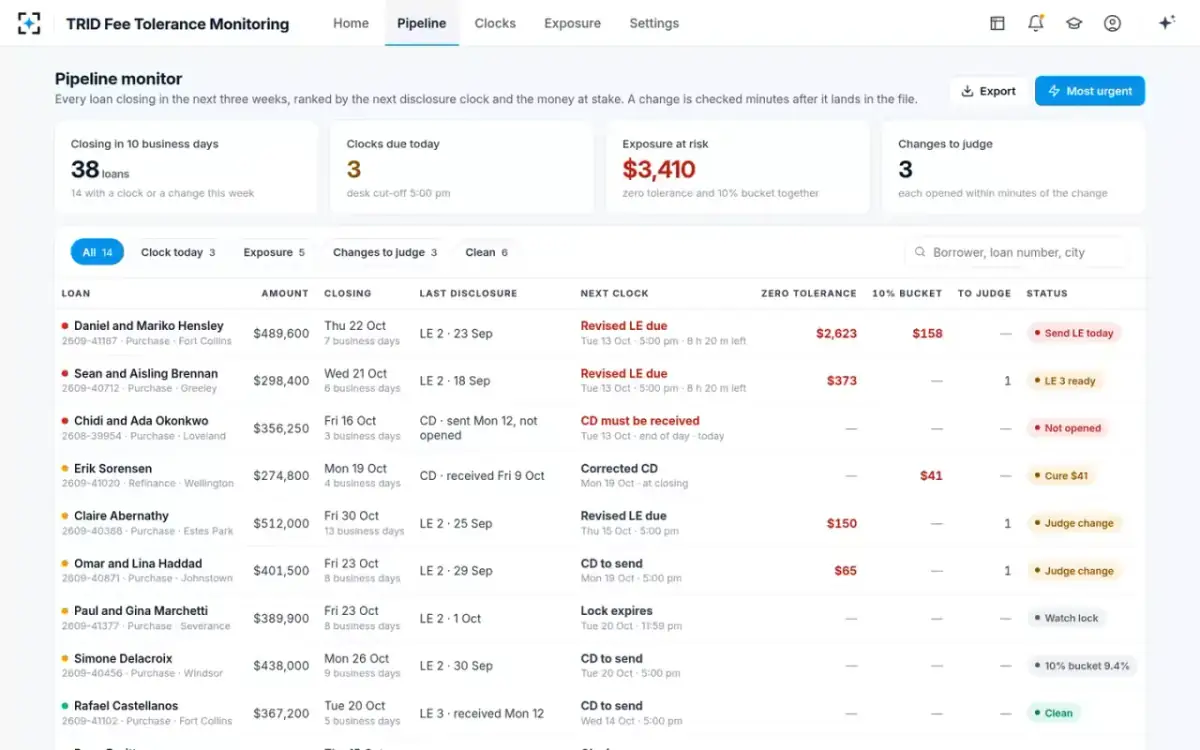
The specialist starts the day on the loan with the nearest clock instead of the oldest email. On the solution's sample pipeline, a fictional lender with 38 loans closing in the next ten business days, the morning screen shows three clocks due today and $3,410 of tolerance exposure, each traced to a loan and a fee. She accepts or overrides each judgement and approves every send; compliance co-approves overrides and cures above the desk's limit. How the monitor sits next to the systems the desk already uses is covered in what closing disclosure software does not watch, and the full solution is on the TRID Fee Tolerance Monitoring page.
The morning starts on the nearest clock, not the oldest email
Questions people ask
Who sends the Closing Disclosure, the lender or the settlement agent?
The lender is responsible for it. Regulation Z lets the settlement agent provide the Closing Disclosure, but the creditor remains responsible for its accuracy and timing, which is why many lenders keep the initial Closing Disclosure on the disclosure desk and hand balancing to the closer.
What does a disclosure desk specialist earn?
The government does not publish a figure for the title. The nearest occupation, loan interviewers and clerks, had a mean annual wage of $48,660 in May 2023, across 203,940 jobs that also include processors and closers.
Is the disclosure desk part of compliance or operations?
Usually operations, reporting to mortgage operations alongside processing and closing, with compliance setting policy and reviewing exceptions. The split matters for overrides: a decision to treat a reason as valid against the evidence should need a second person outside the desk.
How long does a revised Loan Estimate take to prepare?
The drafting is short once the figures are known. The time goes on establishing the reason and its date, and on checking that nothing else on the form moved without one. A reason that takes two days to confirm leaves one day to send.
Do disclosure desks work on Saturdays?
Some do. It matters for the calendar: if the office is open on Saturday for substantially all its business, Saturday is a business day for sending revised Loan Estimates. For receipt and the Closing Disclosure wait, Saturday counts whether the desk works or not.