A changed circumstance form, sometimes called a changed circumstance detail form or letter, is the lender's own account of why a fee on a revised Loan Estimate was allowed to rise. Regulation Z does not prescribe a form, but its commentary sets out what the lender must be able to show: the original estimate, the reason for the revision and how it affected costs, that the increase went only as far as the reason caused, and that the revised disclosure went out on time. A form with those five parts, each tied to a dated document, is what an examiner reads when deciding whether a reset was valid. A form with a reason code and a checked box is what CFPB examiners rejected in 2022. Botminds' TRID Fee Tolerance Monitoring builds the five parts from the loan file as each change lands, so the form exists before the revised Loan Estimate goes out rather than being reconstructed after closing.
A changed circumstance form with every part an examiner looks for
Changed circumstanceLoan 2609-41187 · Hensley · purchase · closing Thu 22 Oct 2026
Revised Loan Estimate 3
Baseline
Loan Estimate 2, Wed 23 Sep: discount points $1,224 (0.250%), no mortgage insurance
The original estimate
Reason
(e)(3)(iv)(A), relied-on information inaccurate: the property’s value
The reason for revision
Evidence
Appraisal report, page 1, received Thu 8 Oct, 4:12 pm: value $598,000 against a $612,000 price
The reason for revision
Who caused it
Independent appraisal; no request from the lender or the borrower
The reason for revision
Effect on cost
Loan-to-value 80.00% to 81.87%; the locked rate now prices at 0.750 points, $3,672; mortgage insurance $118 a month
How it affected costs
Limit
Only the points and mortgage insurance revised; the rush appraisal fee and the 10% group stay at their own baselines
Only what the reason caused
Timing
Due Tue 13 Oct (office days Fri 9, Mon 12, Tue 13); sent Tue 13 Oct, 9:12 am, by e-delivery; to be received by Sat 17 Oct
The timing was met
Decision
Accepted by the disclosure desk lead; no override; within the desk’s approval limit
Who decided
What should a changed circumstance form include?
Five parts come straight from the commentary, which says the lender "must be able to show compliance with § 1026.19(e) by documenting the original estimate of the cost at issue, explaining the reason for revision and how it affected settlement costs, showing that the corrected disclosure increased the estimate only to the extent that the reason for revision actually increased the cost, and showing that the timing requirements of § 1026.19(e)(4) were satisfied" (comment 19(e)(3)(iv)-3). The same comment adds that one revised Loan Estimate may reflect several changed circumstances, "provided that the creditor's documentation demonstrates that each correction complies".
Two more parts come from what examiners have tested since. The first is who caused the change, because a reason the lender created fits none of the definition's limbs, and because "borrower requested" is a claim that needs the borrower's words. The second is who decided and on what evidence, so that an override of the evidence is visible as an override. The checklist below turns all seven into fields.
Seven fields a changed circumstance form needs
- The baseline for each affected fee
Which Loan Estimate, its date, and the amount. "Original estimate" means the figure the fee is measured against today.
- The reason, by paragraph
Which of the six in §1026.19(e)(3)(iv), and for a changed circumstance, which of the three limbs.
- The evidence, dated and timed
The appraisal, invoice, lock confirmation, title commitment or email, with when the lender received it.
- Who caused it
The borrower, a third party, an outside event, or the lender. A borrower request needs the borrower’s own request.
- How it changed each cost
The arithmetic from cause to fee: a new fee schedule, a new price, a new program.
- What was not revised
The fees on the same Loan Estimate that stay at their old baseline, so nothing rides along.
- The timing, counted
The day information became sufficient, the office days counted, the send date, the delivery method and the receipt date.
How do you document a changed circumstance?
By attaching the document that made the reason known and writing down what it did to the cost, at the time, not after closing. The test an examiner applies is whether a stranger could rebuild the decision from the file: open the appraisal and see the value; open the pricing sheet and see the new points; open the calendar and see that the revised Loan Estimate went out by the third office day. A form that says "appraisal came in low, points changed" without those attachments asks the examiner to take the lender's word.
Timing is part of the documentation, and it is the part most often reconstructed. The rule counts three business days from "receiving information sufficient to establish" the reason (12 CFR 1026.19(e)(4)(i)). If the form notes when a processor opened the task instead of when the invoice arrived, it documents the wrong day. One afternoon's race to a 5:00 Thursday deadline shows how a day zero gets chosen.
Is a checkbox enough for a borrower-requested change?
No. A borrower's request is one of the six reasons for revision, and it is the easiest to claim. In 2022 the CFPB reported lenders that had put appraisal rush fees on revised Loan Estimates as borrower requests. The documentation showed that either the appraisal management company had told the lenders a rush was needed or the lenders' own loan officers had asked for it, and in some files there was nothing at all.
In certain instances, the lenders' documentation included only a checked box indicating the consumer requested the rush appraisal, but there was no other evidence retained reflecting this occurred.
CFPB Supervisory Highlights, Issue 26, Spring 2022
The lenders agreed to remediate affected consumers, revise their policies to make sure documentation is obtained and kept, and strengthen quality control. The lesson for the form is simple: a borrower request needs the borrower's request, in an email, a signed change form or a dated call note in the borrower's words. A loan officer's note that the borrower wanted it is the loan officer's account, and the loan officer may be the person who wanted it.
The email behind the note: who actually asked for the rush
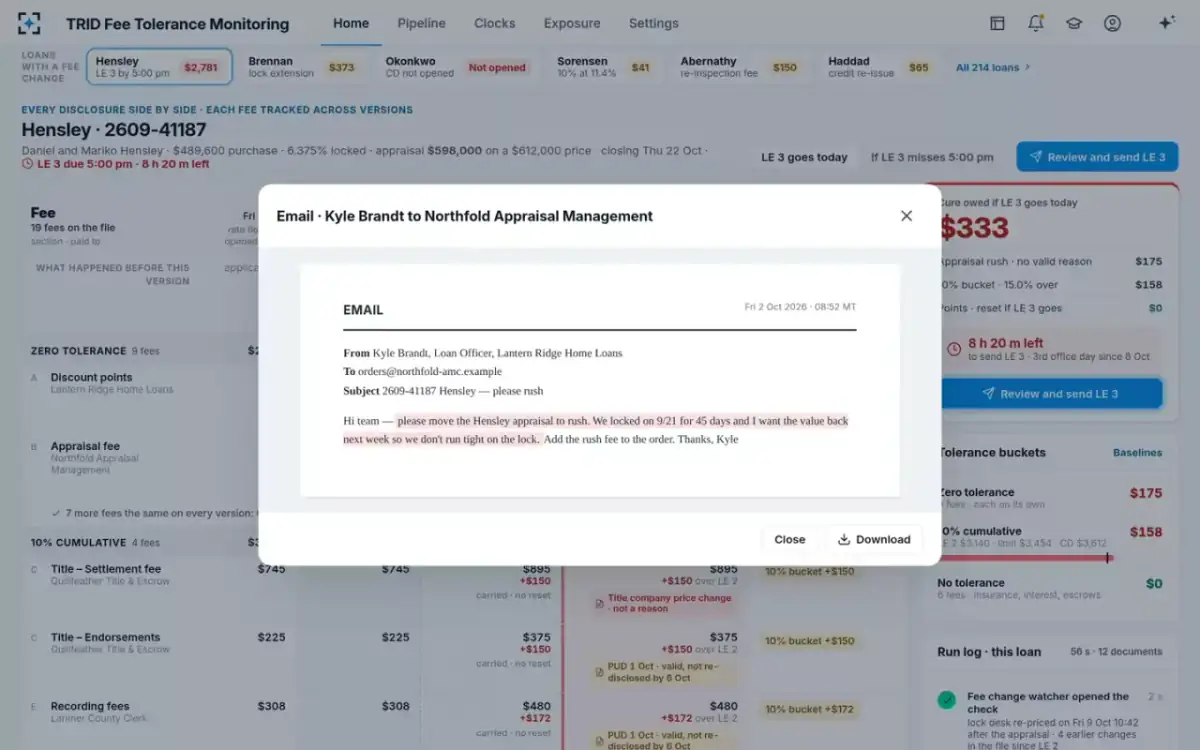
This is the evidence an examiner would ask for, found while the loan is open. With it, the $175 rush fee is judged not valid and planned as a cure, rather than claimed as a borrower request.
What do examiners look for in changed circumstances?
Evidence and timing, more than the reason itself. Before TRID, the CFPB's examiners already reported lenders that "failed to provide the consumer a timely revised GFE within three business days of receiving information to establish a changed circumstance" and that failed to properly document changed circumstances (CFPB TRID Rule Assessment, 2020). In the first round under TRID, they found entities that "failed to retain evidence of compliance with the requirements associated with the Loan Estimate" (CFPB Supervisory Highlights, Summer 2017).
The FDIC's counts show why this matters at scale: section 1026.19(e), which covers good-faith estimates, revised disclosures and their timing, was the most-cited TILA provision in its 2021 examinations (FDIC Consumer Compliance Supervisory Highlights, March 2022). A reset that cannot be shown is treated as a reset that did not happen, and the fee is compared with the original estimate.
The same change, documented two ways
A file that fails: "Rush appraisal: borrower request" chosen from a list
A file that holds: Paragraph and limb named, with the document that establishes it
A file that fails: A checked box
A file that holds: The borrower’s email or signed request; for a value change, the appraisal page
A file that fails: Not written down
A file that holds: Who asked or what happened, from the evidence, not the note
A file that fails: New fee on the revised Loan Estimate
A file that holds: The arithmetic from cause to fee, and the fees left at their old baseline
A file that fails: Date the revised Loan Estimate was printed
A file that holds: Date the information arrived, office days counted, send and receipt dates
A file that fails: Nobody named
A file that holds: The person who accepted it, and any override with its reason and second approver
The appraisal you doubted: documenting why the clock had not started
One situation needs a document most desks never think to write. When a low appraisal arrives and the lender doubts it, orders a second opinion and receives a similar value, the clock starts with the second report, not the first. The commentary allows that, on one condition: "the creditor must maintain records documenting the creditor's doubts regarding the validity of the appraisal to demonstrate that the reason for revision did not occur upon receipt of the first appraisal report" (comment 19(e)(4)(i)-1.iii).
Without that note, written when the doubt arose, the clock is measured from the first report, and a revised Loan Estimate sent after the second is probably late. The form should carry both reports, the reason for doubting the first and the date of the second. The same logic applies to any reason the lender chose to verify before acting: the verification has to be on file, dated, to move day zero.
How long must changed circumstance records be kept?
Three years, and five for the Closing Disclosure itself. Regulation Z requires a creditor to "retain evidence of compliance with the requirements of § 1026.19(e) and (f) for three years after the later of the date of consummation, the date disclosures are required to be made, or the date the action is required to be taken", and to keep each Closing Disclosure and the documents related to it for five years after consummation (12 CFR 1026.25(c)(1)).
How long the changed-circumstance file must outlive the loan
3yrs
for evidence of compliance with the Loan Estimate, revision and timing rules
5yrs
for each Closing Disclosure and the documents related to it
60days
after consummation to refund any amount over tolerance
Is a changed circumstance letter required?
No. Regulation Z requires the revised Loan Estimate, delivered on time, and the documentation behind it; it does not require a separate letter to the borrower. Many lenders send a short cover note explaining what changed, which helps the borrower read the revised form. Anything the note says becomes part of the file, so it should match the reason on the form, not a friendlier version of it.
The form is internal; the borrower never has to see it. Its reader is the quality-control reviewer, the auditor and the examiner, which is why the reason should be stated as the regulation states it. The six reasons, and what counts under each, are set out in the changed-circumstance rule in plain words.
Building the form into the file, not after it
TRID Fee Tolerance Monitoring assembles the form as part of judging the change. The fee change watcher logs the time the change became known and the document it came from. The changed-circumstance judge reads the note and the evidence behind it, names the reason and the limb, and notes who caused it. The tolerance calculator shows the original estimate and limits the reset to what the reason caused. The clock keeper counts the deadline on the office calendar and the receipt date on the receipt calendar. Every amount cites its page and line.
The disclosure desk accepts or overrides each judgement. An override needs a written reason and the compliance officer's approval, and both are kept with the form, along with every decision and send. The agents never send a disclosure, change a fee or contact a borrower. The result is a form an examiner can follow, written while the loan was open. The full solution is on the TRID Fee Tolerance Monitoring page.
Questions people ask
Is there a standard changed circumstance form?
No regulator publishes one. Lenders and their disclosure systems each use their own, often called a changed circumstance detail form. What matters is that it covers the parts the commentary names and links to dated evidence.
Who should sign a changed circumstance form?
The person who judged the change, usually on the disclosure desk. When the decision goes against the evidence, or the fee is large, a second person should approve, typically from compliance, with the reason on the form.
Does a rate lock need a changed circumstance form?
A lock is its own reason for revision, not a changed circumstance, but the same documentation applies: the lock confirmation and date, the rate-dependent charges that changed, and the revised Loan Estimate within three business days of the lock.
Can one revised Loan Estimate cover several changed circumstances?
Yes. The commentary does not require a separate revised disclosure for each change, as long as the documentation shows that each correction complies, each with its own reason, effect and timing.
What happens if the changed circumstance form is missing?
The reset is hard to defend, and an examiner may compare the closing charge with the original estimate. The difference becomes an amount over tolerance, to be refunded, and a missing file across many loans becomes a finding about the lender's procedures.