A TRID date calculator has to count two different kinds of business day, because Regulation Z uses two. Sending a revised Loan Estimate within three business days of a changed circumstance counts the days the lender's offices are open. Receipt of a revised Loan Estimate, the four-day limit before closing and the three-day Closing Disclosure wait count every calendar day except Sundays and federal holidays, Saturdays included. A lender that opens on Columbus Day or Veterans Day therefore counts that Monday toward its re-disclosure deadline but not toward the borrower's receipt. Most date errors at a disclosure desk come from running one calendar for both, and a desk that meets one deadline can still miss the other. Botminds' TRID Fee Tolerance Monitoring counts every disclosure clock on the calendar its rule names, with the lender's own office days and holidays as settings.
Here are the two calendars side by side, before the rules behind them.
Two calendars run on every loan, and they disagree on Saturdays and holidays
Office days (the general rule): A day the lender’s offices are open to the public for substantially all business functions
Receipt days (the specific rule): Every calendar day except Sundays and the federal legal public holidays
Office days (the general rule): Counts only if the office is open for substantially all business that day
Receipt days (the specific rule): Always counts
Office days (the general rule): Counts if the lender is open
Receipt days (the specific rule): Never counts
Office days (the general rule): The initial Loan Estimate (3 days after application), the revised Loan Estimate (3 days after a reason or a lock), Loan Estimate expiry (10 days)
Receipt days (the specific rule): Receipt of every disclosure, the 7-day wait after the Loan Estimate, the 4-day limit on a revised Loan Estimate, the 3-day Closing Disclosure wait
Office days (the general rule): The lender, by when it opens
Receipt days (the specific rule): The regulation and 5 U.S.C. 6103(a)
How do you count TRID business days?
Start from the definition and check which provision you are timing. Regulation Z says a business day is "a day on which the creditor's offices are open to the public for carrying on substantially all of its business functions. However, for purposes of … 1026.19(e)(1)(iii)(B), 1026.19(e)(1)(iv), 1026.19(e)(2)(i)(A), 1026.19(e)(4)(ii), 1026.19(f)(1)(ii), 1026.19(f)(1)(iii) … the term means all calendar days except Sundays and the legal public holidays specified in 5 U.S.C. 6103(a)" (12 CFR 1026.2(a)(6)). If the provision is in that list, use the receipt calendar. If it is not, use the office calendar.
The list is short, and two important clocks are missing from it. Paragraph (e)(4)(i), the three business days to send a revised Loan Estimate, is not there, and neither is (e)(3)(iv)(D), the three business days after a rate lock, or (e)(3)(iv)(E), the 10 business days before a Loan Estimate expires. All three run on the lender's office days. The day the information arrives is day zero; the first business day after it is day one.
Which TRID clock runs on which calendar
| Clock | Rule | Calendar |
|---|---|---|
| Initial Loan Estimate delivered or mailed | 3 business days after the application, (e)(1)(iii)(A) | Office days |
| Initial Loan Estimate before closing | Delivered or mailed 7 business days before consummation, (e)(1)(iii)(B) | Receipt days |
| Mailed or e-delivered Loan Estimate presumed received | 3 business days after sending, (e)(1)(iv) | Receipt days |
| Revised Loan Estimate after a valid reason | Within 3 business days of sufficient information, (e)(4)(i) | Office days |
| Revised Loan Estimate after a rate lock | Within 3 business days of the lock, (e)(3)(iv)(D) | Office days |
| Loan Estimate expiry | Intent to proceed more than 10 business days later, (e)(3)(iv)(E) | Office days |
| Revised Loan Estimate received | At least 4 business days before consummation; presumed 3 days after sending, (e)(4)(ii) | Receipt days |
| Closing Disclosure received | At least 3 business days before consummation, (f)(1)(ii) | Receipt days |
| Closing Disclosure presumed received | 3 business days after sending, (f)(1)(iii) | Receipt days |
Is Saturday a business day for TRID?
For receipt and waiting periods, always. Saturday is a calendar day that is neither a Sunday nor a federal holiday, so a Closing Disclosure for a Tuesday closing must arrive by the Friday before (Monday, Saturday and Friday make the three days, with Sunday skipped). For sending a revised Loan Estimate, Saturday counts only if the lender's offices are open that day for substantially all business functions. A branch that opens on Saturday mornings for appointments is a question for the lender's written policy, and the answer belongs in the calculator's settings, not in a desk specialist's memory.
Do federal holidays count for TRID?
Not for receipt. The eleven legal public holidays in 5 U.S.C. 6103(a) are never receipt days: New Year's Day, the birthday of Martin Luther King Jr., Washington's Birthday, Memorial Day, Juneteenth, Independence Day, Labor Day, Columbus Day, Veterans Day, Thanksgiving and Christmas (5 U.S.C. 6103(a)). For office days, a holiday counts if the lender is open, and many lenders open on Columbus Day and Veterans Day.
The list changes, and a calculator has to change with it. When Juneteenth became a federal holiday in June 2021, the CFPB issued an interpretive rule within weeks, explaining that these timing requirements "are based on a definition of 'business day' that excludes days that are designated as legal public holidays under Federal law". For periods that had started on or before 17 June 2021, 19 June 2021 still counted as a business day, though a lender could treat it as a holiday (86 FR 44267).
The Columbus Day trap, worked on one loan
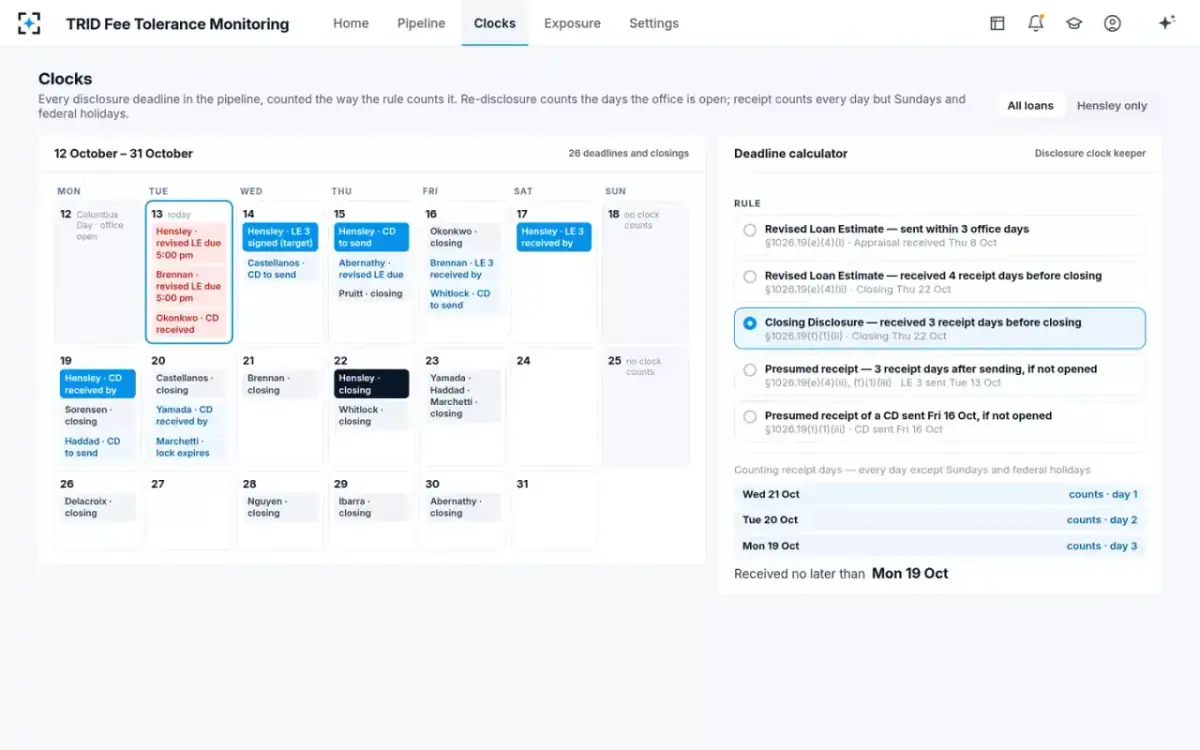
Take a sample loan in the solution's fictional pipeline. The Hensleys' appraisal arrives on Thursday 8 October 2026 at 4:12 pm, at a value low enough to raise their discount points: a valid reason for a revised Loan Estimate. Their closing is Thursday 22 October. The lender, Lantern Ridge Home Loans, is open Monday to Friday and stays open on Columbus Day, Monday 12 October. The chart counts the next fortnight on both calendars.
One fortnight, two calendars: the Hensley loan counted the way TRID counts
Three things in the chart are worth slowing down for. The re-disclosure deadline is Tuesday, not Wednesday, because the lender's open Monday is a business day for (e)(4)(i). A spreadsheet that loads the federal holiday list into its workday function gives the desk a day it does not have. Second, the same Monday is not a receipt day, so if the revised Loan Estimate had gone out on Friday by mail, it would be presumed received on Wednesday 14, not Tuesday 13.
Third, the Closing Disclosure. It must be received by Monday 19: count back Wednesday 21, Tuesday 20 and Monday 19, with no Sunday or holiday to skip. Sent unopened on Thursday 15, it is presumed received on Monday 19, just in time; sent on Friday 16, it lands on Tuesday 20, a day late. A spreadsheet that skips Saturdays makes the opposite error on this calendar: it pushes presumed receipt later than the rule does, which is safe but can delay a closing for nothing.
How long after a changed circumstance must a revised Loan Estimate be sent?
Three business days, on the office calendar, from the day the lender had information sufficient to establish the reason. The commentary's simplest example is a pest inspector reporting termite damage on a Monday, with the revised disclosures due by Thursday (comment 19(e)(4)(i)-1.i). The hard part is not the arithmetic but day zero: when the information became sufficient. That is a judgement about evidence, and one afternoon's race to a Thursday deadline shows how it is made and missed.
A date calculator cannot make that judgement, but it can refuse to guess. It should ask for the date and time the information arrived, not the date someone opened the task, and it should show the count day by day so a reviewer can see which Monday it treated as open.
What is the four business day rule?
A revised Loan Estimate must be received at least four business days before consummation, counted on the receipt calendar, and it may not be given on or after the day the Closing Disclosure is given. The rule reads: "The creditor shall not provide a revised version of the disclosures required under paragraph (e)(1)(i) of this section on or after the date on which the creditor provides the disclosures required under paragraph (f)(1)(i) … The consumer must receive any revised version … not later than four business days prior to consummation" (12 CFR 1026.19(e)(4)(ii)).
Unless it is handed over in person, a revised Loan Estimate is considered received three business days after it is delivered or mailed. In practice the four-day rule means a revised Loan Estimate for a Thursday closing has to be sent by e-delivery or mail no later than the Wednesday of the week before (presumed received on the Saturday), or handed to the borrower. When the window has closed, the revision goes on the Closing Disclosure instead, which since June 2018 can also reset tolerance if it is provided within the same three business days.
What triggers a new 3 day waiting period for a Closing Disclosure?
Only three changes: the APR becomes inaccurate under 1026.22, the loan product changes, or a prepayment penalty is added (12 CFR 1026.19(f)(2)(ii)). For any of them, the borrower must receive the corrected Closing Disclosure three receipt days before closing, and the closing moves if necessary. Every other change, including most fee changes, needs a corrected Closing Disclosure at or before consummation, and the borrower may inspect it on the business day before.
An APR that falls usually does not restart the clock. The CFPB's FAQ explains that if the APR is overstated because the finance charge is overstated, the APR is still accurate under 1026.22(a)(4), so the creditor "is permitted to provide it at or before consummation without a new three business-day waiting period" (CFPB TRID FAQs). A date calculator that restarts the wait on any APR change will delay closings that the rule would let proceed.
How close to closing the last Closing Disclosure arrives
6days
median, in calendar days, from the first Closing Disclosure to closing
36.4%
of lenders surveyed said their final Closing Disclosure went out three or more business days before closing
11.9%
of those surveyed said it went out on the day of closing itself
What a TRID date calculator must ask you
Search for a TRID date calculator and most of what comes back is a spreadsheet or a single-date form: enter an application or closing date, get the dates back. That is enough for the initial Loan Estimate and the Closing Disclosure on a clean loan. It is not enough for the clocks that do the damage, which start when something changes and depend on the lender's own calendar. Whether you build one or buy one, these are the inputs it needs.
Eight questions a TRID date calculator should ask before it gives you a date
- Which clock is this?
Each paragraph names its calendar. A calculator that uses one business-day setting for everything is wrong somewhere.
- Which days is your office open?
Including Saturdays and the federal holidays you work, such as Columbus Day and Veterans Day.
- When did the information arrive?
The date and time the reason was established, not the date the task was opened.
- How is it being delivered?
In person, or mailed or e-delivered with presumed receipt three receipt days later.
- What is your cut-off?
The latest time a disclosure counts as sent that day, written down as policy.
- Has the Closing Disclosure gone out?
If so, a revised Loan Estimate is no longer allowed; the change goes on a corrected Closing Disclosure.
- Does the change restart the wait?
Only an inaccurate APR, a new product or an added prepayment penalty.
- Can I see each day counted?
A reviewer should be able to check which days counted and why, on the date the clock ran.
How TRID Fee Tolerance Monitoring counts the clocks
The solution's disclosure clock keeper counts every deadline in the pipeline on the calendar its rule names. Office days, the desk cut-off and the warning time are the lender's settings; the receipt calendar is fixed where the regulation fixes it. Each clock starts from the time the fee change watcher logged the change, and the clocks screen shows each counted day, so a reviewer can see that Monday 12 October was treated as open.
It does not move a closing date, send a disclosure or decide whether a reason is valid on its own; those stay with the disclosure desk. What it changes is when the desk finds out. A clock counted the morning a change lands leaves days to act; a clock found while balancing the Closing Disclosure leaves none. The Loan Estimate's own expiry runs on the office calendar too, as explained in how long a Loan Estimate is good for. The rest of the solution is on the TRID Fee Tolerance Monitoring page.
Every deadline on a calendar, with each receipt day counted
Questions people ask
Is there a TRID date calculator in Excel?
Many desks build one, usually on a workday function with a holiday list. Check two things: that office-day clocks use your own open days rather than the federal list, and that receipt-day clocks count Saturdays. A single workday function cannot do both.
When is the Loan Estimate due after an application?
The lender must deliver or mail it no later than the third business day after receiving the application, counted in office days. Separately, it must be delivered or mailed at least seven business days before consummation, counted in receipt days.
Does an email count as delivery for TRID timing?
A disclosure that is not handed over in person, by mail or electronically, is considered received three business days after it is sent, on the receipt calendar. Electronic delivery also depends on the borrower's consent under the E-Sign Act, which a calculator should treat as a separate check.
How many days before closing must the Closing Disclosure be received?
At least three business days, counted on the receipt calendar: for a Thursday closing, by the Monday before. The borrower may waive the wait only for a bona fide personal financial emergency, which the CFPB's 2017 examinations found lenders accepting without one.
Can the revised Loan Estimate and the Closing Disclosure go out on the same day?
No. A revised Loan Estimate may not be provided on or after the day the Closing Disclosure is provided. The commentary's example finds a violation where both go out on Wednesday 3 June; the change belongs on the Closing Disclosure instead.