Closing disclosure software is the part of a lender's technology that generates the Closing Disclosure, and usually the Loan Estimate, from the loan's data: it lays the fees into the right sections of the CFPB's forms, calculates the APR, the total of payments and cash to close, and delivers the documents for e-signature. It often lives inside the loan origination system or comes from a document-preparation provider connected to it, and the settlement agent's own software prepares the seller's side and the fee sheet. What none of these systems is built to know is why a fee moved: when the lender first had the information, who asked for the change, and whether the reason meets the TRID rule. Those facts sit in emails, lock confirmations and vendor invoices, and they decide whether an increase on the Closing Disclosure is lawful. Botminds' TRID Fee Tolerance Monitoring is built to sit beside closing disclosure software, read that evidence, judge each change and count each clock, while the disclosure desk keeps sending through the systems it already has.
Who uses which system, and what each one cannot see
Today
Works in the loan origination system and email; relays requests and orders services, often outside the system
With agents
A rush or re-order they request is read from their own email and judged the same day
Still theirs: The borrower and the request
Today
Locks and extends in the pricing engine; the disclosure system sees the new price, not who asked for the extension
With agents
Each lock event opens a check, with the reason it rests on
Still theirs: Pricing
Today
Generates and sends every Loan Estimate in the disclosure software, and keeps the clocks in a spreadsheet
With agents
Starts on the nearest clock with each fee already judged against its baseline
Still theirs: Every decision and every send
Today
Balance the Closing Disclosure against the fee sheet in settlement software, days before closing
With agents
Receive a Closing Disclosure with the cure worked out a week earlier
Still theirs: Balancing, signing, funding
Today
Tests closed loans after the fact, when a missed reason can no longer be re-disclosed
With agents
Co-approves overrides and larger cures with the evidence attached, before closing
Still theirs: Policy and exceptions
What is closing disclosure software?
It is software that turns loan data into the Closing Disclosure the TRID rule requires, in the form and content of 12 CFR 1026.38, and gets it to the borrower on time. Buyers meet it in three shapes. A disclosure module inside the loan origination system draws the fees straight from the loan file. A document-preparation service, connected to the system, produces the Loan Estimate, Closing Disclosure and closing package, often with its own compliance checks. And settlement or title software, used by the closing agent, prepares the fee sheet and the seller's figures, which the lender's Closing Disclosure has to match.
All three are document engines. Their job is to make each version complete, internally consistent and on the right form. That is a real control: a correct, complete form is the floor of compliance, and the arithmetic the forms require is no job for a person with a calculator. But a document engine works from the data it is given. When a fee changes, it records the new amount; it does not ask whether the lender was entitled to change it.
What does doc prep software do, and what doesn't it know?
Doc prep software prepares and checks documents; it does not investigate the events between them. The table sets out what each system in a typical stack holds, and the question about each fee change it cannot answer.
What each system knows about a fee change, and what it cannot answer
| System | What it holds | What it cannot answer |
|---|---|---|
| Loan origination system | Loan data, fees as entered, the disclosures issued, conditions and tasks | When the information behind a change arrived, and from whom |
| Pricing engine and lock desk | Locks, extensions, re-prices and their dates | Whether the borrower asked for the extension, or the lender’s delay caused it |
| Disclosure and doc prep software | Each Loan Estimate and Closing Disclosure, calculations, delivery and e-signature dates | Whether the baseline it compares against was entitled to reset |
| Settlement agent software and fee sheet | The actual charges at closing, title and recording | Which Loan Estimate each fee should be measured against, and why |
| Email, notes and vendor portals | Who asked for what, and when | Nothing in a form another system can use |
| Post-closing compliance testing | Tolerance, APR and finance-charge tests on the closed file | Anything in time to re-disclose before closing |
Does LOS software track tolerance?
Many loan origination and disclosure systems include a tolerance comparison and a cure figure, and that is useful. The question to ask is where the baseline comes from. If it is the last disclosed amount, or an amount a user sets when marking a changed circumstance in the system, the comparison trusts that entry. A rush fee put on a revised Loan Estimate under "borrower request" becomes the baseline, and the comparison shows no problem.
That is the exact failure the CFPB's examiners described in 2022: rush appraisal fees on revised Loan Estimates, claimed as borrower requests, where the documentation showed the appraisal management company or the loan officer had asked (CFPB Supervisory Highlights, Issue 26). A system that computes tolerance from its own entries cannot catch an entry that is wrong for reasons outside it. The comparison has to be made against evidence, not against the field.
What none of them knows: when and why a fee moved
The rule turns on two things no document engine holds. First, the date the lender had "information sufficient to establish" the reason, which starts the three-business-day clock (12 CFR 1026.19(e)(4)(i)). Second, whether the reason is one of the six, and the increase no larger than the reason caused. Both live in the trail of events around the documents: the appraisal delivered at 4:12 pm, the loan officer's email asking for a rush, the title commitment that showed a planned unit development.
Examiners point lenders at the gap. A Federal Reserve examiner wrote that strong institutions run secondary reviews, some "risk-focused and limited to higher-risk TRID disclosures, such as charges subject to tolerances, APRs, and finance charge calculations. Regardless, having an effective secondary review of TRID-covered loans prior to loan consummation can help prevent violations" (Consumer Compliance Outlook, First Issue 2019). A secondary review before closing is what a monitor beside the document engine provides, on every loan rather than a sample.
The Loan Estimate rule is where examiners keep finding problems
#1
Loan Estimate and good-faith rule, §1026.19(e), first among the FDIC’s three most-cited TILA violations in 2025
462
TILA violations cited by the FDIC in 2025, 40% of all consumer violations
87.6%
of lender respondents said revised disclosures increased their ongoing costs
Who sends the revised disclosure?
The lender, through the disclosure desk and the disclosure software it already uses. The creditor is responsible for the Loan Estimate, any revised Loan Estimate and the Closing Disclosure; a settlement agent may provide the Closing Disclosure on the lender's behalf, but the creditor remains responsible for its content and timing. Nothing about adding a monitor changes who sends.
TRID Fee Tolerance Monitoring drafts; it does not send. Its redisclosure drafter prepares the revised Loan Estimate, the corrected Closing Disclosure and the cure in Section J for the desk to review, and a named person approves and sends each one. The agents never send a disclosure, edit an issued one, move a closing, change a fee or contact a borrower. That boundary is what lets the monitor sit next to the lender's core systems without competing with them.
How do you add tolerance monitoring to an LOS?
With read access, not integration surgery. The monitor needs the same six things a careful desk lead reads: every Loan Estimate and Closing Disclosure version, the fee worksheets and settlement agent fee sheets, the lock desk's events, appraisal and title orders and invoices, the change notes and email, and the delivery system's sent, opened and signed dates. Where the system exports data, the agents read data; where it holds only documents, they read the documents and cite page and line.
How a fee change moves when a monitor sits beside the disclosure system
Agent
Fee change watcherSees a lock event, invoice or new fee sheet and opens a check, logging when the change became known.
Never: contacts a borrower
Agent
Disclosure readerReads every Loan Estimate, Closing Disclosure and fee sheet and maps each fee to its section and line.
Never: edits an issued disclosure
Agent
Tolerance calculatorPuts each fee in its bucket against the right baseline and computes the exposure.
Never: moves a fee to a looser bucket without the provider list
Agent
Changed-circumstance judgeReads the evidence and decides whether the reason is valid and was re-disclosed in time.
Never: decides alone
Agent
Clock keeper and drafterCounts the deadline on the right calendar and drafts the revised Loan Estimate or the cure.
Never: moves a closing date or sends
A person decides
Disclosure deskAccepts or overrides each judgement and approves and sends through the existing disclosure system. Compliance co-approves overrides and larger cures.
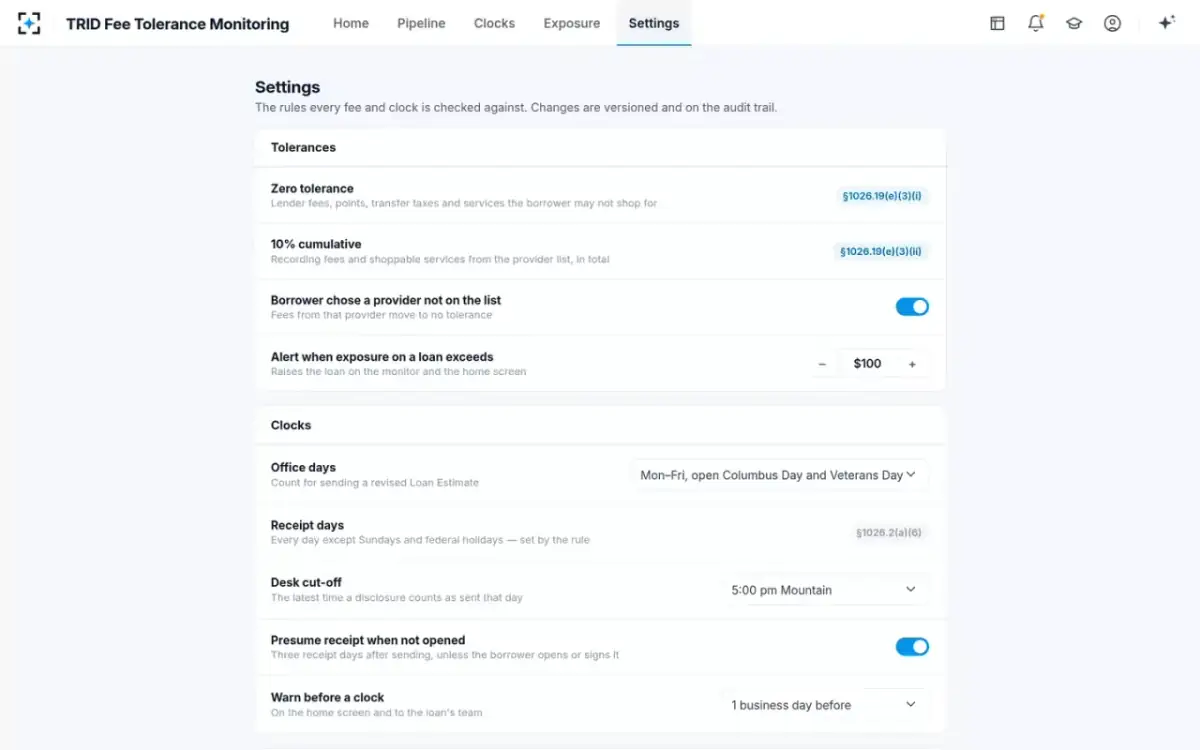
The lender's settings come in at the same time: its office days and the holidays it works, the desk's cut-off, the approval limits and who co-approves overrides. A sensible start is a back-test on recent loans whose answers the desk already knows, the same method described for testing compliance software on last month's closed loans. How the agents divide the work, fee by fee, is traced in the TRID tolerance calculator guide.
The lender's calendar and limits are settings; the rule's day counts are fixed
What to ask before buying closing disclosure software
If you are choosing closing disclosure software, the core questions are about the documents: form accuracy, calculations, e-delivery and e-consent, integration with the loan system and with settlement agents. Add a second set about what happens between the documents, because that is where the examination findings are. The same questions tell you whether you need a monitor beside the software you choose.
Eight questions about fee changes to put to any closing disclosure software
- Where does each fee’s baseline come from?
The last disclosure, a user’s entry, or evidence of a valid reason?
- Does it know when the lender learned of each change?
From the document’s time stamp, or from when someone opened a task?
- Can it show who asked for a change?
A borrower-requested revision needs the borrower’s request.
- Does it limit a reset to what the reason caused?
A lock extension resets the extension fee, not the title fees on the same form.
- Which calendar does each clock use?
Office days for sending; every day but Sundays and federal holidays for receipt.
- Does it treat a lower lender credit as an increased charge?
Credits are zero tolerance in reverse.
- Who approves an override, and is it kept?
A decision against the evidence should need a second person and a written reason.
- What does it leave for the examiner?
The original estimate, the reason, its effect, the limit and the timing, for each change.
Where a monitor does not fit
A monitor is not a document engine and should not become one. TRID Fee Tolerance Monitoring does not generate the official Loan Estimate or Closing Disclosure, does not replace the loan origination system, and does not run post-closing APR and finance-charge tests; each of those stays where it is. It adds value in proportion to how often fees move after the Loan Estimate and how far the evidence sits from the disclosure system. The CFPB's data says fees move on most loans, with almost 90% getting at least one revised Loan Estimate or corrected Closing Disclosure, but a lender should test that on its own pipeline before deciding.
It also needs access the document engine does not: change notes, email and vendor invoices. That is a decision for IT and compliance together, and the monitor's governance is built for it: every amount cites its page and line, every decision quotes its evidence, and every override and send is kept, with the rules versioned. The FDIC's 2020 supervisory highlights suggested a secondary review of loans before consummation (FDIC Supervisory Highlights, April 2020); a monitor is one way to run it on every loan. The work of the desk it serves is described in the mortgage disclosure desk, clock by clock, and the full solution is on the TRID Fee Tolerance Monitoring page.
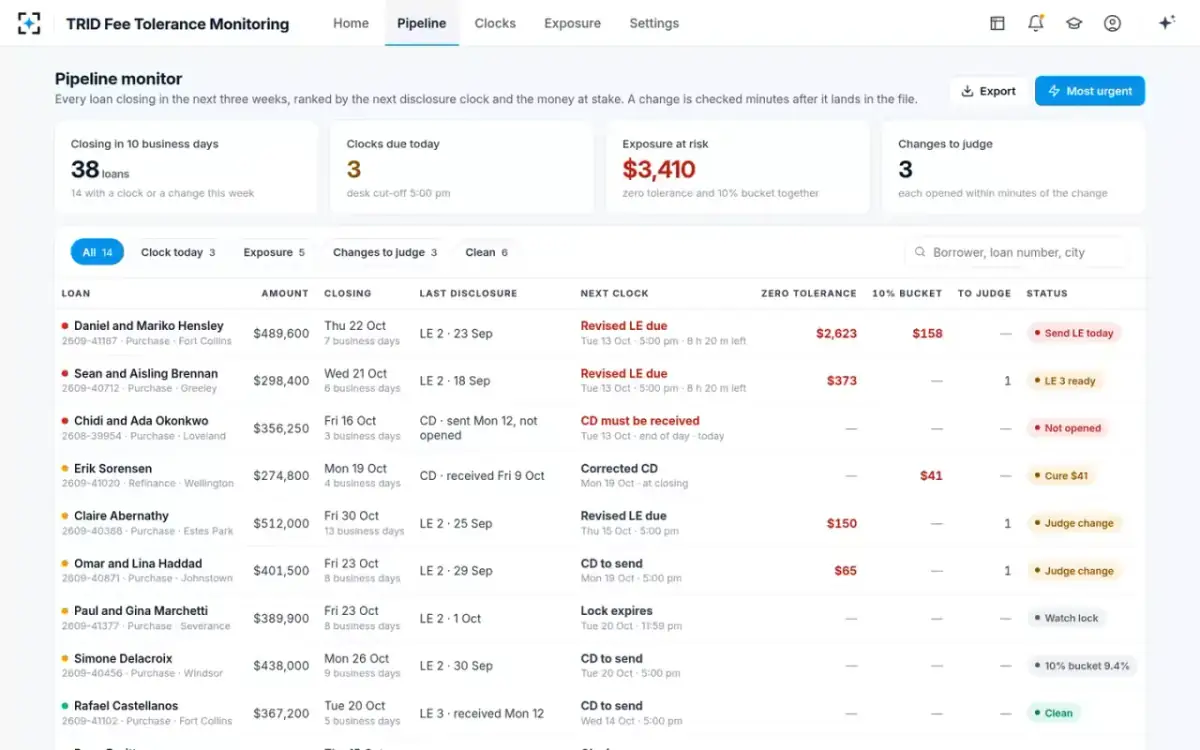
One view across the pipeline, beside the system that produces the documents
Questions people ask
Is closing disclosure software the same as an LOS?
Not always. Many loan origination systems include a disclosure module, and others connect to a separate document-preparation service. Either way, the disclosure software produces the forms from the loan data; the LOS holds the loan.
Does doc prep software check TRID compliance?
Many run checks on the documents they produce: form completeness, calculations, timing against the dates they are given. They cannot check facts they are not given, such as who asked for a rush or when an invoice arrived, which is where many tolerance problems start.
Can a monitor send disclosures through our existing system?
It should not send at all. A monitor that drafts and recommends, with a person approving and sending through the lender's own disclosure software, keeps a single system responsible for what the borrower receives.
What data does a tolerance monitor need from the LOS?
Every disclosure version, the fee worksheets, lock events, orders and invoices, change notes and delivery dates. Read access is enough; nothing has to be written back to the loan system.
Do settlement agents use closing disclosure software too?
Yes. Settlement and title software prepares the fee sheet and the seller's figures, and many lenders balance the Closing Disclosure with the settlement agent before sending it. The lender remains responsible for the borrower's Closing Disclosure whichever party prepares it.