A changed circumstance on a Loan Estimate is one of three things: an extraordinary event beyond anyone's control or an unexpected event specific to the borrower or the loan; information about the borrower or the loan that the lender relied on and that turns out to be wrong or changes; or new information about the borrower or the loan that the lender did not rely on. When one of them raises a closing cost, Regulation Z lets the lender issue a revised Loan Estimate within three business days and compare the final charge with the revised figure instead of the original. Without a valid reason, or without the revised estimate in time, the original stands and the lender pays the difference. Changed circumstances are the most argued-over judgement at a mortgage disclosure desk, because every fee increase between the Loan Estimate and the Closing Disclosure rests on one. Botminds' TRID Fee Tolerance Monitoring judges each increase against the rule and its evidence, while the desk can still re-disclose.
The changed circumstance is only one of six reasons a lender may revise. The full list, from the regulation itself, is the first thing to fix in mind.
The six reasons a Loan Estimate may be revised for a new baseline
- A changed circumstance that raises a settlement charge
(e)(3)(iv)(A). For the 10% group, the circumstance must push the group past 10% in total.
- A changed circumstance that affects eligibility
(e)(3)(iv)(B). The borrower no longer qualifies for the disclosed terms because creditworthiness or the value of the property changed.
- A revision the borrower asks for
(e)(3)(iv)(C). The borrower asks to change the credit terms or the settlement, and an estimated charge rises as a result.
- The interest rate is locked
(e)(3)(iv)(D). Points, lender credits and other rate-dependent charges, re-disclosed within three business days of the lock.
- The Loan Estimate expires
(e)(3)(iv)(E). Intent to proceed comes more than 10 business days after the Loan Estimate, or after a longer period the lender set.
- Settlement on a new-construction loan is delayed
(e)(3)(iv)(F). Only if the original Loan Estimate said clearly that revisions may come more than 60 days before closing.
What is a changed circumstance on a Loan Estimate?
It is any of three things the regulation defines, word for word: "(1) An extraordinary event beyond the control of any interested party or other unexpected event specific to the consumer or transaction; (2) Information specific to the consumer or transaction that the creditor relied upon when providing the disclosures … and that was inaccurate or changed after the disclosures were provided; or (3) New information specific to the consumer or transaction that the creditor did not rely on when providing the original disclosures" (12 CFR 1026.19(e)(3)(iv)(A)).
Read closely, every limb has the same two conditions. The trigger is either outside everyone's control or specific to this consumer or this transaction, and it is something the lender did not know or had wrong when it issued the Loan Estimate. A market-wide price change fails the first condition. A fact the lender already had fails the second. The definition does not ask whether the borrower is to blame, only whether the lender learned something new about the loan.
Being a changed circumstance is not enough on its own. The circumstance has to cause the increase, the revised estimate may rise only by what it caused, and the revised Loan Estimate must go out within three business days of the lender having "information sufficient to establish" the reason (12 CFR 1026.19(e)(4)(i)). Each of those is a separate way to lose the reset, and one afternoon's race to the deadline shows how the third is usually lost.
The three limbs of the definition, each with the commentary's own example
| Limb | What it means | The commentary’s example |
|---|---|---|
| 1. Extraordinary or unexpected event | Something outside anyone’s control, or a surprise specific to this loan | A war or natural disaster; the title insurer quoted on the Loan Estimate goes out of business during underwriting |
| 2. Relied-on information was wrong or changed | The lender used a fact from the borrower or the file, and it turned out different | Stated income of $90,000 that underwriting verifies at $80,000; a co-applicant earning $30,000 who loses the job |
| 3. New information not relied on | Something about the borrower or the property the lender did not know at all | A neighbour of the seller files a claim contesting the boundary of the property |
What counts as a valid changed circumstance? The commentary's examples
The official commentary is the best guide to what examiners accept, because each example shows the whole chain: what changed, what it caused, and which figure the closing charge is compared with. In its appraisal example, an affiliated appraiser quotes $200 for a single-family house that turns out to be on a farm, where the fee schedule is different. If the lender re-discloses, the $400 actual fee is compared with the revised $400. If it does not, the $400 is measured against the original $200 (comment 19(e)(3)(iv)(A)-1.i).
The eligibility example works the same way at loan level. The lender thinks the borrower qualifies for a program with no appraisal; underwriting finds past mortgage delinquencies; the borrower moves to a program that needs one. The new appraisal fee is compared with the revised estimate. But "if the revised disclosures also include increased estimates for title fees, the actual title fees must be compared to the original estimates", because the change of program did not cause them (comment 19(e)(3)(iv)(B)-1). One valid reason does not open every line on the form.
A borrower's own request is the simplest reason. The commentary's example is a borrower who decides to grant a power of attorney so a relative can sign at closing: the fee to record it may be added on a revised estimate. The request has to be the borrower's, and the file has to show it, a point examiners have tested hard, as the section on lender-caused reasons explains.
What is not a changed circumstance?
Four things fail regularly. The first is information the lender is presumed to have. A Loan Estimate is due once the lender has six pieces of information: the borrower's name, income, Social Security number, the property address, an estimate of the property's value and the loan amount. The commentary presumes all six were collected, whether or not they were.
If a creditor provides the disclosures … prior to receiving the property address from the consumer, the creditor cannot subsequently claim that the receipt of the property address is a changed circumstance.
Official commentary to Regulation Z, comment 19(e)(3)(iv)(A)-3
The second is an increase too small to count. A changed circumstance in the 10% group resets nothing unless it pushes the group past 10% in total; the commentary's unreleased lien adds 5%, and the closing title fees are still compared with the original estimate. The third is an increase beyond what the reason caused. The fourth is a valid reason re-disclosed late: the circumstance was real, but the reset was lost on the calendar. On the solution's fictional sample loan, a planned unit development found on the title commitment on 1 October was a valid reason whose window closed on 6 October without a revised Loan Estimate. It stays a cost to the lender.
Valid changed circumstances and the ones that fail
Usually a valid reason: Verified income is lower than stated, so the loan needs mortgage insurance or a different program
Usually not, or not enough: Income the lender estimated before collecting it, then verified: it was presumed collected
Usually a valid reason: The appraisal finds a farm, a boundary dispute or a value well below the estimate
Usually not, or not enough: The property address arriving after the Loan Estimate
Usually a valid reason: The title insurer quoted goes out of business
Usually not, or not enough: A provider raises its general price list for every customer
Usually a valid reason: The borrower asks for a different loan, a lock extension or a power of attorney
Usually not, or not enough: A note that says "borrower requested", with nothing from the borrower
Usually a valid reason: Only what the reason caused
Usually not, or not enough: Other fees revised on the same Loan Estimate without their own reason
Is a rate lock a changed circumstance?
No, it is a separate reason with its own rule. When the rate was floating on the Loan Estimate and is later locked, paragraph (e)(3)(iv)(D) requires a revised Loan Estimate "no later than three business days after the date the interest rate is locked", showing the new rate, the points, lender credits "and any other interest rate dependent charges and terms" (12 CFR 1026.19(e)(3)(iv)(D)). Those charges are then measured against the revised figures. Nothing else on the form resets because of the lock.
A lock after the Closing Disclosure has gone out cannot use a revised Loan Estimate at all. The lender corrects the Closing Disclosure instead, and if the lock makes the APR inaccurate, a new three-business-day wait applies (comment 19(e)(3)(iv)(D)-2). A lock extension the borrower asks for is a borrower-requested revision, limited to the lender's usual extension fee; who pays the rate lock extension fee works through what a late file can and cannot pass on.
Is a low appraisal a changed circumstance?
Usually yes. The lender relied on an estimate of value when it issued the Loan Estimate, and an appraisal that comes in well below it is relied-on information that turned out to be inaccurate. The CFPB's consumer answer lists an appraisal higher or lower than expected among the situations it calls "a change in circumstances" (Ask CFPB #172). It can also be an eligibility change when the lower value moves the loan-to-value ratio past a pricing or mortgage-insurance threshold.
The clock starts when the lender has enough information to establish the reason, which is normally receipt of the report. If the lender has reason to doubt the report and orders a second opinion, the clock starts with the second report, but only if the doubts are written down at the time. On the Hensley sample loan in the solution, the appraisal came in at $598,000 on a $612,000 price on Thursday 8 October, the loan-to-value ratio moved from 80.00% to 81.87%, mortgage insurance became necessary and the locked rate's points rose by $2,448. The appraisal was a valid reason; the only question left was the deadline.
Each change judged: what changed, when it was known, the deadline and the rule
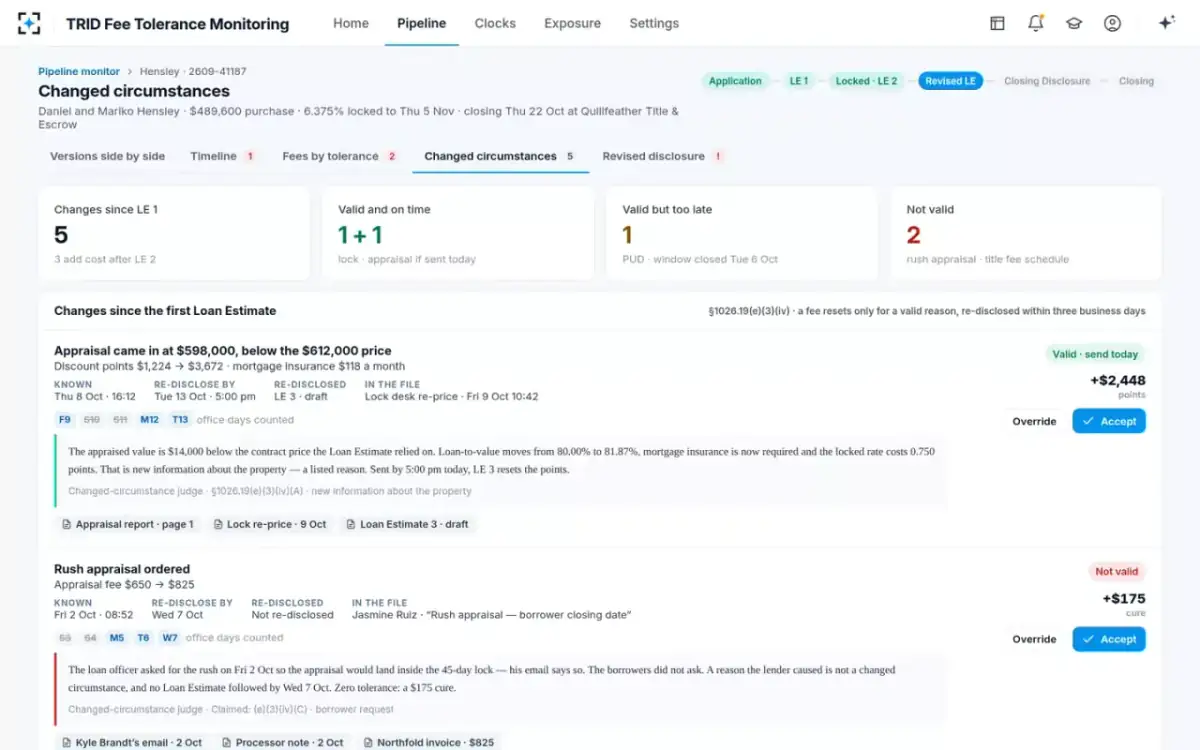
The judge recommends and the desk accepts or overrides. An override needs a written reason and the compliance officer.
Can the lender cause a changed circumstance?
Not by its own choice. The first limb requires an event "beyond the control of any interested party", and the lender is an interested party. The other two require information specific to the borrower or the loan that the lender did not have or had wrong. A loan officer deciding to rush an appraisal so it lands inside the lock, a re-order because the first appraiser was slow, or a switch to a costlier vendor is a lender decision, not new information about the loan. That is why the solution's judge works on a plain reading: a reason the lender caused does not reset a fee.
The CFPB's examiners met this exact pattern. In 2022 they reported lenders that put appraisal rush fees on revised Loan Estimates as borrower requests, when the documentation showed the appraisal management company or the lenders' own loan officers had asked for the rush; the lenders agreed to remediate consumers and strengthen quality control (CFPB Supervisory Highlights, Issue 26). The lesson is less about appraisals than about evidence. A borrower-requested change needs the borrower's request in the file, and what an examiner needs to see in a changed circumstance form sets out the rest.
COVID-19, the black hole and the 2026 request for information
Three pieces of history still shape how the rule reads today. In May 2020 the CFPB concluded that "as with wars or natural disasters, the COVID-19 pandemic is an example of an extraordinary event beyond the control of any interested party, and thus is a changed circumstance" (85 FR 26319). The interpretive rule was not among the 67 guidance documents the CFPB withdrew in May 2025. It does not make every pandemic-era increase valid: the event still has to cause the specific increase.
Before June 2018, a cost increase learned after the Closing Disclosure had gone out could fall into a gap: no revised Loan Estimate was allowed, and it was unclear whether a corrected Closing Disclosure could reset tolerance. The CFPB's final rule named the problem: "This has been referred to in industry as a 'gap' or 'black hole' in the TILA-RESPA Rule", and noted that "some creditors may be denying applications, even after providing the Closing Disclosure" (83 FR 19159). Since 1 June 2018, a Closing Disclosure or corrected Closing Disclosure can carry a revised estimate whenever it is provided, within the same three business days.
The third piece is still open. In July 2026 the CFPB asked whether it should give more guidance on changed circumstances, whether to adjust tolerances, and how to reduce the number of revised disclosures. Comments closed in August. As of October 2026 the regulation text and commentary quoted on this page are unchanged.
The 2026 request for information: what it asks, and where it stands
9 Jul
2026: the CFPB asks how to promote access to mortgage credit, TRID included
Q11
asks whether more guidance on changed circumstances is needed
Q5
asks how to reduce the number of revised disclosures without closing delays
0
TRID proposals published since, as of October 2026
How TRID Fee Tolerance Monitoring judges each changed circumstance
The solution's changed-circumstance judge does what a careful desk lead does, on every change, as soon as it lands. It reads the note and the evidence behind it, the appraisal, the lock change, the title commitment or the email, and establishes what changed, when the lender knew and who caused it. It tests the reason against the six in §1026.19(e)(3)(iv), limits the reset to what the reason caused, and checks whether a revised Loan Estimate went out within three office days. Its decision quotes the document it rests on.
It recommends; it does not decide. The disclosure desk accepts or overrides each judgement, an override needs a written reason and the compliance officer, and the agents never send a disclosure, change a fee or contact a borrower. The point is timing: a judgement made the day the change lands still has a deadline in front of it. If no reason applies, a lender may still be able to re-estimate everything once the offer lapses, as explained in how long a Loan Estimate is good for. The full solution is on the TRID Fee Tolerance Monitoring page.
Questions people ask
Was COVID-19 a changed circumstance?
Yes. The CFPB's May 2020 interpretive rule treats the pandemic, like a war or natural disaster, as an extraordinary event beyond the control of any interested party. It was not withdrawn in 2025. A lender still had to show the pandemic caused the particular increase and re-disclose within three business days.
Is a borrower changing the loan amount a changed circumstance?
A change the borrower asks for is its own reason for revision, (e)(3)(iv)(C), whether it is a different loan amount, program or closing date. Fees that rise because of the request may be re-disclosed; fees that rise for other reasons are still compared with the original.
How long does a lender have to send a revised Loan Estimate after a changed circumstance?
Three business days from receiving information sufficient to establish the reason, counted in days the lender's offices are open. The revised Loan Estimate must also reach the borrower at least four business days before closing and cannot be given on or after the day the Closing Disclosure is provided.
Can a lender revise a Loan Estimate without a changed circumstance?
Yes, for information, at any time; but an informational revision does not reset the baseline. Only the six reasons do, and one of them, expiry, needs no justification beyond the borrower indicating intent to proceed more than 10 business days after the Loan Estimate.
Does a changed circumstance reset every fee on the revised Loan Estimate?
No. The commentary allows the new baseline "only to the extent that the reason for revision … actually increased the particular charge". In its lock-extension example, only the extension fee resets, and other charges on the same revised Loan Estimate are still compared with the original estimates.