A revised Loan Estimate must be issued no later than three business days after the lender receives information sufficient to establish a valid reason for revision, counted in days its offices are open; news on a Monday means a revised Loan Estimate by Thursday. It must also reach the borrower at least four business days before closing, and it cannot go out on or after the day the Closing Disclosure does. Miss the three days and the increase is measured against the original estimate, however valid the reason was. The deadline is easy to state and easy to lose, because the hard part is not counting to three but deciding which day was day zero, and whether the reason holds at all. Botminds' TRID Fee Tolerance Monitoring starts that count when the change lands, judges the reason against its evidence, and puts the deadline in front of the disclosure desk. Below is one afternoon without it.
The people, lender and loan are fictional: Lucía Ferrer, a disclosure specialist at Harrow Lane Home Loans, and the purchase loan of Tomas and Hana Novak, closing on Tuesday 17 November 2026.
Thursday 5 November, 1:05 to 5:00 pm: one revised Loan Estimate against the clock
- Opens1:05
- Day zero?1:20
- Who asked?1:45
- Compliance2:30
- Draft, check dates3:10
- Approve, send4:12
When must a revised Loan Estimate be issued?
Within three business days of the information. The rule says the lender "shall provide a revised version of the disclosures … reflecting the revised estimate within three business days of receiving information sufficient to establish that one of the reasons for revision provided under paragraphs (e)(3)(iv)(A) through (F) of this section applies" (12 CFR 1026.19(e)(4)(i)). Those are office days: (e)(4)(i) is not among the provisions that Regulation Z's definition moves to the every-day-but-Sunday calendar (12 CFR 1026.2(a)(6)).
The commentary's own example sets the rhythm every desk learns. A pest inspection company reports termite damage on Monday that will push the 10% group over its limit, and "the creditor must provide revised disclosures by Thursday". A second example adds a twist that matters for this afternoon: two changes, 5% three weeks ago and 6% now, cross the 10% line only together, and the clock starts with the second.
On Monday, the creditor has received sufficient information to establish a valid reason for revision and must provide revised disclosures reflecting the 11 percent increase by Thursday.
Official commentary to Regulation Z, comment 19(e)(4)(i)-1.ii
Monday, 1:40 pm: the appraiser's email
The story starts three days earlier. On Monday 2 November at 1:40 pm, the appraisal management company emails the processor: the appraiser has found an accessory dwelling unit behind the Novaks' house, the report will be on a different form, and the appraisal fee will be $725 instead of the $575 on the Loan Estimate. The application had described a single-family house with no second unit. Relied-on information turned out to be inaccurate, and it raised a zero-tolerance fee: a valid changed circumstance, the same shape as the commentary's appraiser who finds the house sits on a farm.
The processor parks the change "pending final invoice", which arrives on Wednesday at 4:50 pm. The invoice also carries a $175 rush fee. The processor's note on the file says: "Rush per borrower: closing date." On Thursday at 1:05 pm, Lucía opens the parked task. The lender's cut-off for a disclosure to count as sent that day is 5:00 pm.
When does the 3-day clock start for an appraisal?
When the lender has enough to establish the reason, which is not always when the paperwork is complete. At 1:20 pm Lucía has two candidate days. If day zero is Wednesday, when the invoice arrived, the deadline is Monday 9 November. If it is Monday, when the appraisal management company stated the new fee and why, the deadline is today. The Monday email named the cause and the amount, and nothing on Wednesday changed either; Lucía counts from Monday. Tuesday, Wednesday and Thursday are the three office days. The revised Loan Estimate is due by close of business today.
Day zero: the email that established the reason, or the invoice that confirmed it
Monday 2 Nov, 1:40 pm: The appraisal company’s email: second unit found, new form, fee $725
Wednesday 4 Nov, 4:50 pm: The invoice: $725, plus a $175 rush fee
Monday 2 Nov, 1:40 pm: Yes: the cause and the amount are both stated
Wednesday 4 Nov, 4:50 pm: Nothing new about the reason; one new charge
Monday 2 Nov, 1:40 pm: Thursday 5 Nov, by the cut-off
Wednesday 4 Nov, 4:50 pm: Monday 9 Nov
Monday 2 Nov, 1:40 pm: An email naming the change, time-stamped
Wednesday 4 Nov, 4:50 pm: A later invoice, after the email was already on file
The commentary does allow a later day zero in one situation: a lender that doubts a low appraisal and orders a second opinion starts the clock with the second report, but only if it keeps records of its doubts. Nobody at Harrow Lane doubted the appraiser's email. Parking a task to wait for the invoice is not a doubt; it is a delay, and the clock does not wait for it. What a file needs to show in each case is set out in what an examiner needs to see in a changed circumstance form.
Thursday, 1:45 pm: was the rush a valid reason?
Probably not, and the next 45 minutes are spent finding out. The note says the borrower asked for the rush. Lucía looks for the request and finds none: no email from the Novaks, no call note in their words. What she finds instead is the loan officer's email to the appraisal management company on Monday morning, asking to rush the order "so we don't run tight on the lock". The lender asked; the borrower did not.
This is the pattern the CFPB's examiners reported in 2022: appraisal rush fees put on revised Loan Estimates as borrower requests, where the documentation showed the appraisal management company or the loan officer had asked for the rush, and lenders that then agreed to remediate consumers (CFPB Supervisory Highlights, Issue 26). At 2:30 pm Lucía takes it to Ines Albright in compliance. The loan officer argues the Novaks wanted to close quickly; Ines asks for anything from the Novaks that says so. There is nothing. The rush fee stays at its baseline, and $175 will be owed at closing.
The afternoon's decisions, with the rule behind each
| Time | Question | Decision | Rule |
|---|---|---|---|
| 1:20 pm | When was the reason established? | Monday 1:40 pm, the appraisal company’s email | (e)(4)(i): three business days from sufficient information |
| 1:30 pm | Is the second unit a valid reason? | Yes: relied-on information was inaccurate and raised the fee | (e)(3)(iv)(A), comment (A)-1.i |
| 2:30 pm | Is the rush a borrower request? | No: the loan officer asked; nothing from the borrowers | (e)(3)(iv)(C) needs the consumer’s request |
| 3:10 pm | What may the revised Loan Estimate reset? | The appraisal fee to $725; not the rush fee | Comment (iv)-2: only what the reason caused |
| 3:40 pm | Will it arrive in time? | E-delivered today, presumed received Mon 9 Nov; needed by Thu 12 Nov | (e)(4)(ii): four business days before consummation |
| 3:55 pm | When can the Closing Disclosure go? | By Mon 9 Nov if not opened: Veterans Day, Wed 11, is not a receipt day | (f)(1)(ii)–(iii): three receipt days before consummation |
3:10 pm: what goes out by 5:00, and what does not
Lucía drafts the revised Loan Estimate with the appraisal fee at $725 and nothing else moved. The rush fee is left off, because a fee without a valid reason cannot reset, and putting it on the form would only create a baseline that could not be defended. Then the dates. The closing is Tuesday 17 November. Counting back four receipt days (Monday 16, Saturday 14, Friday 13, Thursday 12), the revised Loan Estimate must be received by Thursday 12. Sent by e-delivery today and not opened, it is presumed received on Monday 9: Friday, Saturday and Monday are the three receipt days, with Sunday skipped.
The Closing Disclosure is the trap she nearly misses. It must be received three receipt days before closing, by Friday 13. Veterans Day falls on Wednesday 11 November, and it is not a receipt day. A Closing Disclosure sent on Monday 9 and not opened is presumed received on Friday 13: Tuesday, Thursday and Friday. Sent on Tuesday 10, it would land on Saturday 14, a day late. She notes the Monday send date on the file. At 4:12 pm her lead approves the revised Loan Estimate; it goes out at 4:20 pm, forty minutes before the cut-off. The TRID date calculator guide explains why the office calendar and the receipt calendar gave her different answers this week.
Can a revised Loan Estimate be sent the same day as the Closing Disclosure?
No. A revised Loan Estimate may not be provided on or after the day the lender provides the Closing Disclosure (12 CFR 1026.19(e)(4)(ii)). The commentary's example finds a violation where both go out on Wednesday 3 June.
What the lender can do instead is put the revised estimate on the Closing Disclosure itself. Since June 2018, a Closing Disclosure or corrected Closing Disclosure can reflect a revised estimate for tolerance purposes whenever it is provided, as long as it is within the same three business days of the reason. That amendment closed what the industry called the "black hole", where a cost increase learned after the Closing Disclosure could not be passed on on either form (83 FR 19159). It does not extend the three days.
What happens if the revised Loan Estimate is late?
The reason stays valid and the reset is lost. The closing charge is compared with the original estimate, and the excess is owed back to the borrower. The commentary's appraisal example puts it in one line: "if the creditor failed to provide revised disclosures, then the actual appraisal fee of $400 must be compared to the originally disclosed estimated appraisal fee of $200" (comment 19(e)(3)(iv)(A)-1.i).
For the Novaks, a send at 9:00 am Friday instead of 4:20 pm Thursday would have turned the $150 appraisal increase into a refund, owed on top of the $175 rush fee: $325 instead of $175. On a loan where the reason moved discount points, the same hour can cost thousands. The refund itself, usually a lender credit on the Closing Disclosure and allowed up to 60 days after consummation, is covered in why a loan must be tested before day 60.
How many days after a changed circumstance? A checklist for the clock
Three office days, from a day zero someone has to choose and defend. The checklist below is what Lucía's afternoon would have looked like if the file had answered its questions on Monday.
Seven checks between a changed circumstance and the 5:00 pm send
- Fix day zero from the evidence
The time the information that establishes the reason arrived, not the time a task was opened or an invoice confirmed it.
- Name the reason and the limb
Which of the six reasons; for a changed circumstance, which of the three limbs.
- Find who caused it
A borrower request needs the borrower’s request. A lender’s own choice resets nothing.
- Limit the reset
Only the fees the reason actually raised; nothing rides along on the same form.
- Count three office days
Using the days your office was actually open, including holidays you work.
- Check receipt and the Closing Disclosure
Four receipt days before closing for the revised Loan Estimate; three for the Closing Disclosure, with holidays skipped.
- Send before the cut-off, and keep the proof
Delivery method, time sent, and opened or presumed-received date.
The same week with the monitor running
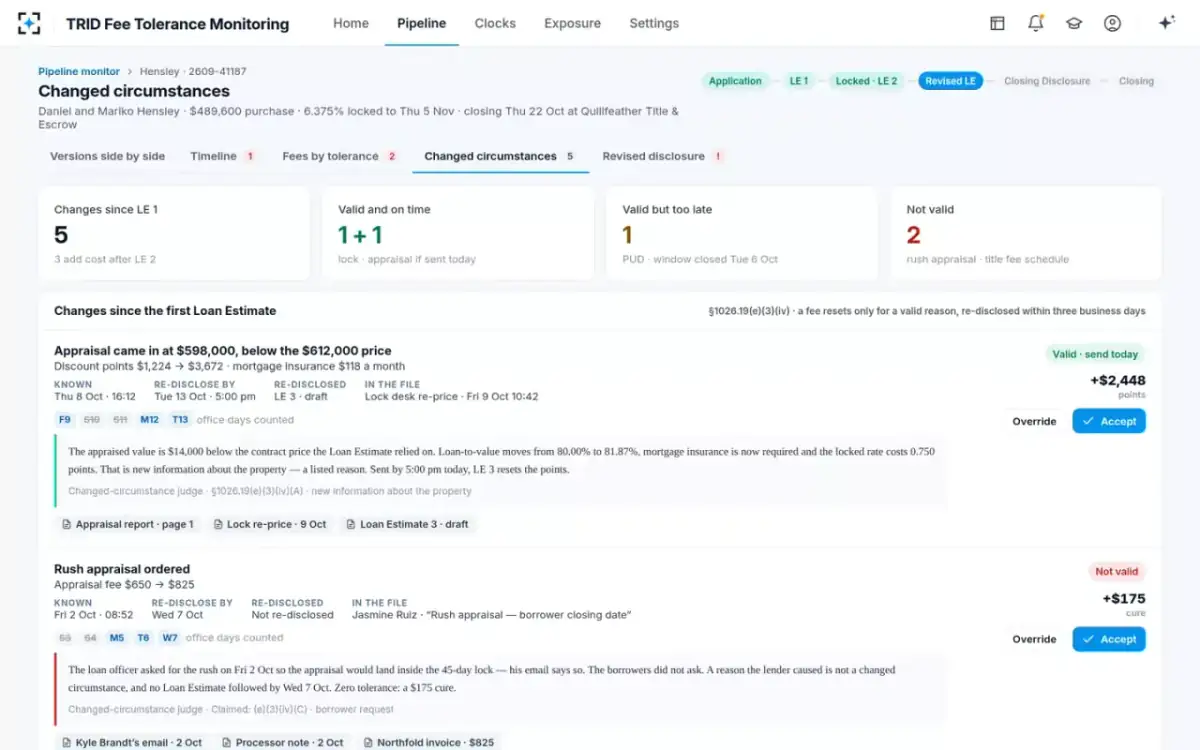
With TRID Fee Tolerance Monitoring running, the afternoon moves to Monday. The fee change watcher logs the appraisal company's email at 1:40 pm as the moment the change became known and opens a check. The changed-circumstance judge reads the email behind the rush and finds the loan officer's request, and the clock keeper puts Thursday's deadline on the desk's screen on Monday afternoon. The drafter prepares the revised Loan Estimate with the appraisal fee reset and the rush fee planned as a credit. Lucía has three days to decide instead of three hours.
The decisions stay with people: Lucía accepts or overrides each judgement, an override needs a written reason and the compliance officer, and the agents never send a disclosure, change a fee or contact a borrower. In the solution's own sample loan, the same pattern plays out with a rush appraisal ordered "so we don't run tight on the lock" and a low appraisal whose deadline falls on the Tuesday after Columbus Day; the screen below shows how each change is laid out. The full solution is on the TRID Fee Tolerance Monitoring page.
Known, re-disclose by, re-disclosed: each change with its own clock
Questions people ask
Is the revised Loan Estimate deadline three business days or three calendar days?
Three business days, in the general sense: days the lender's offices are open to the public for substantially all business. Weekends count only if the office is open that way; a federal holiday counts if the lender is open.
Does the 5:00 pm cut-off come from the rule?
No. The rule counts days, not hours. A cut-off is the lender's own policy for when a disclosure counts as sent that day, and it should be written down and applied the same way on every loan.
When is the latest a revised Loan Estimate can be received?
Four business days before consummation, counting every day except Sundays and federal holidays. If it is not handed over in person, it is considered received three of those days after it is sent.
Can a revised Loan Estimate include fees the lender forgot?
It can show them, and should, since every disclosure must rest on the best information available. But a fee the lender simply forgot is not a reason for revision, so it is measured against the original estimate, which for an omitted zero-tolerance fee is nothing.
What if the borrower asks for a change after the Closing Disclosure is sent?
The lender cannot send a revised Loan Estimate any more; it provides a corrected Closing Disclosure instead, which can reset tolerance if it goes out within three business days of the request. A change that makes the APR inaccurate also restarts the three-business-day wait.