A TRID tolerance cure is how a lender puts right a charge that rose more than the Loan Estimate allowed: it refunds the excess to the borrower and delivers or mails a corrected Closing Disclosure showing the refund, both no later than 60 days after consummation (12 CFR 1026.19(f)(2)(v)). Done in time, the cure means the lender complied; done late, it is only remediation of a violation. So the cure depends on how long after closing a loan is tested. In most second-line programmes a closed mortgage is tested, if at all, in the quarter after it closes, and our estimate for that path is about 100 days from closing to a confirmed finding. Botminds' Loan Compliance Testing tests every loan the night after month-end, or nightly, and on the loan followed here the finding was signed 19 days after closing. A breach found on day 19 can still be cured; one found on day 100 cannot.
The loan is the Whitcombe loan from the sample bank used throughout this series: a $412,000 conventional 30-year purchase through a wholesale broker, closed on Friday 14 August 2026. The people and the bank are invented; the rules and their windows are real.
The Whitcombe loan, closing to confirmed finding, drawn to scale
- Waiting for the quarter and the sample55 days
- Reading the file, ticking the checklist25 days
- Recompute, group, confirm20 days
- Waiting for the month-end run17.5 days
- Tested overnight, then signed
- Tested the night after closing, then confirmed
How long do you have to cure a TRID tolerance violation?
Sixty days after consummation, for both the refund and the corrected disclosure. The rule: the creditor complies "if the creditor refunds the excess to the consumer no later than 60 days after consummation", and complies with the Closing Disclosure rule "if the creditor delivers or places in the mail corrected disclosures that reflect such refund no later than 60 days after consummation" (12 CFR 1026.19(f)(2)(v)). Both halves have the same deadline, and a refund without the corrected disclosure is only half a cure.
The window was lengthened on purpose. The CFPB's assessment of the rule notes that "Regulation X allows creditors to cure tolerance violations by providing the refund 30 days after settlement", while "for tolerance violations under the TRID Rule the cure period was lengthened to 60 days after consummation" (CFPB TRID Rule Assessment, 2020). For a loan closed on Friday 14 August 2026, day 60 is Tuesday 13 October. The count is in calendar days from consummation, not business days, and the rule makes no exception for a loan sold or transferred in the meantime.
What are the TRID tolerance cure requirements?
Four things: the right amount, paid to the borrower, a corrected Closing Disclosure that reflects it, and both inside the 60 days. The amount is the excess over the tolerance, not the whole increase in the group. For a zero-tolerance charge it is the full increase. For the 10% group it is the amount by which the group's total exceeds 110% of the total on the Loan Estimate: a group disclosed at $1,840 may reach $2,024, so $2,100 at closing means a $76 cure.
A tolerance cure that will stand up in a test
- Measure against the right baseline
The last valid Loan Estimate, or a revised one issued within three business days of a documented changed circumstance; an invalid revision does not reset the baseline.
- Compute the excess by bucket
Zero tolerance: each increase in full. 10%: the group total over 110% of its disclosed total. No-limit charges: no cure, but good faith still required.
- Refund the borrower
The excess was paid by or imposed on the borrower, so the refund goes to the borrower: a credit at closing or a payment after it.
- Show it on the Closing Disclosure
Lender Credits must state that the amount includes a credit for the increase above the legal limit, and Calculating Cash to Close states the excess (§1026.38(h)(3), (i)).
- Deliver or mail it by day 60
Counted in calendar days from consummation; keep the mailing or delivery evidence, which the retention rule requires for three years.
How is a tolerance cure shown on the Closing Disclosure?
In two places. The Lender Credits line on page 2 includes "a statement that this amount includes a credit for an amount that exceeds the limitations on increases in closing costs", and the Calculating Cash to Close table states that the increase "exceeds the legal limits by the dollar amount of the excess" (12 CFR 1026.38(h)(3), (i)). A refund paid after closing appears on the corrected disclosure in the same way, which is what a test should look for.
How long after closing is a loan tested for compliance?
Usually months. A quarterly programme cannot draw its sample until the quarter's closings are in, so a loan that closes early in a quarter waits most of that quarter and then some, before anyone opens its file. Then the reading starts. By hand, our estimate is about 25 days of the cycle spent reading files and ticking the checklist, 8 more recomputing APRs and counting business days, and a week grouping fails and looking for causes. Most of the 100 days is waiting, not work, which is why the gap closes so far when the reading is done overnight.
The Whitcombe loan closed on 14 August, in the middle of the third quarter. On the quarterly path it would join the sample pool on 30 September and, our estimate, have its finding confirmed in late November. On the month-end path it was read, recomputed and grouped in the run that started at 22:00 on 31 August, and the testing manager signed the finding on 2 September.
Day 19 and day 100 sit on opposite sides of the 60-day TRID cure
TRID has a built-in correction. If the borrower paid more than the Loan Estimate allowed in a zero or 10% tolerance group, the lender complies "if the creditor refunds the excess to the consumer no later than 60 days after consummation" and sends a corrected Closing Disclosure reflecting the refund within the same period (12 CFR 1026.19(f)(2)(v)). For a loan closed on 14 August, the window closes on 13 October. A finding on 2 September leaves six weeks to refund. A finding in late November finds a violation that can no longer be cured, only reported and remediated.
The sample bank's August run makes the point loan by loan. Eleven loans closed in August with fees over the 10% tolerance and no cure, finding F-03. They closed between 1 and 31 August, so their 60-day windows closed between 30 September and 30 October. When the run reported them on the morning of 1 September, every one could still be cured with a refund and a corrected disclosure. On a quarterly sample, at best a few of the eleven would have been drawn, all after their windows had closed.
What the clock decides for the August closings
60days
to cure a tolerance breach after closing: for the Whitcombe loan, closed 14 August, until 13 October
11
August loans over the 10% tolerance with no cure, all still curable when the run reported them on 1 September
19days
from the Whitcombe closing to the signed finding, in the sample run
~100days
our estimate for the same loan in a quarterly sample tested by hand
Does the 60-day cure start at closing or at discovery?
The TRID tolerance cure starts at closing; TILA's separate correction rule for APR and finance-charge errors starts at discovery. Confusing the two is common, and expensive in both directions.
The Whitcombe loan's failure was not a fee tolerance but an understated finance charge: $6,300.00, from discount points and a lock extension fee coded as seller-paid. The 60-day TRID cure does not apply to that. The statute does instead: a creditor has no liability under TILA's damages and reimbursement sections "if within sixty days after discovering an error ... through the creditor's or assignee's own procedures, and prior to the institution of an action ... or the receipt of written notice of the error from the obligor", it notifies the borrower and adjusts the account (15 U.S.C. 1640(b)).
Because that window opens at discovery, testing later does not close it. What testing later does is let two other things happen first. The borrower, a servicer or a loan buyer's reviewer may find the error and give written notice, which ends the protection. And the cause keeps producing new loans with the same error. The sample bank's fee table affected seven wholesale loans in August; on the quarterly path, every month until late November would have added more, each one a borrower to notify and an account to adjust, and each one more evidence of "a clear and consistent pattern or practice" if an examiner found it first (15 U.S.C. 1607(e)).
Testing late rarely changes what the first loan's error is. It changes how many loans share it, and who finds it first.
Can a TRID timing violation be cured?
No. A Loan Estimate delivered late or a Closing Disclosure received less than three business days before consummation cannot be cured after the fact; the rule offers corrections only for amounts and clerical errors. What a lender can do is fix the cause for future loans and remediate any harm. The table sets out every window that opens at or after closing, which is what a post-closing test has to beat.
The windows that open at closing, and what each can still fix
| Window | Runs from | What it fixes | Rule |
|---|---|---|---|
| 30 days | Learning of a settlement event in the 30 days after consummation | Corrected Closing Disclosure when the event changed an amount the borrower paid | §1026.19(f)(2)(iii) |
| 60 days | Consummation | Corrected disclosure for non-numeric clerical errors | §1026.19(f)(2)(iv) |
| 60 days | Consummation | Tolerance cure: refund of the excess plus corrected disclosure | §1026.19(f)(2)(v) |
| 60 days | Discovery of the error | APR or finance charge error: notice and account adjustment, no liability if first | 15 U.S.C. 1640(b) |
| None | Not applicable | Late Loan Estimate or late Closing Disclosure: cannot be cured | §1026.19(e)(1), (f)(1) |
Side by side: what each date means on the two paths
The same file, the same rules, the same failure. The table follows the Whitcombe loan through the dates that matter after closing, on each path.
The Whitcombe loan's dates after closing, sampled and fully tested
Quarterly sample, by hand: Joins the third-quarter population; nothing happens yet.
Loan Compliance Testing, month-end run: Joins August's population; nothing happens yet.
Quarterly sample, by hand: Still untested.
Loan Compliance Testing, month-end run: Tested overnight: APR 7.031% against 6.875% disclosed, finance charge $6,300.00 understated, cause traced to fee table v14. Finding signed 2 September.
Quarterly sample, by hand: The fee table keeps coding the fees as seller-paid on new wholesale locks.
Loan Compliance Testing, month-end run: Fee-table correction proposed to the owner; September wholesale loans set to be re-tested.
Quarterly sample, by hand: Any tolerance breach on the loan passes uncured.
Loan Compliance Testing, month-end run: Any tolerance breach on an August loan was reported with weeks to spare.
Quarterly sample, by hand: If drawn in the sample, the failure is found and confirmed; the other affected loans still have to be found.
Loan Compliance Testing, month-end run: Remediation of the seven borrowers with the control owner since early September.
What the change timeline shows that a late test cannot
Testing close to closing also keeps the cause visible. When the finding is days old, the change behind it is recent, the people who made it remember why, and the system's change log is short. In the sample bank the findings analyst laid the dates side by side: a 10-day lock extension added to the wholesale rate sheet on 21 July, fee table v14 deployed on 28 July, the first wholesale lock under it on 29 July, and the seven affected loans closing between 3 and 22 August. Examiners weigh a violation's "root cause, severity, duration, and pervasiveness" (FFIEC rating system); a short timeline answers duration and root cause at once.
The change timeline behind the finding, in Loan Compliance Testing
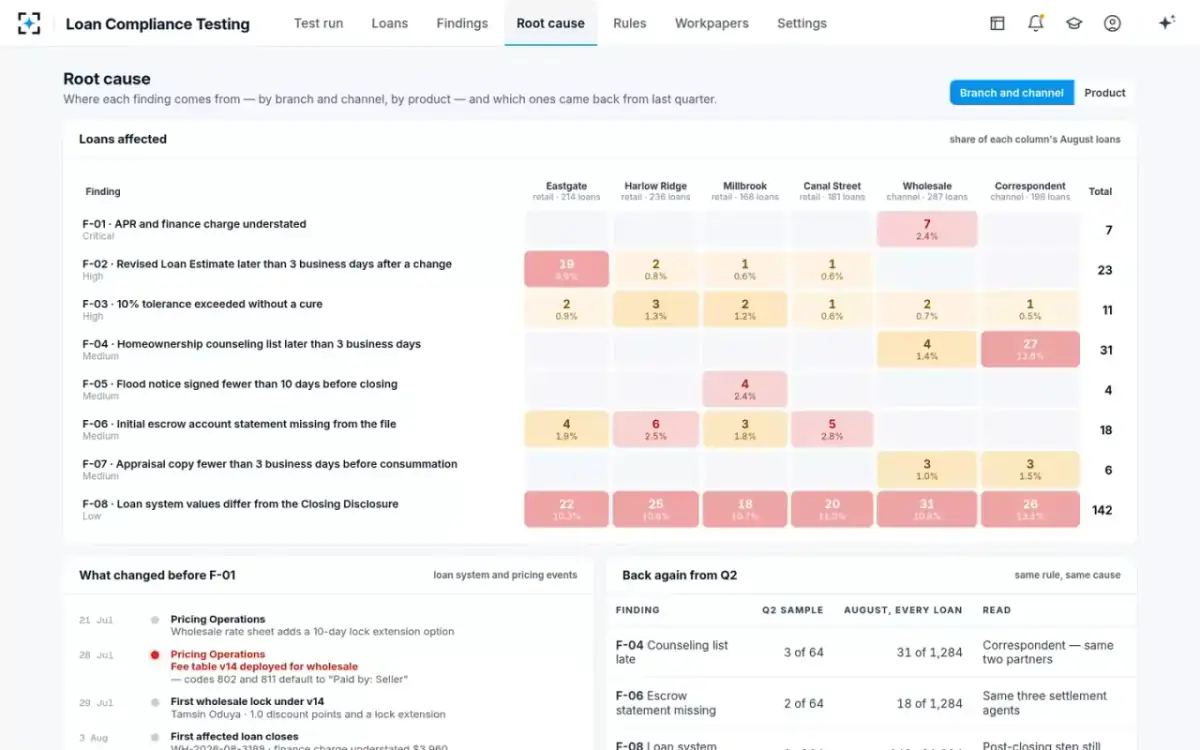
With nightly testing, the first affected loan, closed on 3 August, would have been tested that night.
How fast is fast enough? Choosing a testing cadence
Three dates set the useful limit. The 60-day TRID cure means a tolerance breach found after day 60 can no longer be fixed as the rule intends, so a cadence that confirms findings well inside 60 days keeps every cure available. Post-consummation events in the first 30 days that change what the borrower paid need a corrected Closing Disclosure within 30 days of the lender learning of them (§1026.19(f)(2)(iii)), which a test soon after closing also catches. And the rate at which a systemic error adds loans is set by volume, so a high-volume channel benefits from nightly testing more than a low-volume one.
Evidence is not the constraint. A lender keeps each Closing Disclosure and related documents for five years after consummation and other TRID evidence for three (§1026.25(c)), so the file is available whenever the test runs. What runs out is the window to put things right. That is why the sample bank's testing manager set wholesale loans to be tested the night after closing, on top of the monthly run, after F-01: had it been on in August, the first affected loan would have failed on 4 August, before the other six closed.
The understated finance charge prices each step of the delay, and automated compliance testing against a sample shows how seldom the quarterly path draws the loan at all. The tolerances guide sets out the zero and 10% groups the cure applies to, and the Loan Compliance Testing page follows the whole August run.
Questions people ask
What happens if a tolerance cure is late?
The borrower should still be made whole, and usually is, but the refund no longer cures the violation under §1026.19(f)(2)(v). It becomes a violation that was remediated, which an examiner weighs differently from one that was cured in time.
Does the 60-day cure apply to both zero and 10% tolerance?
Yes. The cure covers amounts that exceed either the zero-tolerance limit of §1026.19(e)(3)(i) or the 10% aggregate limit of §1026.19(e)(3)(ii). Charges in the no-limit group need no cure, though they must still have been estimated in good faith.
Is a tolerance cure the same as a lender credit?
A cure at closing is usually given as a lender credit, but not every lender credit is a cure. The Closing Disclosure must say what part of the credit is for the increase above the legal limit, so a test can tell the two apart.
Does a TRID tolerance cure fix an understated finance charge?
No. The 60-day cure covers fees over their tolerance. An understated APR or finance charge is corrected under 15 U.S.C. 1640(b), within 60 days of discovering it, by notice and an adjustment to the borrower's account.
Does testing nightly mean more work for testers?
The reading and arithmetic are done by the agents, so testers see the same results sooner, spread across the month rather than piled up at quarter end. The reviews that need a person arrive a few at a time.