The Closing Disclosure errors examiners cite most are wrong fees, fees in the wrong section or with the wrong payer, and loan calculations that do not match the loan, and many of them start as a loan origination system setting. A configuration error is a setting that makes the system compute or classify something differently from what the note, the fee agreement or Regulation Z requires: a rate that is not rounded as the note says, a fee mapped to the wrong section, a payer default that marks borrower-paid charges as seller-paid. Because the system generates the disclosures, the error appears on every loan the setting touches, and each one looks internally consistent. Testing the file against the form does not catch it, because the form was filled in by the same system. Botminds' Loan Compliance Testing reads the file and the system separately, recomputes from the contract terms and compares all three, so the test can see when the system itself is the problem.
How Loan Compliance Testing catches a setup error: three comparisons, then people
Agent
File readerReads the note, the Loan Estimates and the Closing Disclosure, and separately the loan system's fee screen with each fee code, payer and section.
Never: treats the loan system's values as the answer, or writes to the system.
Agent
Independent calculatorRecomputes the rate, payment, finance charge and APR from the note's terms and the fees the borrower actually paid.
Never: starts from a figure the system produced.
Agent
Data-integrity testCompares the loan system with the Closing Disclosure field by field: fee, amount, payer, section, dates.
Never: decides which source is right; it reports that they differ, and where.
Agent
Findings analystLines the fails up against channel, product and the system's change log, and proposes the setting and the date it changed.
Never: confirms the cause.
A person decides
Loan system administratorConfirms the setting, when it changed and who changed it, and corrects it.
A person decides
Compliance Testing ManagerConfirms the finding and requires the corrected setting to be re-tested on the next loans through it.
What are common Closing Disclosure errors?
They fall into five kinds, and the first three are where examiners' citations concentrate. The FDIC's three most-cited TILA provisions in 2025 included the Closing Disclosure's closing cost details, §1026.38(f) to (k), and its loan calculations, §1026.38(o) (FDIC, March 2026). What matters for a tester is which errors come from a person handling one file and which from a system handling all of them.
Common Closing Disclosure errors, where they appear and where they usually start
| Error | Where on the Closing Disclosure | Usual origin |
|---|---|---|
| A fee in the wrong section, or with the wrong payer | Page 2, Loan Costs and Other Costs, §1026.38(f)–(g) | A fee code mapping or payer default in the loan system |
| Finance charge, APR or total of payments understated | Page 5, Loan Calculations, §1026.38(o) | A fee flagged as not a finance charge, or a calculation rule, in the system |
| Cash to close that does not tie to the other pages | Page 3, Calculating Cash to Close, §1026.38(i) | A late change made in one place and not carried through |
| A fee above its tolerance with no cure shown | Page 2 Lender Credits and page 3, §1026.38(h)(3), (i) | A changed circumstance not documented, or a cure not applied |
| A delivery or receipt date too close to consummation | Not on the form; in the delivery evidence | Workflow, or a wrong business-day calendar in the system |
Can a loan origination system cause disclosure errors?
Yes, and on every loan the setting touches at once. The CFPB described a clean example in its supervisory findings. "Examiners found that the standard adjustable-rate promissory note used by an institution stated that the result of the margin plus the current index should be rounded up or down to the nearest one-eighth of one percentage point. However, examiners discovered that the institutions' loan origination system was not programmed to round. Thus, the fully indexed rate that the entity calculated and provided on their disclosures was calculated contrary to the promissory note." The institutions "reconfigured their loan origination system to round according to the promissory note" (CFPB Supervisory Highlights, Issue 30, 2023).
Nothing in a single disclosure from that system would have looked wrong. The fully indexed rate was computed consistently, presented in the right place, and carried through the payment figures. The error was only visible against the contract: the note said round, the system did not. That is the general shape of a setup error. It is consistent, repeatable and invisible to any check that compares a disclosure with the data that produced it.
Testing the file against the form, and testing the setup
File against the form: Is every required item on the disclosure, and do the numbers agree with each other?
Setup against the contract and the rule: Did the system compute and classify each item the way the note and Regulation Z require?
File against the form: The loan system's data.
Setup against the contract and the rule: The note, the fees the borrower actually paid, and the regulation.
File against the form: Missing items, typing errors, a late delivery.
Setup against the contract and the rule: Rounding rules, payer defaults, fee-type and section mappings, a wrong business-day calendar.
File against the form: Any error the system makes consistently.
Setup against the contract and the rule: Little on its own; it runs beside the file checks for dates and delivery, not instead of them.
File against the form: A loan.
Setup against the contract and the rule: A setting, the date it changed and every loan since.
How one fee-table default understated seven finance charges
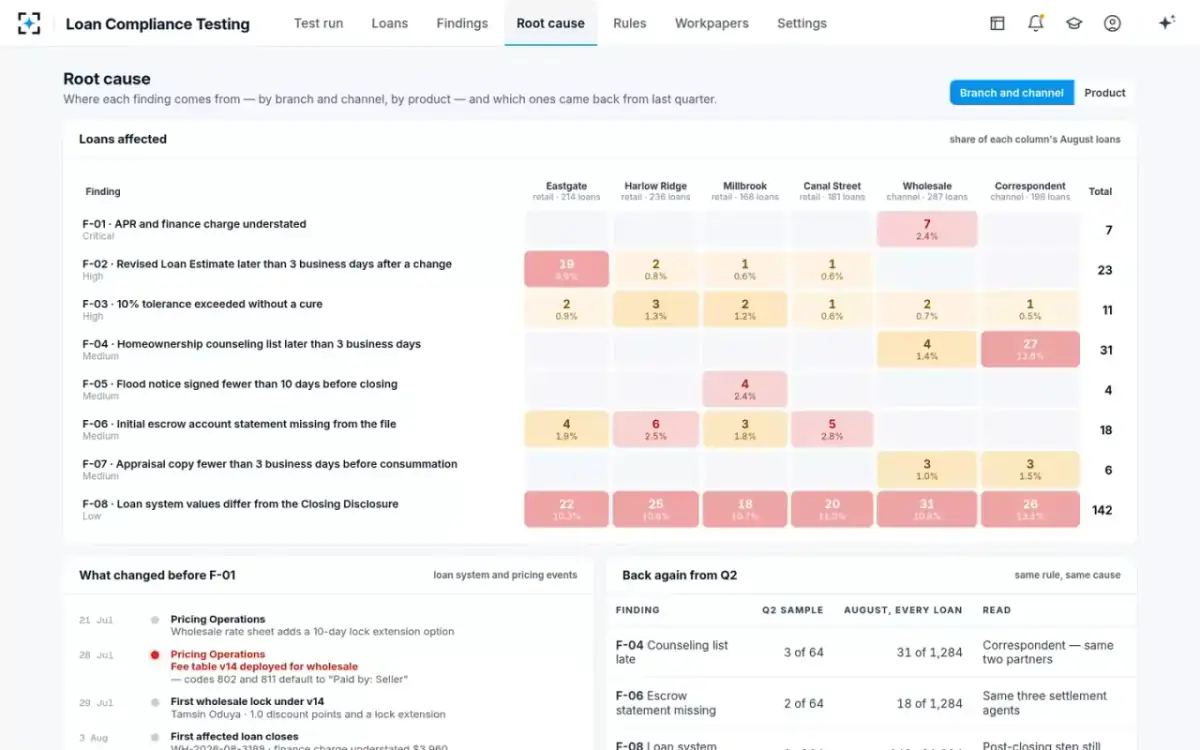
The sample bank used throughout this series, a fictional lender, shows the same pattern with fees. On 21 July its pricing team added a 10-day rate-lock extension option to the wholesale rate sheet. On 28 July a new wholesale fee table, version 14, went live, and it set the default payer for fee code 802, loan discount points, and 811, the rate-lock extension, to "Seller". From the first wholesale lock under the new table on 29 July, any loan with either fee had them marked seller-paid in the system, while the Closing Disclosure the borrowers signed showed them paid by the borrower.
Points and loan fees paid by the borrower are finance charges; seller's points are not (12 CFR 1026.4(b)(3), (c)(5)). So the system left both fees out of the finance charge. On the Whitcombe loan, a $412,000 purchase closed on 14 August, that was $6,300.00, enough to move the disclosed APR to 6.875% against 7.031% recomputed. Seven wholesale loans closed in August with the fault, $38,940 of finance charges understated in total. No retail or correspondent loan was affected, because their fee tables did not change.
The loan system against the Closing Disclosure, in Loan Compliance Testing
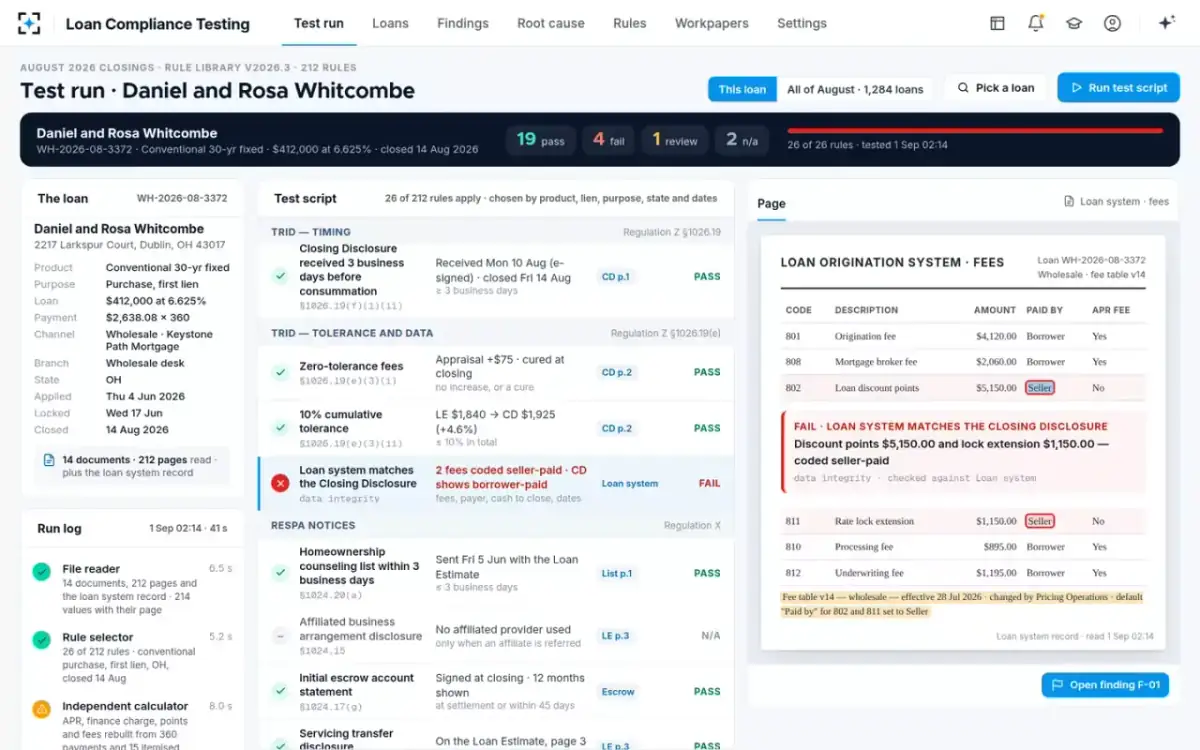
The footnote on the fee screen is the cause: the table version, its date and the team that changed it.
Who is responsible for errors on the Closing Disclosure?
The creditor, whoever prepared it. A settlement agent may deliver the Closing Disclosure, but "the creditor shall ensure that such disclosures are provided in accordance with all requirements" of the rule (12 CFR 1026.19(f)(1)(v)), and a system vendor's software does not move the duty either: "the institution remains responsible for ensuring that the output from vendor-provided systems and services meets regulatory requirements" (Consumer Compliance Outlook, 2019).
Inside the lender, responsibility splits by cause. An error made on one file belongs to the closer or the processor who made it. An error made by a setting belongs to whoever owns the setting, often a pricing, product or system team that never sees a Closing Disclosure. In the sample bank, that was Pricing Operations, and the control owner for the affected loans was the Head of Wholesale Lending.
How do you correct a Closing Disclosure error after closing?
With a corrected Closing Disclosure inside the window that fits the error, and, for a system cause, a fixed setting. Non-numeric clerical errors are corrected by a new disclosure within 60 days of consummation; a fee over its tolerance by a refund and a corrected disclosure within the same 60 days; an amount changed by a settlement event in the first 30 days by a corrected disclosure within 30 days of learning of it (§1026.19(f)(2)(iii)–(v)). An understated APR or finance charge is corrected under the statute, by notice and an account adjustment within 60 days of discovering it (15 U.S.C. 1640(b)).
A system-caused error needs two more steps that a one-file error does not. Every loan that went through the setting since it changed has to be found and corrected, not only the one the test happened to read. And the corrected setting has to be re-tested on the next loans through it, because a correction is itself a change.
The cause is a date: line every failure up against the change log
A setup error has a start date, and finding it is most of the root-cause work. The test results give one side: the affected loans, their channel, their lock and closing dates. The system's change log gives the other. When the two line up, as they did in the sample bank, with every affected loan locked after 28 July in one channel whose table changed that day, the cause stops being a hypothesis. The CFPB's examination procedures ask exactly this of a lender's own reviews: whether they "include comprehensive root cause analysis", for example "whether an information system coding error led to inaccuracies across a portfolio" (CFPB compliance management review).
Loans affected by channel, and what changed before the finding
Setup faults in one month of testing
193
failed data-integrity tests across 1,284 loans: loan system and Closing Disclosure disagree
142
loans in the broadest finding, loan system values that differ from the Closing Disclosure, back again from the prior quarter
7
loans, one channel, one fee-table version: the finding that understated $38,940 of finance charges
How do examiners review system changes?
They test the change process as well as the loans it produced. Configuration errors arrive with changes: a new fee table, a new product, a system upgrade, a new rate sheet. That is why examiners look at change management. The OCC tells its examiners that "information to review may include the bank's project management tracking records, applicable committee meeting minutes, adopted policies and procedures related to the change, and monitoring or audit reports for reviews conducted throughout and after the change" (OCC Comptroller's Handbook, Compliance Management Systems). The FFIEC rating system assesses "the effectiveness of the institution's change management processes" (FFIEC, 2016).
Outsourcing the system does not move the duty. A Federal Reserve examiner wrote that "the institution remains responsible for ensuring that the output from vendor-provided systems and services meets regulatory requirements" (Consumer Compliance Outlook, 2019). And when a disclosure error is a "clear and consistent pattern or practice", which a setting by definition produces, the agencies must order an adjustment for the affected borrowers (15 U.S.C. 1607(e)).
A loan system makes the same mistake perfectly every time. Test it against the contract, not against itself.
How to test loan origination system fee setup
The cheapest moment to catch a setup error is before the first loan closes under it. A testing programme that can re-run past loans through its rules can also run them through a changed setup and see what moves. The checklist below is the minimum we would expect around any change to fee tables, pricing, products or disclosure templates.
Before and after a loan system change
- List what the change can touch
Fee codes, payer defaults, section mappings, finance-charge flags, tolerance groups, rounding, calendars. A rate-sheet change that adds a fee is a fee-table change too.
- Test the new setup on last month's loans
Recompute the disclosures with the new setting and compare with the old. Every difference should be one the change intended.
- Compare against the contract, not the system
Rounding against the note; finance charge against §1026.4 and who actually paid; sections against the Closing Disclosure form.
- Watch the first loans through it
Test every loan locked or closed under the new setup, nightly, for its first weeks, however small the channel.
- Keep the change log next to the findings
Version, effective date, owner. When a finding starts on a date, the log should say what changed that day.
- Re-test after the fix
A correction is a change. Test the next loans through it, and keep the result for the examiner.
The seats involved in this work are not the usual testing seats: the loan system administrator and the pricing or product team own the setting, and compliance testing in banks, seat by seat follows a finding to them. The understated finance charge prices what a setting does when it runs unnoticed, and automated compliance testing against a sample explains why a sample is the wrong tool to find one. The Loan Compliance Testing page follows the fee-table fault from the first failed test to the signed workpaper.
Questions people ask
What is a corrected Closing Disclosure?
A new Closing Disclosure that replaces an inaccurate one. Before consummation it must reach the borrower at or before closing; after consummation it is due within the window for the kind of error, such as 60 days for clerical errors and tolerance refunds.
Does an error on the Closing Disclosure delay closing?
Usually not. Most changes need only a corrected disclosure at or before consummation. Three restart the three-day wait: an APR that becomes inaccurate, a change of loan product, or an added prepayment penalty (§1026.19(f)(2)(ii)).
Is a loan system configuration error a bona fide error under TILA?
The statute lists "calculation, computer malfunction and programing" errors as examples of bona fide errors, but only where the creditor maintained "procedures reasonably adapted to avoid any such error" (15 U.S.C. 1640(c)). Testing the setup is one such procedure. Whether a defence succeeds depends on the facts.
Who should own testing of loan system configuration?
The system's owners test their changes; compliance tests the outcome on real loans and confirms findings. Neither replaces the other, and the change log is what connects them.
How do you know whether the system or the disclosure is right?
Neither, by default. The test reports that they differ; the signed Closing Disclosure, the settlement statement and the note decide what the borrower was told and paid, and the regulation decides how it should have been disclosed.