TRID violations, breaches of the TILA-RESPA Integrated Disclosure rules in Regulation Z, cluster in three places: the Loan Estimate's good-faith estimates and timing under 12 CFR 1026.19(e), the closing cost details on the Closing Disclosure under §1026.38(f) to (k), and the loan calculations on the Closing Disclosure under §1026.38(o): the finance charge, amount financed, APR, total of payments and total interest percentage. Together they were 28% of the 462 Truth in Lending violations the FDIC cited in 2025, and TILA was the most-cited law in the FDIC's consumer compliance exams that year. Botminds' Loan Compliance Testing is a testing solution that checks every closed loan against every disclosure rule that applies to it; this page takes the most-cited sections one at a time, with how each goes wrong and the test that catches it.
TILA was the FDIC's most-cited consumer law in 2025
What are the most common TRID violations?
The FDIC names them in order. "The three TILA violations cited most frequently were: 1) 15 U.S.C. § 1638 and 12 CFR § 1026.19(e)", the good-faith estimates and their timing; "2) ... 12 CFR §§ 1026.38(f) – (k)", the detailed breakdown of loan costs in a prescribed table; "and 3) 12 C.F.R. § 1026.38(o)", the loan calculations. "Collectively, these violations comprised 28 percent of the total TILA violations cited in 2025" (FDIC, March 2026). The FDIC adds why TILA ranks so high in a risk-focused exam: "if institutions do not comply with TILA, consumers could be harmed and reimbursements may be required."
The Federal Reserve's 2024 list shows the same sections. Four TRID provisions were in its top twelve across 223 examinations: the loan calculations, §1026.38(o), and the Loan Estimate, §1026.19(e), tied at 10 citations each; closing cost details, §1026.38(f), at 9; and cash to close, §1026.38(i), at 8, out of 662 violations in all (Consumer Compliance Outlook, 2025). In 2025 no Regulation Z provision made the Fed's top list, from a much smaller base of 97 examinations.
The most-cited TRID sections, how each goes wrong, and the test that catches it
| Section | What it requires | How it goes wrong in a file | The test |
|---|---|---|---|
| §1026.19(e) Loan Estimate | Good-faith estimates, delivered by the third business day after application and the seventh before consummation; revised only for a valid reason | Late Loan Estimate; revised estimate with no documented reason, or issued more than three business days after the reason; fees over tolerance and not refunded | Count business days from application, lock and changed-circumstance dates; compare each fee with its tolerance group; check for a refund within 60 days |
| §1026.38(f)–(k) Closing cost details | Every loan and other cost in its prescribed section, with who paid it | A fee in the wrong section; borrower-paid shown as seller-paid or the reverse; a fee missing | Compare the Closing Disclosure with the settlement statement and the loan system, fee by fee, including payer |
| §1026.38(i) Cash to close | The calculating cash to close table, with Loan Estimate and final figures | Figures that do not tie to the rest of the disclosure; changes not explained | Re-add the table from its components and compare with page 1 and page 3 |
| §1026.38(o) Loan calculations | Total of payments, finance charge, amount financed, APR and total interest percentage | Finance charge understated by over $100; APR off by over 1/8 of a point; total of payments understated | Recompute each from the payment stream and the itemised fees; never read the disclosed figure as the answer |
Loan Estimate good faith and timing, §1026.19(e): where most findings start
The Loan Estimate is the baseline every later fee is measured against, so most of its violations show up later, at the Closing Disclosure. Three failures account for most of them. The first is timing: an estimate delivered more than three business days after the application, counted in days the lender is open for business. The second is the revised estimate: a lender may reset the baseline for a changed circumstance, a borrower's request or a rate lock, but only "within three business days of receiving information sufficient to establish" the reason (§1026.19(e)(4)), and only if the file documents it. The third is the tolerance itself: a fee above its limit with no refund within 60 days of consummation.
Revised estimates are common, which is why they generate so many findings. The CFPB's assessment of the TRID rule found that "about 12 percent of all mortgages in the sample experienced a change in interest rate between their first Loan Estimate and last Closing Disclosure" (CFPB TRID Rule Assessment, October 2020). Every one of those needs a dated reason and a timely revision. In the sample bank used throughout this series, a fictional lender, the largest timing finding of the August run was a revised Loan Estimate issued more than three business days after the change: 23 loans, 18 of them from one branch, Eastgate.
Where a TRID finding comes from: findings by branch and channel in Loan Compliance Testing
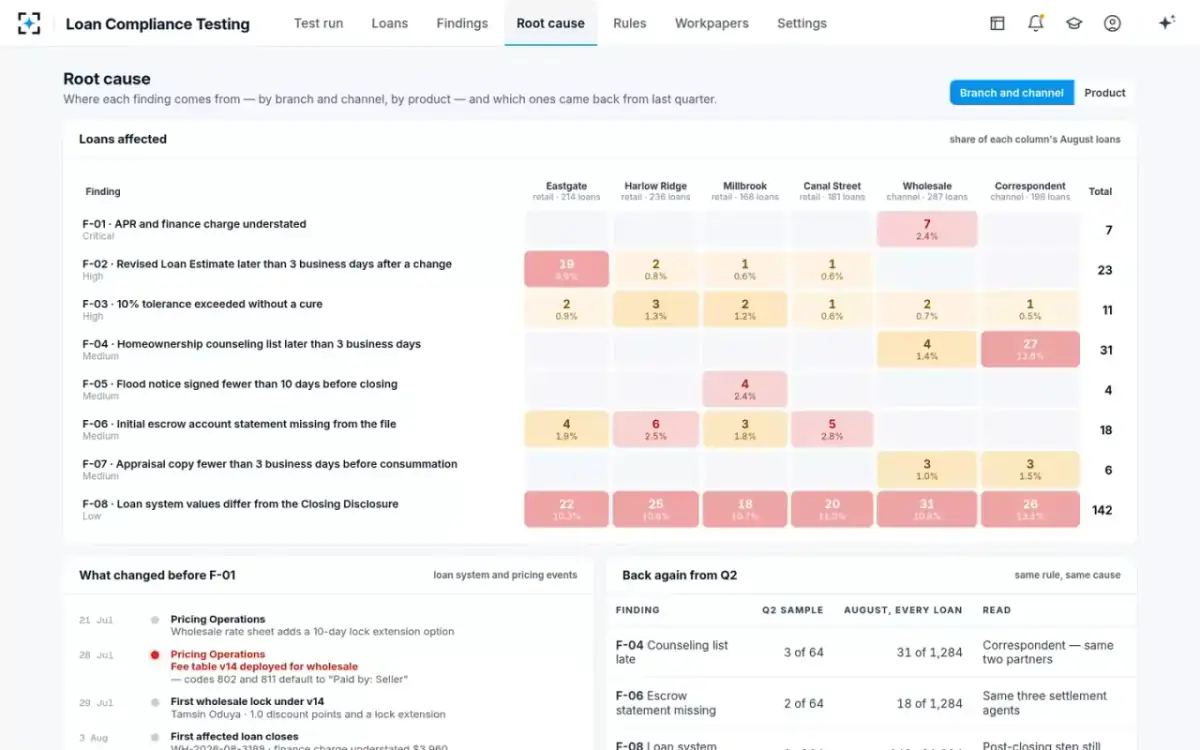
Read the F-02 row: 18 of 23 in Eastgate. A branch-level cause is a training or workflow fix, not a system one.
What TRID errors do examiners cite on the Closing Disclosure? The right fee in the wrong place
The closing cost details are the fee tables on page 2 of the Closing Disclosure and the summaries that depend on them. The usual errors are not wrong amounts but wrong placement: a fee in the wrong section, a borrower-paid charge shown as paid by the seller or by others, a charge missing. Each misplacement can cascade, because the section decides the tolerance group and the payer decides whether the charge is part of the borrower's finance charge.
The test compares three sources for every fee: the Closing Disclosure, the settlement statement, and the loan system's fee screen with its fee code and payer. When two of them disagree, the file has a problem whichever is right. In the sample bank's August run that comparison failed on 142 loans, the run's largest finding by count: values in the loan system that differed from the Closing Disclosure. One difference among them, a fee table that marked discount points as seller-paid on wholesale loans, was the cause of the most serious finding of the month.
Loan calculations, §1026.38(o): the arithmetic a test has to redo
The loan calculations table on page 5 carries the five figures TILA was written to protect: total of payments, finance charge, amount financed, APR and total interest percentage. They are cited because they are derived; an error anywhere upstream, a misclassified fee or a payment computed on the wrong basis, arrives here. The only reliable test is to recompute each figure from the payment stream and the itemised fees and compare, rather than to check that the figures are internally consistent with each other.
A loan calculations failure, recomputed and cited to page 5
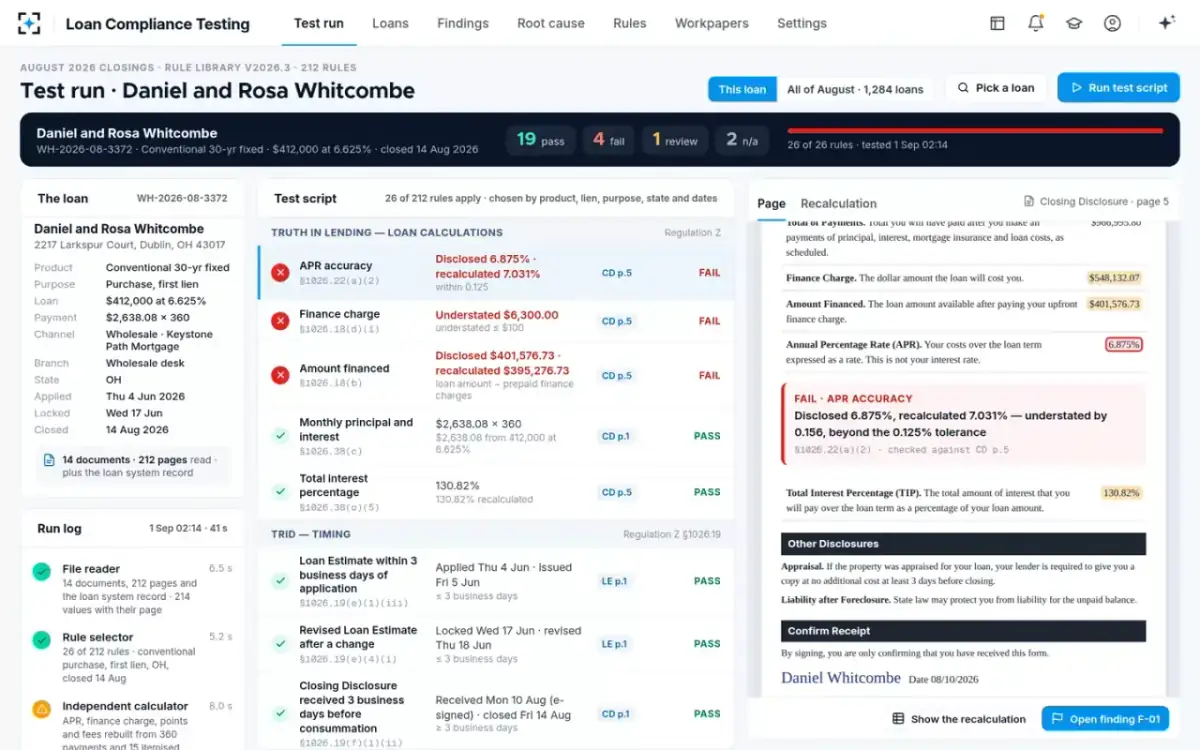
The pattern that makes these violations systemic is visible in a CFPB supervisory finding. Examiners found that an institution's adjustable-rate note required the index plus margin to be rounded to the nearest one-eighth of a point, but "the institutions' loan origination system was not programmed to round", so the fully indexed rate on the disclosures was calculated contrary to the note (Supervisory Highlights, Issue 30). Every loan on that system carried the error. A test that recomputes from the note catches it on the first loan.
What is a TRID tolerance violation?
It is a charge at closing that exceeds what the Loan Estimate allowed for its tolerance group, without a valid revision or a refund. Zero-tolerance charges may not rise at all; the 10% group may not rise by more than 10% in total; the rest may vary if estimated in good faith (§1026.19(e)(3)). The violation is the excess, and it is curable: refund it "no later than 60 days after consummation" with a corrected Closing Disclosure (§1026.19(f)(2)(v)).
The arithmetic is simple and easy to get wrong in one place: the 10% is measured on the group's total as disclosed, not fee by fee. On the Whitcombe loan, a fictional $412,000 purchase from the sample bank, the group went from $1,840 to $1,925, up 4.6%, and passed. Had it reached $2,100, the limit of $2,024 would have left $76 to refund. The appraisal, a zero-tolerance charge on that loan, rose by $75 and passed only because the lender cured it at closing. In August the sample bank had 11 loans over the 10% limit with no cure, 22 failed tests.
What the most-cited TRID sections look like in one month of testing
23
loans with a revised Loan Estimate issued more than three business days after the change
11
loans over the 10% tolerance with no cure, 22 failed tests
7
loans with the finance charge and APR understated, $38,940 in all
142
loans whose loan system values differ from the Closing Disclosure
What causes TRID violations? Mostly setup, so test for the cause as well as the loan
Of the 462 TILA violations the FDIC cited in 2025, 451 were Level 2: "systemic, recurring, or repetitive violations that represent a failure of the bank to meet a key purpose" of the rule. Only 11 were Level 3. That distribution is a hint about cause. Systemic violations come from a fee table, a template, a workflow step or a branch habit, and they repeat until the setup changes. A useful TRID test therefore reports two things for every fail: the loan, and what it shares with the other loans that failed the same rule. Closing Disclosure errors that start in the loan system takes that idea further.
A post-closing TRID check, in the order findings arise
- Loan Estimate timing
Application date to delivery: three business days, on the creditor's calendar. Seven business days before consummation, Saturdays counting.
- Every revision has a reason and a date
Changed circumstance, borrower request or rate lock, documented, with the revised estimate inside three business days and received four business days before consummation.
- Tolerance groups, fee by fee
Zero for the lender's and broker's charges; 10% in total for recording fees and shoppable services from the list; a refund within 60 days of consummation for any excess.
- Closing Disclosure receipt
Three business days before consummation, Saturdays counting; a new wait if the APR became inaccurate, the product changed or a prepayment penalty was added.
- Fees in the right section, with the right payer
Closing Disclosure against the settlement statement and the loan system fee screen.
- Loan calculations recomputed
Finance charge to $100, APR to 1/8 of a point, total of payments to $100, from the payment stream, not from the disclosure.
How do examiners test TRID compliance?
By risk: they read the bank's compliance management system first, then pull loan files where risk and weakness meet. The FDIC's manual tells examiners to "conduct transaction testing where risks intersect with weaknesses in the CMS or uncertainties about aspects of that system" (FDIC Consumer Compliance Examination Manual II-1.1). A bank with strong, documented testing of its own gets less transaction testing; a bank with none gets more.
On the files they pull, examiners do what a good tester does: count the business days, compare fees with the Loan Estimate, and recompute the loan calculations, using the FFIEC APR Computational Tool, which "supports the process by which examiners and financial institutions can verify applicable calculations" (OCC Bulletin 2020-40). They also read the bank's own testing workpapers. A finding the bank found, fixed and documented reads very differently from the same finding discovered by the examiner.
What are the penalties for TRID violations?
They range from a refund to agency-ordered reimbursement, private damages and civil money penalties, depending on the violation and who finds it. Tolerance overages are refunded to the borrower. An understated APR or finance charge that results from "a clear and consistent pattern or practice" must be reimbursed on agency order (15 U.S.C. 1607(e)). Borrowers can recover actual damages and, for certain disclosure failures on a dwelling-secured loan, statutory damages of $400 to $4,000 in an individual action, with a class cap of the lesser of $1,000,000 or 1% of net worth (15 U.S.C. 1640(a)).
What a TRID violation can cost, by who acts
| Who acts | What follows | Size |
|---|---|---|
| The lender, within 60 days of closing | Refund of a tolerance overage with a corrected Closing Disclosure | The excess over the tolerance |
| The lender, within 60 days of discovery | Correction of an APR or finance charge error under 1640(b) | The adjustment; no liability if done first |
| The examiner | Finding, rating weight, ordered reimbursement for a pattern | Every affected loan, back to the previous exam |
| A borrower or a class | Actual and statutory damages, costs and fees | $400 to $4,000 a borrower; class cap $1M or 1% of net worth |
| The CFPB, in enforcement | Civil money penalties under the Consumer Financial Protection Act | Up to $7,217, $36,083 or $1,443,275 a day by tier (2025) |
Is TRID changing in 2026? What the executive order and the CFPB's request mean
Not yet. On 13 March 2026, Executive Order 14393 directed the CFPB to consider, among other things, "replacing TRID timing rules with a materiality-based standard that preserves consumer clarity and reduces closing delays", and tailoring TRID and related rules for smaller banks. The CFPB issued a request for information on 9 July 2026, with comments due by 10 August 2026 (91 FR 42382). As of October 2026 the TRID timing and tolerance text in Regulation Z is unchanged, and the sections above remain the ones examiners test.
A testing programme can prepare without guessing. Keep the rules in a versioned library with their sources and dates, so that a change to the regulation is a new rule version tested on past loans before it applies, not a rewrite of a checklist. APR tolerance under Reg Z lists each current line, and AI mortgage compliance testing describes which part of the check each agent does. The Loan Compliance Testing page follows one month of closings through these tests.
Questions people ask
What is the single most common TRID mistake?
By the FDIC's 2025 count, violations of §1026.19(e), the Loan Estimate's good-faith estimates and timing, were listed first. In practice that covers late estimates, revisions without a documented reason, and fees over tolerance with no refund.
Are TRID violations usually one-off clerical errors?
The FDIC's grading suggests not: 451 of the 462 TILA violations it cited in 2025 were Level 2, systemic or recurring. Clerical errors happen, and non-numeric ones can be corrected within 60 days of consummation, but the cited violations are mostly patterns.
Can a TRID violation be cured?
Some can. A tolerance overage is cured by a refund and a corrected Closing Disclosure within 60 days of consummation, and a non-numeric clerical error by a corrected disclosure in the same window. A late Loan Estimate or a Closing Disclosure received too late cannot be cured after the fact; it can only be fixed for future loans.
Which loans does TRID cover?
Closed-end consumer credit secured by real property or a cooperative unit, other than reverse mortgages (§1026.19(e)(1)(i)). Home equity lines of credit, which are open-end, follow different disclosure rules.
What did TRID cost lenders to implement?
The CFPB's 2020 assessment put a typical lender's implementation cost at "$146 per mortgage originated in 2015, or roughly 2.0 percent of the average cost of originating a mortgage", and found that about 12% of loans saw a rate change between the first Loan Estimate and the last Closing Disclosure.