The APR tolerance under Reg Z is 1/8 of a percentage point: a mortgage's APR is accurate if it is within 1/8 of a percentage point of the correctly computed APR, or 1/4 of a point in an irregular transaction. The finance charge is accurate if it is understated by no more than $100 or is overstated. Under TRID, the fees on the Closing Disclosure may exceed the Loan Estimate by nothing for most charges, by 10% in total for recording fees and certain third-party services, and by any amount for a short list of charges estimated in good faith. Delivery and receipt deadlines have no tolerance at all. Botminds' Loan Compliance Testing applies each of these lines on every closed loan, and allows them to be set tighter but never looser. This page sets them out in one table, explains how they interact, and shows how to recompute the APR that the tolerance is measured against.
The TILA and TRID tolerances a loan compliance test applies
| What is tested | How far it may be off | Where it comes from |
|---|---|---|
| APR, regular transaction | Within 1/8 of a percentage point, above or below | §1026.22(a)(2) |
| APR, irregular transaction | Within 1/4 of a percentage point (multiple advances, irregular payment periods or amounts) | §1026.22(a)(3) |
| APR on a mortgage, further | Also accurate if it results from a finance charge that is itself treated as accurate | §1026.22(a)(4), (5) |
| Finance charge, mortgage | Understated by no more than $100, or overstated | §1026.38(o)(2); §1026.18(d)(1) |
| Total of payments | Understated by no more than $100, or overstated | §1026.38(o)(1) |
| Finance charge, for rescission | 1/2 of 1% of the note or $100, whichever is greater; 1% for a refinance with a new creditor and no new money; $35 once foreclosure has begun | §1026.23(g), (h) |
| Fees, general rule | No increase over the Loan Estimate | §1026.19(e)(3)(i) |
| Recording fees and shoppable third-party services from the lender's list | No more than 10% over the Loan Estimate, in total | §1026.19(e)(3)(ii) |
| Prepaid interest, insurance, escrow deposits, services the borrower chose off the list or that were not required | Any amount, if estimated in good faith on the best information then available | §1026.19(e)(3)(iii) |
| Delivery and receipt dates | None: a day late is a fail | §1026.19(e), (f) |
What is the APR tolerance under Regulation Z?
One-eighth of a percentage point for a regular transaction and one-quarter for an irregular one. The regulation says the APR "shall be considered accurate if it is not more than 1/8 of 1 percentage point above or below" the APR determined under the actuarial method, and defines an irregular transaction as one with "multiple advances, irregular payment periods, or irregular payment amounts" (12 CFR 1026.22(a)). A fixed-rate 30-year purchase is regular. A construction loan with draws is irregular.
Mortgages have two further rules. A disclosed APR is also accurate if it "results from the disclosed finance charge" and that finance charge is itself treated as accurate under the $100 rule (§1026.22(a)(4)). And when the finance charge is understated within tolerance, an APR understated by less than the APR that would result from it is also accurate (§1026.22(a)(5)). In practice these mean the finance charge test, not the APR test, decides most mortgage results.
What is the finance charge tolerance under Reg Z, and why does it fail before the APR?
$100 understated, and on a long loan that line is far tighter than the APR's. On a long loan, 1/8 of a point of APR is worth thousands of dollars of upfront finance charges, while the finance charge tolerance is $100. On the Whitcombe loan, a fictional $412,000 30-year purchase from the sample bank used throughout this series, moving the APR by 1/8 of a point takes about $5,050 of prepaid finance charges. The finance charge would have failed at $101.
How much each tolerance allows on one $412,000 loan
The Whitcombe loan failed both. Its Closing Disclosure left out $5,150.00 of discount points and a $1,150.00 rate-lock extension fee, both paid by the borrowers. The finance charge was understated by $6,300.00, far past $100, and that one omission also moved the APR from 7.031% to the 6.875% disclosed, 0.156 of a point, past the 1/8 line. A smaller omission, say $500, would have failed the finance charge and passed the APR, and still been a violation.
How do you recalculate APR to test a Closing Disclosure?
The tolerance is measured against the APR as it should have been computed, so the test starts by computing it. Six steps take a tester from the Closing Disclosure to a result. The order matters, because a mistake in the first step, which fees are finance charges, carries through every later number.
Recomputing an APR and finance charge from the file
- List every charge on the Closing Disclosure
Page 2, sections A to H, with who paid it. Charges the seller paid are not the borrower's finance charge; check the payer against the settlement statement, not the loan system alone.
- Classify each as a finance charge or not
Points and loan fees are in (§1026.4(b)(3)); seller's points and bona fide real-estate fees such as title, appraisal and credit report are out (§1026.4(c)(5), (7)).
- Total the prepaid finance charges
Including prepaid interest. On the Whitcombe loan, $16,723.27, against $10,423.27 the disclosure counted.
- Compute the amount financed
Loan amount less prepaid finance charges: $412,000 − $16,723.27 = $395,276.73.
- Solve the APR from the payment stream
The rate at which 360 payments of $2,638.08 are worth the amount financed, by the actuarial method in Appendix J: 7.031%.
- Compare, and fail on the right test
Finance charge against $100 understated; APR against 1/8 or 1/4 of a point, with the §1026.22(a)(4) and (5) mortgage rules applied.
Each step of the recomputation in Loan Compliance Testing, beside the page
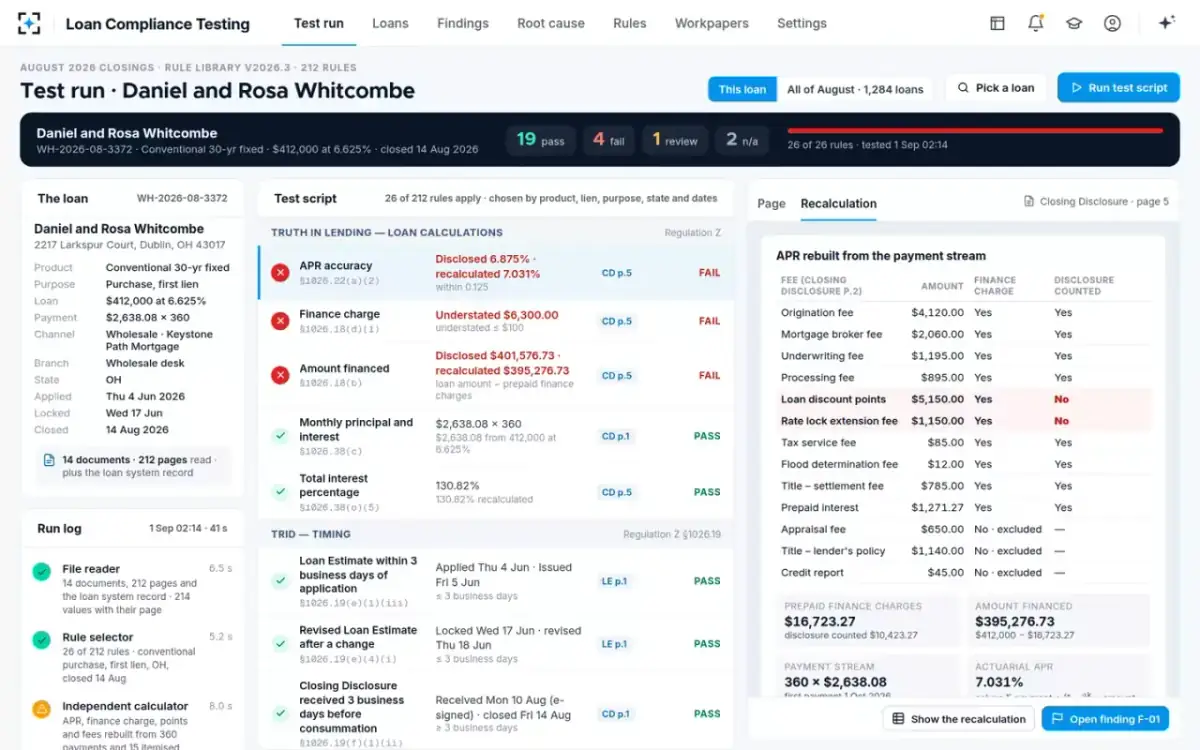
The two highlighted rows are the whole failure: fees the borrowers paid that were not counted.
What is the FFIEC APR tool, and how do testers use it?
It is the examiners' own APR calculator, and the most defensible independent check on any other. The OCC retired its APRWIN program "in favor of the FFIEC Federal Disclosure Computational Tools", and the APR tool "supports the process by which examiners and financial institutions can verify applicable calculations included on consumer loan disclosures subject to the Truth in Lending Act" (OCC Bulletin 2020-40). A calculation that agrees with it on the same inputs is unlikely to be challenged on method.
The tool solves the APR from what a tester feeds it, so it inherits any mistake in the inputs. The amount financed has to be rebuilt first, with the fees correctly classified, and the payment schedule, the loan date and the first payment date entered as the note sets them. For a fixed-rate monthly loan the actuarial method of Appendix J uses a one-month unit period, and the APR is the monthly rate times twelve. Entering the disclosed amount financed of $401,576.73 for the Whitcombe loan returns 6.875%, the disclosed figure; entering the rebuilt $395,276.73 returns 7.031%. The tool confirms arithmetic; only the classification step finds the error.
Where an APR test can go wrong, step by step
Agent
Classify the chargesDecide which fees on Closing Disclosure page 2 are finance charges, and who paid each.
Never: trusts the loan system payer code without the disclosure.
Agent
Rebuild the amount financedLoan amount less prepaid finance charges: $395,276.73 on the Whitcombe loan, not the disclosed $401,576.73.
Agent
Solve the APRActuarial method, monthly unit period: 7.031%; agrees with the FFIEC APR tool on the same inputs.
Agent
Apply the tolerance0.156 over against 0.125: fail; finance charge $6,300 understated against $100: fail.
A person decides
Testing managerConfirms the failure as a finding, with its cause, and signs.
What are the TRID tolerance buckets? Zero, 10% and no limit
TRID measures each fee on the Closing Disclosure against the Loan Estimate, and the good-faith test sorts every fee into one of three groups. The general rule is zero: a charge is in good faith only if it "does not exceed the amount originally disclosed" (§1026.19(e)(3)(i)). That covers, in practice, the lender's and broker's own charges and charges for services the borrower was not allowed to shop for.
The 10% group is the total of recording fees and third-party services, provided "the charge for the third-party service is not paid to the creditor or an affiliate" and "the creditor permits the consumer to shop" for it. The test is on the aggregate, not on each fee: one title charge can rise 30% if the group as a whole stays within 10%. A last group may vary by any amount if estimated in good faith: prepaid interest, property insurance premiums, escrow deposits, services the borrower chose from outside the lender's list, and charges for services the lender did not require.
Which fees are zero tolerance under TRID?
Every fee is zero tolerance unless a rule moves it to another bucket. In practice that means the lender's own charges, such as origination fees and discount points; fees paid to a mortgage broker or to an affiliate; transfer taxes; and third-party services the borrower was not permitted to shop for, such as an appraisal ordered by the lender (comment 19(e)(3)(i)-1). On the Whitcombe loan the appraisal rose by $75 between the Loan Estimate and closing; it passed only because the increase was cured at closing.
Which fees are in the 10% tolerance bucket?
Recording fees, and third-party services the borrower was allowed to shop for and chose from the lender's written list, provided the provider is not the lender or its affiliate (§1026.19(e)(3)(ii)). On the Whitcombe loan the group rose from $1,840 to $1,925, 4.6%, and passed. The same services move to the no-limit bucket if the borrower picks a provider who is not on the list.
A revised Loan Estimate resets the baseline only for a valid reason, such as a changed circumstance, a borrower's request or a rate lock, and only if issued "within three business days" of the lender learning of it. Revised estimates are where most tolerance results become a matter for a person, because the file has to show the reason and its date. The TRID errors examiners cite most starts with exactly this provision.
Zero and 10% tolerance results, with the page they rest on
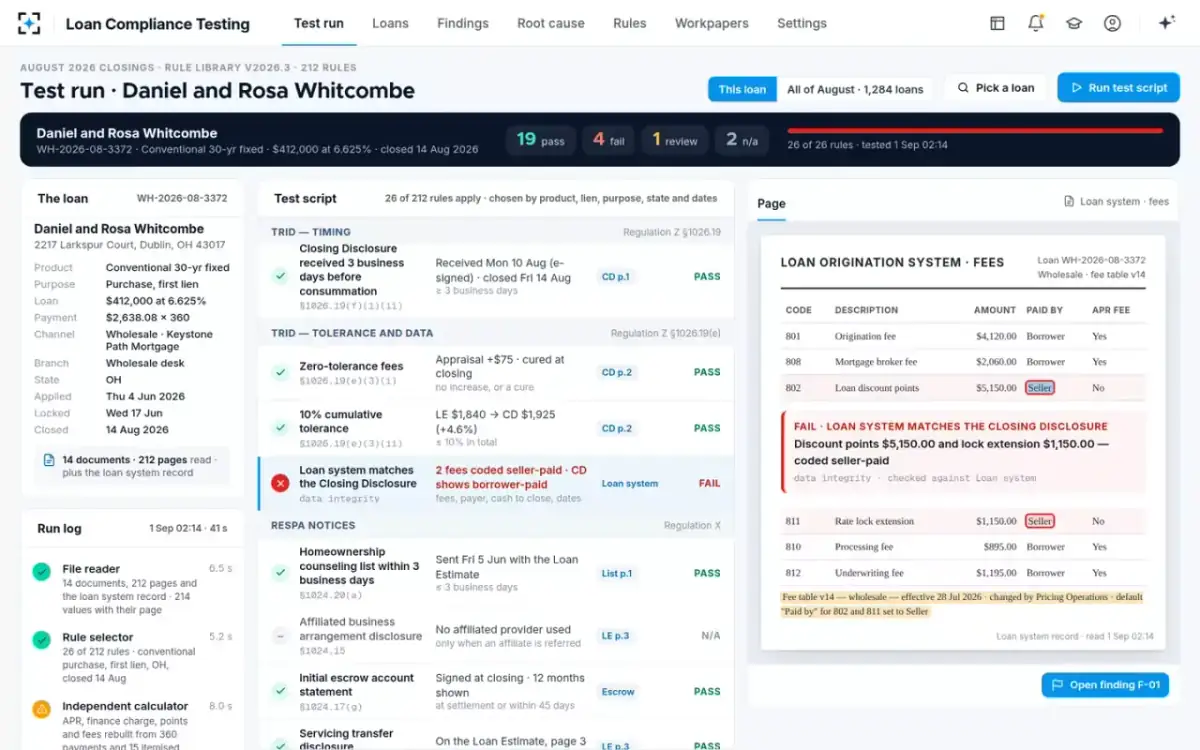
Timing has no tolerance: the business-day counts
Dates are pass or fail. The Loan Estimate must be delivered or mailed "not later than the third business day after" the application and "not later than the seventh business day before consummation"; the Closing Disclosure must be received "no later than three business days before consummation"; a revised Loan Estimate must be received "not later than four business days prior to consummation" (§1026.19(e), (f)). Mailed disclosures are presumed received three business days after mailing unless there is evidence of receipt.
The four business-day counts in a TRID timing test
3days
after application, latest Loan Estimate delivery (general business day)
7days
before consummation, latest Loan Estimate delivery (Saturdays count)
4days
before consummation, latest receipt of a revised Loan Estimate (Saturdays count)
3days
before consummation, latest Closing Disclosure receipt (Saturdays count)
Some changes after the Closing Disclosure restart the three-day count: the APR becoming inaccurate under §1026.22, a change of loan product, or a prepayment penalty added. Other changes need a corrected Closing Disclosure at or before consummation without a new wait. As of October 2026 these timing rules are unchanged, though Executive Order 14393 asked the CFPB to consider "replacing TRID timing rules with a materiality-based standard", and the CFPB took comments on that until 10 August 2026 (91 FR 42382).
Curing a tolerance breach: the 60 days after consummation
A fee that exceeded its tolerance is cured if the lender "refunds the excess to the consumer no later than 60 days after consummation" and sends a corrected Closing Disclosure reflecting the refund within the same 60 days (§1026.19(f)(2)(v)). Non-numeric clerical errors are corrected on the same schedule. The window opens at closing, so a test that runs months after closing finds tolerance breaches that can no longer be cured, only reported. The TRID tolerance cure shows how the testing schedule decides which side of that line a breach falls on. The 60-day cure does not cover an understated finance charge, which has its own correction rule in the statute; the understated finance charge covers it.
Tighter is allowed, looser is not: setting tolerances in Loan Compliance Testing
A lender may test to a stricter line than the regulation, for example to catch APR drift before it reaches 1/8 of a point. It may not test to a looser one and call the result compliant. The solution's tolerance settings start at the regulation's values and can only be tightened; each rule carries its source and version, and a change needs the testing manager's approval and a test on the previous month's loans before it goes live. The same table drives the higher-priced and qualified mortgage thresholds, which the QM points-and-fees test covers. The Loan Compliance Testing page shows the tolerances at work across a full month.
Questions people ask
Is the APR tolerance 1/8 or 1/4 of a percentage point?
1/8 for a regular transaction, such as a fixed-rate loan with level monthly payments, and 1/4 for an irregular one with multiple advances or irregular payment periods or amounts, such as a construction loan with draws (§1026.22(a)(2)–(3)). An adjustable-rate loan disclosed on a regular amortization schedule is not irregular just because its payments may later change (comment 22(a)(3)-1).
When does an APR change require a new three-day waiting period?
When the APR on the Closing Disclosure becomes inaccurate under §1026.22, which for a regular transaction means more than 1/8 of a point off. An APR that falls because the finance charge fell is treated as accurate under the mortgage rules, so it does not normally restart the clock; a change of loan product or an added prepayment penalty does.
Is an overstated APR a violation?
Not when it results from an overstated finance charge: the finance charge rule treats overstatement as accurate, and §1026.22(a)(4) carries that through to the APR. An APR overstated by more than the tolerance for some other reason, such as a wrong payment schedule, is still inaccurate.
How much in fees does 1/8 of a point of APR represent?
It depends on the loan's size and term. On a $412,000 30-year loan at 6.625%, about $5,050 of prepaid finance charges moves the APR by 1/8 of a point, which is why the $100 finance charge test fails first.
Do Regulation Z tolerances apply to the Loan Estimate?
The Loan Estimate's figures are estimates made in good faith, and its fees are judged by the TRID buckets when the Closing Disclosure is compared with it. The $100 and 1/8-point accuracy tests apply to the Closing Disclosure's finance charge, total of payments and APR.