When a mortgage's finance charge is understated by more than $100, the disclosure is inaccurate under Regulation Z, and the cost to the lender climbs with each step the error takes before it is found. Found and corrected by the lender within 60 days of discovery, it costs the adjustment to the borrower's account. Found by an examiner as a pattern, it becomes an ordered reimbursement on every affected loan back to the previous examination. Found by a borrower's lawyer, it adds statutory damages and fees. Botminds' Loan Compliance Testing recomputes the APR and finance charge on every closed loan, so that the lender is the one who finds it, in the first step rather than the third. This page prices each step.
The amounts per loan are small; the multiplication is not. A disclosure error that comes from a system setting, a fee table or a rounding rule repeats on every loan the setting touches. That is what turns a $6,300 understatement on one file into a remediation project.
The cost cascade: who finds an understated finance charge, and what it then costs
- 1Before closingThe closer or the lender's pre-closing check
A corrected Closing Disclosure. If the APR is now inaccurate, a new three-business-day wait and a later closing.
§1026.19(f)(2)(ii) - 2Within 60 days of discoveryThe lender's own testing
Notify the borrower and adjust the account. No liability under TILA's damages section or the agency reimbursement power, if done before a suit or a written complaint.
15 U.S.C. 1640(b) - 3At the next examinationThe examiner
An ordered adjustment on every affected loan when the error is a pattern or practice, back to the previous examination, plus the finding and its rating weight.
15 U.S.C. 1607(e) - 4In a lawsuitA borrower or a class
Actual damages, $400 to $4,000 statutory damages per individual action, costs and attorney's fees; a class recovery up to the lesser of $1 million or 1% of net worth.
15 U.S.C. 1640(a) - 5Repeated, after a findingThe regulator, again
An enforcement order with restitution and penalties, and a compliance management finding on top of the violation.
FDI Act §8(b)
What is the finance charge tolerance for a mortgage?
$100. For a mortgage, the disclosed finance charge, and the amount financed and APR that depend on it, are treated as accurate if the finance charge "is understated by no more than $100" or is overstated (12 CFR 1026.18(d)(1)); the Closing Disclosure rule repeats the same test for loans under TRID (§1026.38(o)(2)). An overstated finance charge does not breach the accuracy rule; an understatement beyond $100 does. The APR has its own tolerance, 1/8 of a percentage point for a regular transaction, and on a long loan a fee large enough to break one usually breaks both.
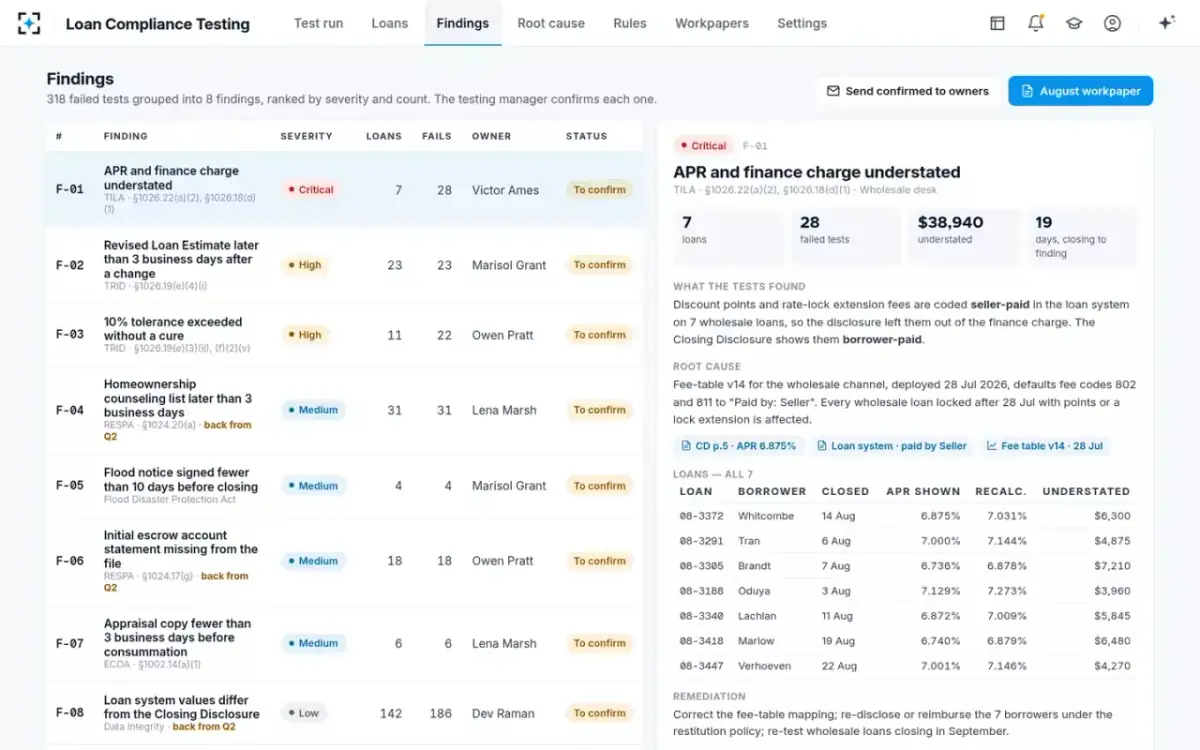
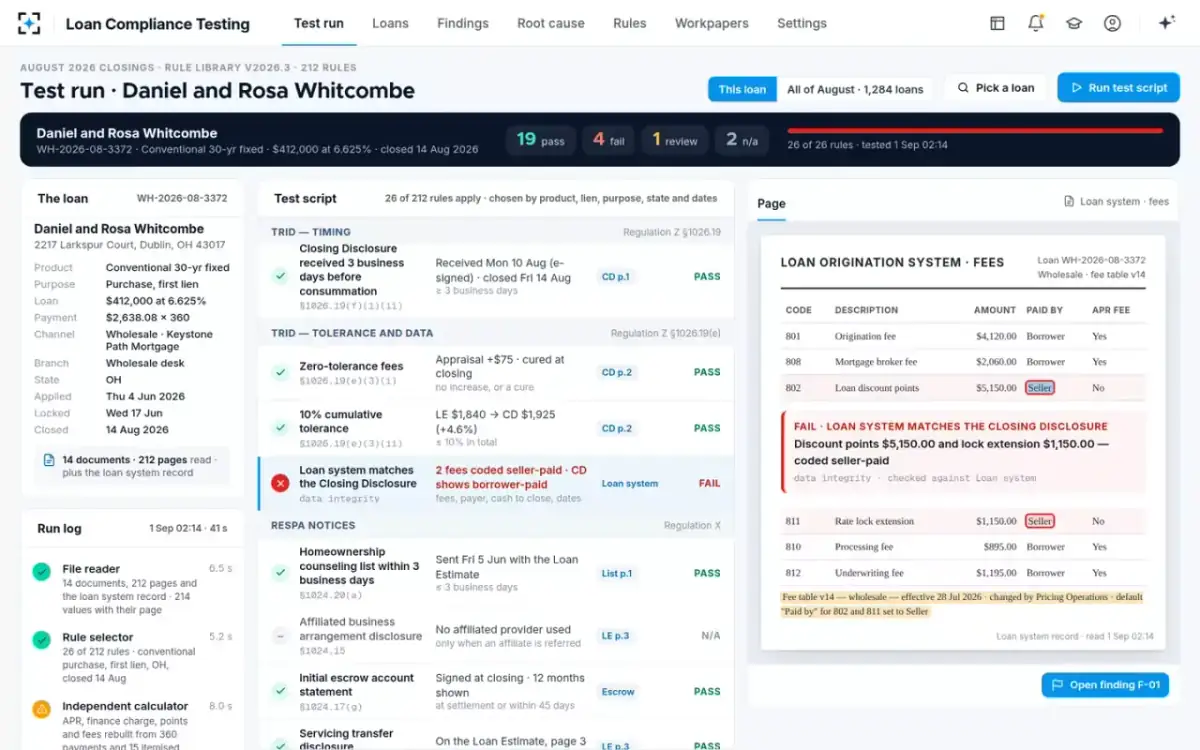
The usual causes are mechanical. A fee that is a finance charge is treated as one that is not, because it was coded to the wrong payer, the wrong section or the wrong fee type. Take the sample bank used throughout this series, a fictional lender: its wholesale fee table, version 14, coded the discount points and a rate-lock extension fee as seller-paid from 28 July. On the Whitcombe loan, a $412,000 purchase, the borrowers paid both, $5,150.00 and $1,150.00, and the disclosure left both out. The finance charge was understated by $6,300.00, 63 times the tolerance, and the APR by 0.156 of a point. Six other wholesale loans had the same fault.
Seven loans, one cause, $38,940: the finding in Loan Compliance Testing
Is the finance charge tolerance $100 or $35?
Both, for different purposes: $100 for disclosure accuracy, $35 only for rescission once foreclosure has begun. The rescission rules carry their own, wider tolerances. For a loan with a right of rescission, the finance charge is accurate for rescission purposes if understated "by no more than 1/2 of 1 percent of the face amount of the note or $100, whichever is greater"; 1% in a refinancing with a new creditor and no new money; and "by no more than $35" after foreclosure proceedings start (12 CFR 1026.23(g), (h)). A test that applies $35 to an ordinary refinance is testing a foreclosure defence that does not yet exist.
Which finance charge tolerance applies, and to what
| Purpose | Tolerance on an understatement | Rule |
|---|---|---|
| Disclosure accuracy, any mortgage | $100 | §1026.18(d)(1); §1026.38(o)(2) |
| Total of payments on the Closing Disclosure | $100 | §1026.38(o)(1) |
| Rescission, loans with a right to rescind | ½% of the note or $100, whichever is greater | §1026.23(g)(1) |
| Rescission, refinancing with a new creditor, no new advance | 1% of the note | §1026.23(g)(2) |
| Rescission as a foreclosure defence | $35 | §1026.23(h)(2) |
| Other closed-end credit | $5 up to $1,000 financed, $10 above | §1026.18(d)(2) |
Does an understated finance charge extend the right of rescission?
It can. The finance charge is a "material disclosure", and when material disclosures are not accurately delivered the borrower's right to rescind a refinance or home-equity loan does not end after three business days but runs until "3 years after consummation, upon transfer of all of the consumer's interest in the property, or upon sale of the property, whichever occurs first" (§1026.23(a)(3)). Had the Whitcombe loan been a refinance with a right to rescind, on the same note, the rescission tolerance would have been ½% of $412,000, or $2,060, and its $6,300 understatement would have exceeded it. A rescission claim unwinds the security interest and the finance charges, which is a larger exposure than any refund.
How to correct an understated finance charge within 60 days
Notify the borrower and adjust the account, within 60 days of discovering the error and before the borrower sues or complains in writing. A creditor "has no liability" under TILA's damages section or the agency reimbursement section "if within sixty days after discovering an error, whether pursuant to a final written examination report ... or through the creditor's or assignee's own procedures", it notifies the borrower and makes the adjustments needed so that the borrower will not pay more than "the charge actually disclosed, or the dollar equivalent of the annual percentage rate actually disclosed, whichever is lower" (15 U.S.C. 1640(b)).
On the Whitcombe loan the adjustment can take two shapes that are worth the same. A lump sum of about $6,301 at once brings the effective amount financed back to where 360 payments of $2,638.08 produce the disclosed 6.875%, and the finance charge back to the disclosed $548,132.07. Or the payment can be cut to about $2,596.69, $41.39 a month for 360 months, which is the same value spread over the term. The lump sum is simpler to evidence; the payment reduction is what a servicer has to set up.
Two ways to make the Whitcombe borrowers whole
| Method | What the borrowers receive | Result |
|---|---|---|
| Lump sum | About $6,301 refunded once | APR back to the disclosed 6.875%; finance charge back to $548,132 |
| Payment reduction | $41.39 less each month for 360 months | The same value, at the disclosed APR, over the term |
Two conditions in the statute make speed valuable. The clock runs from discovery, so finding errors sooner simply starts the clock sooner; it does not lose the window. But the protection ends if a borrower sues or sends written notice first, and the longer an error sits unfound, the more likely a borrower, a servicer or a loan buyer's due diligence reviewer finds it before the lender does.
The other 60-day window is different. Under TRID, a lender that charged more than the Loan Estimate allowed in a zero or 10% tolerance category cures it by refunding the excess "no later than 60 days after consummation" (§1026.19(f)(2)(v)). That clock starts at closing, not at discovery, and quarterly sampling routinely misses it. The TRID tolerance cure follows a single loan through both clocks.
What is the TILA reimbursement policy?
It is the rule, in statute and interagency policy, under which an agency orders a lender to repay borrowers for an understated APR or finance charge. When examiners find an inaccurate APR or finance charge, the agency "shall notify the creditor" and may require an adjustment to the borrower's account so that the borrower pays no more than what was disclosed. It must require one when the error resulted from "(A) a clear and consistent pattern or practice of violations, (B) gross negligence, or (C) a willful violation" (15 U.S.C. 1607(e)). A fee-table fault that understates the finance charge on every affected wholesale loan is the textbook pattern.
The interagency reimbursement policy sets how far back the order reaches. For closed-end credit the cutoff is the "immediately preceding examination", which the agencies read as an examination "of any type conducted for any purpose" by an agency with TILA enforcement authority. For terminated loans, "an adjustment will not be ordered if the violation occurred in a transaction consummated more than two years prior to the date of the current examination" (FFIEC reimbursement Q&A). The policy governs agency enforcement only; it "does not alter a creditor's responsibility to comply fully".
The same Q&A sets how the amount is chosen. A prepaid fee left out of the finance charge and paid at closing is refunded as a lump sum, less the applicable tolerance. When both the APR and the finance charge are understated, "the lump sum finance charge adjustment is compared to the lump sum APR adjustment as of the loan maturity date and the larger adjustment determines which disclosure error is subject to reimbursement". On the Whitcombe loan one uncounted pair of fees drives both errors, so the two measures land within a few dollars of each other, about $6,300 before any tolerance.
What consumer compliance examinations recovered in 2025
$1.2B
restitution ordered by the FDIC under section 8(b) in 2025, across all consumer laws
$4.7M
voluntary restitution paid by other FDIC-supervised banks, to 47,902 consumers
$10,000
aggregate restitution above which a violation is typically graded Level 3, the highest concern
The CFPB's own priorities point the same way. Its April 2026 description of its examinations says that "Bureau-issued MRAs will focus on pattern and practice violations of law where there is substantive and identifiable consumer harm or clear violations of the disclosure requirements" (CFPB, April 2026). An understated finance charge repeated across a channel meets both halves of that sentence.
What are the penalties for TILA disclosure violations?
Actual damages, statutory damages, costs and attorney's fees in a private action, and restitution or penalties in an enforcement action. A borrower can sue for actual damages plus, for a closed-end loan secured by a dwelling, statutory damages "not less than $400 or greater than $4,000" in an individual action, and the costs of the action and a reasonable attorney's fee. In a class action the total for one failure is capped at "the lesser of $1,000,000 or 1 per centum of the net worth of the creditor" (15 U.S.C. 1640(a)). An action must generally be brought within one year of the violation.
The statute also has a defence that turns on testing. A creditor is not liable if it shows "the violation was not intentional and resulted from a bona fide error notwithstanding the maintenance of procedures reasonably adapted to avoid any such error"; the examples include "calculation, computer malfunction and programing" errors (15 U.S.C. 1640(c)). A fee-table fault is close to a programming error. Whether a defence succeeds depends on the procedures a lender can show, and a test that recomputes every loan's finance charge is the kind of procedure the clause describes.
The same $6,300 understatement costs a refund, a portfolio reimbursement or a damages claim, depending on who finds it first.
Why a systemic error grows every month it is not found
The price of finding an error late is mostly the loans made in the meantime. The sample bank's fee-table fault affected seven wholesale loans in its first August. If nothing had changed, every month would add a similar number until a quarterly sample happened to land on one, and the CFPB's examiners have described the same mechanism in a loan origination system "not programmed to round", which put the wrong fully indexed rate on every affected disclosure until the system was reconfigured (Supervisory Highlights, Issue 30).
If August's rate had continued: finance charge understated, by month found (our estimate)
The adjustment itself is not the whole cost. Each reimbursement project carries the work of identifying the population, recalculating each loan, notifying borrowers, crediting accounts or sending checks, and documenting it for the examiner. For a lender that sells its loans, it also means the servicer and often the investor. Those costs scale with the number of loans, which is why the time an error runs matters more than its size on one file.
Pricing early detection: the value of finding it yourself
A finance chief can put the argument in one sum. The return on testing every loan quickly is the reimbursement and remediation avoided on loans that would have closed before a later detection, plus the reduction in exposure to claims, minus what the testing costs. The terms below are what to estimate; the owners in each card are who usually can.
What finding an understated finance charge a quarter earlier is worth
Loans not affected
loans a month the fault touches × months earlier × average understatement
In the sample bank, about 7 × 2 × $5,563 for finding it after August rather than after October.
Testing manager with finance
Remediation work avoided
loans not affected × cost to remediate one loan
Recalculation, notice, account credit or check, servicer and investor handling, documentation.
Operations and servicing
Claims exposure reduced
chance a borrower finds it first × expected damages and fees
Self-correction under 1640(b) is lost once a suit or written notice arrives.
Legal
Cost of testing every loan
loans a month × cost per loan tested + people reviewing
Including the tester time on results the rules cannot settle.
Compliance
The comparison that matters is not testing against no testing; every lender tests. It is testing every loan within days against testing a sample within months, and the difference sits almost entirely in the first two terms. What a 64-loan sample never sees shows how seldom a quarterly sample draws a loan from a small systemic error, and the APR and TRID tolerances sets out the exact lines each test applies.
The cause the remediation has to fix: the loan system against the disclosure
Questions people ask
How far back do banks have to reimburse for an understated finance charge?
Under the interagency policy for agency-ordered adjustments, closed-end loans are reviewed back to the immediately preceding examination, and terminated loans consummated more than two years before the current examination are not ordered. Open-end credit covers the 24 months before the examination. A lender correcting on its own under 1640(b) sets its scope by the error, not by the examination.
Is a finance charge understated by less than $100 a violation?
No. For a mortgage it is treated as accurate, and so are the amount financed and APR that depend on it. The APR still has its own 1/8-point test, which a large loan can fail while the finance charge passes, or the reverse.
Are discount points coded as seller-paid a finance charge?
Points the seller genuinely pays are excluded from the finance charge as "seller's points" (§1026.4(c)(5)). Points the borrower pays are a finance charge whatever the loan system calls them, so the test has to follow who actually paid, which the Closing Disclosure shows.
Does reimbursing the borrowers end the matter?
It settles the borrowers' accounts. An examiner will still weigh the violation's root cause, duration and pervasiveness, and will ask whether the cause, here the fee table, was fixed and re-tested.
How long does a borrower have to sue over an understated finance charge?
An action for damages must generally be brought within one year of the violation (15 U.S.C. 1640(e)). A rescission claim on a refinance can run for up to three years after consummation, which is why rescission tolerances matter more for refinances than for purchases.